
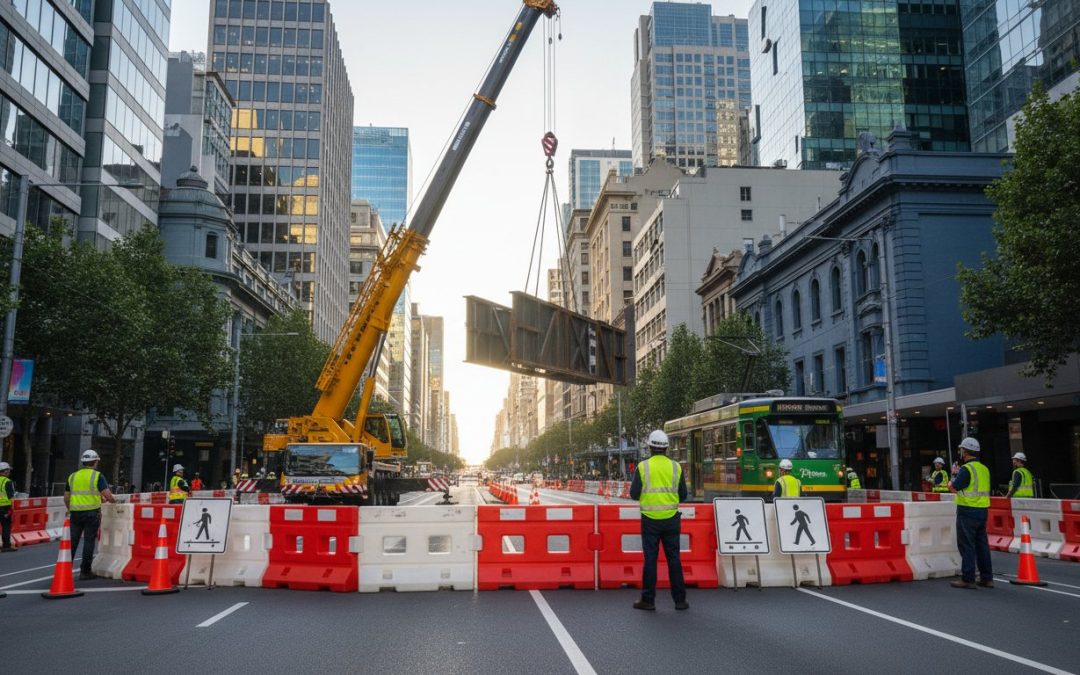
Planning a crane lift on or near a public road introduces significant risks, from potential project delays and council rejections to serious public safety liabilities. A common point of failure is the documentation. A professionally engineered traffic control plan for a crane lift is not merely a procedural step; it is a critical safety and compliance document mandated by Australian road authorities. Confusing the requirements of a lift study with those of a traffic management plan is a frequent and costly mistake, leading to non-compliant submissions that halt progress and compromise site safety.
This comprehensive guide provides the necessary clarity. We will detail the essential components required by councils, outline the step-by-step approval process, and differentiate between the roles of a lift plan and a traffic plan. By following this guide, you will understand how to prepare compliant documentation that ensures your crane lift operation proceeds safely, legally, and without unnecessary delays, protecting both your workers and the public.
Key Takeaways
- A Lift Plan is a separate document from a traffic control plan for a crane lift; understand why both are often mandatory for a compliant crane operation in Australia.
- Learn your legal obligations under Work Health & Safety (WHS) legislation and why a professional traffic control plan for a crane lift is a non-negotiable requirement for high-risk operations.
- A compliant plan for managing traffic during a lift follows a structured process, from initial site assessment and design through to final council approval.
- The expertise of your traffic consultant directly impacts project timelines and safety; discover how to select a provider with the necessary qualifications.
Table of Contents
- Lift Plan vs. Traffic Control Plan: Understanding the Critical Difference
- Why a Professional Traffic Control Plan is Non-Negotiable
- The Process: From Site Assessment to Council Approval
- Choosing the Right Consultant for Your Traffic Plan
Lift Plan vs. Traffic Control Plan: Understanding the Critical Difference
For any crane operation that interfaces with public infrastructure, two distinct and critical documents are required: a Lift Plan and a Traffic Control Plan (TCP). A common and costly mistake is to confuse these documents or to assume one covers the other. They are separate, non-interchangeable, and in most Australian jurisdictions, both are mandatory for legal and safe project execution. A single lift requires both meticulous operational planning for the machinery and comprehensive public interface planning for community safety.
To better understand the technical calculations that form the basis of a lift plan, the following video provides a helpful overview:
The Crane Lift Plan: Focusing on the Machine
The Lift Plan is a technical document focused entirely on the mechanics and safety of the lift itself. It is the operational blueprint prepared by the crane operator or a specialised lift engineer to ensure the lift is conducted safely and efficiently. This plan addresses the ‘how’ of the operation, ensuring compliance with foundational safety frameworks like the Lifting Operations and Lifting Equipment Regulations 1998 (LOLER), which inform Australian Work Health and Safety (WHS) standards. Its primary audience is the crane crew and on-site personnel.
- Scope: Defines crane type and configuration, load weight, rigging details, and lift radius.
- Safety Factors: Assesses ground conditions, crane capacity charts, weather limitations, and operational risks.
- Personnel: Outlines the roles and responsibilities of the dogman, rigger, and crane operator.
The Traffic Control Plan (TCP): Managing the Public Interface
In contrast, the traffic control plan for a crane lift is an external-facing document focused on public safety and minimising disruption. Prepared by a qualified traffic engineering consultant, the TCP details how the work site will safely interact with all public road users. This is the document submitted to local councils and state road authorities (e.g., Transport for NSW, VicRoads) to obtain the necessary permits for road or footpath closures. Its primary audience is these authorities, the public, and traffic control crews.
- Scope: Details road closures, traffic detours, and management of pedestrian and cyclist movements.
- Safety Factors: Specifies signage placement (in accordance with AS 1742.3), use of traffic controllers, and emergency vehicle access.
- Compliance: Ensures the proposed setup meets all local and state government requirements for working on or near public roads.
Why a Professional Traffic Control Plan is Non-Negotiable
Operating a crane in a public space is an inherently high-risk activity. It introduces significant hazards to pedestrians, motorists, and surrounding properties. For this reason, a professional traffic control plan for crane lift operations is not a recommendation; it is a fundamental requirement for project safety, legal compliance, and operational continuity. A compliant plan demonstrates due diligence, mitigates liability, and ensures minimal disruption to the local community.
Meeting Legal and Regulatory Obligations
In Australia, a compliant Traffic Control Plan (TCP) is a legal necessity under Work Health and Safety (WHS) legislation. Your plan must be designed in accordance with the Australian Standard AS 1742.3, Traffic control for works on roads. Furthermore, state-based authorities like Transport for NSW (TfNSW) have specific requirements that must be met. Failure to implement a compliant plan breaches your duty of care to the public and can result in significant fines, immediate site shutdowns, and prosecution.
Gaining Council and Road Authority Approval
Local councils and road authorities will not issue the necessary permits to occupy a road or footpath without a compliant TCP. This document is a critical component of any development application (DA) or road occupancy license. A professionally prepared plan anticipates and addresses specific local requirements, ensuring the submission is comprehensive and correct. This directly streamlines the approval process, preventing costly delays and rejections that can derail project timelines.
Ensuring Site and Public Safety
The primary function of a TCP is to create a safe, controlled work environment. It systematically addresses critical risks, including:
- Falling objects from the crane load or structure.
- Collisions between site vehicles, public traffic, and the crane.
- Conflicts with pedestrians and cyclists unaware of the overhead hazard.
A key element is the establishment of clear exclusion zones around the crane’s operating radius. This aligns with global best practices, where regulations like the OSHA Work Area Control Standards mandate strict work area control. The plan details the precise placement of signage, barriers, and accredited traffic controllers to guide the public safely around the worksite.
The Core Components of a Compliant Traffic Control Plan
A compliant traffic control plan for crane lift operations is far more than a simple map with cones drawn on it. It is a detailed technical document, meticulously prepared and tailored to the specific site, the crane’s specifications, and the nature of the lift. A professionally developed plan demonstrates due diligence and is a non-negotiable requirement for obtaining council or road authority permits. The following elements are essential for a robust and effective plan, forming the basis of our comprehensive traffic engineering services.
Detailed Site Plans and Diagrams
The foundation of any TCP is an accurate, to-scale representation of the work site. This is not a rough sketch; it is a technical drawing that must clearly detail all critical elements to ensure the safety and efficiency of the operation. Key components include:
- Existing road conditions, line markings, and infrastructure (e.g., traffic signals, street furniture).
- The precise location of the crane, its outriggers, support vehicles, and the designated load landing zone.
- Systematic placement of all signage, barriers, VMS boards, and other traffic control devices.
- Clearly marked and safe pedestrian detours and vehicle diversion routes.
Traffic Guidance Scheme (TGS) Drawings
Traffic Guidance Scheme (TGS) drawings, also known as Traffic Control Diagrams (TCDs), provide a visual, step-by-step representation of the traffic management setup. These drawings must use standardised symbols and layouts that conform to Australian Standards to be understood by all site personnel and authorities. A comprehensive TGS for a crane lift will include separate diagrams for each distinct phase of the project: the initial setup, the lift itself, and the final pack-down and site remediation.
Risk Assessment and Mitigation Strategy
A professional traffic control plan for crane lift must be underpinned by a thorough risk assessment. This process involves identifying all potential traffic and pedestrian-related hazards, from vehicle conflicts to public access issues. Following identification, each risk is assessed for its likelihood and potential consequence. This analysis informs the development of specific control measures designed to eliminate or minimise each risk, aligning with principles found in authoritative resources like the WorkSafeBC crane safety guidelines. The strategy must also include clear emergency procedures and contingency plans for unforeseen events.
The Process: From Site Assessment to Council Approval
Securing approval for a traffic control plan for a crane lift is not an ad-hoc task. It is a structured, multi-step process designed to ensure every operational and safety variable is identified, assessed, and correctly documented. Navigating the specific requirements of local councils and road authorities demands precision and experience. Engaging a professional traffic consultant is critical to managing these steps efficiently and avoiding costly delays.
At ML Traffic Engineers, we manage this entire process for our clients, ensuring a compliant and streamlined path from initial concept to final approval.
Step 1: Initial Consultation and Site Assessment
The foundation of any successful Traffic Control Plan (TCP) is a comprehensive understanding of the project and its environment. This initial phase involves a detailed assessment to define the scope and identify potential challenges. Our process includes:
- Gathering Project Details: We document the specifics of the operation, including the crane type and size, the exact lift location, and the planned duration of works.
- Site Analysis: A physical site visit or a detailed desktop review is conducted to analyse existing traffic conditions, road geometry, and infrastructure.
- Identifying Constraints: We identify and map key logistical constraints that will influence the plan, such as nearby schools, hospitals, public transport routes (bus, tram), and areas with high pedestrian activity.
- Determining Authority Requirements: Each local council and road authority has unique submission criteria. We confirm these specific requirements at the outset to ensure the plan is tailored for compliance from day one.
Step 2: Plan Development and Drafting
Once all site data is collected, our experienced engineers begin the technical design and drafting phase. This involves translating the operational requirements into a formal set of documents that meet all regulatory standards. Our qualified team drafts detailed Traffic Guidance Scheme (TGS) diagrams using specialised software, illustrating the precise placement of signs, devices, and personnel. This is supported by a comprehensive report detailing the scope of works, risk control measures, and communication protocols. Every document is checked to ensure it meets relevant Australian Standards and state-specific codes of practice before an internal review for accuracy.
Step 3: Submission and Authority Liaison
With the documentation complete, the final step is to manage the formal application. We submit the complete traffic control plan package to the relevant authorities for assessment and approval. This is a critical stage where our experience becomes invaluable. We act as the primary liaison, managing all communication with the council or road authority, promptly responding to any queries, and making any necessary revisions based on their feedback to secure a timely permit. This proactive management minimises administrative friction and keeps your project on schedule. For a direct consultation on your project’s needs, contact our team.
Choosing the Right Consultant for Your Traffic Plan
The quality of your traffic control plan for a crane lift directly impacts the safety, budget, and timeline of your operation. An inadequate plan can lead to council rejection, costly delays, and significant safety risks on site. Therefore, selecting a qualified traffic engineering consultant is one of the most critical project management decisions you will make. Not all providers possess the necessary engineering qualifications or local authority experience to deliver a compliant and effective plan.
Essential Qualifications and Experience
When engaging a consultant, due diligence is essential. Look for a firm with a proven track record in traffic engineering for construction and development projects. Key indicators of competence include:
- Verified Credentials: Ensure the engineers are chartered (CPEng) and hold relevant state registrations, demonstrating a commitment to professional standards and accountability.
- Relevant Portfolio: Ask to see examples of similar, successfully approved TCPs for crane lifts. This provides direct evidence of their capability and past performance.
- Local Council Experience: The consultant must have a deep, working understanding of your specific local council’s requirements, preferences, and submission processes. This knowledge is invaluable for a smooth approval.
Our principals have over 15 years of specialised experience in securing approvals for complex projects. You can learn more about us and our qualifications.
Beyond Drafting: The Value of an Engineering Consultant
A professional traffic engineering consultant provides strategic expertise, not just a set of drawings. A comprehensive traffic control plan for a crane lift is a technical document that requires foresight and problem-solving. An experienced consultant can identify potential conflicts-such as impacts on public transport, pedestrian access, or emergency services-long before they become on-site problems.
This strategic oversight is where the real value lies. A qualified engineer understands how to negotiate with councils to achieve workable outcomes that meet both regulatory requirements and your project’s operational needs. This expertise saves you time, reduces the risk of costly revisions, and ultimately protects your project from unnecessary financial exposure and delays.
Secure Your Project with an Expert Traffic Control Plan
Executing a crane lift safely and legally requires far more than just a well-devised lift plan. As this guide has detailed, a Traffic Control Plan is a separate, critical document focused entirely on managing public safety and vehicle movement. Failing to secure a professionally prepared plan can lead to significant project delays, council rejection, and serious safety risks. Therefore, engaging an expert to develop a compliant traffic control plan for crane lift operations is not an option-it is an essential investment in your project’s success and public safety.
Ensure your project proceeds without issue. The team at ML Traffic Engineers brings over 15 years of specialised traffic engineering experience to every job. All plans are prepared by senior, registered traffic engineers who possess a deep understanding of regulatory requirements. With a proven track record of securing council approvals across Australia, we provide the assurance and expertise your project demands. Get a Quote for Your Crane Lift Traffic Control Plan and let our dedicated professionals handle the complexities, ensuring a smooth path from planning to approval.
Frequently Asked Questions
How much does a traffic control plan for a crane lift cost?
The cost for a professional Traffic Control Plan (TCP) typically ranges from A$400 to A$1,500+. The final price depends on the complexity of the lift and the location. Factors influencing cost include the road classification (local road vs. arterial road), the number of traffic lanes or footpaths affected, and specific submission requirements mandated by the local council or state road authority. A simple plan for a local street will be at the lower end of this range.
How long does it take to get a TCP developed and approved?
Plan development by a qualified traffic consultant is efficient, often completed within 2-5 business days. However, the critical factor is the approval timeframe from the relevant road authority (e.g., local council or state transport department). This can range from 10 business days to over 6 weeks, depending on the authority’s processes and the complexity of the plan. It is essential to factor this approval lead time into your project schedule to avoid delays on site.
Do I need a TCP for a lift on a quiet residential street?
Yes. A compliant Traffic Control Plan for a crane lift is required whenever the work impacts public access, including roads, parking lanes, or footpaths. Even on a low-traffic residential street, the plan is a legal and safety requirement. It ensures the safety of workers, residents, pedestrians, and motorists, while also satisfying council permit conditions and public liability insurance obligations. Operating without an approved TCP creates significant risk and potential for penalties.
Can the traffic control company prepare the plan for me?
Yes, a professional traffic engineering consultancy is responsible for designing and preparing the TCP. It is critical that the plan is developed by a qualified and certified designer with the requisite industry accreditations. While the on-site traffic controllers implement the plan, the design itself requires engineering expertise to ensure it complies with Australian Standards (AS 1742.3) and all relevant state and local government regulations. We provide this expert design service.
What happens if the crane lift plan changes after the TCP is approved?
If there are any material changes to the crane lift-such as a change in date, time, crane position, or duration of the road occupancy-the approved TCP is no longer valid. The plan must be formally amended by the traffic consultant and resubmitted to the road authority for re-approval. Proceeding with a modified lift using an outdated plan is a serious compliance breach that can result in work stoppage, fines, and increased liability.
Is a Traffic Control Plan the same as a Traffic Management Plan (TMP)?
No, they are different but related documents. A Traffic Management Plan (TMP) is a high-level strategic document outlining the overall risks and procedures for managing traffic throughout a larger project. A Traffic Control Plan (TCP) is a detailed, technical drawing (also called a Traffic Guidance Scheme) showing the specific layout of signs, devices, and personnel for a particular short-term activity. For a standalone crane lift, you typically require a TCP as the primary document.
Which areas do we service?
We prepare Traffic Guidance Schemes or Traffic Control Plans in every suburb of Sydney such as Abbotsbury, Abbotsford, Acacia Gardens, Agnes Banks, Airds, Alexandria, Alfords Point, Allambie Heights, Allawah, Ambarvale, Angus, Annandale, Annangrove, Arcadia, Arncliffe, Arndell Park, Artarmon, Ashbury, Ashcroft, Ashfield, Asquith, Auburn, Austral, Avalon Beach, Badgerys Creek, Balgowlah, Balgowlah Heights, Balmain, Balmain East, Bangor, Banksia, Banksmeadow, Bankstown, Bankstown Aerodrome, Barangaroo, Barden Ridge, Bardia, Bardwell Park, Bardwell Valley, Bass Hill, Baulkham Hills, Bayview, Beacon Hill, Beaconsfield, Beaumont Hills, Beecroft, Belfield, Bella Vista, Bellevue Hill, Belmore, Belrose, Berala, Berkshire Park, Berowra, Berowra Heights, Berowra Waters, Berrilee, Beverley Park, Beverly Hills, Bexley, Bexley North, Bidwill, Bilgola Beach, Bilgola Plateau, Birchgrove, Birrong, Blackett, Blacktown, Blair Athol, Blairmount, Blakehurst, Bligh Park, Bondi, Bondi Beach, Bondi Junction, Bonnet Bay, Bonnyrigg, Bonnyrigg Heights, Bossley Park, Botany, Bow Bowing, Box Hill, Bradbury, Bradfield, Breakfast Point, Brighton-Le-Sands, Bringelly, Bronte, Brooklyn, Brookvale, Bundeena, Bungarribee, Burraneer, Burwood, Burwood Heights, Busby, Cabarita, Cabramatta, Cabramatta West, Caddens, Cambridge Gardens, Cambridge Park, Camellia, Cammeray, Campbelltown, Camperdown, Campsie, Canada Bay, Canley Heights, Canley Vale, Canoelands, Canterbury, Caringbah, Caringbah South, Carlingford, Carlton, Carnes Hill, Carramar, Carss Park, Cartwright, Castle Cove, Castle Hill, Castlecrag, Castlereagh, Casula, Catherine Field, Cattai, Cecil Hills, Cecil Park, Centennial Park, Chatswood, Chatswood West, Cheltenham, Cherrybrook, Chester Hill, Chifley, Chippendale, Chipping Norton, Chiswick, Chullora, Church Point, Claremont Meadows, Clarendon, Clareville, Claymore, Clemton Park, Clontarf, Clovelly, Clyde, Coasters Retreat, Cobbitty, Colebee, Collaroy, Collaroy Plateau, Colyton, Como, Concord, Concord West, Condell Park, Connells Point, Constitution Hill, Coogee, Cottage Point, Cowan, Cranebrook, Cremorne, Cremorne Point, Cromer, Cronulla, Crows Nest, Croydon, Croydon Park, Curl Curl, Currans Hill, Currawong Beach, Daceyville, Dangar Island, Darling Point, Darlinghurst, Darlington, Davidson, Dawes Point, Dean Park, Dee Why, Denham Court, Denistone, Denistone East, Denistone West, Dharruk, Dolans Bay, Dolls Point, Doonside, Double Bay, Dover Heights, Drummoyne, Duffys Forest, Dulwich Hill, Dundas, Dundas Valley, Dural, Eagle Vale, Earlwood, East Hills, East Killara, East Lindfield, East Ryde, Eastern Creek, Eastgardens, Eastlakes, Eastwood, Edensor Park, Edgecliff, Edmondson Park, Elanora Heights, Elderslie, Elizabeth Bay, Elizabeth Hills, Elvina Bay, Emerton, Enfield, Engadine, Englorie Park, Enmore, Epping, Ermington, Erskine Park, Erskineville, Eschol Park, Eveleigh, Fairfield, Fairfield East, Fairfield Heights, Fairfield West, Fairlight, Fiddletown, Five Dock, Forest Glen, Forest Lodge, Forestville, Frenchs Forest, Freshwater, Gables, Galston, Georges Hall, Gilead, Girraween, Gladesville, Glebe, Gledswood Hills, Glen Alpine, Glendenning, Glenfield, Glenhaven, Glenmore Park, Glenorie, Glenwood, Gordon, Grantham Farm, Granville, Grays Point, Great Mackerel Beach, Green Valley, Greenacre, Greendale, Greenfield Park, Greenhills Beach, Greenwich, Gregory Hills, Greystanes, Guildford, Guildford West, Gymea, Gymea Bay, Haberfield, Hammondville, Harrington Park, Harris Park, Hassall Grove, Haymarket, Heathcote, Hebersham, Heckenberg, Henley, Hillsdale, Hinchinbrook, Hobartville, Holroyd, Holsworthy, Homebush, Homebush West, Horningsea Park, Hornsby, Hornsby Heights, Horsley Park, Hoxton Park, Hunters Hill, Huntingwood, Huntleys Cove, Huntleys Point, Hurlstone Park, Hurstville, Hurstville Grove, Illawong, Ingleburn, Ingleside, Jamisontown, Jannali, Jordan Springs, Kangaroo Point, Kareela, Kearns, Kellyville, Kellyville Ridge, Kemps Creek, Kensington, Kenthurst, Kentlyn, Killara, Killarney Heights, Kings Langley, Kings Park, Kingsford, Kingsgrove, Kingswood, Kirkham, Kirrawee, Kirribilli, Kogarah, Kogarah Bay, Ku-ring-gai Chase, Kurnell, Kurraba Point, Kyeemagh, Kyle Bay, La Perouse, Lakemba, Lalor Park, Lane Cove, Lane Cove North, Lane Cove West, Lansdowne, Lansvale, Laughtondale, Lavender Bay, Leets Vale, Leichhardt, Len Waters Estate, Leppington, Lethbridge Park, Leumeah, Lewisham, Liberty Grove, Lidcombe, Lilli Pilli, Lilyfield, Lindfield, Linley Point, Little Bay, Liverpool, Llandilo, Loftus, Londonderry, Long Point, Longueville, Lovett Bay, Lower Portland, Lucas Heights, Luddenham, Lugarno, Lurnea, Macquarie Fields, Macquarie Links, Macquarie Park, Maianbar, Malabar, Manly, Manly Vale, Maraylya, Marayong, Maroota, Maroubra, Marrickville, Marsden Park, Marsfield, Mascot, Matraville, Mays Hill, McCarrs Creek, McGraths Hill, McMahons Point, Meadowbank, Melonba, Melrose Park, Menai, Menangle Park, Merrylands, Merrylands West, Middle Cove, Middle Dural, Middleton Grange, Miller, Millers Point, Milperra, Milsons Passage, Milsons Point, Minchinbury, Minto, Minto Heights, Miranda, Mona Vale, Monterey, Moore Park, Moorebank, Morning Bay, Mortdale, Mortlake, Mosman, Mount Annan, Mount Colah, Mount Druitt, Mount Kuring-Gai, Mount Lewis, Mount Pritchard, Mount Vernon, Mulgoa, Mulgrave, Narellan, Narellan Vale, Naremburn, Narrabeen, Narraweena, Narwee, Nelson, Neutral Bay, Newington, Newport, Newtown, Nirimba Fields, Normanhurst, North Balgowlah, North Bondi, North Curl Curl, North Epping, North Kellyville, North Manly, North Narrabeen, North Parramatta, North Rocks, North Ryde, North St Marys, North Strathfield, North Sydney, North Turramurra, North Wahroonga, North Willoughby, Northbridge, Northmead, Northwood, Norwest, Oakhurst, Oakville, Oatlands, Oatley, Old Guildford, Old Toongabbie, Oran Park, Orchard Hills, Oxford Falls, Oxley Park, Oyster Bay, Paddington, Padstow, Padstow Heights, Pagewood, Palm Beach, Panania, Parklea, Parramatta, Peakhurst, Peakhurst Heights, Pemulwuy, Pendle Hill, Pennant Hills, Penrith, Penshurst, Petersham, Phillip Bay, Picnic Point, Pitt Town, Pleasure Point, Plumpton, Point Piper, Port Botany, Port Hacking, Potts Hill, Potts Point, Prairiewood, Prestons, Prospect, Punchbowl, Putney, Pymble, Pyrmont, Quakers Hill, Queens Park, Queenscliff, Raby, Ramsgate, Ramsgate Beach, Randwick, Redfern, Regents Park, Regentville, Revesby, Revesby Heights, Rhodes, Richards, Richmond, Riverstone, Riverview, Riverwood, Rockdale, Rodd Point, Rookwood, Rooty Hill, Ropes Crossing, Rose Bay, Rosebery, Rosehill, Roselands, Rosemeadow, Roseville, Roseville Chase, Rossmore, Rouse Hill, Rozelle, Ruse, Rushcutters Bay, Russell Lea, Rydalmere, Ryde, Sackville North, Sadleir, Sandringham, Sandy Point, Sans Souci, Schofields, Scotland Island, Seaforth, Sefton, Seven Hills, Shalvey, Shanes Park, Silverwater, Singletons Mill, Smeaton Grange, Smithfield, South Coogee, South Granville, South Hurstville, South Maroota, South Penrith, South Turramurra, South Wentworthville, South Windsor, Spring Farm, St Andrews, St Clair, St Helens Park, St Ives, St Ives Chase, St Johns Park, St Leonards, St Marys, St Peters, Stanhope Gardens, Stanmore, Strathfield, Strathfield South, Summer Hill, Surry Hills, Sutherland, Sydenham, Sydney, Sydney Olympic Park, Sylvania, Sylvania Waters, Tallawong, Tamarama, Taren Point, Telopea, Tempe, Tennyson Point, Terrey Hills, The Ponds, The Rocks, Thornleigh, Toongabbie, Tregear, Turramurra, Turrella, Ultimo, Varroville, Vaucluse, Villawood, Vineyard, Voyager Point, Wahroonga, Waitara, Wakeley, Wareemba, Warrawee, Warriewood, Warwick Farm, Waterfall, Waterloo, Watsons Bay, Wattle Grove, Waverley, Waverton, Wedderburn, Wentworth Point, Wentworthville, Werrington, Werrington County, Werrington Downs, West Hoxton, West Pennant Hills, West Pymble, West Ryde, Westleigh, Westmead, Wetherill Park, Whalan, Whale Beach, Wheeler Heights, Wiley Park, Willmot, Willoughby, Willoughby East, Windsor, Windsor Downs, Winston Hills, Wisemans Ferry, Wolli Creek, Wollstonecraft, Woodbine, Woodcroft, Woodpark, Woollahra, Woolloomooloo, Woolooware, Woolwich, Woronora, Woronora Heights, Yagoona, Yarrawarrah, Yennora, Yowie Bay, Zetland.
