

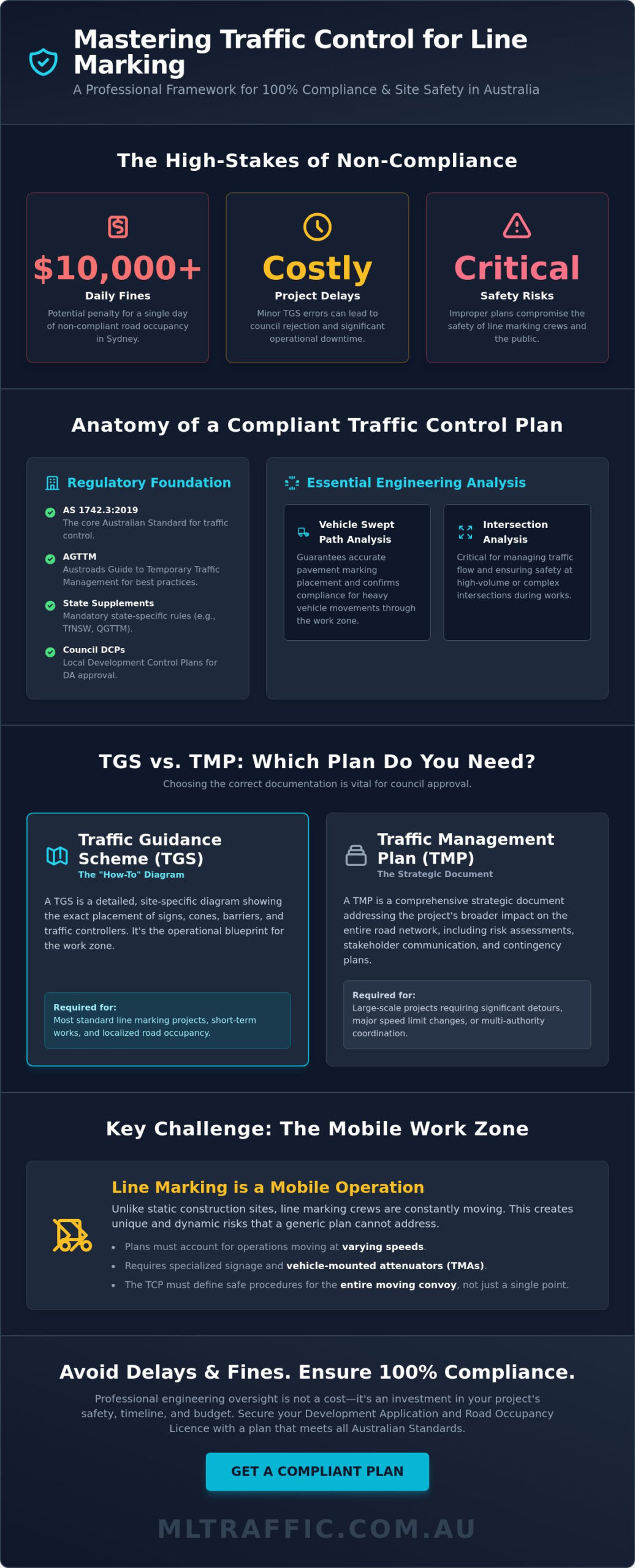
A single day of non-compliant road occupancy in Sydney can result in fines of $10,000. For project managers and developers, the complexity of obtaining council approval for development applications often hinges on the quality of technical documentation. Developing a precise traffic control plan for line marking is a specialized engineering task that must align with AS 1742.3:2019 and the latest 2026 TfNSW updates. You likely recognize that even minor errors in a Traffic Guidance Scheme (TGS) can lead to costly project delays or compromised contractor safety during mobile works.
This guide provides a professional framework for creating compliant plans that meet rigorous Australian Standards. We’ll outline how to integrate vehicle swept path analysis and intersection analysis into your site planning to ensure regulatory acceptance. You’ll gain a clear understanding of the technical requirements for the Austroads Guide to Temporary Traffic Management (AGTTM) and state-specific supplements to minimize disruption to existing traffic flow and ensure 100% compliance.
Key Takeaways
- Identify the technical distinctions between static and mobile work zones to ensure your site safety documentation meets rigorous Australian Standards.
- Learn how to integrate vehicle swept path analysis into a traffic control plan for line marking to guarantee accurate pavement placement and heavy vehicle compliance.
- Navigate the council approval process for Development Applications by understanding the specific requirements for Road Occupancy Licences and Traffic Guidance Schemes.
- Secure site safety and avoid project delays through professional engineering oversight and adherence to the latest Austroads and state-specific regulatory supplements.
Table of Contents
-
Understanding Traffic Control Plans (TCP) for Line Marking Projects
-
Regulatory Compliance: Australian Standards for Pavement Marking Safety
-
The Approval Process: Coordinating with Councils and Authorities
-
Professional Engineering for Compliant Traffic Guidance Schemes
Understanding Traffic Control Plans (TCP) for Line Marking Projects
A traffic control plan for line marking is a technical document designed to mitigate risks during pavement delineation. It differs from standard construction plans because line marking often utilizes mobile work zones. These operations move along the road at varying speeds, requiring specialized signage and vehicle-mounted attenuators. A professional Pavement Marking Overview confirms that these markings are vital for traffic guidance. Consequently, the plan must ensure they’re applied without endangering crews or motorists.
Professional engineering input is mandatory for complex site layouts. When you’re dealing with high-volume intersections or restricted urban spaces, a generic template won’t suffice. Senior experts design a site-specific Traffic Guidance Scheme (TGS) to meet AS 1742.3:2019 standards. This precision is necessary to avoid the $10,000 daily fines issued for non-compliant road occupancy in jurisdictions like Sydney. Meticulous planning ensures your project moves from the design phase to execution without regulatory friction.
To better understand the fundamentals of site safety, watch this video on temporary traffic control zones:
The Purpose of a Line Marking TCP
The primary objective is the protection of human life. Line marking crews often work in close proximity to live traffic with limited physical barriers. A robust traffic control plan for line marking establishes clear exclusion zones. These zones serve two purposes. First, they keep vehicles away from workers. Second, they provide the necessary time for materials to cure. If traffic enters a zone before the paint dries, it ruins the infrastructure and creates hazardous road conditions. Effective plans also maintain traffic flow, preventing the congestion that leads to rear-end collisions.
TGS vs. TMP: Which Does Your Project Need?
It’s essential to distinguish between the various levels of traffic documentation. A Traffic Guidance Scheme (TGS) is a detailed diagram showing exactly where signs and cones are placed. For most line marking tasks, a TGS is the standard requirement. However, a comprehensive Traffic Management Plan (TMP) is necessary for larger projects. A TMP is a strategic document that addresses the broader impact on the road network. If your project requires significant detours, changes to speed limits, or coordination with multiple authorities, a TMP becomes the governing document. Ensuring you have the correct level of documentation is critical for obtaining council approval and avoiding site shutdowns.
Regulatory Compliance: Australian Standards for Pavement Marking Safety
Adherence to AS 1742.3:2019 is the non-negotiable baseline for any traffic control plan for line marking. This national standard dictates the minimum requirements for device placement, worker visibility, and motorist guidance. While national standards provide the framework, state-specific supplements often introduce stricter technical requirements. For instance, Transport for NSW (TfNSW) utilizes Supplement Version 4.1 to AS 1742.3:2019, which remains a critical reference for worksites in that jurisdiction. Designers must also reference the Austroads Guide to Temporary Traffic Management (AGTTM) to ensure their documentation aligns with current industry best practices and national harmonization efforts.
Key Standards and Manuals
Effective plan development requires a multi-layered approach. Engineers often look to international benchmarks, such as the Manual on Uniform Traffic Control Devices, to inform advanced safety layouts and device communication. Domestically, each jurisdiction maintains its own code. In Queensland, the QGTTM was updated as recently as November 27, 2025. In Western Australia, the Code of Practice saw a significant update in March 2026. These documents aren’t suggestions; they’re legal requirements. Failure to integrate local council Development Control Plans (DCP) during the DA phase can lead to immediate project rejection.
Risk Assessment and Mitigation
Hazards associated with line marking are distinct from general roadwork. Moving plant machinery and the presence of wet paint require specific exclusion zones and taper lengths. A standard sign sequence must account for the mobile nature of the work. If your project takes place in high-traffic urban areas, managing pedestrian access is paramount. This involves creating designated crossing points and using physical barriers to prevent contact with toxic materials or heavy vehicles. Meticulous risk management is the only way to ensure 100% compliance with AS 1742.3.
Liability for non-compliance is severe. Beyond the threat of $10,000 daily fines in Sydney, project managers face significant legal exposure if an incident occurs due to an inadequate traffic control plan for line marking. Professionals designing these schemes must hold specific qualifications, such as the "Prepare Work Zone Traffic Management Plan" (PWZTMP) in NSW. Ensuring your site meets these rigorous benchmarks is a core component of our specialized traffic engineering services. We focus on results-oriented compliance to protect your project from costly shutdowns and legal repercussions.
Integrating Swept Path Analysis into Your Line Marking Plan
A successful traffic control plan for line marking requires more than just adherence to safety signage. It must account for the physical space required by vehicles navigating the site. Integrating Vehicle Swept Path Analysis into your planning ensures that pavement markings are placed where vehicles can actually travel without overrunning curbs or crossing into opposing lanes. This is particularly critical for heavy vehicle compliance under AS 2890.2. For a deeper understanding of these technical requirements, see our Swept Path Analysis: A Complete Guide for Australian Developments.
Engineers utilize AutoTURN software to simulate the movements of specific design vehicles. This data provides the objective justification councils require for Development Applications (DA). By overlaying swept paths onto the proposed line marking plan, designers can identify potential conflicts before paint touches the asphalt. This proactive approach prevents the need for costly remedial works and ensures that the final site layout is both functional and compliant with national standards.
Verifying Maneuverability with Swept Paths
Analysing truck turning circles is essential to prevent premature line marking wear and tear. If a vehicle’s swept path frequently overlaps with a painted line, the marking will degrade rapidly, leading to increased maintenance costs. For car parks, ensuring that line marking meets AS 2890.1 standards is a legal necessity. Swept path diagrams provide visual proof of vehicle clearance. These diagrams demonstrate to council authorities that the proposed design accommodates the intended vehicle types, such as waste collection trucks or delivery vans, without compromising safety.
Optimising Site Layouts for Safety
Precise marking placement guides vehicles away from hazardous zones and structural elements. Using swept paths allows engineers to determine safe buffer zones for marking crews during the implementation of a traffic control plan for line marking. By understanding exactly where a vehicle’s body and wheels will be at any point in a turn, designers can establish exclusion zones that protect workers from moving traffic. This level of detail reduces the risk of vehicle-to-infrastructure conflict and enhances the overall safety of the worksite. It transforms a standard traffic guidance scheme into a data-driven engineering solution.
The Approval Process: Coordinating with Councils and Authorities
A technically sound traffic control plan for line marking is only effective if it secures the necessary regulatory approvals. For developers, this process begins with the Development Application (DA). Authorities require detailed evidence that proposed works won’t compromise road safety or network efficiency. Obtaining a Road Occupancy Licence (ROL) is a separate, critical step. This licence grants specific permission to occupy a section of the road for a defined period. In major metropolitan areas like Sydney, the City of Sydney approval fees for these permits can exceed $1,200 for significant projects. Failure to secure an ROL before starting work leads to immediate site shutdowns and heavy financial penalties.
Review timelines vary significantly between local councils and state road authorities like Transport for NSW or VicRoads. Expect a review period of several weeks for standard applications. Common causes for rejection include inadequate impact assessments, missing insurance certificates, or failing to account for peak-hour traffic restrictions. For complex projects, understanding the role of a traffic engineer in developments is essential. An experienced engineer ensures all documentation meets the specific criteria of the relevant authority, reducing the likelihood of costly revisions and project delays.
Submission Requirements for Developers
Your submission must be comprehensive. At a minimum, you need a site-specific Traffic Guidance Scheme (TGS), a broader traffic control plan for line marking, and current Public Liability Insurance certificates. You must demonstrate that the work has a minimal impact on the local traffic network. This involves justifying the proposed hours of operation and the specific methods used to manage traffic flow. Councils also examine how your plan addresses their unique Development Control Plans (DCP). If your project involves high-volume roads, you may need to provide additional data, such as an intersection analysis, to prove that the worksite won’t cause excessive queuing.
Stakeholder Communication
Approval often hinges on your ability to manage community impact. You must notify residents and local businesses of upcoming line marking works well in advance. This notification should include the expected duration of the works and any changes to street parking availability. If the project affects bus routes, you must coordinate with public transport providers to arrange diversions or temporary stop relocations. Emergency vehicle access is a non-negotiable requirement. Your TGS must clearly show how ambulances, fire trucks, and police vehicles can navigate the site during restricted hours. Proactive communication minimizes complaints and demonstrates professional accountability to the council.
If you need a results-oriented Traffic Guidance Scheme designed to pass council scrutiny, our senior principals provide direct oversight on every project to ensure compliance.
Professional Engineering for Compliant Traffic Guidance Schemes
Engineering a traffic control plan for line marking requires a level of technical precision that generic templates cannot provide. At ML Traffic Engineers Australia, we prioritise senior principal involvement in every design phase. This ensures the technical work is performed by the same expert who initiates the client relationship. This continuity is a core philosophy of our firm; it eliminates the gatekeepers often found in larger, impersonal consultancies. By leveraging decades of experience, we produce results-oriented documentation that withstands the scrutiny of council reviewers and state road authorities across Australia.
Site safety is a primary driver for professional engineering. While earlier sections of this guide addressed the regulatory framework and swept path requirements, the final execution depends on expert engineering judgment. A non-compliant plan doesn’t just risk human life; it invites immediate site shutdowns and financial liability. Our Traffic Engineering Services focus on integrating current regulatory standards into every Traffic Guidance Scheme (TGS). ML Traffic Engineers Australia streamlines the DA approval process by delivering documentation that is accurate from the first submission.
Expert Consultancy for Complex Projects
Complex project environments, such as high-volume intersections or multi-vehicle loading docks, demand specialised assessments. We design custom traffic control plans that account for specific land-use categories and heavy vehicle requirements. Every design adheres to AS 1742.3:2019 and the Austroads Guide to Temporary Traffic Management (AGTTM). Clients receive direct access to senior traffic engineers throughout the project duration. This ensures technical queries from councils or contractors are addressed with authority and speed. We don’t just provide a diagram; we provide an engineering solution tailored to the unique constraints of your site.
Request a Traffic Control Plan
Developing a tailored traffic control plan for line marking begins with a meticulous site assessment. We collect essential data regarding existing traffic volumes, speed zones, and sight distances. This information allows us to design a TGS that minimises disruption while maximising safety. Whether your project involves a simple driveway marking or a complex intersection redesign, we provide the technical expertise required for regulatory approval. Our team holds the mandatory qualifications necessary for designing these schemes in all Australian states. To secure a compliant, professional plan for your next development, contact ML Traffic Engineers Australia for professional traffic planning. We focus on delivering deep-seated expertise that keeps your project on schedule.
Optimise Site Safety and Regulatory Compliance
Developing a compliant traffic control plan for line marking is a critical engineering requirement for any modern development. Precision in these documents prevents technical rejections from authorities and ensures the safety of all road users. You’ve seen how integrating vehicle swept path analysis and adhering to AS 1742.3 standards mitigates operational risks. These technical assessments are essential for securing a Road Occupancy Licence and meeting development application criteria without the burden of unnecessary revisions.
ML Traffic Engineers Australia brings over 15 years of experience in Australian traffic engineering to your project. We ensure senior principal involvement in every traffic guidance scheme we produce. This hands-on approach guarantees that comprehensive knowledge of AS 2890 and AS 1742.3 standards is applied directly to your specific site conditions. We eliminate the friction of bureaucracy by providing direct access to the experts performing the technical work. This results-oriented methodology protects your project from delays and ensures long-term site functionality.
Secure Your DA Approval with Expert Traffic Planning by contacting our team today. We’re ready to provide the meticulous engineering oversight your project requires for success.
Frequently Asked Questions
What is the difference between a Traffic Management Plan and a Traffic Control Plan?
A Traffic Management Plan (TMP) is a strategic document that addresses the high-level impact of a project on the surrounding road network. It outlines the broad safety objectives and coordination efforts required. A Traffic Control Plan (TCP) is a site-specific diagram that illustrates the exact placement of signs, cones, and barriers. For line marking, the TCP provides the immediate operational layout for the work zone.
When is a Traffic Guidance Scheme (TGS) required for line marking?
A Traffic Guidance Scheme (TGS) is mandatory whenever line marking activities alter the normal flow of traffic or occupy any portion of the roadway. This documentation is required for both static and mobile operations to define exclusion zones and taper lengths. It ensures the worksite remains compliant with state-specific technical manuals and national safety standards, protecting both the crew and the public during short-term works.
Do I need a certified traffic engineer to design my line marking TCP?
Yes, complex sites and development applications typically require a qualified professional to design a traffic control plan for line marking. In jurisdictions like New South Wales, the designer must hold a "Prepare Work Zone Traffic Management Plan" (PWZTMP) qualification. Professional engineering oversight ensures that the plan accounts for technical variables like sight distances and intersection analysis, which are critical for securing council approval.
How long does it typically take to get council approval for a traffic plan?
Council approval for traffic plans generally takes between two to four weeks depending on the local authority’s current workload and the complexity of the site. Major projects involving state-managed roads may require additional time for review by agencies like Transport for NSW or VicRoads. Submitting comprehensive documentation, including insurance certificates and technical diagrams, helps prevent delays caused by requests for further information.
What Australian Standards govern traffic control for pavement marking?
The primary standard is AS 1742.3:2019, which covers traffic control for works on roads. This is supplemented by the Austroads Guide to Temporary Traffic Management (AGTTM), which provides a framework for national harmonisation. These documents provide the foundational requirements for signage, worker visibility, and motorist guidance. Designers must also reference AS 2890 for specific car park and off-street parking requirements during the planning phase.
Is a Road Occupancy Licence (ROL) always necessary for line marking?
A Road Occupancy Licence (ROL) is mandatory whenever line marking works require the closure of a lane or any restriction of public road access. This permit is issued by the relevant road authority to manage the timing and impact of the work on the broader network. Projects confined entirely to private property may not require an ROL but still need a compliant traffic guidance scheme to ensure site safety.
How does Swept Path Analysis impact the design of a traffic control plan?
Swept Path Analysis determines the exact placement of line markings by simulating the turning movements of specific design vehicles. This analysis ensures that markings are positioned to accommodate the physical dimensions of trucks or buses without causing infrastructure damage. It provides the empirical data needed to justify site layouts in a traffic control plan for line marking during the development application process.
Can a traffic control plan be reused for different stages of the same project?
A traffic control plan can only be reused if the site conditions, road geometry, and traffic volumes remain identical across different project stages. Any change in speed limits, plant machinery, or work area requires an updated or new Traffic Guidance Scheme. Reusing a non-compliant or outdated plan exposes project managers to significant legal liability and potential site shutdowns by regulatory authorities.
Which areas do you cover?
We are traffic engineers servicing Abbotsbury, Abbotsford, Acacia Gardens, Agnes Banks, Airds, Alexandria, Alfords Point, Allambie Heights, Allawah, Ambarvale, Angus, Annandale, Annangrove, Arcadia, Arncliffe, Arndell Park, Artarmon, Ashbury, Ashcroft, Ashfield, Asquith, Auburn, Austral, Avalon Beach, Badgerys Creek, Balgowlah, Balgowlah Heights, Balmain, Balmain East, Bangor, Banksia, Banksmeadow, Bankstown, Bankstown Aerodrome, Barangaroo, Barden Ridge, Bardia, Bardwell Park, Bardwell Valley, Bass Hill, Baulkham Hills, Bayview, Beacon Hill, Beaconsfield, Beaumont Hills, Beecroft, Belfield, Bella Vista, Bellevue Hill, Belmore, Belrose, Berala, Berkshire Park, Berowra, Berowra Heights, Berowra Waters, Berrilee, Beverley Park, Beverly Hills, Bexley, Bexley North, Bidwill, Bilgola Beach, Bilgola Plateau, Birchgrove, Birrong, Blackett, Blacktown, Blair Athol, Blairmount, Blakehurst, Bligh Park, Bondi, Bondi Beach, Bondi Junction, Bonnet Bay, Bonnyrigg, Bonnyrigg Heights, Bossley Park, Botany, Bow Bowing, Box Hill, Bradbury, Bradfield, Breakfast Point, Brighton-Le-Sands, Bringelly, Bronte, Brooklyn, Brookvale, Bundeena, Bungarribee, Burraneer, Burwood, Burwood Heights, Busby, Cabarita, Cabramatta, Cabramatta West, Caddens, Cambridge Gardens, Cambridge Park, Camellia, Cammeray, Campbelltown, Camperdown, Campsie, Canada Bay, Canley Heights, Canley Vale, Canoelands, Canterbury, Caringbah, Caringbah South, Carlingford, Carlton, Carnes Hill, Carramar, Carss Park, Cartwright, Castle Cove, Castle Hill, Castlecrag, Castlereagh, Casula, Catherine Field, Cattai, Cecil Hills, Cecil Park, Centennial Park, Chatswood, Chatswood West, Cheltenham, Cherrybrook, Chester Hill, Chifley, Chippendale, Chipping Norton, Chiswick, Chullora, Church Point, Claremont Meadows, Clarendon, Clareville, Claymore, Clemton Park, Clontarf, Clovelly, Clyde, Coasters Retreat, Cobbitty, Colebee, Collaroy, Collaroy Plateau, Colyton, Como, Concord, Concord West, Condell Park, Connells Point, Constitution Hill, Coogee, Cottage Point, Cowan, Cranebrook, Cremorne, Cremorne Point, Cromer, Cronulla, Crows Nest, Croydon, Croydon Park, Curl Curl, Currans Hill, Currawong Beach, Daceyville, Dangar Island, Darling Point, Darlinghurst, Darlington, Davidson, Dawes Point, Dean Park, Dee Why, Denham Court, Denistone, Denistone East, Denistone West, Dharruk, Dolans Bay, Dolls Point, Doonside, Double Bay, Dover Heights, Drummoyne, Duffys Forest, Dulwich Hill, Dundas, Dundas Valley, Dural, Eagle Vale, Earlwood, East Hills, East Killara, East Lindfield, East Ryde, Eastern Creek, Eastgardens, Eastlakes, Eastwood, Edensor Park, Edgecliff, Edmondson Park, Elanora Heights, Elderslie, Elizabeth Bay, Elizabeth Hills, Elvina Bay, Emerton, Enfield, Engadine, Englorie Park, Enmore, Epping, Ermington, Erskine Park, Erskineville, Eschol Park, Eveleigh, Fairfield, Fairfield East, Fairfield Heights, Fairfield West, Fairlight, Fiddletown, Five Dock, Forest Glen, Forest Lodge, Forestville, Frenchs Forest, Freshwater, Gables, Galston, Georges Hall, Gilead, Girraween, Gladesville, Glebe, Gledswood Hills, Glen Alpine, Glendenning, Glenfield, Glenhaven, Glenmore Park, Glenorie, Glenwood, Gordon, Grantham Farm, Granville, Grays Point, Great Mackerel Beach, Green Valley, Greenacre, Greendale, Greenfield Park, Greenhills Beach, Greenwich, Gregory Hills, Greystanes, Guildford, Guildford West, Gymea, Gymea Bay, Haberfield, Hammondville, Harrington Park, Harris Park, Hassall Grove, Haymarket, Heathcote, Hebersham, Heckenberg, Henley, Hillsdale, Hinchinbrook, Hobartville, Holroyd, Holsworthy, Homebush, Homebush West, Horningsea Park, Hornsby, Hornsby Heights, Horsley Park, Hoxton Park, Hunters Hill, Huntingwood, Huntleys Cove, Huntleys Point, Hurlstone Park, Hurstville, Hurstville Grove, Illawong, Ingleburn, Ingleside, Jamisontown, Jannali, Jordan Springs, Kangaroo Point, Kareela, Kearns, Kellyville, Kellyville Ridge, Kemps Creek, Kensington, Kenthurst, Kentlyn, Killara, Killarney Heights, Kings Langley, Kings Park, Kingsford, Kingsgrove, Kingswood, Kirkham, Kirrawee, Kirribilli, Kogarah, Kogarah Bay, Ku-ring-gai Chase, Kurnell, Kurraba Point, Kyeemagh, Kyle Bay, La Perouse, Lakemba, Lalor Park, Lane Cove, Lane Cove North, Lane Cove West, Lansdowne, Lansvale, Laughtondale, Lavender Bay, Leets Vale, Leichhardt, Len Waters Estate, Leppington, Lethbridge Park, Leumeah, Lewisham, Liberty Grove, Lidcombe, Lilli Pilli, Lilyfield, Lindfield, Linley Point, Little Bay, Liverpool, Llandilo, Loftus, Londonderry, Long Point, Longueville, Lovett Bay, Lower Portland, Lucas Heights, Luddenham, Lugarno, Lurnea, Macquarie Fields, Macquarie Links, Macquarie Park, Maianbar, Malabar, Manly, Manly Vale, Maraylya, Marayong, Maroota, Maroubra, Marrickville, Marsden Park, Marsfield, Mascot, Matraville, Mays Hill, McCarrs Creek, McGraths Hill, McMahons Point, Meadowbank, Melonba, Melrose Park, Menai, Menangle Park, Merrylands, Merrylands West, Middle Cove, Middle Dural, Middleton Grange, Miller, Millers Point, Milperra, Milsons Passage, Milsons Point, Minchinbury, Minto, Minto Heights, Miranda, Mona Vale, Monterey, Moore Park, Moorebank, Morning Bay, Mortdale, Mortlake, Mosman, Mount Annan, Mount Colah, Mount Druitt, Mount Kuring-Gai, Mount Lewis, Mount Pritchard, Mount Vernon, Mulgoa, Mulgrave, Narellan, Narellan Vale, Naremburn, Narrabeen, Narraweena, Narwee, Nelson, Neutral Bay, Newington, Newport, Newtown, Nirimba Fields, Normanhurst, North Balgowlah, North Bondi, North Curl Curl, North Epping, North Kellyville, North Manly, North Narrabeen, North Parramatta, North Rocks, North Ryde, North St Marys, North Strathfield, North Sydney, North Turramurra, North Wahroonga, North Willoughby, Northbridge, Northmead, Northwood, Norwest, Oakhurst, Oakville, Oatlands, Oatley, Old Guildford, Old Toongabbie, Oran Park, Orchard Hills, Oxford Falls, Oxley Park, Oyster Bay, Paddington, Padstow, Padstow Heights, Pagewood, Palm Beach, Panania, Parklea, Parramatta, Peakhurst, Peakhurst Heights, Pemulwuy, Pendle Hill, Pennant Hills, Penrith, Penshurst, Petersham, Phillip Bay, Picnic Point, Pitt Town, Pleasure Point, Plumpton, Point Piper, Port Botany, Port Hacking, Potts Hill, Potts Point, Prairiewood, Prestons, Prospect, Punchbowl, Putney, Pymble, Pyrmont, Quakers Hill, Queens Park, Queenscliff, Raby, Ramsgate, Ramsgate Beach, Randwick, Redfern, Regents Park, Regentville, Revesby, Revesby Heights, Rhodes, Richards, Richmond, Riverstone, Riverview, Riverwood, Rockdale, Rodd Point, Rookwood, Rooty Hill, Ropes Crossing, Rose Bay, Rosebery, Rosehill, Roselands, Rosemeadow, Roseville, Roseville Chase, Rossmore, Rouse Hill, Rozelle, Ruse, Rushcutters Bay, Russell Lea, Rydalmere, Ryde, Sackville North, Sadleir, Sandringham, Sandy Point, Sans Souci, Schofields, Scotland Island, Seaforth, Sefton, Seven Hills, Shalvey, Shanes Park, Silverwater, Singletons Mill, Smeaton Grange, Smithfield, South Coogee, South Granville, South Hurstville, South Maroota, South Penrith, South Turramurra, South Wentworthville, South Windsor, Spring Farm, St Andrews, St Clair, St Helens Park, St Ives, St Ives Chase, St Johns Park, St Leonards, St Marys, St Peters, Stanhope Gardens, Stanmore, Strathfield, Strathfield South, Summer Hill, Surry Hills, Sutherland, Sydenham, Sydney, Sydney Olympic Park, Sylvania, Sylvania Waters, Tallawong, Tamarama, Taren Point, Telopea, Tempe, Tennyson Point, Terrey Hills, The Ponds, The Rocks, Thornleigh, Toongabbie, Tregear, Turramurra, Turrella, Ultimo, Varroville, Vaucluse, Villawood, Vineyard, Voyager Point, Wahroonga, Waitara, Wakeley, Wareemba, Warrawee, Warriewood, Warwick Farm, Waterfall, Waterloo, Watsons Bay, Wattle Grove, Waverley, Waverton, Wedderburn, Wentworth Point, Wentworthville, Werrington, Werrington County, Werrington Downs, West Hoxton, West Pennant Hills, West Pymble, West Ryde, Westleigh, Westmead, Wetherill Park, Whalan, Whale Beach, Wheeler Heights, Wiley Park, Willmot, Willoughby, Willoughby East, Windsor, Windsor Downs, Winston Hills, Wisemans Ferry, Wolli Creek, Wollstonecraft, Woodbine, Woodcroft, Woodpark, Woollahra, Woolloomooloo, Woolooware, Woolwich, Woronora, Woronora Heights, Yagoona, Yarrawarrah, Yennora, Yowie Bay, Zetland.

Disclaimer
The content on www.mltraffic.com.au, including all technical articles, guides, and resources, is provided for general informational and educational purposes only. It is not intended to constitute professional advice in traffic engineering, transportation planning, development approvals, or any other technical or legal field.
While ML Traffic Engineers makes every reasonable effort to ensure the accuracy, completeness, and timeliness of the information published, we do not provide any warranties or representations (express or implied) regarding its reliability, suitability, or availability for any particular purpose. Any reliance you place on the content is strictly at your own risk.
In no event shall ML Traffic Engineers, its directors, employees, authors, or affiliates be liable for any direct, indirect, incidental, special, consequential, or punitive damages (including, without limitation, loss of profits, data, or business opportunities) arising out of or in connection with the use of, or inability to use, any information provided on this website.
The articles and guides on this site are not a substitute for engaging a qualified, registered professional traffic engineer (such as an NPER or RPEQ engineer) to assess your specific project requirements. For tailored advice, compliance assessments, or traffic engineering services, please contact a competent professional.
This disclaimer may be updated from time to time without notice. By accessing or using this website, you agree to be bound by the most current version of this disclaimer.
