
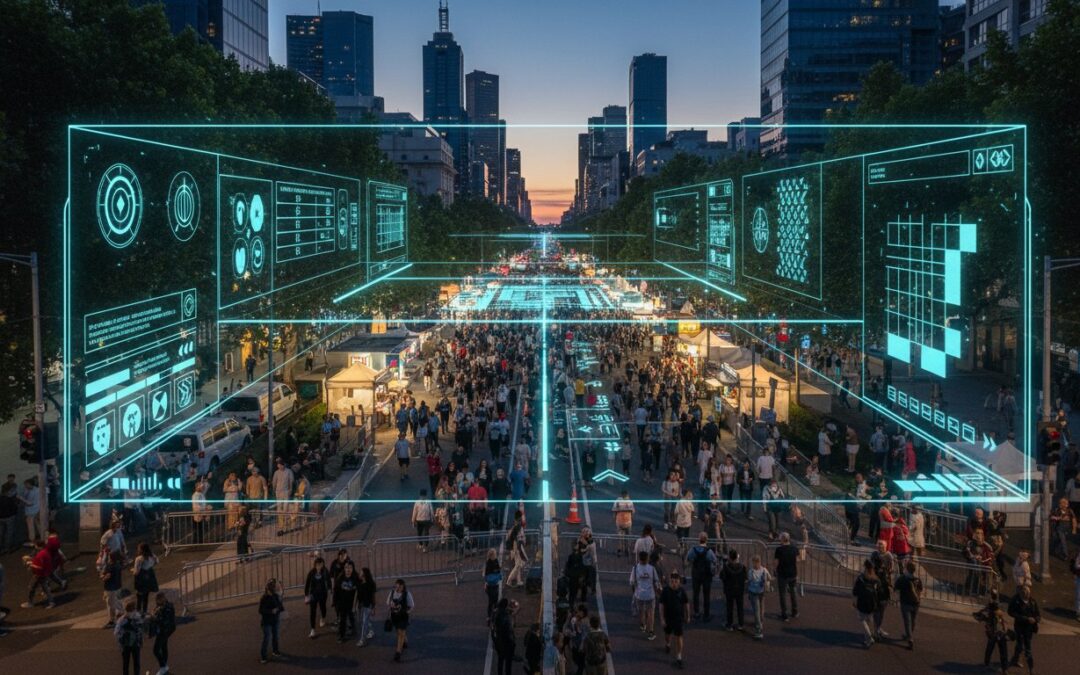
A single administrative error on your traffic control plan for special events can delay your festival’s permit by 14 days, potentially costing your organization A$12,000 in lost revenue. You likely already know that managing 5,000 attendees alongside moving vehicles is a significant logistical challenge. It’s common to feel stressed about whether your council application will be rejected or if you’ve confused a Traffic Guidance Scheme with a comprehensive plan. Liability is a major concern. No one wants to manage the fallout of a pedestrian conflict point.
This guide provides a clear roadmap to help you design a compliant traffic control plan that protects your attendees and secures rapid approval. You’ll learn how to identify high risk zones and reduce your liability through professional documentation that meets Australian Standards. We’re breaking down the exact steps required to move from technical planning to physical control on the day of your event. By following these proven strategies, you can focus on running a successful event while ensuring every vehicle and pedestrian movement is accounted for.
Key Takeaways
-
Understand the technical distinction between a TCP and TGS to ensure your event submission meets strict Australian regulatory standards.
-
Identify the essential signage and barrier configurations required to pass council scrutiny and protect your attendees.
-
Master strategies for managing the high-risk "end-of-event" surge with a professional traffic control plan for special events that keeps pedestrians and vehicles safely separated.
-
Streamline your approval process by following a clear roadmap for coordinating with local councils, Police, and Transport departments.
-
Learn how expert engineering oversight can lower your total project costs while ensuring the consultant who quotes your job is the one delivering the work.
Table of Contents
What is a Traffic Control Plan for Special Events?
A traffic control plan for special events is a technical package of documents that outlines how vehicle and pedestrian movements will be managed during a public or private gathering. It isn’t just a map showing where to put bollards. It’s a comprehensive safety strategy required by local councils and state road authorities to grant an event permit. Without a certified plan, your event lacks the legal framework to occupy or impact public road reserves.
Councils and road authorities require professional engineering diagrams because they need to ensure public safety and minimize congestion. These authorities don’t accept hand-drawn sketches. They demand precise, scaled drawings that reflect current road conditions and traffic volumes. A compliant plan acts as your primary risk management tool, protecting you from massive liability if an accident occurs within your event’s footprint.
There’s a clear distinction between operational event management and technical traffic engineering. Your event team handles the stage, the vendors, and the ticket holders. Our role as traffic engineering consultants is to manage the interface between your event and the moving world around it. We focus on vehicle swept paths, sight-line assessments, and ensuring emergency vehicles have uninterrupted access, even during peak attendance.
TCP vs. TGS: Clearing the Confusion
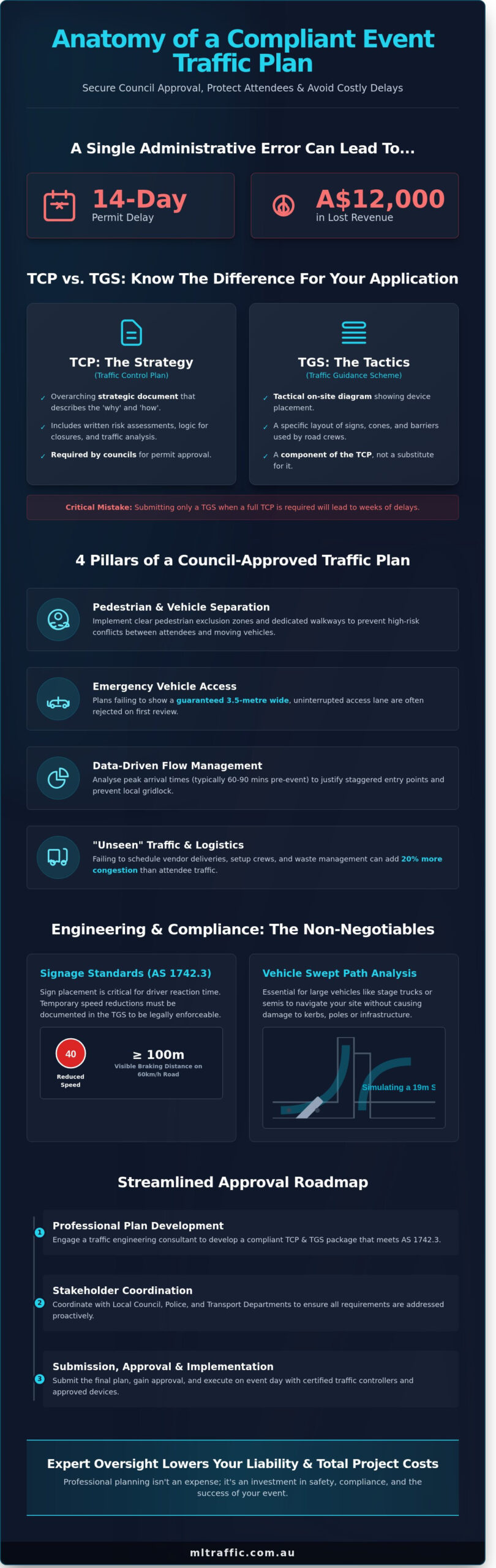
Terminology matters when you’re dealing with government regulators. A Traffic Control Plan (TCP) is the overarching strategic document that describes the "why" and "how" of your traffic management approach. It includes the written risk assessments and the logic behind road closures. In contrast, the Traffic Guidance Scheme (TGS) is the tactical diagram used by crews on the ground. A TGS is a site-specific layout of temporary signs and devices. If you submit a TGS when the council asked for a full TCP, your application will likely face weeks of delays.
The Legal Necessity of Professional Planning
Organising an event involves strict adherence to Australian Standards, specifically AS 1742.3, and state-based road management acts. These laws dictate exactly how traffic must be diverted and what signage is required for a traffic control plan for special events. Operating without an engineered plan is a breach of duty of care. If a motorist or pedestrian is injured, the lack of a professional plan leaves the organiser personally liable for damages. Professional planning ensures your event meets every regulatory hurdle while keeping the public safe and the traffic flowing.
Key Components of an Effective Event Traffic Plan
A traffic control plan for special events is more than a simple map; it’s a technical blueprint that ensures every attendee, contractor, and local resident remains safe. To pass council scrutiny in Australia, your plan must demonstrate a deep understanding of local road dynamics. We’ve seen that plans without a clear pedestrian exclusion zone or those that fail to account for a 3.5-metre wide emergency access lane are often rejected during the first round of review.
Effective planning uses data to prevent local gridlock. By analysing peak arrival times, usually 60 to 90 minutes before the main attraction starts, we can implement staggered entry points. This reduces the pressure on single intersections. You also need to account for "unseen" traffic. This includes delivery logistics for vendors and waste management vehicles that often require access while the event is live. If these movements aren’t scheduled into the plan, they can cause 20% more congestion than the event visitors themselves.
Signage and Delineation Standards
All signage must comply with Australian Standard AS 1742.3. It’s not just about having the signs; it’s about where they sit. Drivers need time to react. For a road with a 60km/h limit, signs should be visible from at least 100 metres away to allow for safe braking. We often implement temporary speed limit reductions, dropping 60km/h zones down to 40km/h or even 25km/h in high-footfall areas. These changes must be documented in your Traffic Guidance Scheme (TGS) to be legally enforceable by police and traffic controllers.
Vehicle Maneuverability and Swept Paths
The biggest logistical headaches often come from the largest vehicles. Event stages, generators, and heavy food trucks don’t move like standard cars. This is why a Swept Path Analysis is a non-negotiable part of the planning phase. We use specialized software to simulate the turning circles of 12.5-metre heavy rigid vehicles or 19-metre semi-trailers. This identifies "tight spots" before the first truck arrives on site, preventing damage to kerbs, light poles, or expensive event infrastructure.
If you’re unsure if your site can handle the heavy vehicles required for your setup, it’s a good idea to chat with a specialist who can run these simulations for you. Getting the geometry right early saves thousands in potential site repairs and prevents embarrassing delays on bump-in day.
-
Ensure all barriers are crash-rated if they sit near high-speed traffic.
-
Map out specific "drop-off zones" for rideshare vehicles to prevent double-parking.
-
Include a dedicated communication protocol for marshals and emergency services.
Managing the Conflict: Pedestrians vs. Vehicles
The most dangerous moment of any event isn’t the kickoff. It’s the "egress" or the end-of-event surge. Internal data from major Australian metropolitan events shows that 80% of near-miss incidents occur in the 45-minute window after the final whistle or curtain call. This is when thousands of pedestrians flood onto streets simultaneously, often while distracted or fatigued. A robust traffic control plan for special events must prioritise the physical separation of these crowds from moving vehicles to prevent tragedy.
Effective Traffic Guidance focuses on "flow management" rather than just stopping cars. If a plan creates a bottleneck at the exit, people will naturally spill over barriers and into live traffic lanes. We design systems that keep the crowd moving at a steady 1.2 metres per second. This prevents the "crush" effect and ensures that pedestrians don’t feel the need to take risky shortcuts across unmanaged roads.
Safe Pedestrian Zones
Effective zones rely on more than just yellow tape. For high-impact events, we specify water-filled plastic barriers or concrete "Jersey" barriers to provide a physical crash-rated shield. Visual cues like floor decals or LED wands help with direction, but they don’t stop a vehicle. Every path must comply with AS 1428 standards to ensure patrons using wheelchairs or mobility aids aren’t forced into dangerous detours. We typically design 3-metre wide "buffer zones" between the primary walking path and any road with a speed limit above 40km/h to provide a safety margin for both drivers and walkers.
Public Transport and Shuttle Integration
Congestion often peaks at the rideshare ranks and shuttle stops. We design these zones using a "sawtooth" bay configuration. This allows vehicles to pull in and out independently without waiting for the car in front to move. A dedicated rank for Uber and Taxis should be located at least 200 metres away from the main pedestrian exit. This distance prevents "door-zone" collisions where passengers step out into the path of moving crowds. For family-friendly events, we engineer "kiss and drop" zones with enough capacity to handle 15 to 20 vehicles at a time, ensuring the main thoroughfare remains clear for emergency services.
If you need a compliant and safe design for your next project, view our full range of traffic engineering services or contact our senior consultants directly.
The Approval Roadmap: Navigating Councils and Authorities
Securing approval for your event isn’t just about ticking a box; it’s about legal compliance and public safety. The process is rigorous. You’ll need to submit your traffic control plan for special events to the Local Traffic Committee (LTC) well before the first barrier is moved. This committee typically includes representatives from the local Council, the Police, and state transport authorities like Transport for NSW or Victoria’s Department of Transport.
The roadmap to approval follows a strict sequence:
-
Initial Consultation: Meet with Council event officers to identify potential red flags.
-
Plan Drafting: Develop a detailed TCP and TGS that adheres to Australian Standard AS 1742.3.
-
Stakeholder Review: Submit the plan to Police and transport departments for formal comment.
-
LTC Presentation: The committee reviews the plan and provides a recommendation to the Council.
-
Final Consent: Council issues the formal permit once all conditions are met.
Lead times are the biggest hurdle for event organisers. For a major festival, you should start this process at least 6 months out. Even small community markets require a 12-week lead time to navigate the monthly meeting cycles of local committees. Plans are often rejected because they lack detail on "swept path" analysis for buses or fail to account for local business delivery windows. Avoid these setbacks by ensuring your data is precise from day one.
Working with Local Government
Councils prioritise their residents and local economy. To get them on your side, you must address community impact directly. For events attracting over 5,000 attendees, a comprehensive Traffic Impact Assessment is essential. This document proves you’ve considered noise, parking overflow, and the specific bylaws of the LGA. If local businesses lose trade due to road closures, you’ll need a clear mitigation strategy to prevent formal objections that can stall your permit for weeks.
Consulting with Emergency Services
Police, Fire, and Ambulance services look at your plan through the lens of response times. They require "clear run" access routes that stay unobstructed throughout the event duration. We recommend pre-approving your plan with local police commands before the formal LTC meeting to resolve issues early. Emergency access must be maintained even during total road closures. This ensures that if an incident occurs, responders aren’t searching for a way past your infrastructure.
Don’t risk your event date with a rejected application. Get your plan right the first time by speaking with our senior traffic engineers today.
Why Expert Engineering is Your Secret Event Weapon
A traffic control plan for special events is more than just a regulatory requirement. It’s a strategic asset that protects your budget and your attendees. We operate with a "no-gatekeepers" philosophy. The traffic consultant who provides your quote is the person who does the work. This direct accountability ensures that the technical nuances of your site aren’t lost in a hand-off between sales staff and junior designers. You get a direct line to the experts responsible for your permit’s success.
Professional engineering oversight from an RPEQ or Chartered Engineer provides the technical authority councils demand. This level of qualification means your plan is built on Australian Standards like AS 1742.3 from the outset. It’s the difference between a permit being granted in 5 business days or being tied up in three rounds of revisions. You gain the peace of mind that comes from knowing your event’s safety is backed by decades of professional registration and a proven track record.
-
Direct access to senior principals Michael Lee and Benny Chen.
-
Plans designed to meet specific Council, Transport for NSW, or Victorian Department of Transport requirements.
-
Significant reduction in physical equipment and labor costs through precise, site-specific design.
Efficiency Through Experience
ML Traffic’s 15+ years of experience since 2005 allows us to navigate the approval process with speed. We’ve managed over 10,000 sites, which gives us a deep database of previous approvals to draw from. This experience helps you avoid the "over-engineering" trap. Many inexperienced designers add excessive signage and personnel to cover their own liability. This can inflate your event budget by A$2,500 to A$5,000 per day in unnecessary traffic controller wages. Our senior engineers focus on lean, safe, and compliant designs that keep your costs down.
Ready to Secure Your Event Permit?
Getting your traffic control plan for special events started is straightforward. To provide a fixed-fee quote, we need your event location, proposed dates, and an idea of your expected crowd size. If you have a draft site map or specific road closure requests, include those in your initial inquiry. We’ll review the details and provide a professional path forward so you won’t have to worry about bureaucratic delays. Contact ML Traffic Engineers to discuss your event requirements today and move your project from a concept to a council-ready reality.
Secure Your Event Approval with Expert Engineering
Successful events rely on more than just a good venue; they require a robust traffic control plan for special events that prioritizes public safety and seamless vehicle flow. You’ve seen that managing the delicate balance between pedestrians and traffic is non-negotiable for local council approval. Navigating the technical requirements of Australian road authorities doesn’t have to be a bureaucratic hurdle when you have the right engineering data on your side.
ML Traffic Engineers brings decades of experience to your project, having assessed more than 10,000 sites across Australia. You don’t have to worry about junior staff or gatekeepers here. You get direct access to senior engineers Michael Lee and Benny Chen, who specialize in securing complex council and road authority approvals. We operate on a simple principle: the consultant who provides your quote is the one who does the work. This hands-on approach ensures your event stays compliant and safe from the first permit to the final pack-down.
Ready to move forward? Get a Professional Traffic Plan Quote for Your Event and let’s get your project approved. Your event’s success is just one expert plan away.
Frequently Asked Questions
Do I need a traffic control plan for a small community event?
You need a traffic control plan for special events if your gathering impacts public roads, footpaths, or verge areas. Most Australian councils mandate a formal plan for any event exceeding 50 participants to ensure pedestrian safety and emergency vehicle access. Even a small street fair requires a certified plan to comply with the Road Management Act 2004 and local government regulations.
How much does a traffic control plan for a special event cost?
A basic traffic control plan typically costs between A$500 and A$1,500 depending on the complexity of the road network. For larger festivals requiring multiple road closures and detours, professional fees often range from A$2,500 to A$5,000. These costs cover the design by an accredited engineer and the necessary site inspections required for council submission and approval.
What is the difference between a Traffic Management Plan (TMP) and a Traffic Control Plan (TCP)?
A Traffic Management Plan (TMP) is a comprehensive report outlining the overall strategy, risk assessments, and stakeholder roles for the entire project. In contrast, a Traffic Control Plan (TCP), now often called a Traffic Guidance Scheme (TGS), is a technical diagram showing the exact placement of signs and bollards. You’ll usually need both documents to satisfy the requirements of Australian Standard AS 1742.3.
How long does it take to get a traffic plan approved by the council?
You should allow 4 to 8 weeks for a council to review and approve your traffic documentation. Major events involving state-managed roads may require 12 weeks of lead time to coordinate with Transport for NSW, VicRoads, or TMR. Submitting a high-quality, compliant plan the first time prevents delays caused by council requests for further information or plan amendments.
Can I implement the traffic plan myself once it is drawn up?
You cannot implement the traffic plan yourself unless you hold a current RIIWHS205E or RIIWHS302E accreditation. Australian law requires that only qualified traffic controllers set up signs and manage active traffic lanes on public roads. Hiring a professional team ensures the site remains safe and protects you from personal liability if an accident occurs during your event.
What happens if my event traffic plan is not compliant with Australian Standards?
If your traffic control plan for special events fails to meet Australian Standard AS 1742.3, the council will reject your permit application immediately. Operating without a compliant plan exposes organizers to fines exceeding A$10,000 and can void your public liability insurance. We ensure every plan meets rigorous safety benchmarks to protect your organization, the attendees, and the general public.
Do I need to notify the police about my event traffic plan?
You must notify the police for any event that involves road closures or significant changes to traffic flow on public land. In states like NSW, you’ll need to submit a "Notice of Intention to Hold a Public Assembly" at least 7 days before the event takes place. Providing the police with your approved traffic plan helps them coordinate emergency responses and maintain local order during the proceedings.
Can a traffic plan include parking management for a private field?
A professional traffic plan can definitely include parking management for private land or temporary event fields. We use vehicle swept path assessments to ensure that 12.5m coaches or emergency vehicles can navigate the grassed areas safely without getting stuck. Properly mapped parking prevents bottlenecks on the main road and ensures a smooth entry and exit for your 500 or 5,000 guests.
Which areas do you cover?
We are traffic engineers servicing NSW, which includes Sydney, Newcastle, Wollongong, Central Coast, Maitland, Tweed Heads, Wagga Wagga, Albury, Dubbo, Tamworth, Orange, Bathurst, Broken Hill.

Disclaimer
The content on www.mltraffic.com.au, including all technical articles, guides, and resources, is provided for general informational and educational purposes only. It is not intended to constitute professional advice in traffic engineering, transportation planning, development approvals, or any other technical or legal field.
While ML Traffic Engineers makes every reasonable effort to ensure the accuracy, completeness, and timeliness of the information published, we do not provide any warranties or representations (express or implied) regarding its reliability, suitability, or availability for any particular purpose. Any reliance you place on the content is strictly at your own risk.
In no event shall ML Traffic Engineers, its directors, employees, authors, or affiliates be liable for any direct, indirect, incidental, special, consequential, or punitive damages (including, without limitation, loss of profits, data, or business opportunities) arising out of or in connection with the use of, or inability to use, any information provided on this website.
The articles and guides on this site are not a substitute for engaging a qualified, registered professional traffic engineer (such as an NPER or RPEQ engineer) to assess your specific project requirements. For tailored advice, compliance assessments, or traffic engineering services, please contact a competent professional.
This disclaimer may be updated from time to time without notice. By accessing or using this website, you agree to be bound by the most current version of this disclaimer.
