

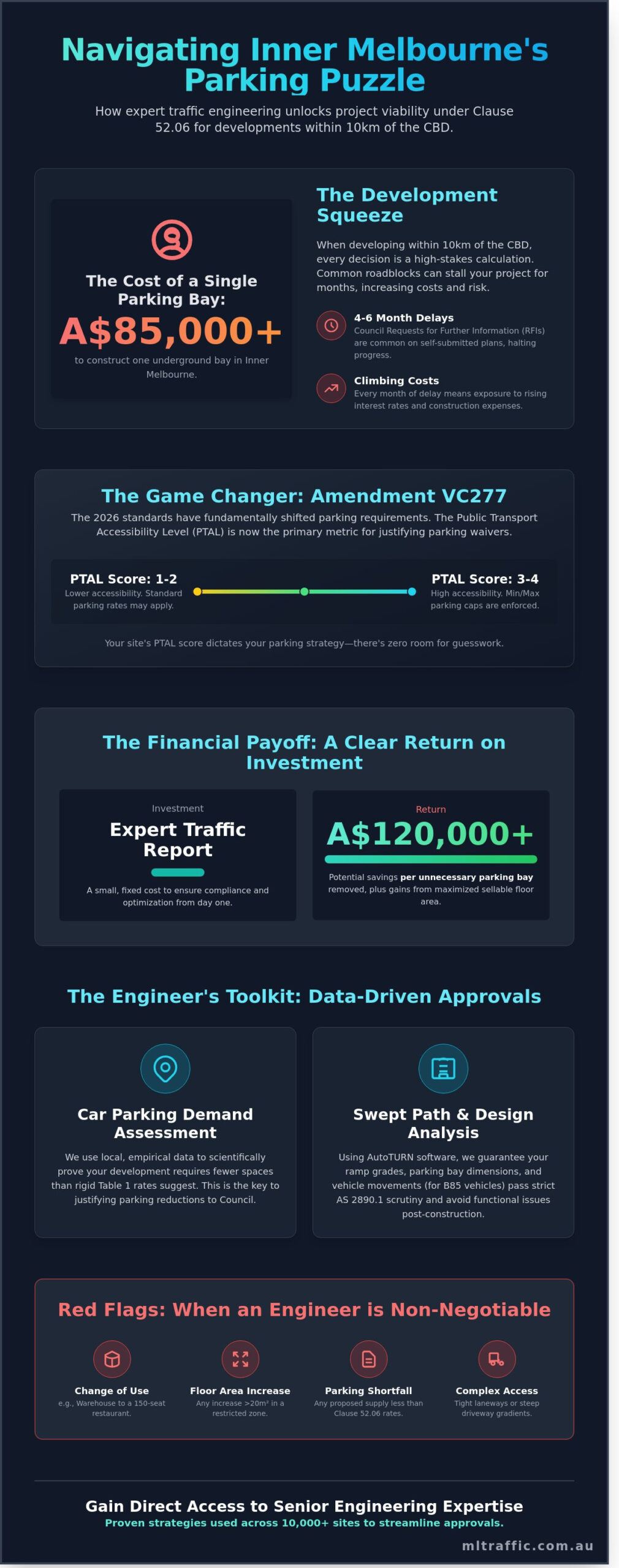
Did you know that a single underground parking bay in Inner Melbourne now costs upwards of A$85,000 to construct? When you’re developing within 10km of the CBD, every square metre of space is a high stakes calculation. Finding the right traffic engineer for your planning application in Inner Melbourne (0-10km) capability and cost clause 52.06 is no longer just about compliance; it’s about project viability. You’re probably tired of Council RFIs stalling your progress while interest rates and construction costs climb. It’s frustrating to deal with the 2026 PTAL maps and the technical shifts brought on by Amendment VC277 without a clear roadmap.
This guide explains how to leverage the latest 2026 standards to reduce parking requirements and maximize your sellable floor area. We’ll provide a transparent breakdown of engineering fees, show you how to secure a planning permit on your first attempt, and demonstrate how expert traffic advice delivers a massive return on investment. You’ll learn exactly how to navigate the new Clause 52.06 requirements to keep your project profitable and on schedule.
Key Takeaways
-
Understand how the 2026 Amendment VC277 has fundamentally shifted parking requirements in Inner Melbourne and what this means for your project’s immediate compliance.
-
See why engaging a traffic engineer for your planning application in Inner Melbourne (0-10km) capability and cost clause 52.06 specialist is a high-value investment that can save you up to A$120,000 per unnecessary parking bay.
-
Learn to navigate the seven mandatory Design Standards using professional AutoTURN swept path analysis to guarantee your ramp grades and vehicle movements pass strict council scrutiny.
-
Discover how a Car Parking Demand Assessment uses local empirical data to prove your development requires fewer spaces than the rigid Table 1 rates suggest.
-
Gain direct access to senior engineering expertise and proven strategies used across 10,000+ sites to streamline approvals with Melbourne, Yarra, and Port Phillip councils.
Table of Contents
-
Navigating Clause 52.06 in Inner Melbourne: Why 2026 is Different
-
Capability and Technical Standards: Mastering Table 1 and Design Standards
-
The True Cost: Engineering Fees vs. The Value of Saved Floor Area
-
Winning Your Planning Permit: The Role of a Car Parking Demand Assessment
-
Direct Expertise: Why ML Traffic Engineers for Your Melbourne Application
Navigating Clause 52.06 in Inner Melbourne: Why 2026 is Different
Clause 52.06 is the Victorian Planning Scheme’s primary mechanism for controlling car parking. It isn’t a set of suggestions; it’s a rigid framework that can make or break your permit. In the 0-10km ring around Melbourne, including high-pressure zones like Yarra and Port Phillip, the rules have tightened significantly. The 2026 environment requires a sophisticated approach to parking reductions that simple site plans can’t provide. Professional Traffic engineering is the only way to navigate these requirements without losing valuable yield.
To better understand the complexities of modern transport design, watch this helpful video:
The 0-10km ring is unique because Councils are no longer just asking for enough parking; they’re often actively discouraging it. In suburbs like Cremorne or Fitzroy, providing too much parking can be just as problematic as providing too little. Understanding the role of a traffic engineer for your planning application in Inner Melbourne (0-10km) capability and cost clause 52.06 helps you avoid the common trap of over-engineering parking at the expense of sellable floor area.
Amendment VC277 and the PTAL Shift
Amendment VC277 changed the game for developers by formalizing the Public Transport Accessibility Level (PTAL) system. This metric measures how close your site is to high-frequency trains, trams, and buses. PTAL is the primary metric for 2026 parking waivers. If your site lands a PTAL score of 4, you might face maximum parking caps, meaning you literally aren’t allowed to build more than a certain number of spots. This shift forces a move away from standard rates toward bespoke assessments. Your site’s PTAL category (1-4) dictates your minimum and maximum parking rates with zero room for guesswork. We use these scores to justify parking reductions that save our clients hundreds of thousands in excavation costs.
When is a Traffic Engineer Non-Negotiable?
Many developers try to "self-submit" using only an architect’s drawings, but this often triggers a Request for Further Information (RFI) from Council. These RFIs can cost 4 to 6 months in project delays. A professional report becomes non-negotiable when your project involves:
-
A formal change of use (e.g., converting a warehouse to a 150-seat restaurant).
-
An increase in floor area of more than 20 square metres in a restricted zone.
-
Any shortfall between the Clause 52.06 requirement and your proposed supply.
-
Complex driveway gradients or tight laneway access that requires B85 vehicle swept path analysis.
Architects focus on the aesthetic and spatial layout, but they rarely have the software or technical certification to guarantee compliance with AS 2890.1 (Off-street car parking). Engaging a traffic engineer for your planning application in Inner Melbourne (0-10km) capability and cost clause 52.06 ensures that your basement or parking layout is actually functional. Learn more about our traffic engineering services for Victorian developments to see how we handle these technical hurdles. We provide the data Council needs to see, such as empirical parking demand surveys and sight-line assessments, to ensure your application moves through the system without friction.
Capability and Technical Standards: Mastering Table 1 and Design Standards
Inner Melbourne developments live or die by Clause 52.06. If you are building within 10km of the CBD, you are dealing with the tightest spatial constraints in Victoria. A qualified traffic engineer for your planning application in Inner Melbourne (0-10km) capability and cost clause 52.06 assessment ensures your basement does not become a construction liability. Council planners do not accept "best efforts." They require strict adherence to the 7 Design Standards. These cover everything from accessway width to the 2.1m minimum internal clearance required for car spaces. We have seen projects stalled for months because a designer missed a 300mm clearance requirement in a tight laneway.
The technical bar is high. Every site we assess must meet the requirements of Table 1, which dictates exactly how many car spaces your specific land use requires. Whether you are developing a 4-unit townhouse site in Richmond or a mixed-use tower in South Melbourne, the math must be perfect. We rely on Austroads’ national parking guidelines to provide the technical authority Council engineers expect in a formal Traffic Impact Assessment.
Standard 3: The 1:8 Ramp Grade Challenge
Ramp grade errors are the leading cause of basement redesigns in 2026. If your ramp is too steep, vehicles will scrape their undercarriages, leading to long-term structural issues and resident complaints. We certify compliance with AS 2890.1 (Australian Standards for Off-street Car Parking) by conducting rigorous Driveway Ramp Grade Assessments. A standard 1:8 grade is often the limit, but you must include transition segments of 1:12 or 1:15 to prevent bottoming out. We catch these errors in the early design phase, saving clients thousands in mid-construction variations.
Swept Path Analysis: Proving it Fits
In Inner Melbourne, "near enough" is never good enough. We use AutoTURN software to provide data-backed swept path diagrams. This demonstrates that a B85 vehicle, which represents the 85th percentile of cars on Australian roads, can enter and exit your site in a single maneuver. Council engineers trust these digital simulations over manual overlays every time. Our capability focus includes:
-
Handling complex heritage constraints where building footprints cannot be altered.
-
Navigating narrow laneways common in Fitzroy and Collingwood.
-
Proving that tandem parking arrangements actually function without blocking traffic.
-
Verifying that heavy rigid vehicles (HRVs) can access loading bays without mounting curbs.
The number one objection we see from Councils involves inadequate sight distances. Standard 9 of Clause 52.06 requires a 2.5m by 2.0m splay at the property line to protect pedestrians. If your architect has placed a structural column or a high fence in this "clear sight" zone, Council will likely refuse the permit. We provide the exact dimensions needed to satisfy safety requirements while maximizing your buildable area. At ML Traffic Engineers, the consultant who provides your quote is the senior engineer who does the work. If you’re unsure if your basement ramp meets the 1:8 requirement, contact our senior engineers for a preliminary review of your site plan.
The True Cost: Engineering Fees vs. The Value of Saved Floor Area
Inner Melbourne land prices reached record highs in early 2026. For developers and owner-builders, every square metre of a site in Richmond, Carlton, or South Yarra must generate value. Many applicants view the traffic engineer as a mandatory compliance hurdle, but this perspective ignores the massive financial leverage a skilled consultant provides. When you engage a traffic engineer for your planning application in Inner Melbourne (0-10km) capability and cost clause 52.06, you aren’t just buying a report; you’re buying the technical justification to reclaim your site’s most expensive real estate.
Consider the raw data of construction costs. In 2026, excavating and constructing a single basement car parking bay in the Inner Melbourne ring costs between A$85,000 and A$120,000. These figures account for shoring, ventilation, and structural requirements. If your project is burdened by the standard rates of Clause 52.06, you might be forced to dig a second basement level just to house two or three "required" visitor spaces. A professional Traffic Impact Assessment (TIA) typically costs between A$2,800 and A$4,500. If that report successfully justifies a two-bay waiver, your A$3,000 investment has saved you at least A$170,000 in hard construction costs. That represents an ROI of over 5,500%.
Cheap reports often carry a hidden, devastating cost. A low-quality assessment frequently triggers a Request for Further Information (RFI) from Council, or worse, a rejection that leads to the Victorian Civil and Administrative Tribunal (VCAT). The delay of a six-month VCAT appeal can cost tens of thousands in holding costs and legal fees. We’ve seen projects stall because a cut-price consultant failed to accurately model a driveway ramp grade or missed a critical swept path conflict. Professional precision prevents these expensive redesigns.
Consultancy Fee Structures in 2026
When you receive a quote from ML Traffic Engineers, it’s transparent and inclusive. You’ll see line items for the TIA report, Vehicle Swept Path Analysis using the latest software, and Parking Demand Assessments. We operate on a senior-only model. The traffic consultant who provides your quote is the person who actually does the work. This eliminates the "junior error" risk found in large firms where senior partners sell the job but graduates complete the technical modelling. Our focus is on accuracy that survives Council scrutiny the first time.
ROI of Professional Parking Justification
In high-density suburbs like Richmond or Carlton, the ROI of a parking waiver goes beyond construction savings. Reclaiming space from a redundant parking bay allows for increased apartment yield or additional storage units, which are highly prized in the 2026 market. One recent project in Fitzroy successfully converted two unneeded bays into three substantial storage cages and a larger bike parking area, adding A$45,000 to the project’s end-sale value. To see how these savings apply to your specific site, contact us for a direct quote on your project. We provide the technical authority needed to make your development both compliant and profitable.
Winning Your Planning Permit: The Role of a Car Parking Demand Assessment
Clause 52.06 of the Victoria Planning Provisions sets the standard for every development in the state. For projects within the 0-10km ring of Melbourne, these "Table 1" rates are often a poor fit for reality. If you’re building a mixed-use development in Brunswick or a medical clinic in South Melbourne, the statutory requirement might demand 30 parking spaces. However, the actual demand might only be 12. Hiring a traffic engineer for your planning application in Inner Melbourne (0-10km) capability and cost clause 52.06 is about bridging that gap with data. We don’t just ask for a reduction; we prove it’s the only logical outcome based on how people live and work in the city today.
Council planners are often under pressure from local residents to refuse any project that doesn’t provide 100% of its parking on-site. We counter this skepticism by moving away from theoretical models and focusing on empirical data. We look at "Actual Demand" by surveying similar land uses in your specific neighborhood. If a nearby gym only sees 40% occupancy of its car park at 6:00 PM, that’s a powerful data point for your application. It’s much harder for a Council officer to argue against real-world observations than it is to argue against a generic report.
Leveraging PTAL and PPTN Data
Proving your site is "well-served" by public transport requires more than just showing a train station on a map. We use Public Transport Accessibility Level (PTAL) data and the Principal Public Transport Network (PPTN) to create a technical justification for your parking reduction. We analyze exact walk-times, the frequency of services during peak hours, and the variety of transport modes available. Amendment VC277 empowers developers in PTAL Category 4 areas by significantly reducing or even eliminating the need for residential visitor parking. This isn’t a loophole; it’s a state-level recognition that inner-city residents don’t rely on cars the same way suburban families do.
The Car Parking Demand Assessment (CPDA) Process
A successful CPDA follows a rigorous, step-by-step methodology that we’ve refined over thousands of projects. We start by analyzing land-use synergy. For example, a development with an office and a restaurant can share parking spaces because their peak demands happen at different times of the day. We also look at the impact of car-sharing schemes. Introducing a single dedicated car-share pod can sometimes justify a reduction of up to 10 private spaces. Our 30+ years of experience allows us to see these opportunities where others see obstacles.
Local context is everything in the 0-10km zone. You can’t use parking data from a suburban shopping center to justify a project in Fitzroy. We use localized surveys to show that 65% of patrons at similar inner-city venues arrive by foot, bike, or tram. This granular level of detail is what makes a case "water-tight" during the RFI (Request for Further Information) stage or at a VCAT hearing. We provide the technical weight needed to convince authorities that your project won’t cause overspill into neighboring streets.
Our approach is direct and hands-on. At ML Traffic Engineers, the consultant who provides your quote is the same person who does the work. This accountability ensures that the technical nuances of your traffic engineer for your planning application in Inner Melbourne (0-10km) capability and cost clause 52.06 are handled by a senior expert who understands the specific triggers of Clause 52.06. We focus on results, not just reports.
Ready to justify your parking reduction with a data-driven report? Get a professional traffic assessment today and move your application forward.
Direct Expertise: Why ML Traffic Engineers for Your Melbourne Application
The ML Traffic Engineers Pty Ltd promise is simple: the traffic consultant who provides your quote is the same senior expert who performs the work. You won’t find gatekeepers or junior graduates learning on your project. Selecting the right traffic engineer for your planning application in Inner Melbourne (0-10km) capability and cost clause 52.06 compliance is the difference between a streamlined permit and a costly rejection. We’ve built our reputation on this direct access model since 2005.
Our track record spans over 10,000 sites across Victoria. This deep history means we’ve seen every possible curveball a council can throw. We understand the specific, nuanced requirements of the City of Melbourne, City of Yarra, and City of Port Phillip. These councils have distinct approaches to heritage constraints, narrow laneway access, and high-density parking reductions. We don’t guess what they want; we know based on thousands of successful applications. Our reports are built to meet 2026 standards today, ensuring your project remains compliant through the entire planning cycle.
Efficiency is a core pillar of our service. Large engineering firms often operate with six-week lead times and layers of bureaucracy that slow your application down. We operate with a lean, senior-led structure that allows us to deliver professional reports without those "big firm" delays. We focus on moving you from the planning stage to construction with a compliant traffic strategy that actually works on the ground. Whether it’s a car parking demand assessment or a complex vehicle swept path analysis, we provide the technical data required to satisfy Clause 52.06 and beyond.
The ‘Principal-Led’ Advantage
Having Michael Lee personally handle your report ensures total accountability. He brings between 30 and 40 years of experience each to your project. This level of seniority reduces the risk of Request for Further Information (RFI) letters because we identify potential bottlenecks at the quote stage. You can contact our principals directly for immediate advice on A$500,000 renovations or A$50 million developments. This direct line of communication saves time and keeps your project moving.
Securing Your Permit in 2026
Our job doesn’t end when we submit the report. We provide comprehensive support during the RFI stage and represent your interests at VCAT if necessary. We’ve successfully defended thousands of assessments by relying on hard data and established Australian Standards like AS 2890.1. To get started, send us your current plans for a preliminary feasibility check. We’ll identify any immediate red flags regarding driveway ramp grades or sight-line assessments before they become expensive problems. Book a consultation with our Melbourne experts today to secure your project’s future.
-
Direct Accountability: Deal directly with Michael Lee on every project.
-
Local Knowledge: Specific expertise in Inner Melbourne council requirements and laneway logistics.
-
Proven Success: Over 10,000 sites assessed with a focus on private development applications.
-
Technical Precision: Full compliance with Clause 52.06 and 2026 transport planning standards.
-
Rapid Turnaround: Avoid the month-long wait times common at multi-disciplinary firms.
Secure Your Inner Melbourne Permit with Direct Engineering Expertise
Navigating Clause 52.06 isn’t just about ticking boxes. It’s about protecting your project’s floor area and your bottom line. In the high-density 0 to 10km ring of Melbourne, a professional car parking demand assessment often makes the difference between a permit rejection and a successful development. You need a partner who understands the technical standards of Table 1 and the specific nuances of local council expectations. Finding the right traffic engineer for your planning application in Inner Melbourne (0-10km) capability and cost clause 52.06 ensures you don’t overpay for unnecessary spaces or lose valuable square meterage to poor design.
At ML Traffic Engineers, we bring over 30 years of senior engineering experience and a track record of over 10,000 sites assessed across Australia to your project. You won’t deal with junior staff or administrative gatekeepers. You get direct access to our principal, Michael Lee, who is responsible for the Melbourne practice. It’s a simple, accountable promise: the consultant who provides your quote is the one who does the work. We’ve assessed every land-use type imaginable and know how to navigate the most complex inner-city constraints.
Get an Expert Quote for Your Melbourne Planning Application
We’re ready to help you achieve a compliant, cost-effective result for your next development project.
Frequently Asked Questions
What is Clause 52.06 and how does it affect my Melbourne planning permit?
Clause 52.06 is the Victorian planning provision that dictates the mandatory number of car parking spaces required for any new land use or development. It affects your permit by setting a baseline for parking; if your design doesn’t meet these specific rates, you must apply for a permit to reduce the requirement. We use our experience from over 10,000 sites nationally to navigate these statutory requirements and ensure your application remains compliant.
How much does a traffic engineer cost for a standard planning application in 2026?
A standard traffic report for a small to medium development in Inner Melbourne typically costs between A$2,500 and A$4,800 in 2026. These costs depend on the project’s complexity and whether Council requires a full Traffic Impact Assessment or a simpler statement. At ML Traffic Engineers, the consultant who provides your quote is the one who performs the technical work, which eliminates the overhead costs of middle management.
Can a traffic engineer really help me reduce the number of parking spaces required?
Yes, we can justify a parking reduction by proving that the actual demand for your site is lower than the standard Clause 52.06 rates. We use empirical data from similar local sites and proximity to public transport to support your case. Hiring a traffic engineer for your planning application in Inner Melbourne (0-10km) capability and cost clause 52.06 considerations often saves developers A$50,000 or more per space by avoiding unnecessary basement construction.
What is a PTAL score and why is it important for my Inner Melbourne site?
A Public Transport Accessibility Level (PTAL) score measures the density and connectivity of the transport network at a specific geographic location. In Inner Melbourne suburbs like Richmond or Carlton, a high PTAL score is vital because it provides a data-driven justification for reducing on-site parking. We calculate this score using precise walking distances to train stations and tram stops to prove your site is highly accessible under the planning scheme.
What is the difference between a Traffic Impact Assessment (TIA) and a Parking Demand Assessment?
A TIA is a comprehensive study of how a development affects the broader road network, while a Parking Demand Assessment focuses specifically on the supply and need for car spaces. Most Inner Melbourne projects require both components for a successful submission. We assess 15 to 20 different data points in a TIA, including traffic volume and intersection capacity, whereas the parking assessment focuses on peak occupancy rates within a 200 meter radius.
How long does it take to get a completed traffic report for Council submission?
You can expect a completed traffic report within 10 to 15 business days for most standard Inner Melbourne applications. Complex projects involving extensive traffic counts or multi-level basement designs might take up to 21 days to finalize. We prioritize direct communication, so you’ll deal directly with Michael Lee, who is responsible for the Melbourne practice, to ensure your deadlines are met without any bureaucratic delays or gatekeepers.
Does ML Traffic Engineers provide swept path analysis for tight Inner Melbourne basements?
We provide detailed vehicle swept path assessments using specialized software to ensure compliance with Australian Standards (AS 2890.1). This is critical for Inner Melbourne sites where every square millimeter of space counts. Our team has designed over 500 basement layouts, ensuring that even the tightest B85 or B99 vehicle maneuvers work perfectly on the first submission, which prevents costly redesigns after your permit is lodged.
What happens if the Council rejects my traffic report or issues an RFI?
If the Council issues a Request for Further Information (RFI), we handle the technical response and update the report to address their specific concerns. This happens in roughly 15% of applications due to changing local policies or specific resident objections. Our 30 to 40 years of experience means we often anticipate these requests, providing a robust defense of our findings to keep your planning application moving toward approval.
Which inner ring suburbs (0-10km from Melbourne CBD) do you cover?
Abbotsford, Aberfeldie, Albert Park, Alphington, Armadale, Ascot Vale, Balaclava, Balwyn, Balwyn North, Bellfield, Brunswick, Brunswick East, Brunswick West, Burnley, Camberwell, Canterbury, Carlton, Carlton North, Caulfield, Caulfield East, Caulfield North, Caulfield South, Clifton Hill, Coburg, Collingwood, Cremorne, Deepdene, Docklands, East Melbourne, Elsternwick, Elwood, Essendon, Essendon West, Fairfield, Fitzroy, Fitzroy North, Flemington, Footscray, Gardenvale, Glen Iris, Hawthorn, Hawthorn East, Ivanhoe, Ivanhoe East, Kensington, Kew, Kew East, Kingsville, Kooyong, Maidstone, Malvern, Malvern East, Maribyrnong, Melbourne, Middle Park, Moonee Ponds, Newport, North Melbourne, Northcote, Parkville, Pascoe Vale South, Port Melbourne, Prahran, Preston, Princes Hill, Richmond, Ripponlea, Seddon, South Kingsville, South Melbourne, South Wharf, South Yarra, Southbank, Spotswood, St Kilda, St Kilda East, St Kilda West, Thornbury, Toorak, Tottenham, Travancore, West Footscray, West Melbourne, Williamstown, Williamstown North, Windsor, Yarraville.

Disclaimer
The content on www.mltraffic.com.au, including all technical articles, guides, and resources, is provided for general informational and educational purposes only. It is not intended to constitute professional advice in traffic engineering, transportation planning, development approvals, or any other technical or legal field.
While ML Traffic Engineers makes every reasonable effort to ensure the accuracy, completeness, and timeliness of the information published, we do not provide any warranties or representations (express or implied) regarding its reliability, suitability, or availability for any particular purpose. Any reliance you place on the content is strictly at your own risk.
In no event shall ML Traffic Engineers, its directors, employees, authors, or affiliates be liable for any direct, indirect, incidental, special, consequential, or punitive damages (including, without limitation, loss of profits, data, or business opportunities) arising out of or in connection with the use of, or inability to use, any information provided on this website.
The articles and guides on this site are not a substitute for engaging a qualified, registered professional traffic engineer (such as an NPER or RPEQ engineer) to assess your specific project requirements. For tailored advice, compliance assessments, or traffic engineering services, please contact a competent professional.
This disclaimer may be updated from time to time without notice. By accessing or using this website, you agree to be bound by the most current version of this disclaimer.
