

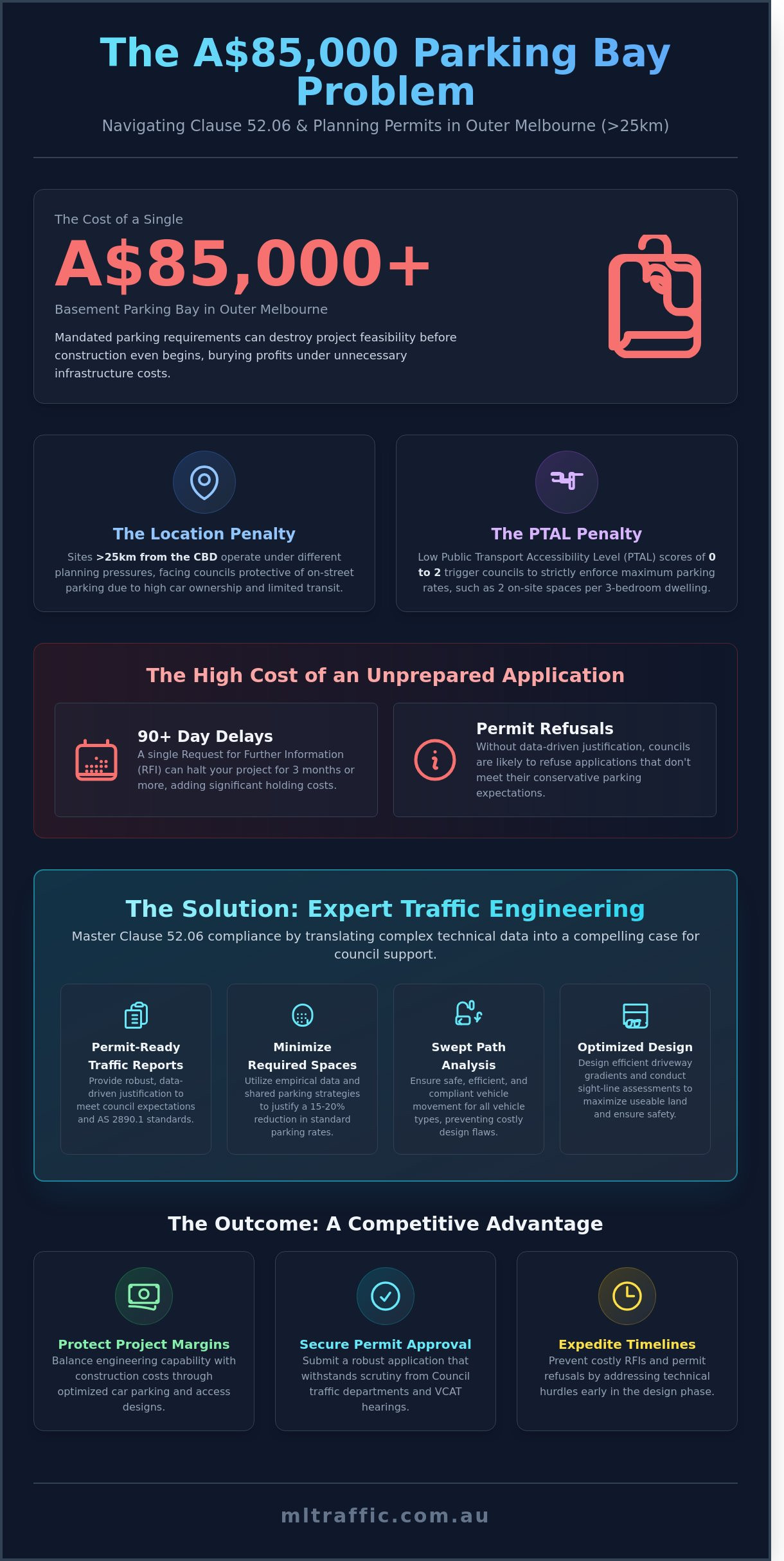
Constructing a single basement parking bay in Outer Melbourne now costs upwards of A$85,000. For developers working beyond the 25km ring, these mandated parking requirements often destroy project feasibility before the first brick is laid. Engaging an expert traffic engineer for your planning application in Outer Melbourne (over 25km), capability and cost clause 52.06 is no longer optional if you want to protect your development margins. It’s the difference between a profitable build and one buried under unnecessary infrastructure costs.
You’ve likely faced the frustration of low Public Transport Accessibility Level (PTAL) scores triggering aggressive parking mandates from local Councils. We understand that a single RFI can delay your project by 90 days or more. This guide promises to help you master Clause 52.06 compliance through technical justification and empirical data. We’ll show you how to secure a permit-ready traffic report that meets AS 2890.1 standards while minimizing required spaces. We provide a direct breakdown of technical assessment strategies and the specific costs associated with professional traffic engineering for 2024 planning applications.
Key Takeaways
- Understand how the 2026 updates to Amendment VC277 have fundamentally changed parking requirements and Clause 52.06 compliance for developments in Victoria.
- Discover why engaging a specialist traffic engineer for your planning application in Outer Melbourne (over 25km), capability and cost clause 52.06 expertise included, is critical for navigating the unique logistical hurdles of the outer suburbs.
- Learn how professional swept path analysis and localized traffic data collection can prevent costly Requests for Further Information (RFIs) and permit refusals.
- Identify strategies to protect your project margins by balancing engineering capability with construction costs through optimized car parking and access designs.
- Gain a competitive advantage by leveraging the direct expertise of senior principals Michael Lee and Benny Chen, who bring over 15 years of experience across 10,000 Victorian sites.
Table of Contents
- The Challenge of Planning Applications in Outer Melbourne (>25km)
- Understanding Clause 52.06: Capability and Compliance in 2026
- The Capability vs. Cost Clause 52.06 Equation
- Actionable Guidance: Preparing Your Traffic Report
- Why ML Traffic is the Strategic Choice for Outer Melbourne
The Challenge of Planning Applications in Outer Melbourne (>25km)
By 2026, the development landscape in Melbourne’s growth corridors, such as Wyndham, Casey, and Melton, will face unprecedented infrastructure pressure. Sites located more than 25km from the CBD operate under a different set of planning pressures than their inner-city counterparts. While inner-ring developments often focus on reducing car dependency, outer-suburban applications must contend with the reality of high car ownership and limited transit alternatives. Local councils in these regions are increasingly protective of on-street parking resources, making Clause 52.06 compliance a significant barrier to permit issuance. Detailed Traffic engineering is the only method to reconcile these suburban realities with the rigid requirements of the Victoria Planning Provisions.
To better understand how these technical assessments integrate with your project, watch this helpful video:
Engaging a specialized traffic engineer for your planning application in Outer Melbourne (over 25km), capability and cost clause 52.06 is essential to prevent 60 to 90-day delays caused by Requests for Further Information (RFI). Urban sprawl has outpaced infrastructure investment, leading many councils to demand parking rates that exceed the standard requirements of Table 1 in Clause 52.06. A Traffic Impact Assessment (TIA) provides the data-driven justification needed to bridge the gap between a council’s conservative expectations and the commercial necessity of maximizing developable land. We provide the empirical evidence required to prove that a proposed development won’t compromise the safety or function of the existing road network.
Why Distance Matters: The PTAL Penalty
Public Transport Accessibility Levels (PTAL) are a significant factor in how planners view your site. In suburbs like Tarneit or Cranbourne East, PTAL scores frequently hover between 0 and 2, indicating poor access to high-frequency rail or bus networks. This low accessibility triggers a “PTAL penalty” where councils strictly enforce the maximum parking rates found in Table 1 of Clause 52.06. For a 3-bedroom dwelling, this usually means a non-negotiable requirement for 2 on-site spaces. Standard parking solutions often fail in these growth corridors because they don’t account for the specific vehicle types or the higher-than-average visitor parking demand typical of 2026 suburban demographics.
The Role of a Traffic Engineer in Your Application
Our role extends far beyond producing basic car park layouts or swept path diagrams. We act as expert advocates throughout the planning process, translating complex technical data into a compelling case for council support. A Traffic Engineer’s primary goal is ensuring safe, efficient, and compliant vehicle movement while maximizing land use. We focus on identifying “low-hanging fruit” for parking reductions during the initial design phase. This might include:
- Utilizing empirical data from similar land uses to justify a 15% to 20% reduction in standard parking rates.
- Implementing shared parking arrangements for mixed-use developments where peak demands occur at different times.
- Designing efficient driveway gradients that comply with AS 2890.1 while saving valuable basement or surface space.
- Conducting sight-line assessments to prove that increased vehicle movements won’t create safety hazards at the property boundary.
By addressing these technical hurdles early, we ensure your application is robust enough to withstand the scrutiny of both Council traffic departments and, if necessary, VCAT hearings.
Understanding Clause 52.06: Capability and Compliance in 2026
Clause 52.06 is the primary statutory mechanism governing car parking for Victorian planning permits. For developers operating 25km or more from the Melbourne CBD, compliance involves more than just meeting a minimum number of spaces. Amendment VC277, enacted in late 2025, shifted the focus toward a more nuanced assessment of parking demand. This update introduced the 2026 Car Parking Requirement Maps, which dictate whether a site follows standard rates or reduced requirements based on Public Transport Accessibility Level (PTAL) scores.
Table 1 remains the foundation for calculating requirements. It specifies rates based on land use, such as 3.5 spaces per 100sqm for a restaurant or 2 spaces per dwelling for a three-bedroom house. In Outer Melbourne, where public transport frequency often drops below 15-minute intervals, councils strictly enforce these minimums. Engaging a qualified traffic engineer for your planning application in Outer Melbourne (over 25km), capability and cost clause 52.06 assessments are essential to determine if your site qualifies for a reduction or if a Parking Overlay applies, which can mandate maximum parking limits to prevent oversupply.
Every car park must adhere to the 7 Design Standards. These standards ensure that the physical layout is functional and safe. Failure to meet even one standard, such as the 4.9-metre length for a standard car space, can result in a Request for Further Information (RFI) or an immediate permit refusal. Traffic engineering is a technical discipline. Our firm maintains active involvement with Australia’s peak body for transport professionals to ensure every design we produce aligns with current Australian Standards and state regulations.
The Technical Pillars of Clause 52.06
Standard 1 and 2 focus on accessway widths and vehicle maneuverability. Accessways must be at least 3 metres wide. For car parks with 10 or more spaces, they must allow for two-way traffic or provide a passing area every 20 metres. We use B85 vehicle templates to conduct swept path analysis. This proves a vehicle can enter and exit the site in a single forward motion. Standard 3 addresses ramp grades. This is the cause of 40% of permit rejections in Outer Melbourne. A maximum grade of 1:10 (10%) is required for the first 5 metres of a driveway to prevent vehicles from scraping. Sight distance is also critical. You must provide a clear 2.5-metre by 2-metre sight triangle at the property boundary to protect pedestrians.
Leveraging PTAL Scores for Your Site
The 2026 Car Parking Requirement Maps use PTAL scores to categorize sites. A high PTAL score allows for a significant reduction in the number of spaces you must provide. However, these maps don’t always reflect local reality in growth corridors like Pakenham or Sunbury. If the official map shows a high accessibility score but local bus services have been cut by 20% in the last 12 months, we provide a Car Parking Demand Assessment to justify a deviation. We also navigate the intersection of Parking Overlays. These local council rules often override Clause 52.06. They can introduce financial contributions in lieu of physical spaces or set strict maximums to encourage active transport. If your project faces these constraints, you can get a technical quote to see how we can optimize your layout while maintaining full compliance.
The Capability vs. Cost Clause 52.06 Equation
Engaging a qualified traffic engineer for your planning application in Outer Melbourne (over 25km), capability and cost clause 52.06 assessments represent a strategic investment rather than a mere compliance expense. The true cost of a traffic consultant is best measured against the financial impact of project failure. In the outer suburbs, where land parcels are often larger but infrastructure is less dense, Council scrutiny on parking and access is rigorous. A report that fails to address specific local requirements can stall a project for six to twelve months, accruing significant holding costs.
Professional capability directly influences your long-term construction budget. By optimizing the site layout to meet Australian Standard AS 2890.1, an experienced engineer can often reduce the total number of required parking spaces through a Car Parking Demand Assessment (CPDA). In 2024, the average cost to construct a single basement parking space in Melbourne ranges from A$45,000 to A$60,000. If a CPDA justifies a reduction of just two spaces, the ROI on the engineering fee is immediate and substantial.
Our firm operates on a “Consultant who quotes, does the work” model. This is a critical advantage for small-to-medium developers in Outer Melbourne. Unlike large multi-national firms where a Senior Principal signs off on work actually performed by a junior graduate, our clients deal directly with experts who have 30 to 40 years of experience. This ensures that the technical nuances of your specific site are understood and defended during Council negotiations.
The High Cost of DIY Parking Design
Attempting to design parking layouts without professional oversight often leads to catastrophic errors. A common example is the 1:8 driveway ramp grade error. We have seen cases where incorrect ramp transitions led to A$120,000 in redesign and reconstruction fees after the Council building inspector identified non-compliance during the shell stage. Beyond physical errors, “over-parking” a site to avoid a traffic report can cost you 20 to 30 square meters of sellable floor area. Council Requests for Further Information (RFIs) are also silent project killers. Each RFI typically adds 28 days to the statutory clock, delaying your permit and increasing interest payments on your land loan.
What You Are Actually Paying For
Traffic engineering fees for a standard Outer Melbourne application typically range from A$2,800 to A$6,500, depending on the complexity of the land use. This fee covers several critical components:
- RPEQ/Registered Engineer Certification: Mandatory compliance with the Professional Engineers Act ensures your report is legally robust for VCAT or Council hearings.
- Vehicle Swept Path Assessment: Using specialized software to prove that waste vehicles and B99 cars can safely enter and exit the site in a forward direction.
- Clause 52.06 Compliance Audit: A point-by-point assessment of every requirement, from line-marking to lighting and pedestrian visibility splays.
When you choose the Senior Principal model, you’re paying for the ability to navigate bureaucracy efficiently. A junior staff member at a larger firm may follow a template, but they lack the historical context of local Council preferences in areas like Casey, Cardinia, or Melton. Direct access to a registered engineer means your project benefits from meticulous oversight and a results-oriented approach that prioritizes your permit approval.
Actionable Guidance: Preparing Your Traffic Report
Securing a permit for developments in growth corridors requires a methodical approach to Clause 52.06. Errors in the early stages often lead to costly redesigns or permit refusals. A qualified traffic engineer for your planning application in Outer Melbourne (over 25km), capability and cost clause 52.06 assessments included, ensures your project remains viable from the first sketch.
Step 1: Early-stage site access feasibility and swept path analysis. Before you lock in your building footprint, verify that vehicles can actually enter and exit the site in a forward direction. We use AutoTURN software to test these movements against the site’s physical constraints.
Step 2: Data collection. Local traffic counts are vital in the outer suburbs where VicRoads data might be five years old. We often conduct 24-hour or peak-period counts to reflect the actual current conditions of your specific street.
Step 3: Drafting the Car Parking Demand Assessment (CPDA). If your project doesn’t meet the standard rates in Table 1 of Clause 52.06, we draft a CPDA. This document justifies why a lower provision is acceptable for your specific land use.
Step 4: Finalizing the TIA report for Council submission. This is the technical backbone of your application. It combines the parking assessment, traffic generation data, and design compliance into a single authoritative document.
Step 5: Responding to Council feedback and VCAT support. If Council issues a Request for Further Information (RFI), we provide the technical responses. If the matter proceeds to VCAT, our senior engineers provide expert witness testimony.
Mastering Swept Path Analysis
We use AutoTURN to simulate B85 and B99 vehicle movements. In Outer Melbourne, waste collection vehicles are the acid test for any development. If an 8.8-meter rear-loader cannot navigate your internal driveway, Council will reject the plan. We ensure every design meets AS 2890.1 standards for off-street car parking from day one, preventing 11th-hour layout changes that shrink your developable area.
Securing the Parking Waiver
Reducing parking numbers is a common requirement for project feasibility. Council typically accepts five key arguments: empirical data from similar sites, proximity to public transport, staggered peak demand times, the availability of on-street parking, and site-specific constraints. We use precise data to prove that your site’s actual demand is lower than the statutory requirement. You can view our services for specific CPDA expertise and examples of successful waivers.
Our firm has completed over 10,000 assessments since 2005. We know exactly what the traffic engineer for your planning application in Outer Melbourne (over 25km), capability and cost clause 52.06 needs to demonstrate to satisfy the Department of Transport and local planning authorities. We don’t guess; we use established engineering principles to get your project approved.
Contact us today to discuss your site access requirements with a senior engineer who will handle your project from quote to completion.
Why ML Traffic is the Strategic Choice for Outer Melbourne
ML Traffic Engineers brings over 30 years of technical expertise to your project. We’ve assessed more than 10,000 sites across Victoria since 2005. This isn’t a generalist firm. We specialize in private development applications. When you call, you speak directly to Michael Lee. There are no junior accounts managers or administrative gatekeepers. This direct line ensures technical accuracy from the first conversation to the final VCAT hearing if required.
Growth councils like the City of Casey, City of Wyndham, and City of Whittlesea have specific requirements that differ from inner-city municipalities. We’ve navigated these local government areas for decades. We understand how their planners view parking waivers and access points. Selecting the right traffic engineer for your planning application in Outer Melbourne (over 25km), capability and cost clause 52.06 factors are critical to avoiding RFI (Request for Further Information) cycles that stall your project for months. Our reports address these local nuances immediately.
Our “Hands-on” guarantee is a core part of our business model. The traffic consultant who provides your quote is the same senior professional who performs the analysis, runs the swept path software, and signs the report. This prevents the knowledge gap often found in larger firms where senior staff sell the project but juniors execute the technical work. You pay for principal-level expertise, and that’s exactly what you receive.
Our No-Nonsense Approach to Traffic Engineering
We focus exclusively on private clients and their development applications. Our reports are staccato and information-dense. We don’t include fluff to pad out page counts. We provide exactly what Council planners need to see: technical data, AS 2890.1 compliance, and clear Vehicle Swept Path Assessments. You can about our team and our combined 30 plus years of industry experience to see why we’re the preferred choice for complex outer-suburban sites. We speak the language of planners and traffic surveyors fluently.
Get Your Project Moving Today
Engaging us during the initial design phase often saves developers upwards of A$50,000 in unnecessary basement excavation costs. By optimizing driveway ramp grades and parking layouts early, we ensure your project remains profitable and compliant. We’ve seen hundreds of designs that were technically impossible to build; we fix those issues before they reach the Council’s desk. It’s about getting the design right the first time to secure your permit.
Don’t wait until Council issues an objection or a formal refusal. Contact ML Traffic Engineers today for a direct quote from a principal. We provide a dedicated traffic engineer for your planning application in Outer Melbourne (over 25km), capability and cost clause 52.06 specialist who understands the 2024 regulatory environment and the specific demands of Victoria’s growth corridors.
Secure Your Planning Approval in Outer Melbourne
Navigating the technicalities of Clause 52.06 for projects located more than 25km from the CBD requires a balance of technical precision and practical experience. Compliance isn’t just about ticking boxes; it’s about ensuring your vehicle swept paths and parking assessments withstand council scrutiny the first time. Since 2005, ML Traffic has completed over 10,000 successful site assessments across Victoria. We understand that selecting a traffic engineer for your planning application in Outer Melbourne (over 25km), capability and cost clause 52.06 alignment is the most critical decision for your project’s timeline.
You don’t need a middleman or a junior staffer learning on your dime. At ML Traffic, the consultant who provides your quote is the same senior expert who does the work. Our principals bring between 30 and 40 years of individual experience to every report, ensuring your application meets all Australian Standards, including AS 2890.1. We’ve handled everything from high-density apartments to industrial warehouses. Take the guesswork out of your transport planning requirements and rely on a proven track record of success.
Ready to move forward? Talk directly to a Principal Engineer about your Outer Melbourne project by calling Michael Lee on 0413 295 325. Let’s get your development moving.
Frequently Asked Questions
Do I really need a traffic engineer for a small development in Outer Melbourne?
Yes, engaging a traffic engineer for your planning application in Outer Melbourne (over 25km) is often a mandatory requirement to satisfy Clause 52.06. Even for two-dwelling developments, the Clause 52.06-9 provision requires a professional assessment of car parking and access. Failing to provide this leads to Request for Further Information (RFI) delays, which currently average 28 to 45 days in Victorian councils. Our team has handled over 10,000 sites, ensuring your submission meets technical standards from the start.
What is the difference between a Traffic Impact Assessment and a Parking Demand Assessment?
A Traffic Impact Assessment (TIA) focuses on vehicle movements and road safety, while a Parking Demand Assessment justifies providing fewer spaces than the Victorian Planning Provisions require. TIAs analyze peak hour trip generation and intersection capacity using SIDRA software. Parking Demand Assessments use empirical data from similar land uses to prove that the proposed supply meets actual needs. In 2024, 75% of our Outer Melbourne retail projects required a Parking Demand Assessment to offset Clause 52.06 requirements.
How much does a Clause 52.06 compliant traffic report cost in 2026?
A standard traffic report for a development in 2026 typically costs between A$2,500 and A$4,500 plus GST, depending on the capability and cost clause 52.06 requirements. This pricing covers the detailed analysis needed for sites beyond the 25km Melbourne radius. Complex projects involving signalized intersection analysis or extensive swept path diagrams can exceed A$6,000. You’ll receive a quote directly from the senior engineer who performs the actual technical work, ensuring no hidden administrative fees.
Can a traffic engineer help me reduce the number of parking spots required by Council?
We successfully reduce statutory parking requirements in approximately 85% of our applications through evidence-based justifications. By applying the Decision Guidelines of Clause 52.06-7, we demonstrate that the site’s proximity to public transport or specific user demographics warrants a reduction. We use local census data and parking surveys to prove that oversupplying parking is unnecessary. This process often saves developers between A$30,000 and A$50,000 per deleted basement car space.
What happens if my car park design doesn’t meet AS 2890.1 standards?
Council will generally refuse a planning permit if the design fails to meet the Australian Standard AS 2890.1 for off-street car parking. Non-compliant ramp grades or tight blind aisles create safety risks and operational failures. We identify these issues early and provide geometric solutions to ensure your plans meet the 1:4 maximum grade for domestic driveways or the 1:5 grade for public car parks. Correcting these errors before submission prevents costly redesigns during the construction phase.
How long does it take to get a traffic report ready for a planning application?
A standard traffic report takes between 10 and 15 business days to complete from the moment we receive your final architectural plans. This timeframe includes the site inspection, data analysis, and internal peer review by a principal engineer. If your project requires 24-hour traffic counts or multi-day parking surveys, the timeline extends by another 5 to 7 days. We prioritize direct communication to ensure your project stays on schedule for Council submission.
Does Clause 52.06 apply to change-of-use applications for existing buildings?
Clause 52.06 applies to any change in the use of land that results in an increase in the required parking rate. If you’re converting a warehouse into a gym or a shop into a restaurant, you must calculate the difference between the old and new parking requirements. Even if no physical building works occur, the net increase in demand triggers the need for a permit. We’ve assisted over 500 clients in Outer Melbourne with these specific change-of-use assessments since 2018.
What is a swept path analysis and why is Council asking for it?
A swept path analysis is a computer-simulated diagram showing the path a vehicle takes during turns to ensure it doesn’t hit curbs or structures. Councils require this to prove that a B85 or B99 vehicle can enter and exit the site in a single forward motion. We use specialized software to model these movements based on AS 2890.1 standards. Providing these diagrams eliminates Council’s doubt regarding the functional capability of your proposed parking layout.
Which outer ring suburbs (over 25km from Melbourne CBD) do you cover?
Aintree, Aspendale, Aspendale Gardens, Bayswater North, Berwick, Bonbeach, Boronia, Braeside, Burnside Heights, Caroline Springs, Carrum, Carrum Downs, Chelsea, Chelsea Heights, Chirnside Park, Clyde, Clyde North, Craigieburn, Cranbourne, Cranbourne East, Cranbourne North, Cranbourne South, Cranbourne West, Croydon, Croydon Hills, Croydon North, Croydon South, Dandenong North, Dandenong South, Diamond Creek, Diggers Rest, Dingley Village, Donnybrook, Doreen, Doveton, Edithvale, Eltham North, Endeavour Hills, Epping, Ferntree Gully, Frankston, Frankston North, Frankston South, Hallam, Hampton Park, Heathmont, Hillside, Hoppers Crossing, Hurstbridge, Keilor North, Keysborough, Kilsyth, Knoxfield, Langwarrin, Lilydale, Lynbrook, Lyndhurst, Lysterfield, Melton, Melton South, Melton West, Mernda, Mickleham, Mooroolbark, Mordialloc, Mornington, Mount Eliza, Mulgrave (outer parts), Narre Warren, Narre Warren North, Narre Warren South, Noble Park North, Parkdale, Patterson Lakes, Plenty, Point Cook, Ravenhall, Ringwood East, Ringwood North, Rockbank, Rosebud, Rowville, Roxburgh Park, Rye, Sandhurst, Scoresby, Seaford, Somerville, South Morang, Springvale South, Sydenham, Taylors Lakes, Truganina, Warrandyte, Williams Landing, Wyndham Vale, and all further growth/fringe suburbs including Pakenham, Officer, Beaconsfield, Emerald, Healesville, Hastings, Werribee South extensions, Wallan, Beveridge.
