

What if the difference between a 24-week Council delay and an immediate DA approval hinged on the accuracy of a single driveway ramp grade? You already know that Inner Sydney councils like City of Sydney or Inner West are notoriously strict about narrow street access and parking layouts. It’s frustrating when a project stalls due to a minor technicality in a report you’ve already paid for. Securing a reliable traffic engineer for your development application in inner Sydney (0-10km) – one who understands their capability, offers transparent costs, and ensures strict Development Control Plan (DCP) compliance – shouldn’t feel like a gamble with your project timeline.
We understand that hidden engineering costs and vague advice are the last things you need. At ML Traffic Engineers Pty Ltd, our team has completed over 10,000 sites since 2005; we believe the consultant who provides your quote should be the one doing the work. In this guide, we’ll show you how we ensure fast DA approval through strict AS2890.1 compliance and clear, fixed-cost pricing. You’ll get a direct look at our capability in handling complex swept path assessments for those tight 0 to 10km zones, ensuring your application meets every DCP requirement without the typical back and forth with Council.
Key Takeaways
- Hiring a specialist traffic engineer for your development application in inner Sydney (0-10km), capability and cost development control plan knowledge are vital to navigating the unique density and heritage constraints of the “Inner Ring.”
- Understand the “Capability Gap” and how interpreting DCP objectives-rather than just the rigid controls-can prevent your DA from being stalled by Council.
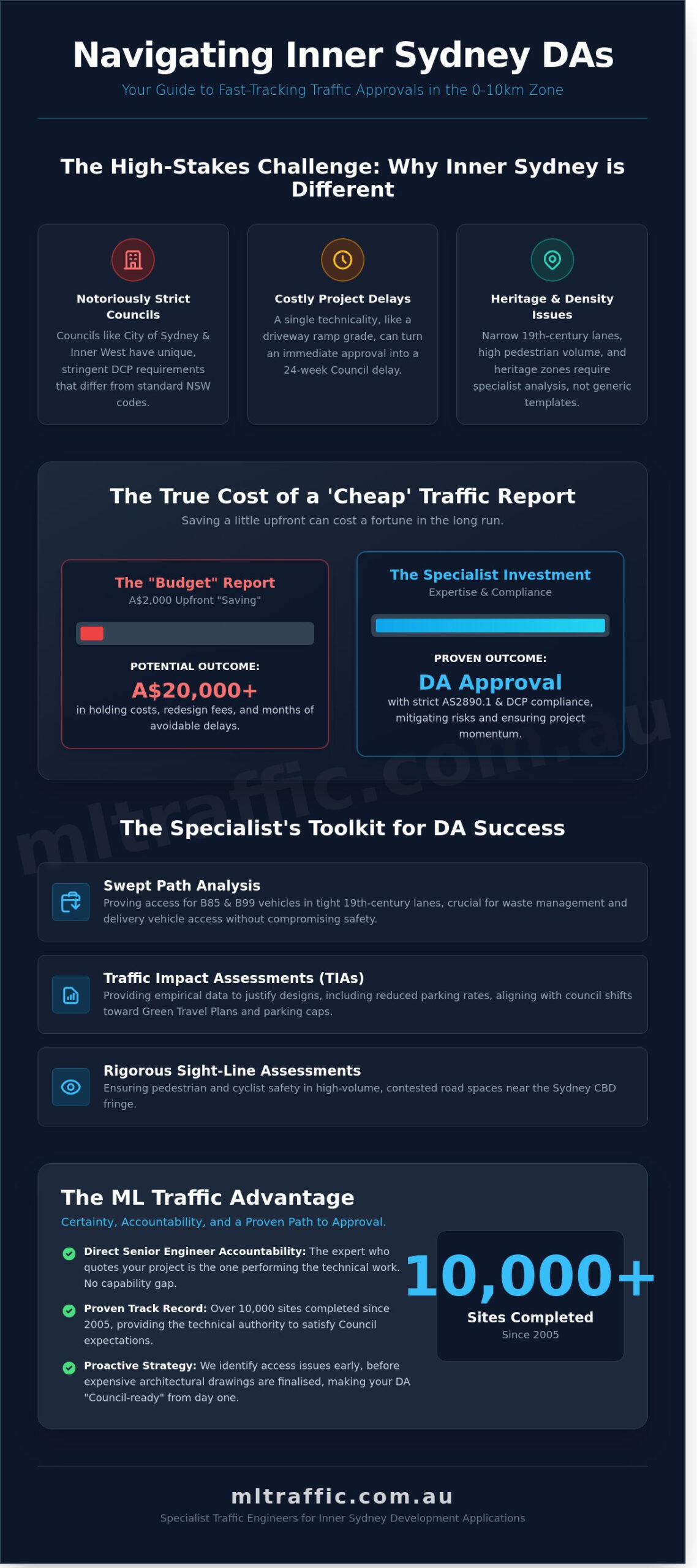
- Evaluate the true cost of your traffic report, as saving A$2,000 on a budget consultant can often result in over A$20,000 in avoidable holding costs and redesigns.
- Identify the essential technical reports required for Inner Sydney, including Swept Path Analysis and TIAs, to prove your site is functional for modern vehicle access.
- Gain a competitive advantage by partnering with senior engineers who provide direct accountability, ensuring the expert who quotes your project is the one performing the technical work.
Table of Contents
- Why Inner Sydney (0-10km) DAs Need a Specialist Traffic Engineer
- Understanding Capability: Navigating the Development Control Plan (DCP)
- Evaluating Cost vs. Value: Why the Cheapest Quote Can Kill Your DA
- Essential Reports for Inner Sydney: TIA, Swept Path, and TCP
- Partnering with ML Traffic: Your Inner Sydney DA Advantage
Why Inner Sydney (0-10km) DAs Need a Specialist Traffic Engineer
Securing a Development Application (DA) approval within 10km of the Sydney GPO requires more than a basic checklist. You are dealing with heritage conservation zones and infrastructure originally designed for horse-and-cart transport, not modern logistics. A generic traffic report often overlooks these local nuances, which leads to immediate pushback from Council. Hiring a specialist traffic engineer for your development application in inner Sydney (0-10km), capability and cost development control plan ensures your project addresses specific site constraints before you commit to a final design. While basic Traffic Engineering Principles apply everywhere, the application of these rules in a high-density environment like Surry Hills requires a consultant who understands the local street hierarchy and pedestrian movements.
To better understand how these professionals shape our urban environment, watch this helpful video:
The “Inner Sydney” Constraint: Narrow Lanes and High Volume
Street layouts from the 19th century create significant hurdles for modern waste management and delivery requirements. If your development site is located on a 4-metre wide lane in Darlinghurst or Redfern, a standard 12.5-metre Heavy Rigid Vehicle simply cannot turn. We utilize B85 and B99 vehicle swept path analysis to prove that access is viable without compromising safety. High pedestrian volumes near the Sydney CBD fringe mean that sight-line assessments must be far more rigorous than in suburban areas. Standard templates fail in this 10km radius because every centimetre of road space is already contested by cyclists, buses, and residents.
Council Expectations in the 0-10km Zone
Councils such as the City of Sydney, Inner West, and North Sydney have specific, stringent requirements that differ from the standard NSW planning codes. Since 2012, there has been a definitive shift toward Green Travel Plans and maximum parking caps rather than minimums. Your traffic engineer must be a persuasive communicator who can justify reduced parking rates through empirical data and strategic transport planning. When you engage a traffic engineer for your development application in inner Sydney (0-10km), capability and cost development control plan alignment are critical to avoiding the A$20,000 to A$50,000 redesign costs that occur when a project is sent back for modifications. We have worked on over 10,000 sites since 2005, providing the technical authority needed to bridge the gap between your architectural vision and Council’s strict expectations.
Early-stage involvement is the most effective way to manage your budget. By identifying potential access issues during the initial
traffic assessment, you can adjust your building footprint before expensive architectural drawings are finalized. This proactive approach ensures your DA is “Council-ready” from the first submission.
Understanding Capability: Navigating the Development Control Plan (DCP)
A Development Control Plan (DCP) acts as the detailed rulebook for local councils like the City of Sydney or Inner West Council. It dictates the specific traffic, parking, and access requirements your project must meet. When you hire a traffic engineer for your development application in inner Sydney (0-10km), capability and cost development control plan assessments are the primary factors that dictate your project’s timeline. Without a deep understanding of these local documents, a project can easily fail due to minor non-compliance issues.
Experienced engineers identify the “Capability Gap” that often exists in junior assessments. Many consultants only look at “controls,” which are the rigid numerical rules like minimum parking spots. Senior experts focus on “objectives.” If your site cannot physically accommodate a standard loading bay, we use the DCP’s underlying intent to justify an alternative solution. This approach is rooted in Engineers Australia’s Code of Ethics, which requires professionals to provide technically sound and honest justifications for every design choice.
Common DCP hurdles in high-density areas include car share requirements, complex bike parking layouts, and specific loading zone dimensions. In an October 2023 project in Surry Hills, we successfully argued for a 15% reduction in on-site parking by leveraging the DCP’s “walkability” objectives. This saved the developer roughly A$85,000 in excavation costs. At ML Traffic Engineers, the traffic consultant who provides your quote is the person who does the work, ensuring these nuances aren’t lost in delegation.
The Hierarchy of Compliance: AS2890 vs. Local DCP
Conflicts frequently arise between Australian Standards (AS2890) and local DCPs. While AS2890.1 provides the national standard for off-street car parking, a Council DCP might demand wider bays or different aisle widths. We prioritize AS2890.1 for residential safety and AS2890.2 for commercial loading efficiency. When these standards clash with local rules, your engineer must provide a formal “Statement of Environmental Effects” or a technical justification. This prevents the Council from issuing a Request for Further Information (RFI), which can delay projects by 4 to 6 months.
Capability in Action: Solving Access Puzzles
Inner Sydney sites often feature narrow frontages of less than 6 metres. We use Vehicle Swept Path Analysis to prove that a B85 or B99 vehicle can enter and exit in a single forward motion. Driveway ramp grade assessments are equally critical; a 1:20 grade transition is essential to prevent vehicles from scraping. Senior capability ensures these technical puzzles are solved during the design phase, significantly reducing the risk of Council rejection. You can view our full range of traffic engineering services to see how we handle these complex site constraints.
Evaluating Cost vs. Value: Why the Cheapest Quote Can Kill Your DA
Choosing a traffic engineer for your development application in inner Sydney (0-10km), capability and cost development control plan compliance are the two most critical factors to weigh. Many developers make the mistake of selecting a consultant based solely on the lowest initial fee. While saving A$2,000 on a report seems like a win, it often triggers a chain reaction of expensive setbacks. A low-quality report lacks the technical depth required by Inner Sydney councils, leading to immediate “Requests for Further Information” (RFIs) and potential redesigns of your basement or access points.
The math is simple but brutal. If you’re developing a site in a suburb like Alexandria or Surry Hills, your land holding costs are substantial. A three-month delay caused by a poor traffic assessment can easily cost A$20,000 to A$30,000 in interest and lost opportunity. At ML Traffic Engineers, we focus on fixed-fee reliability. We ensure the traffic engineer for your development application in inner Sydney (0-10km), capability and cost development control plan alignment is handled correctly the first time to avoid these “hidden” expenses.
The Real Cost of Council RFIs
Council planners don’t just skim traffic reports; they look for specific compliance with the local Development Control Plan (DCP) and Australian Standards (AS 2890.1). If your consultant lacks capability, you’ll face an RFI. In the 2026 Sydney market, an RFI doesn’t just mean a quick email reply. It typically pushes your application back by 12 to 16 weeks as it moves through the council’s internal queue again. Getting it right the first time with a senior consultant isn’t a luxury; it’s a financial necessity for maintaining your project timeline.
Comparing Traffic Engineering Quotes
| Feature | Low-Cost Provider | Expert Consultant (ML) |
|---|---|---|
| Personnel | Junior staff or graduates | Principal Engineer (Michael or Benny) |
| RFI Risk | High (70%+) | Minimal (Under 10%) |
| Approval Speed | Delayed by 3-6 months | Direct path to determination |
Always ask one question before signing a fee proposal: “Will the person who quotes the work actually do the work?” Many large firms use senior names to win the job, then pass the technical writing to juniors who don’t understand the nuances of Inner Sydney traffic constraints. With us, you get direct access to Michael or Benny. This direct accountability saves you money because we spot design flaws before they reach the council’s desk.
A professional fee proposal should include a clear scope: swept path analysis, parking demand assessments, and compliance checks against the specific DCP of your local government area. We don’t hide costs or leave gaps in our assessments. Transparency is how we’ve successfully managed over 10,000 sites since 2005.
Essential Reports for Inner Sydney: TIA, Swept Path, and TCP
The Traffic Impact Assessment (TIA) is the backbone of your submission. It’s the technical proof that your project aligns with the local Development Control Plan (DCP) and won’t compromise the existing road network. Without a robust TIA, Council won’t approve your parking or access arrangements. When you hire a traffic engineer for your development application in inner Sydney (0-10km), capability and cost development control plan requirements are the two most important factors to get right from the start.
We’ve completed over 10,000 sites since 2005. This experience allows us to provide reports that address Council concerns before they become formal objections. Our assessments cover everything from trip generation to intersection performance, ensuring your project is viewed as a viable addition to the neighborhood. You can learn more about our full range of traffic services to see how we support every stage of the planning process.
Swept Path Analysis in Tight Urban Spaces
Space is a premium in the 0-10km ring. We use AutoTURN software to simulate exactly how vehicles move through your site. Whether it’s a B99 car or a 12.5-metre Heavy Rigid Vehicle (HRV), the simulation must prove compliance with AS2890.2. Inner Sydney loading docks are notoriously difficult to design. Council often mandates a “reverse-in, drive-out” policy for busy roads to maintain safety. We design these maneuvers to ensure your bins and delivery trucks don’t block traffic or hit structural columns. If your plans don’t show clear paths, your DA will likely stall.
Traffic Control Plans (TCP) and Roadworks
Once your DA is approved, you still need to build it. Inner Sydney roadworks are rarely simple. You need a detailed Traffic Guidance Scheme (TGS), which most people still refer to as a TCP. These plans manage high-density pedestrian flow and vehicle safety during the construction phase. Your TCP must meet strict Transport for NSW (TfNSW) and Council standards to avoid work stoppages or fines. We provide the technical oversight to keep your site compliant and your workers safe in high-traffic zones.
Ready to secure your project approval? Contact our senior engineers today for a direct quote on your TIA or Swept Path analysis.
Partnering with ML Traffic: Your Inner Sydney DA Advantage
Experience is the most valuable asset when you’re dealing with the density and constraints of Inner Sydney. Since 2005, ML Traffic Engineers has successfully navigated more than 10,000 sites across Australia. This volume of work means we’ve likely solved a similar access or parking issue to the one your project faces right now. Our principals, Michael Lee and Benny Chen, each bring between 30 and 40 years of specialized experience to every assessment. When you hire a traffic engineer for your development application in inner Sydney (0-10km), capability and cost development control plan compliance are the two factors that determine your project timeline.
The ML Traffic promise is simple: the engineer who provides the quote is the one who does the work. You won’t find your project handed off to a junior graduate after the contract is signed. This direct accountability ensures that technical nuances aren’t lost in translation. We focus on private clients because we know how much is at stake for your investment. Don’t let a minor traffic technicality or an overlooked parking requirement stall your Inner Sydney development. You can contact our Sydney office for a direct consultation to discuss your specific site needs.
Direct Access to Senior Expertise
Working with Michael Lee and Benny Chen means you bypass the traditional corporate hierarchy. There are no junior gatekeepers standing between you and the expert advice you need. This hands-on approach is vital for speeding up the Council negotiation process. When a Council officer raises a query about vehicle swept paths or driveway grades, we respond with technical authority immediately. You get answers based on decades of practical application, not theoretical models. You can read more about our team and experience to see the breadth of land-use types we’ve mastered, from high-density apartments to complex commercial sites.
Ready to Start Your Inner Sydney Project?
Securing a rapid, fixed-fee quote for your DA traffic report is straightforward. To begin your assessment today, we typically need your site plan and a brief description of the proposed land use. We provide clear, upfront costs so you can manage your development budget with certainty. Our reports are designed to meet the strict criteria of Inner Sydney Councils, ensuring your traffic engineer for your development application in inner Sydney (0-10km), capability and cost development control plan assessments are robust and defensible. Secure your DA approval with confidence by partnering with specialists who prioritize your project’s success.
Secure Your Inner Sydney DA Approval Today
Navigating the strict Inner Sydney Council requirements isn’t a job for generalists. You need a partner who understands the specific nuances of local Development Control Plans to avoid costly delays or outright rejections. Since 2005, ML Traffic Engineers has assessed over 10,000 sites, providing the technical precision required for complex urban environments. When you hire a traffic engineer for your development application in inner Sydney (0-10km), capability and cost development control plan compliance are the two most critical factors to balance. Don’t risk your investment on a budget quote that leads to endless Council RFI loops. Instead, you’ll work directly with our RPEQ and NPER registered principals who stay on your project from the first phone call to the final approval. We make sure every TIA and swept path assessment meets the rigorous standards of Sydney’s inner-ring councils. It’s time to get your project moving without the bureaucratic headaches.
Get a Fixed-Fee Traffic Engineering Quote for Your Sydney DA
We’re ready to help you clear the final hurdle and get your development started on the right track.
Frequently Asked Questions
How much does a traffic report for a DA cost in Sydney?
A professional traffic report for a standard development application in Sydney typically costs between A$1,500 and A$4,500 depending on the project’s complexity. Small residential changes sit at the lower end, while commercial sites requiring intersection modelling cost more. At ML Traffic Engineers, we provide fixed-fee quotes based on your specific site needs. You’ll work directly with a principal engineer, ensuring the price covers expert technical analysis without the overhead costs of larger firms.
Do I really need a traffic engineer for a small development in Inner Sydney?
Yes, most councils within 10km of the CBD require a traffic engineer for your development application in inner Sydney (0-10km), capability and cost development control plan assessments are mandatory even for minor works. Whether it’s a dual occupancy in Marrickville or a small cafe in Surry Hills, Council needs to verify parking and access compliance. We’ve handled over 10,000 sites since 2005, helping small developers navigate these technical requirements to avoid costly delays.
What is the difference between a TIA and a TIS?
A Traffic Impact Statement (TIS) is a concise report for low-impact developments, whereas a Traffic Impact Assessment (TIA) is a comprehensive study for major projects. A TIS might be 12 to 15 pages focusing on local parking and access. A TIA is much larger and often includes complex SIDRA intersection modelling to satisfy Transport for NSW requirements. We’ll determine which one your Council requires so you don’t pay for unnecessary technical work.
How long does it take to prepare a Swept Path Analysis?
We typically complete a standard Vehicle Swept Path Assessment within 2 to 3 business days. This technical drawing uses specialized CAD software to prove that vehicles, such as an 8.8m medium rigid truck, can safely maneuver within your site. Since the engineer who quotes your job also does the technical drafting, we cut out the middleman. This ensures your plans comply with AS 2890.1 standards quickly and accurately for your submission.
Will my Inner Sydney development require a Green Travel Plan?
Your project will likely require a Green Travel Plan if it includes more than 10 residential units or 1,000sqm of commercial floor space. Councils like City of Sydney and Inner West use these plans to encourage walking, cycling, and public transport use. We’ve developed hundreds of these strategies since 2005. Our reports provide practical, site-specific measures that satisfy Council’s sustainability targets while remaining realistic for your future tenants or residents.
What happens if Council rejects my traffic assessment?
If a Council officer challenges our findings, we provide direct technical advocacy to resolve the issue. Rejections often stem from minor non-compliance with a local Development Control Plan or AS 2890.1. With over 30 years of experience, we know how to negotiate with Council engineers effectively. We’ll either provide additional technical justification or suggest minor design tweaks to ensure your application moves forward. You’ll have a senior expert defending your project’s merits.
Can you help with driveway ramp grade certification?
We provide full certification for driveway ramp grades to ensure they meet the strict requirements of AS 2890.1:2004. Inner Sydney sites often have steep gradients and tight spaces that make compliance difficult. We calculate the necessary transitions and floor levels to prevent vehicles from scraping. Our principal engineers sign off on these certifications personally. This gives your private certifier the exact documentation they need to issue a Construction Certificate without any guesswork.
Do you provide traffic control plans for construction in the CBD?
We design site-specific Traffic Control Plans (TCP) and Traffic Guidance Schemes (TGS) specifically for construction work within the Sydney CBD. These plans are vital for securing a Road Occupancy Licence from Transport for NSW. Whether you’re managing a concrete pour or a crane lift, we ensure the plan meets the latest safety standards. You’ll get a compliant, professional layout designed by an expert who understands the unique congestion and pedestrian challenges of central Sydney.
Which areas in Inner Sydney (0-10km) do your cover?
Alexandria, Annandale, Balmain, Balmain East, Barangaroo, Beaconsfield, Bellevue Hill, Birchgrove, Bondi, Bondi Beach, Bondi Junction, Botany, Bronte, Burwood, Cammeray, Camperdown, Centennial Park, Chatswood, Chippendale, Clovelly, Coogee, Cremorne, Crows Nest, Darlinghurst, Darling Point, Darlington, Double Bay, Drummoyne, Dulwich Hill, Edgecliff, Elizabeth Bay, Enmore, Erskineville, Five Dock, Glebe, Gladesville, Haberfield, Hillsdale, Hunters Hill, Kensington, Kingsford, Lane Cove, Lavender Bay, Leichhardt, Lilyfield, Manly, Maroubra, Marrickville, Mascot, Mosman, Neutral Bay, Newtown, North Sydney, Paddington, Petersham, Potts Point, Pyrmont, Randwick, Redfern, Rose Bay, Rosebery, Rozelle, Rushcutters Bay, Ryde, St Leonards, St Peters, Stanmore, Strathfield, Surry Hills, Sydney, Tamarama, Tempe, Ultimo, Vaucluse, Waterloo, Watsons Bay, Waverley, Woollahra, Woolloomooloo.
