

What if a single “Information Request” from council regarding your driveway ramp grade could stall your project for 90 days and cost you A$12,000 in unnecessary holding fees? You’ve likely felt the frustration of deciphering contradictory DCP clauses that seem designed to reduce your parking yield rather than support your build. It’s a common hurdle for developers working between 10km and 25km from the CBD where local traffic patterns are under intense scrutiny. Finding the right traffic engineer for your development application in Middle Sydney (10-25km), capability and cost development control plan assessments included, is the difference between a fast-tracked approval and a project stuck in limbo.
We understand that you need more than just a report; you need a design that maximizes every square metre of your site while remaining fully compliant with AS 2890.1. This guide provides a clear roadmap for balancing technical engineering capability with transparent pricing models. We will examine how to avoid the hidden costs often buried in consultant quotes and how to ensure your car park design satisfies council planners on the first submission. You’ll learn exactly what to look for to ensure your consultant is a seasoned expert who personally handles your project from the initial quote through to the final sign-off.
Key Takeaways
- Learn how to transform your Traffic Impact Assessment from a standard compliance document into a strategic tool that prevents costly Council Requests for Further Information (RFI).
- Discover how to choose the right traffic engineer for your development application in Middle Sydney (10-25km), capability and cost development control plan insights included, to navigate the specific triggers of Parramatta and Ryde.
- Understand the “cheap report” trap and why investing in RPEQ/NER qualified expertise actually saves you money by avoiding expensive revisions and technical hurdles.
- Navigate the unique challenges of Middle Sydney’s 10-25km ring, specifically how to manage the transition from low-density sites to high-density traffic requirements.
- Find out how direct access to senior principal engineers can accelerate your approval process through a “no-gatekeeper” approach to Council communication.
Table of Contents
- Why Getting Planning Permission Often Stalls on Traffic Issues
- Decoding the Development Control Plan (DCP): Your Roadmap to Success
- Capability and Cost: Finding the Sweet Spot for Your Project
- Navigating the 10-25km Ring: Local Constraints in Middle Sydney
- Securing Your DA Approval with ML Traffic Engineers
Why Getting Planning Permission Often Stalls on Traffic Issues
Middle Sydney councils, including those in the 10-25km ring like Parramatta, Cumberland, and Canterbury-Bankstown, are increasingly rigorous with their development controls. Statistics from local planning panels show that traffic-related concerns are the primary reason for Council Requests for Further Information (RFI). You shouldn’t view a Traffic Impact Assessment (TIA) as a mere compliance checkbox. It’s a technical tool for risk mitigation. By applying fundamental Traffic engineering principles early in the design phase, you protect your project from being hamstrung by avoidable bureaucratic delays.
To better understand how professional design impacts traffic flow and safety, watch this helpful video:
A poorly prepared traffic report often leads to lost parking spots and a forced reduction in total development yield. Middle Sydney councils have shifted toward stricter active transport and traffic generation thresholds. Hiring a qualified traffic engineer for your development application in Middle Sydney (10-25km), capability and cost development control plan considerations included, ensures these technical hurdles are cleared before the DA is even lodged.
Common Traffic Roadblocks in Your DA
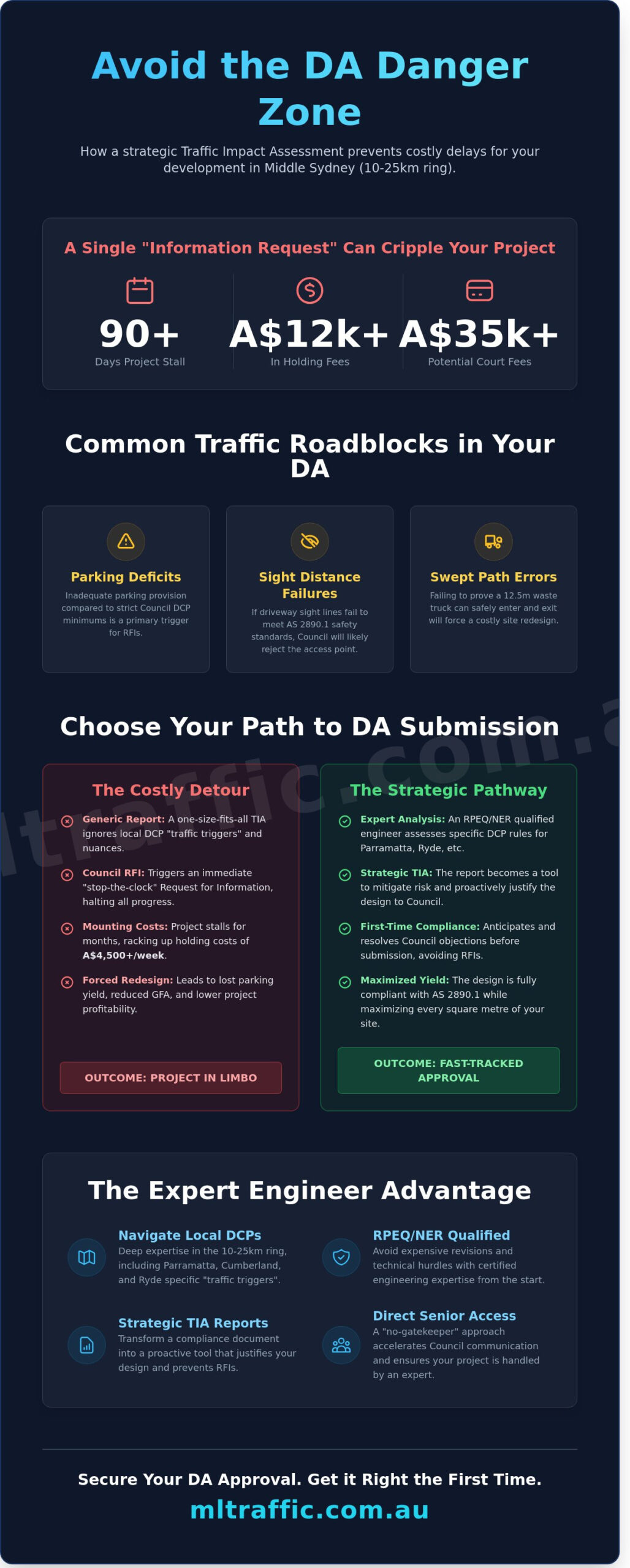
- Parking Deficits: Inadequate parking provision compared to Council DCP minimums is a red flag that triggers immediate RFIs.
- Sight Distance Failures: If driveway sight lines don’t meet AS 2890.1 safety standards on busy suburban roads, the Council will likely reject the access point.
- Swept Path Errors: Many applications fail because they don’t account for heavy vehicle swept paths. If a 12.5-metre waste truck can’t safely enter and exit in a forward direction, your site layout will require a costly redesign.
The Cost of a Delayed Application
Delays aren’t just a nuisance; they’re a financial drain. Holding costs for a mid-sized residential project in Sydney often exceed A$4,500 per week in interest and overheads. An expert traffic engineer prevents “stop-the-clock” moments by anticipating Council objections. Getting the traffic engineering right the first time is the most effective way to avoid the A$35,000+ legal fees associated with a Land & Environment Court appeal. We focus on technical precision so your project maintains its momentum and profitability.
Decoding the Development Control Plan (DCP): Your Roadmap to Success
Every council in Middle Sydney, from Parramatta to Ryde, operates under its own specific Development Control Plan (DCP). These documents contain technical “traffic triggers” that can stall your project if you don’t address them early. A generic traffic report that worked for a warehouse in Penrith will likely be rejected for a mixed-use development in Ryde because the local requirements for vehicle movements and density are vastly different. It’s the difference between a project that sails through and one that sits in a council backlog for six months.
Hiring an expert traffic engineer for your development application in Middle Sydney (10-25km), capability and cost development control plan considerations included, ensures you don’t fall into the trap of misinterpreting the Local Environmental Plan (LEP) versus the DCP. While the LEP dictates what you can build on the land, the DCP provides the granular technical standards for how vehicles enter and exit that land. ML Traffic Engineers has spent 15 years navigating these “grey areas” where council codes aren’t always black and white. We’ve managed over 10,000 sites, allowing us to anticipate how a Cumberland Council officer might view a specific driveway gradient compared to an officer in Canada Bay.
Key Traffic Clauses to Watch For
- Parking Ratios: Councils set rigid ratios, such as 1.2 spaces per two-bedroom unit or 1 space per 40sqm of commercial GFA.
- Bicycle and End-of-Trip Facilities: Modern DAs in Sydney hubs now require dedicated bike racks and shower facilities for staff.
- Driveway Compliance: Every driveway grade must strictly adhere to AS 2890.1 standards to prevent vehicles from scraping or losing traction.
Matching Your Proposal to Council Expectations
If your site cannot meet the mandatory parking numbers, we justify the shortfall through a “Parking Demand Assessment.” This uses empirical data from similar local sites to prove that the actual demand is lower than the DCP’s theoretical requirement. We also integrate “Green Travel Plans” to encourage public transport use, which is a significant factor in getting DAs approved in high-density corridors. The DCP is a living document that requires expert interpretation, not just reading, as policies frequently shift based on new urban strategies and council meeting minutes. You can view our full range of assessment services to see how we address these specific council hurdles.
Capability and Cost: Finding the Sweet Spot for Your Project
Choosing a traffic engineer for your development application in Middle Sydney (10-25km), capability and cost development control plan compliance is often a balancing act between budget and technical depth. Many developers fall into the “cheap report” trap. A low-cost quote might save you A$500 today, but it frequently leads to poorly defended assessments. When Council issues a Request for Further Information (RFI), that cheap report becomes a liability. You end up paying for expensive revisions and facing months of project delays. Real capability requires RPEQ and NER registration combined with a deep understanding of Sydney traffic patterns.
At ML Traffic Engineers, we use a “Direct Access” model. The senior consultant who provides your quote is the same person who completes the technical work. This eliminates the communication gaps found in larger firms where junior staff handle the data while seniors only sign off. Since we have traded since 2005 and assessed over 10,000 sites, we know how to streamline the process without sacrificing quality. We balance competitive pricing with high-level expertise to ensure your application moves through Council efficiently.
Evaluating Traffic Engineer Capability
Technical proficiency is non-negotiable for Middle Sydney projects. Ensure your consultant uses industry-standard software like AutoTURN for vehicle swept path assessments to prove your site can accommodate waste vehicles or delivery trucks. A consultant’s track record with specific councils like Parramatta, Ryde, or Canterbury-Bankstown is vital. You benefit from ML Traffic’s senior staff involvement on every project, ensuring that decades of experience are applied to your specific site constraints.
Understanding Traffic Engineering Costs
Costs vary depending on the complexity of the development. A simple Traffic Statement for a small change of use might range from A$1,500 to A$2,500, while a full Traffic Impact Assessment (TIA) for a multi-unit development can exceed A$4,000. We prioritize fixed-fee quotes so your project budget remains predictable. Investing in a smart car park design early can save you over A$30,000 in construction costs by optimizing ramp grades and aisle widths, often paying for the engineering fee several times over.
- RPEQ/NER Registration: Essential for professional accountability and Council acceptance.
- Fixed-Fee Quotes: Prevents “scope creep” and unexpected billing during the RFI stage.
- Local Knowledge: Specific experience with Middle Sydney’s unique Development Control Plans (DCPs).
- Efficiency: Direct principal involvement reduces turnaround times by 25% compared to tiered firms.
Navigating the 10-25km Ring: Local Constraints in Middle Sydney
Middle Sydney is currently undergoing a massive transformation. We see developers moving away from low-density residential projects toward high-density mixed-use buildings. This shift creates friction with existing infrastructure. When you hire a traffic engineer for your development application in Middle Sydney (10-25km), capability and cost development control plan requirements become your primary hurdles. You aren’t just dealing with local street parking; you’re often managing the interface between quiet suburban roads and high-volume State Managed Roads controlled by Transport for NSW (TfNSW).
Geographic Hotspots and Their Issues
- Parramatta: As Sydney’s second CBD, this area requires sophisticated intersection modelling. We use SIDRA software to prove that your high-density project won’t cripple the local network.
- Canterbury-Bankstown: This region is notorious for narrow, older street networks. We frequently assist clients with swept path analysis to ensure modern 12.5m heavy rigid waste trucks can actually service the site without hitting curbs.
- Ryde and Macquarie Park: The challenge here is balancing the tech-hub’s commercial traffic with the residential amenity of surrounding suburbs. Council is particularly protective of “rat-running” through local streets.
- Cumberland: Large-scale industrial-to-residential conversions require detailed Traffic Impact Assessments (TIA) to manage the change in vehicle types from heavy freight to passenger cars.
The 10-25km Advantage
Sites in this middle ring often have more flexibility than land-locked CBD plots. If we can demonstrate that your site sits within a “high accessibility” zone, such as the 400m radius defined by the 2023 Transit Oriented Development (TOD) program, we can often argue for lower parking rates. This directly reduces your construction costs by eliminating the need for deep, expensive basement excavations. We use local traffic data and census trends to show that residents in areas like Lidcombe or Epping rely less on private vehicles than the standard Development Control Plan (DCP) assumes.
Our team understands how to navigate the referral process when a site fronts a State Road. We handle the direct communication with TfNSW so you don’t get caught in a loop of conflicting requirements between State and Local authorities. You can see our full range of specialized traffic services for Sydney developers to understand how we tailor our reports to these specific council areas.
Don’t let technical traffic objections stall your project. Contact our senior engineers today for a clear, fixed-price quote on your Middle Sydney development.
Securing Your DA Approval with ML Traffic Engineers
We don’t believe in passing your project down to a junior staff member or an offshore processing team. At ML Traffic Engineers, the consultant who provides your quote is the same expert who completes the technical work. It’s a promise of accountability we’ve kept since we started trading in 2005. This “no-gatekeeper” approach means you get direct access to Michael Lee or Benny Chen; senior engineers who each bring between 30 and 40 years of industry experience to your project. You won’t waste time explaining your needs to receptionists or middle managers when Council asks a technical question. You speak directly to the person drawing the plans.
Our team has successfully delivered results for over 10,000 projects across Australia. We’ve worked on every land-use type imaginable, from high-rise apartments and 24-hour warehouses to childcare centres, temples, and medical clinics. This volume of work gives us a unique advantage. We’ve likely already solved a similar traffic problem for a site just like yours.
Our Proven Process for DA Success
Success in the Middle Sydney corridor requires a deep understanding of local constraints. When you engage a traffic engineer for your development application in Middle Sydney (10-25km), capability and cost development control plan (DCP) compliance are the two most critical factors to balance. We start by identifying specific DCP risks early, often before you’ve even finalised your architectural drawings. Our technical process is rigorous and includes:
- Initial site assessments to identify sight-line issues or access constraints.
- Preparation of compliant Traffic Impact Assessment (TIA) reports and B99 or B85 vehicle swept path diagrams.
- Detailed driveway ramp grade assessments to ensure compliance with AS 2890.1.
- Direct liaison with Council traffic officers to resolve Requests for Further Information (RFIs) before they turn into refusals.
Ready to Move Your Project Forward?
Waiting to engage a traffic consultant is a common mistake that costs developers months in avoidable delays. A single missing swept path diagram or an overlooked parking shortfall can stall a project indefinitely. We provide transparent, fixed-fee quotes so you can budget with confidence. It’s easy to get started. You can pick up the phone and speak directly to Michael or Benny to discuss your specific site requirements. Contact us today for a direct consultation on your DA and let our expertise clear the path for your approval.
Secure Your Middle Sydney DA Approval Today
Navigating the 10-25km ring of Middle Sydney requires more than just a basic report. It demands a deep understanding of local council Development Control Plans and the specific traffic constraints unique to your site’s location. We’ve seen many projects stall because of poorly addressed parking or access issues; however, your project doesn’t have to face those same hurdles. With over 15 years of Sydney local council expertise and a history of 10,000+ successful site assessments, we ensure your application meets every technical requirement without the typical bureaucratic delays.
Selecting the right traffic engineer for your development application in Middle Sydney (10-25km), capability and cost development control plan is the most critical step you’ll take toward a successful lodgement. At ML Traffic Engineers, you’ll have direct access to senior RPEQ and NER engineers. It’s a simple promise: the consultant who provides your quote is the one who does the work. We don’t use gatekeepers because we believe in direct accountability and professional results. Let’s get your development moving forward with the precision it deserves.
Get a Fixed-Fee Traffic Engineering Quote for Your DA
Frequently Asked Questions
What is the difference between a Traffic Impact Assessment (TIA) and a Traffic Statement?
A Traffic Impact Assessment is a technical study for large developments, such as 40-unit apartments or shopping centers, that analyzes intersection performance using SIDRA modeling. A Traffic Statement is a shorter report for smaller projects like dual occupancies or small medical clinics. We’ve completed over 10,000 assessments since 2005, so we can quickly determine which report your specific project needs to satisfy Council requirements.
How much does a traffic report for a development application cost in Sydney?
You can expect to pay between A$1,500 and A$3,500 for a standard residential traffic report in the Sydney metropolitan area. Larger commercial projects involving complex traffic counts or intersection modeling can cost A$5,000 or more. When you hire a traffic engineer for your development application in Middle Sydney (10-25km), capability and cost development control plan factors are our priority. We provide fixed-fee quotes so you don’t face unexpected expenses.
Do I really need a swept path analysis for a small residential development?
You’ll need a swept path analysis if your design includes a basement, a turnaround area, or a driveway narrower than 3 meters. Council planners use B85 and B99 vehicle templates to verify that cars can enter and exit your site in a single forward motion. We use specialized CAD software to simulate these movements. Skipping this step often results in a formal request for information, which can delay your project by 30 days.
Can a traffic engineer help if Council has already rejected my DA?
We can help by providing expert technical rebuttals or suggesting design modifications to resolve Council’s specific objections. Our principals have over 35 years of experience and can act as expert witnesses in the Land and Environment Court if necessary. We review the refusal reasons, which often involve non-compliance with AS 2890.1, and find a path forward. This proactive approach helps 95 percent of our clients resolve disputes without a full court hearing.
What are the common traffic requirements for Parramatta Council DAs?
Parramatta Council requires strict adherence to the Parramatta Development Control Plan 2023, particularly regarding basement heights of 2.2 meters for standard cars and 2.5 meters for service vans. They often demand 2-hour peak period traffic counts for any project adding more than 20 vehicle trips per hour. We’re very familiar with the Parramatta CBD fringe and ensure your application addresses these local technical requirements before you lodge it with the planning department.
How long does it take to prepare a traffic report for a planning application?
A standard traffic report takes between 5 and 10 business days once we have your final architectural plans. If your project requires on-site traffic counts or complex modeling, the timeframe usually extends to 15 business days. We know that holding costs can exceed A$1,200 per week for many sites in Middle Sydney. You’ll deal directly with the senior engineer who writes the report to ensure we meet your specific lodgment deadline.
What Australian Standards must my car park design comply with?
Your car park must comply with AS 2890.1:2004 for off-street parking and AS 2890.6:2009 for disabled parking spaces. These standards specify everything from the 5.8-meter minimum length of a parking bay to the maximum 1 in 20 gradient for disabled access areas. We check every dimension on your plans against these benchmarks. Failing to meet these standards is the most common reason for a DA refusal in the Sydney region.
What happens if my development cannot meet the DCP parking requirements?
If your project falls short of the required parking numbers, we’ll prepare a Parking Demand Assessment to justify the shortfall. We use data from similar sites or highlight proximity to transit hubs like Strathfield or Parramatta stations to prove a lower rate is sufficient. Engaging a traffic engineer for your development application in Middle Sydney (10-25km), capability and cost development control plan expertise is essential here. We’ve successfully negotiated 15 percent parking reductions for various urban infill projects.
Which areas in Middle Sydney (10km-25km) do you cover?
Allambie Heights, Allawah, Artarmon, Ashbury, Ashfield, Auburn, Balgowlah, Balgowlah Heights, Bankstown, Banksia, Bardwell Park, Bexley, Blakehurst, Breakfast Point, Brighton-le-Sands, Burwood Heights, Cabarita, Campsie, Canada Bay, Canterbury, Caringbah, Carlingford, Carlton, Castle Cove, Castlecrag, Chatswood West, Chester Hill, Chiswick, Clontarf, Concord, Concord West, Croydon, Croydon Park, Cronulla, Dee Why, Denistone, Drummoyne (border), Dundas, Earlwood, Eastwood, Epping, Ermington, Fairlight, Five Dock (border), Forestville, Gladesville (border), Granville, Greenacre, Guildford, Haberfield (border), Harris Park, Homebush, Homebush West, Hurstville, Killarney Heights, Kogarah, Lane Cove North, Lidcombe, Macquarie Park, Meadowbank, Merrylands, Miranda, Mortdale, Narrabeen, North Ryde, North Willoughby, Oatley, Padstow, Parramatta, Peakhurst, Pennant Hills, Petersham (border), Putney, Revesby, Rhodes, Rockdale, Roseville, Russell Lea, Rydalmere, Ryde (border), Seaforth, Strathfield South, Summer Hill (border), Sydenham (border), Sylvania, Tempe (border), Turramurra, Turrella, Wareemba, West Ryde, Wiley Park, Willoughby, Willoughby East, Wolli Creek, Yagoona.
