
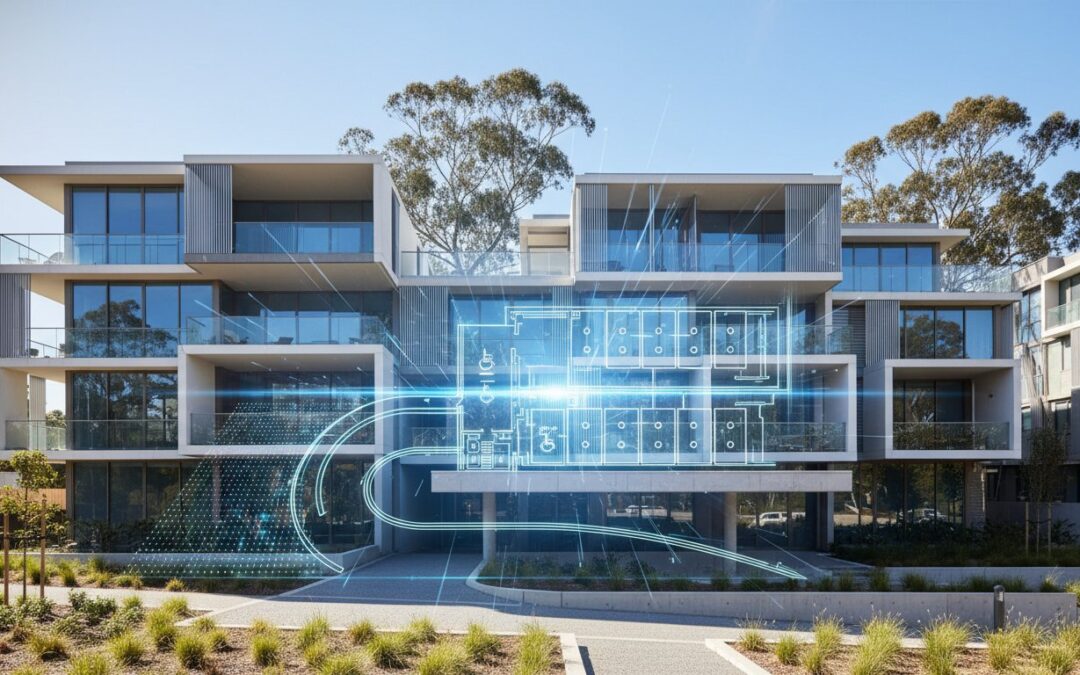
What if a minor 3% miscalculation in your driveway ramp grade added A$50,000 in holding costs to your Campbelltown development project? You’re likely already aware that councils like The Hills and Camden have tightened their grip on parking compliance, leaving little room for error. It’s frustrating to watch your application stall because of technicalities that feel designed to slow you down. When seeking a traffic engineer for your development application in Outer Sydney (over 25km), ensuring their capability and understanding of cost-effective development control plan compliance are paramount for your submission’s success. At ML Traffic Engineers Pty Ltd, we’ve spent the last 19 years ensuring private clients don’t get trapped in these bureaucratic bottlenecks. This guide provides a clear roadmap to navigating AS2890.1 and Outer Sydney DCPs without sacrificing project profitability. We’ll examine how to maximize your car park yield and explain why direct access to the senior engineer who actually writes your report is the only way to ensure a seamless approval in 2026.
Key Takeaways
-
Discover why developments located more than 25km from the Sydney CBD require a specialized approach to traffic planning to navigate lower-density infrastructure and unique local council expectations.
-
Master the latest 2026 interpretations of AS2890.1 to ensure your car parking design meets rigorous safety and accessibility standards, avoiding common compliance rejections.
-
Learn how an expert traffic engineer for your development application in Outer Sydney (over 25km), capability and cost development control plan specialist can help you challenge unfair infrastructure demands and keep your project budget on track.
-
Identify and resolve critical bottlenecks like vehicle swept path failures and sight-line issues early in the design phase to prevent your application from stalling at the council level.
-
Streamline your approval process by leveraging over 15 years of technical expertise and direct principal-level accountability to meet the specific commercial pressures of private developers.
Table of Contents
-
Why You Need a Traffic Engineer for Your Outer Sydney Development Application
-
Mastering AS2890.1: The Parking Standard Your DA Can’t Ignore
-
Navigating Capability and Cost in Your Development Control Plan (DCP)
-
Securing Approval: How ML Traffic Engineers Streamline Your Project
Why You Need a Traffic Engineer for Your Outer Sydney Development Application
Securing a 2026 Development Application (DA) approval requires more than just a basic site plan. It’s about proving your project won’t break the local road network. When you engage a traffic engineer for your development application in Outer Sydney (over 25km), capability and cost development control plan factors become your primary hurdles. Councils now demand rigorous data to back every driveway and parking spot. If your report is thin, you’ll face expensive Requests for Further Information (RFIs) that stall your project for months. Professional Traffic engineering reporting protects your ROI by ensuring site access is safe, efficient, and compliant from day one.
To better understand the technical precision required for modern road design, watch this helpful video:
The Geographic Shift: Developing in Greater Western Sydney
Developing in areas like Penrith, Blacktown, or Liverpool isn’t the same as working in the CBD. These high-growth corridors have unique infrastructure pressures. A one-size-fits-all approach fails here because the road hierarchy is different. You’ll often deal with classified roads where Transport for NSW (TfNSW) has the final say. We use our local knowledge to negotiate these specific expectations. Since 2005, we’ve seen how local councils prioritize heavy vehicle movements and commuter flow differently than inner-city planners do. Our expertise ensures your project aligns with these specific regional requirements.
What Does a Traffic Engineer Actually Provide?
We deliver the technical evidence required for your Statement of Environmental Effects. This starts with a Traffic Impact Assessment (TIA) that analyzes how many trips your site will generate. We translate complex data into a persuasive narrative for council planners. For industrial or multi-deck residential projects, we provide specific technical proofs:
-
Vehicle Swept Path Analysis: Digital simulations to prove trucks and cars can turn safely within your boundaries.
-
Parking Demand Assessments: Justifying your parking numbers to avoid over-engineering or under-providing.
-
Sight-Line Assessments: Ensuring every vehicle exiting your site has a clear, safe view of oncoming traffic.
Our senior engineers handle every detail. The consultant who provides your quote is the one doing the technical work. This direct accountability ensures no details are lost in a junior’s hands, which is vital for meeting the traffic engineer for your development application in Outer Sydney (over 25km), capability and cost development control plan criteria effectively.
Mastering AS2890.1: The Parking Standard Your DA Can’t Ignore
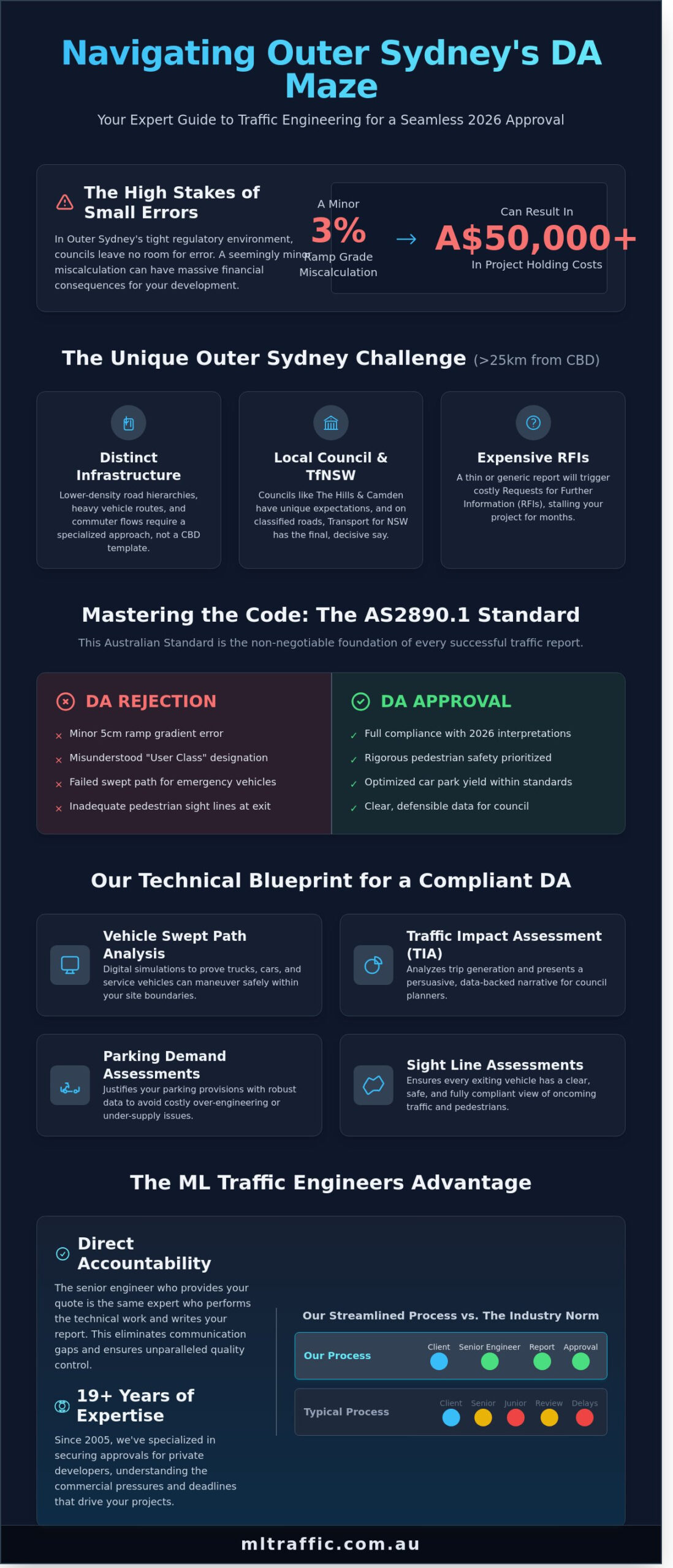
AS2890.1 isn’t just a technical manual; it’s the non-negotiable foundation of every successful traffic report we produce. In 2026, the interpretation of this Australian Standard for off-street parking has shifted to prioritize rigorous pedestrian safety and vehicle accessibility. If you’re engaging a traffic engineer for your development application in Outer Sydney (over 25km), capability and cost development control plan alignment is the primary factor that prevents a refusal. Even a minor 5cm error in a driveway ramp gradient or a misunderstood "User Class" can trigger a total DA rejection, forcing a project back to the drawing board. We work to find the precise balance between meeting these rigid safety benchmarks and protecting the maximum yield for your development.
Key Compliance Areas for Outer Sydney Sites
Precision is mandatory when applying AS2890.1 to larger Outer Sydney allotments. We focus on three critical areas to ensure your plans pass council scrutiny the first time:
-
User Class Identification: We determine if your site falls under Class 1 (residential), Class 2 (staff), or Class 3 (short-term retail). A Class 3 space requires a width of 2.6 metres or 2.7 metres, whereas a Class 1 space can be 2.4 metres. Getting this wrong at the start can cost you several parking spots.
-
Driveway Ramp Grades: To avoid the "scrape" of low-clearance vehicles, we calculate longitudinal profiles using 1:8 or 1:4 gradients with necessary transitions. A 1% error here is enough to fail a compliance check.
-
Sight Distance: We verify the 2.0m x 2.5m splay at the property boundary. This is a non-negotiable safety check that ensures drivers can see pedestrians before crossing the footpath.
Integrating AS2890.1 with Local DCPs
Local councils in Outer Sydney often have Development Control Plans (DCPs) that are more restrictive than the national standard. When a local DCP requires a wider driveway or more generous turning circles than AS2890.1, the council rule usually takes precedence. We navigate these overlapping regulations by applying the "Capability and Cost" provisions found in modern planning instruments, ensuring your infrastructure is both compliant and economically viable. AS2890.1 acts as the technical floor for parking design in 2026. For a detailed look at how we manage these complex requirements for our clients, you can view our full range of traffic engineering services.
Our approach ensures that your design doesn’t just look good on paper but functions perfectly in the real world. We provide the technical certainty needed to satisfy both the Australian Standards and the specific demands of Outer Sydney planning authorities.
Navigating Capability and Cost in Your Development Control Plan (DCP)
Understanding the balance between infrastructure capability and project cost is vital for any project located more than 25km from the Sydney CBD. In these growth corridors, capability refers to the residual capacity of the existing road network to absorb new vehicle trips without dropping the Level of Service (LoS) below acceptable thresholds. When you engage a traffic engineer for your development application in Outer Sydney (over 25km), capability and cost development control plan assessments are the most critical documents you’ll submit to prove your site won’t cause gridlock.
Outer Sydney councils, such as Penrith, The Hills, and Camden, are increasingly protective of their long-term maintenance budgets. They often push for high-spec traffic treatments to minimize their future repair costs. A skilled traffic engineer protects your bottom line by ensuring you aren’t forced to pay for "gold-plated" infrastructure that exceeds the actual impact of your development. We focus on presenting data-backed solutions that meet technical capability requirements without unnecessary expenditure.
The Developer’s Dilemma: Quality vs. Expense
Many developers face "gold-plating" where councils demand signalized intersections or extensive road widening for small-to-medium projects. We push back against these demands using hard data and SIDRA modeling. By optimizing your Car Park Design, we often prove that a more efficient internal layout reduces the need for external road works. Our principal-led reports carry weight with council officers because they’re backed by decades of experience. When the person who quotes the job also does the work, you get a level of technical accountability that prevents expensive over-engineering.
Case Studies: Outer Sydney DCP Wins
Our firm has a proven track record of navigating restrictive DCPs across Western Sydney. Here are two recent examples of how technical expertise translates to cost savings:
-
Blacktown Industrial Hub: A developer faced a restrictive parking rate that would have cost A$120,000 in additional pavement. We conducted empirical parking surveys at similar sites and successfully negotiated a 22% reduction in required spaces, saving the client significant construction capital.
-
Campbelltown Residential: Council requested a complex median strip to manage right-turn movements. Through a detailed Sight-Line Assessment and swept path analysis, we proved a standard driveway was safe, saving the client A$45,000 in civil works.
Empirical data is your best defense against arbitrary council demands. By using site-specific surveys rather than generic DCP rates, we often find that the actual parking demand is lower than what the book suggests. This approach doesn’t just pass the "capability" test; it ensures your project remains financially viable in a competitive market.
Common Traffic Engineering Bottlenecks in Outer Sydney
Developments in Outer Sydney face specific technical hurdles that frequently lead to DA delays or refusals. The "Swept Path" trap is the most frequent culprit. If an 8.8m medium rigid vehicle or a 12.5m heavy rigid vehicle cannot safely enter, turn, and exit the site in a forward direction, Council will likely reject the plans. This is a critical failure point for childcare centres and industrial warehouses where service vehicle access is mandatory. Many developers overlook the fact that a garbage truck requires a much wider turning circle than a standard SUV.
Inadequate sight lines also stall many approvals. Existing street trees or neighbouring boundary walls often obstruct the 2.0m by 2.5m pedestrian visibility splays required by AS 2890.1. If your driveway placement doesn’t account for these fixed objects, you’ll face costly redesigns. Additionally, the "Work Zone" challenge is significant in growth corridors. Narrow local roads in new estates make it difficult to stage construction traffic without a detailed Traffic Management Plan (TMP) that accounts for heavy vehicle movements in constrained spaces.
The "25km+ factor" is a unique geographical bottleneck. Because public transport frequency often drops significantly once you are over 25km from the CBD, car dependency remains high. Your traffic engineer for your development application in Outer Sydney (over 25km), capability and cost development control plan must prove that parking provision is sufficient. Failing to account for this higher demand can lead to Council concerns regarding overspill parking on local streets.
Step-by-Step: Avoiding Technical Objections
-
Engage a traffic engineer during the concept design phase. Fixing a driveway grade or a turning circle is simple on a sketch but expensive on finished architectural plans.
-
Perform a preliminary swept path analysis for the largest vehicle expected on site, such as a 12.5m heavy rigid vehicle for industrial sites.
-
Review the specific "Traffic and Transport" chapter of the local Council’s DCP. Every Council has different requirements for parking rates and driveway widths that must be addressed before finalising layouts.
The Role of Senior Oversight
Having a senior engineer oversee your report prevents rookie mistakes like miscalculating ramp grades or ignoring sight-line obstructions. At ML Traffic, our principals, Michael Lee and Benny Chen, bring over 30 years of experience to every project. This level of expertise ensures your report meets the rigorous standards of Australian Standards and local government requirements. Our "quote-to-work" promise ensures the expert you hire is the one actually performing the technical analysis. The traffic consultant who provides the quote, does the work; this philosophy ensures technical accountability for every complex Outer Sydney DA we handle.
Need a reliable assessment for your project? View our full range of traffic engineering services to see how we can help your DA succeed.
Securing Approval: How ML Traffic Engineers Streamline Your Project
Since 2005, ML Traffic Engineers Pty Ltd has navigated the complex landscape of NSW local councils to secure approvals for our clients. We understand that for a private developer, time is money. Our team focuses on the commercial realities of your project; we don’t just provide a report, we provide a pathway to approval. When you hire a traffic engineer for your development application in Outer Sydney (over 25km), capability and cost development control plan compliance are usually your primary concerns. We address these by ensuring every Traffic Impact Statement (TIS) or Parking Assessment meets the specific DCP requirements of your LGA, whether that is Camden, Penrith, or The Hills.
You won’t be passed off to a junior staff member. Michael Lee and Benny Chen lead every project personally. This principal-led approach means you have direct access to over 70 years of combined experience. The traffic consultant who provides your quote is the one performing the technical work. This direct accountability removes the friction often found in larger firms and ensures your project stays on track.
The ML Traffic Engineers Pty Ltd Advantage in Outer Sydney
Our experience spans over 10,000 sites across New South Wales. We have handled a vast range of land uses including childcare centres, medical clinics, boarding houses, gyms, service stations, and large-scale industrial warehouses. We use the latest AutoTURN software to generate precise Swept Path Analysis. This ensures your site layout works for the intended design vehicle, from a B-double to a simple delivery van. You can learn more about our experienced team and how we have spent decades mastering the technicalities of AS 2890.1 to ensure your project is compliant and functional.
Ready to Move Your Project Forward?
Traffic engineering shouldn’t be the bottleneck in your 2026 development schedule. Delays in the DA process can cost thousands in holding charges and lost opportunities. We provide rapid, expert assessments that stand up to council scrutiny and minimize the risk of costly RFIs. Contact us today to speak directly with a senior engineer about your site’s specific challenges. Get a Professional Traffic Quote and secure the expertise your project deserves to move from the drawing board to construction.
Secure Your Outer Sydney DA Approval with Expert Engineering
Navigating the technicalities of AS2890.1 and site-specific DCP requirements shouldn’t stall your project. Whether you’re managing a warehouse in Penrith or a multi-unit development in Camden, selecting a qualified traffic engineer for your development application in Outer Sydney (over 25km), capability and cost development control plan is the most effective way to bypass Council bottlenecks. We’ve assessed over 10,000 sites across Australia, ensuring every vehicle swept path and parking demand assessment meets strict regulatory standards from the start.
You don’t need to deal with junior staff or layers of bureaucracy. At ML Traffic Engineers, you get direct access to our principals, Michael Lee and Benny Chen. They are Registered Professional Engineers (RPEQ/NSW) with over 30 years of experience each. We’ve been trading since 2005 and understand exactly how to balance technical compliance with project feasibility. Our hands-on approach ensures the consultant who quotes your work is the one who actually completes it. Contact the Senior Traffic Engineers at ML Traffic for Your Outer Sydney Project. Your project is in capable hands, and we’re ready to help you move forward with confidence.
Frequently Asked Questions
When is a Traffic Impact Assessment (TIA) required for an Outer Sydney DA?
You’ll need a TIA when your project exceeds the traffic generation thresholds set by the Transport for NSW Guide or the local council DCP. For a commercial site over 1,000sqm or a large residential flat building, you must hire a traffic engineer for your development application in Outer Sydney (over 25km), capability and cost development control plan experts to ensure compliance. Most councils in the West require these assessments for any development that significantly alters local traffic flow.
What is the difference between AS2890.1 and a local council DCP?
AS2890.1 is the national Australian Standard for off-street car parking, focusing on technical geometry like stall widths and ramp grades. A Development Control Plan (DCP) is a local government document that dictates the quantity of spaces required for your specific land use. If your DCP requires 20 spaces but your layout doesn’t follow AS2890.1 dimensions, council will likely refuse your application. We ensure your design satisfies both the technical standards and the local planning rules.
How much does a traffic engineer cost for a standard residential development?
You can expect to pay between A$1,500 and A$3,500 for a standard residential traffic report in Outer Sydney. This range covers a basic Traffic Impact Statement for a dual occupancy or small townhouse project. More complex sites requiring intersection modelling or extensive swept path analysis will see fees increase toward A$5,000 or more. At our firm, the traffic consultant who provides the quote is the same expert who does the technical work.
Can a traffic engineer help if my car park design doesn’t meet AS2890.1 exactly?
Yes, we provide merit-based assessments when a design deviates from the strict letter of AS2890.1. We use performance-based arguments to show council that the design still operates safely and efficiently. This often involves a specific variation request backed by technical data and safety justifications. Our goal is to find a compliant solution that doesn’t require a total site redesign; saving you significant time and construction costs during the process.
Why is Swept Path Analysis so important for industrial sites in Western Sydney?
Swept Path Analysis proves that heavy vehicles like 19-metre semi-trailers can enter and exit your site in a forward direction. Without this digital simulation, council won’t approve industrial DAs in areas like Marsden Park or Smeaton Grange. It prevents expensive mistakes where trucks get stuck or damage infrastructure. We use specialized software to map these movements precisely against your proposed site plan; ensuring every heavy vehicle maneuver is 100% feasible.
How long does it take to prepare a traffic report for a council submission?
A standard traffic report typically takes 5 to 10 business days to complete once we have your final architectural plans. If your project requires 24-hour traffic counts or complex SIDRA modelling, the timeline might extend to 15 days. We prioritize direct communication to keep your DA on track. Early engagement is the best way to avoid delays during the council’s formal assessment period; especially for projects over 25km from the CBD.
Do I need a separate Traffic Management Plan for the construction phase?
Yes, a Traffic Management Plan (TMP) is usually a condition of consent for the construction phase. While the TIA focuses on how the finished building works, the TMP manages truck movements and pedestrian safety while you’re actually building. Councils in Outer Sydney require these to ensure that construction vehicles don’t block local traffic or create hazards on 80km/h roads. It’s a vital document for site safety and maintaining good relations with the local community.
What happens if council objects to the traffic report provided?
If council issues a Request for Further Information, we review their specific concerns and provide a technical rebuttal or amended plans. Most objections stem from parking shortfalls or safety concerns at the driveway. We’ve handled over 10,000 sites since 2005, so we know how to negotiate with council engineers effectively. We work directly with your architect to resolve issues without compromising the project’s viability; ensuring your development application stays on the path to approval.
Which areas in Outer Sydney (over 25km) do you cover?
Acacia Gardens, Ambarvale, Angus, Arndell Park, Asquith, Avalon, Badgerys Creek, Beaumont Hills, Berowra, Berowra Heights, Berowra Waters, Bidwill, Blackett, Blacktown, Blair Athol, Bonnyrigg Heights, Bossley Park, Box Hill, Bradbury, Bringelly, Busby, Cabramatta, Cambridge Gardens, Cambridge Park, Camden, Camden South, Campbelltown, Carnes Hill, Casula, Castlereagh, Cecil Hills, Cecil Park, Chipping Norton, Claremont Meadows, Colebee, Colyton, Cranebrook, Cronulla, Dean Park, Dharruk, Doonside, Eagle Vale, Edensor Park, Edmondson Park, Elizabeth Hills, Emerton, Emu Heights, Emu Plains, Engadine, Erskine Park, Glen Alpine, Glendenning, Glenhaven, Glenmore Park, Glenwood, Grantham Farm, Green Valley, Gregory Hills, Harrington Park, Hassall Grove, Heathcote, Hebersham, Hinchinbrook, Hornsby, Horsley Park, Hoxton Park, Ingleburn, Jamisontown, Jordan Springs, Kearns, Kellyville, Kellyville Ridge, Kenthurst, Kingswood, Leppington, Lethbridge Park, Leumeah, Llandilo, Liverpool, Lurnea, Macquarie Fields, Marayong, Marsden Park, Melonba, Menai, Miller, Minchinbury, Minto, Mona Vale, Moorebank, Mount Colah, Mount Druitt, Narellan, Narellan Vale, Newport, Nirimba Fields, Oakhurst, Oran Park, Palm Beach, Penrith, Plumpton, Prestons, Quakers Hill, Raby, Richmond, Riverstone, Rooty Hill, Ropes Crossing, Rouse Hill, Ruse, Schofields, Seven Hills, Shalvey, Smithfield, South Penrith, St Clair, St Marys, Sutherland, Tallawong, The Ponds, Tregear, Vineyard, Warwick Farm, Werrington, Whalan, Windsor, Woodcroft, Woodbine.

Disclaimer
The content on www.mltraffic.com.au, including all technical articles, guides, and resources, is provided for general informational and educational purposes only. It is not intended to constitute professional advice in traffic engineering, transportation planning, development approvals, or any other technical or legal field.
While ML Traffic Engineers makes every reasonable effort to ensure the accuracy, completeness, and timeliness of the information published, we do not provide any warranties or representations (express or implied) regarding its reliability, suitability, or availability for any particular purpose. Any reliance you place on the content is strictly at your own risk.
In no event shall ML Traffic Engineers, its directors, employees, authors, or affiliates be liable for any direct, indirect, incidental, special, consequential, or punitive damages (including, without limitation, loss of profits, data, or business opportunities) arising out of or in connection with the use of, or inability to use, any information provided on this website.
The articles and guides on this site are not a substitute for engaging a qualified, registered professional traffic engineer (such as an NPER or RPEQ engineer) to assess your specific project requirements. For tailored advice, compliance assessments, or traffic engineering services, please contact a competent professional.
This disclaimer may be updated from time to time without notice. By accessing or using this website, you agree to be bound by the most current version of this disclaimer.
