
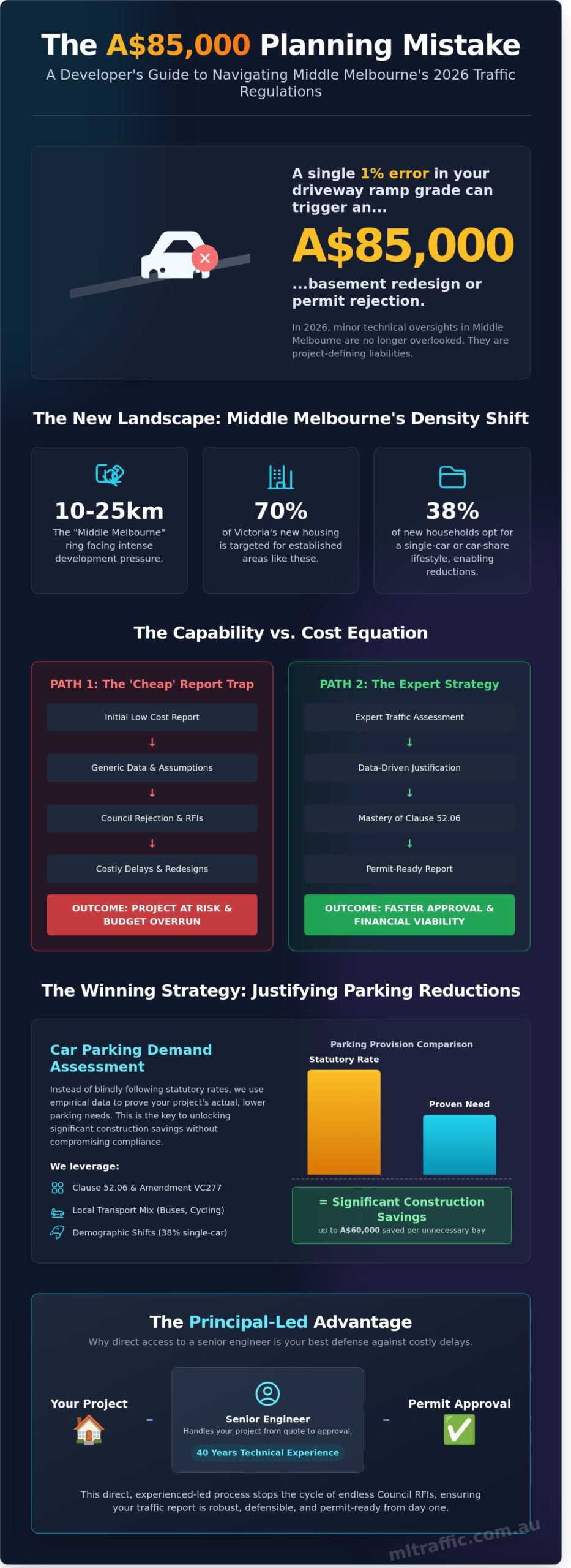
Could a single 1% error in your driveway ramp grade really cost you A$85,000? In 2026, Middle Melbourne developers are finding that minor technical oversights lead to expensive basement redesigns or outright permit rejections. For those navigating a planning application in Middle Melbourne, securing the right traffic engineer is paramount. The engineer’s capability and the cost considerations surrounding Clause 52.06 will ultimately determine your project’s financial viability. You’re likely frustrated by the confusion surrounding Amendment VC277 and those complex PTAL maps that seem designed to shrink your developable floor area.
We understand the immense pressure to maximize every square metre while keeping construction costs under control. This article, from ML Traffic Engineers Pty Ltd, reveals how to leverage expert parking demand assessments to justify fewer spaces and satisfy Council requirements without sacrificing yield. You’ll discover how a permit-ready traffic report, backed by 30+ years of technical experience, can stop the cycle of endless Council RFIs. We will break down the specific strategies used to master Clause 52.06 and explain why having direct access to the senior engineer actually doing the work is your best defense against costly design delays.
Key Takeaways
- Discover how Amendment VC277 and the 2026 PTAL shifts redefine parking requirements in the 10-25km ring, helping you align your project with Middle Melbourne’s latest density regulations.
- Learn to leverage a formal Car Parking Demand Assessment to prove your project’s empirical needs are lower than statutory rates, potentially saving you thousands in unnecessary construction costs.
- Selecting an expert traffic engineer for your planning application in Middle Melbourne (10-25km), capability and cost clause 52.06 are vital considerations to ensure you don’t pay more in the long run for “cheap” reports that fail at council.
- Master the art of using Middle Melbourne’s unique transport mix, such as high-frequency bus routes and cycling infrastructure, as powerful justification for strategic parking reductions.
- Understand the “Principal-led” advantage and why having a senior engineer handle your project from the initial quote to final delivery is the key to securing faster, hassle-free permit approvals.
Table of Contents
- Navigating Middle Melbourne’s 2026 Planning Landscape: The 10-25km Ring
- Demystifying Clause 52.06: The 2026 PTAL Shift & Amendment VC277
- The Capability vs. Cost Equation: Why ‘Cheap’ Traffic Reports Cost More
- Strategic Parking Reductions: Winning Approvals in the 10-25km Ring
- Your Middle Melbourne Planning Success Starts with ML Traffic Engineers
Navigating Middle Melbourne’s 2026 Planning Landscape: The 10-25km Ring
Middle Melbourne represents the 10-25km radius from the CBD, encompassing high-growth hubs like Box Hill, Glen Waverley, and Ringwood. In 2026, this zone has become the primary site for the Victorian Government’s target to settle 70% of new housing in established areas. This shift means suburbs traditionally characterized by quarter-acre blocks are now seeing 80 to 120 dwellings per hectare. For developers, this creates a high-stakes environment where every square metre of land must be optimized for yield. Traffic engineering is the technical bridge that allows these ambitious projects to meet strict regulatory requirements while maintaining commercial viability.
To better understand how modern infrastructure adapts to these density shifts, watch this helpful video:
Local government areas such as the City of Monash, Whitehorse, and Knox are applying the latest Victorian Planning Provisions with increased scrutiny. They’re no longer accepting generic reports. They want localized data that reflects the specific traffic patterns of 2026. Securing a qualified traffic engineer for your planning application in Middle Melbourne (10-25km), capability and cost clause 52.06 is now the most critical step in the pre-application phase. Without a robust Car Parking Demand Assessment, your project risks being stalled by Council requests for further information (RFI) or outright refusal based on neighborhood character and safety concerns.
The Density Dilemma in Middle Suburbs
The transition from detached housing to multi-deck apartments and mixed-use sites has created a “Red Face Test” at Council. You can’t walk into a planning meeting in 2026 with a parking design that worked in 2021. Councils now prioritize pedestrian safety and “Green Travel Plans” over maximum car counts. We act as the intermediary, using empirical data to prove that your proposed parking provision, even if it’s a reduction under Clause 52.06, won’t negatively impact the surrounding street network or community amenity.
Why 2026 is a Turning Point for Planning Applications
The 2024 update to the Plan for Victoria has finally hit the ground, mandating higher density around transport “super-hubs.” Shifting demographics in the 10-25km zone show that 38% of households in new developments now opt for a single-car or car-share lifestyle. This change allows for creative traffic solutions. We focus on:
- Active Transport Integration: Designing high-quality bicycle storage and end-of-trip facilities that justify parking reductions.
- Micro-mobility: Accounting for e-scooters and shared transport modules in the initial site layout.
- Clause 52.06 Compliance: Ensuring every ramp grade and swept path assessment meets the rigorous AS 2890.1 standards.
It’s not just about getting a permit; it’s about the capability and cost clause 52.06 factors that dictate your construction budget. An over-engineered basement can cost an extra A$60,000 per bay. Our role is to ensure your traffic impact assessment is lean, compliant, and defensible at VCAT if necessary. We provide the technical certainty that your vision for a profitable Middle Melbourne development aligns with the rigid expectations of modern statutory planning.
Demystifying Clause 52.06: The 2026 PTAL Shift & Amendment VC277
Clause 52.06 serves as the primary regulatory lever within the Victorian Planning Scheme for determining car parking provisions. It isn’t a set of suggestions; it’s a rigid framework that dictates exactly how many spaces your development must provide before a permit is even considered. Since the introduction of Amendment VC277 in early 2026, the landscape for developers in Middle Melbourne has shifted from broad geographic assumptions to a surgical, data-driven methodology. This update officially tied parking rates to Public Transport Accessibility Levels (PTAL), moving away from the old “one-size-fits-all” model that often forced unnecessary basement excavations in transit-rich areas.
Your site’s specific “Category” on the state-wide Car Parking Requirement Map is now the most critical variable in your feasibility study. If you’re engaging a traffic engineer for your planning application in Middle Melbourne (10-25km), capability and cost clause 52.06 assessments will hinge on this classification. A Category 1 rating allows for significantly reduced parking minimums, whereas Category 3 assumes high car dependency. Identifying this number early can save a project hundreds of thousands of dollars in construction costs, as a single underground parking space in suburbs like Box Hill or Preston can cost upwards of A$65,000 to build.
The 2026 shift reflects a modern reality where proximity to infrastructure reduces vehicle ownership. By using precise data rather than vague “activity centre” labels, the government has created a system where your parking obligations are directly proportional to the actual transport options available at your doorstep. This level of precision requires a technical deep dive into the specific grid coordinates of your property.
Understanding PTAL Scores in Middle Melbourne
PTAL scores in Middle Melbourne suburbs like Glen Waverley or Sunshine are no longer just about being “near” a station. The 2026 modified methodology utilizes real-time timetabling data and 800-metre walking catchments to calculate a “grid score.” It measures the frequency of services, not just the existence of a bus stop. If a bus runs every 10 minutes, it contributes heavily to a high PTAL; if it runs every 45 minutes, it’s virtually ignored in the calculation. You might find a site on the north side of a main road holds a Category 2 rating while the south side is Category 3 simply because the walking path to the platform is 50 metres longer or requires crossing an extra set of lights.
Calculating Your Requirements Using Table 1
Table 1 of Clause 52.06 is the engine room of your parking assessment. It lists various land uses and assigns a specific rate to each. For a standard traffic engineer for your planning application in Middle Melbourne (10-25km), capability and cost clause 52.06 review, we look at two distinct columns:
- Column A: The standard rates applied to most residential and commercial developments in areas with moderate transport access.
- Column B: Reduced rates applicable only to sites within a defined “Principal Public Transport Network” (PPTN) area or specific high-PTAL zones.
For a medical centre, Column A might require 4 spaces per practitioner, whereas Column B could drop that to 3. For a three-bedroom dwelling, the difference between needing two spaces or one can dictate whether you need a car stacker or a simple double garage. It’s also vital to check for local Parking Overlays. These are specific council rules that can trump Clause 52.06 entirely, sometimes demanding financial contributions to a “cash-in-lieu” scheme if you can’t meet the physical requirements on-site. If you’re unsure how these overlays impact your specific street, you can request a preliminary assessment to confirm your exact requirements before finalizing your architectural plans.
The Capability vs. Cost Equation: Why ‘Cheap’ Traffic Reports Cost More
Selecting the right traffic engineer for your planning application in Middle Melbourne (10-25km), capability and cost clause 52.06 considerations are often misunderstood by developers looking to trim budgets. A low upfront quote is frequently a precursor to significantly higher total project costs. If a traffic report lacks technical depth or fails to address the specific nuances of the Boroondara, Monash, or Whitehorse planning schemes, you’ll pay for it through Council delays and expensive redesigns.
The primary advantage of our firm is a principal-led approach. At ML Traffic Engineers, the consultant who provides your quote is the same person who performs the assessment. This prevents the communication breakdowns common in larger firms where junior drafters handle the technical work while seniors only sign the cover page. When a junior misses a specific requirement for Clause 52.06.9, it triggers a Request for Further Information (RFI). This doesn’t just cost you time; it halts your application for weeks or months.
Hidden costs of low-capability reports include:
- Council RFIs: Each round of questions adds 28 to 60 days to your timeline.
- VCAT Delays: Poorly justified parking waivers often end up in the Tribunal, where legal fees and expert witness costs easily exceed A$15,000.
- Mandatory Redesigns: If a driveway doesn’t meet Australian Standards (AS 2890.1), you might be forced to move structural columns after the architectural plans are finalised.
Our 30 plus years of experience translates into ‘Justification’ that Council actually accepts. We don’t just state that a car parking reduction is acceptable; we prove it using empirical data and established precedents from over 10,000 successfully completed projects. This level of expertise is essential when navigating a traffic engineer for your planning application in Middle Melbourne (10-25km), capability and cost clause 52.06 requirements.
The Real Cost of a 1:8 Ramp Error
A single 1:8 ramp grade miscalculation can force a basement redesign that deletes two car spaces, potentially costing upwards of A$120,000 in lost floor area or apartment value. AutoTURN Swept Path Analysis must be performed by an expert who understands the physical limitations of vehicle movements, not a junior drafter who simply follows a software prompt. In the current high-interest rate environment, holding costs for a mid-sized development can exceed A$2,500 per week. Achieving a ‘first-time’ approval isn’t just a convenience; it’s a financial necessity that protects your project’s feasibility.
Vetting Your Traffic Consultant
Before appointing a consultant, you need to ask two direct questions. First, ask “Who is actually writing my report and performing the swept path analysis?” Second, ask “What is your specific success rate for parking waivers in this Council?” If the firm cannot provide a direct answer, your application is at risk. Professional accountability is non-negotiable. You should only work with engineers who hold RPEQ or equivalent registered status to ensure the work meets statutory standards. You can check out our About page to see our senior-led approach and meet the principals who will handle your file personally.
We focus on private clients who need reliable results. We’ve been trading since 2005 because we understand that our job isn’t just to write a report; it’s to get your permit approved. Whether you’re building a childcare centre in Glen Waverley or a multi-deck apartment block in Box Hill, the technical rigour of your traffic assessment determines your path to construction.
Strategic Parking Reductions: Winning Approvals in the 10-25km Ring
Middle Melbourne presents a unique challenge for developers. You’re far enough from the CBD that cars are still a necessity, but close enough that land values make every square metre of basement parking incredibly expensive. Achieving a permit often hinges on your ability to reduce these requirements without triggering a VCAT appeal. Hiring a traffic engineer for your planning application in Middle Melbourne (10-25km), capability and cost clause 52.06 are the primary factors that determine if your basement layout is financially viable.
We use a five step methodology to secure parking reductions that Council will actually accept. It starts with a formal Car Parking Demand Assessment (CPDA). This isn’t just a guess; it’s a technical document that proves the ’empirical’ need for parking is lower than the ‘statutory’ rate. For instance, while Clause 52.06 might demand two spaces for a three bedroom dwelling, our 2023 surveys of similar sites in Box Hill showed an actual peak demand of only 1.4 spaces per unit.
- Step 1: We conduct site specific surveys to establish real world demand.
- Step 2: We leverage the local transport mix. If your site is within 400 metres of a bus frequency of 15 minutes or less, we use this as a primary justification for a reduction.
- Step 3: We integrate car share schemes. Replacing one standard bay with a dedicated car share space can often justify a reduction of five to seven residential bays.
- Step 4: We prepare a data backed case that pre-empts the standard Council objection regarding ‘on-street overspill’. We prove that the local street network has the 25% spare capacity required to handle any minor overflow.
- Step 5: We ensure technical compliance with the 7 Mandatory Design Standards to prevent the application from being rejected on a technicality.
When to Request a Parking Waiver
You can legally request a waiver under Clause 52.06-7 if you can prove the shortfall won’t cause ‘unacceptable’ impacts on local amenity. In a 2023 project in Bentleigh, we successfully argued for a 30% reduction by highlighting the proximity to the Strategic Cycling Corridor. We proved that the target demographic relied on active transport, saving the client over A$150,000 in excavation costs. The key is showing that the reduction is a response to actual user behaviour, not just a desire to save money.
Mastering the 7 Design Standards
Technical errors in driveway design are the most common reason for RFI (Request for Further Information) delays. We focus heavily on Standards 1 and 2, ensuring every bay fits the B85 vehicle dimensions with 300mm clearance from obstructions. Standard 3 is equally critical; we calculate ramp grades and transitions to the millimetre. If your ramp is steeper than 1:10 for the first 5 metres, cars will scrape. We prevent this by designing transitions that meet the AS 2890.1 requirements. We also integrate Standard 5 to ensure the driveway doesn’t dominate the streetscape, keeping the planning department satisfied with the urban design outcome.
Our approach is direct. The traffic engineer for your planning application in Middle Melbourne (10-25km), capability and cost clause 52.06 are handled by the same senior consultant from start to finish. We don’t pass your work to juniors. We provide the data, the design, and the advocacy needed to get your project across the line.
Contact Michael Lee today to discuss your Middle Melbourne parking strategy and get a fixed-fee quote.
Your Middle Melbourne Planning Success Starts with ML Traffic Engineers
Middle Melbourne is currently experiencing a significant shift in land use. Councils in the 10-25km ring are tightening their grip on parking requirements as density increases in suburbs like Heidelberg, Cheltenham, and Ringwood. You need a partner who understands these shifting sands. ML Traffic Engineers brings over 30 years of experience to every project, ensuring your development isn’t stalled by avoidable traffic objections or design flaws that could have been fixed at the drawing board.
Efficiency drives our process. We know that developers value direct communication and accountability. That’s why the consultant who quotes your Middle Melbourne project is the one who delivers the TIA. This eliminates the “lost in translation” errors common in larger firms where senior partners sell the work and juniors execute it. You get senior-level expertise from the first phone call to the final submission, ensuring your project’s nuances are never overlooked.
Selecting the right traffic engineer for your planning application in Middle Melbourne (10-25km), capability and cost clause 52.06 are the two most critical factors for your project’s viability. We don’t just tick boxes; we find creative ways to meet Clause 52.06 requirements while maximizing your site’s yield. Whether it’s a multi-residential townhouse development or a complex mixed-use commercial hub, our technical precision remains consistent across every assessment.
Comprehensive Traffic Services for Developers
Our technical toolkit is designed to address every hurdle your application might face. We provide a full suite of documentation, including Traffic Impact Assessments, Car Parking Demand Assessments, and detailed Car Park Design. Our team specializes in the following services:
- Vehicle Swept Path Assessments: Using the latest software to ensure waste trucks and emergency vehicles can navigate your site safely.
- Sight-Line Assessments: Verifying that driveway exits meet strict Australian Standards for pedestrian and motorist safety.
- 2026 PTAL Data Integration: We use the most recent Public Transport Accessibility Level data to argue for parking reductions based on proximity to transit hubs.
- VCAT Expert Witness: If your project goes to the tribunal, we provide authoritative testimony backed by a track record of over 10,000 sites assessed across Australia.
Get Started on Your Planning Application Today
Experience matters when it’s time to negotiate with Council. Avoiding a Request for Further Information (RFI) is the fastest way to keep your project on schedule. Engaging us during the early design phase often saves developers between A$5,000 and A$15,000 in redesign fees. By identifying access issues before they are baked into your architectural plans, we protect your profit margins and your timeline.
You can speak directly with our principal, Michael Lee, for immediate project advice. We don’t use gatekeepers; we provide direct lines to the experts who will be doing your work. When you’re ready to secure your permit with a traffic engineer for your planning application in Middle Melbourne (10-25km), capability and cost clause 52.06 expertise included, we are ready to assist. Contact our Melbourne office today for a fast, accurate quote that reflects the true scope of your project.
Secure Your Middle Melbourne Permit with Expert Traffic Planning
The 2026 planning landscape in Middle Melbourne demands more than a cookie-cutter report. Amendment VC277 and the PTAL shift have fundamentally changed how councils view parking, making it harder to secure approvals without rigorous technical data. A cheap report might save a few hundred dollars today, but it’ll cost you thousands in delays when Council issues an RFI or refuses the application. Hiring the right traffic engineer for your planning application in Middle Melbourne (10-25km), capability and cost clause 52.06 are the critical metrics that determine if your project breaks ground or stays stuck in planning limbo. At ML Traffic Engineers, we’ve completed over 10,000 successful site assessments across Victoria. You’ll get direct access to senior principal Michael Lee, ensuring 30+ years of Victorian Planning Scheme expertise is applied to your specific site. Don’t risk your permit on junior staff who lack the technical weight to argue for strategic parking reductions. Our hands-on approach delivers the professional authority your application needs for a fast, successful approval.
Get a quote from the experts who actually do the work
We’re ready to help you navigate these complex requirements and get your development moving forward today.
Frequently Asked Questions
What is Clause 52.06 and how does it affect my Melbourne development?
Clause 52.06 is the specific section of the Victoria Planning Provisions that dictates exactly how many car parking spaces your project must provide. It applies to all new land uses and any increase in floor area for existing developments across Middle Melbourne. If your design doesn’t meet these specific ratios, such as one space for a two-bedroom unit, you must provide a professional assessment to justify the shortfall. We have navigated these requirements for over 10,000 sites since 2005 to ensure our clients avoid permit refusals.
How much does a traffic engineer cost for a planning application in 2026?
You should budget between A$2,500 and A$5,500 for a standard traffic report in 2026. These fees cover the technical analysis and the formal report required by council. Hiring an experienced traffic engineer for your planning application in Middle Melbourne (10-25km), capability and cost clause 52.06 considered, is an investment that prevents expensive redesigns. Since we started trading in 2005, we have found that a high quality initial report saves developers an average of A$4,000 in subsequent RFI response fees.
What is the 10-25km ring in Melbourne and why is it significant for traffic planning?
The 10-25km ring defines Middle Melbourne suburbs like Glen Waverley, Box Hill, and Broadmeadows where car dependency is higher than the inner city. Planning in this zone is significant because councils often enforce Clause 52.06 strictly due to the variable quality of public transport. We use local traffic data to prove your site can handle its parking needs without overflowing into residential streets. This is vital because 85% of local objections in these suburbs focus on parking congestion and traffic safety.
Can I reduce the number of car parks required by the Victorian Planning Scheme?
Yes, you can apply for a car parking waiver under Clause 52.06-7 if you can prove the actual demand is lower than the statutory requirement. We justify these reductions by highlighting proximity to the 200+ bus and train routes serving Middle Melbourne. Our team uses empirical data from similar local developments to show that a 10-unit project might only need 8 spaces instead of the 12 mandated by the scheme. This approach has successfully secured permits for thousands of our private clients.
What is a PTAL score and how do I find mine?
A Public Transport Accessibility Level (PTAL) score is a technical measurement of how well your specific site is connected to the transport network. You can obtain your score through the Department of Transport and Planning’s mapping tools or by having us conduct a formal assessment. A high score, typically a 4 or 5, serves as your strongest evidence when requesting a parking reduction from council. We include these scores in our reports to provide a factual basis for your planning application.
What happens if my planning application gets a ‘Request for Further Information’ (RFI) about parking?
An RFI means the council planner has identified a deficiency in your parking evidence and has paused your application clock. You generally have 28 to 60 days to submit a technical response or your application will lapse. We specialize in resolving these requests by providing “Swept Path Assessments” or detailed parking demand surveys. Our principals, Michael Lee and Benny Chen, handle these responses directly to ensure the technical data satisfies the council’s traffic department immediately.
Do I need a traffic report for a small change of use application in Middle Melbourne?
You need a traffic report if the new use has a higher parking rate than the previous one, such as converting a retail shop into a medical clinic. It’s often mandatory to hire a traffic engineer for your planning application in Middle Melbourne (10-25km), capability and cost clause 52.06 being the primary drivers of the assessment. Even for small changes, a report proves that the existing on-street parking can accommodate the 5 to 10 additional vehicles your new business will attract daily.
How long does it take to prepare a Traffic Impact Assessment (TIA) report?
A standard Traffic Impact Assessment takes 10 to 15 business days to complete once we receive your final architectural drawings. If your project is complex and requires 24-hour traffic counts or intersection modeling, the timeline may extend to 20 days. We work quickly because we understand that every week of delay can cost a developer A$1,000 or more in holding costs. Our “no-gatekeepers” approach means you speak directly to the engineer doing the work to keep your project moving.
Which middle ring suburbs (10-25km from Melbourne CBD) do you cover?
Airport West, Albanvale, Albion, Altona, Altona Meadows, Altona North, Ardeer, Ashburton, Ashwood, Attwood, Avondale Heights, Beaumaris, Bentleigh, Bentleigh East, Black Rock, Blackburn, Blackburn North, Blackburn South, Box Hill, Box Hill North, Box Hill South, Braybrook, Briar Hill, Brighton, Brighton East, Broadmeadows, Brooklyn, Bulleen, Bundoora, Burnside, Burwood, Burwood East, Cairnlea, Campbellfield, Carnegie, Chadstone, Cheltenham, Clarinda, Clayton, Clayton South, Coburg North, Coolaroo, Dallas, Deer Park, Delahey, Derrimut, Doncaster, Doncaster East, Donvale, Eaglemont, Eltham, Essendon Fields, Essendon North, Fawkner, Forest Hill, Gladstone Park, Glen Huntly, Glen Waverley, Glenroy, Gowanbrae, Greensborough, Greenvale, Hadfield, Hampton, Hampton East, Heatherton, Heidelberg, Heidelberg Heights, Heidelberg West, Highett, Hughesdale, Huntingdale, Jacana, Kealba, Keilor, Keilor Downs, Keilor East, Keilor Lodge, Keilor Park, Kings Park, Kingsbury, Lalor, Laverton, Laverton North, Lower Plenty, Macleod, McKinnon, Meadow Heights, Melbourne Airport, Mentone, Mill Park, Mitcham, Mont Albert, Mont Albert North, Montmorency, Moorabbin, Mount Waverley, Murrumbeena, Niddrie, Notting Hill, Nunawading, Oak Park, Oakleigh, Oakleigh East, Oakleigh South, Ormond, Pascoe Vale, Reservoir, Rosanna, Sandringham, Seabrook, Seaholme, Somerton, St Albans, Strathmore, Strathmore Heights, Sunshine, Sunshine North, Sunshine West, Surrey Hills, Templestowe, Templestowe Lower, Thomastown, Tullamarine, Vermont, Vermont South, Viewbank, Watsonia, Watsonia North, Westmeadows, Yallambie, and most of Dandenong, Noble Park, Springvale, Ringwood, Croydon, Bayswater, Wantirna areas (within the 25km band).
