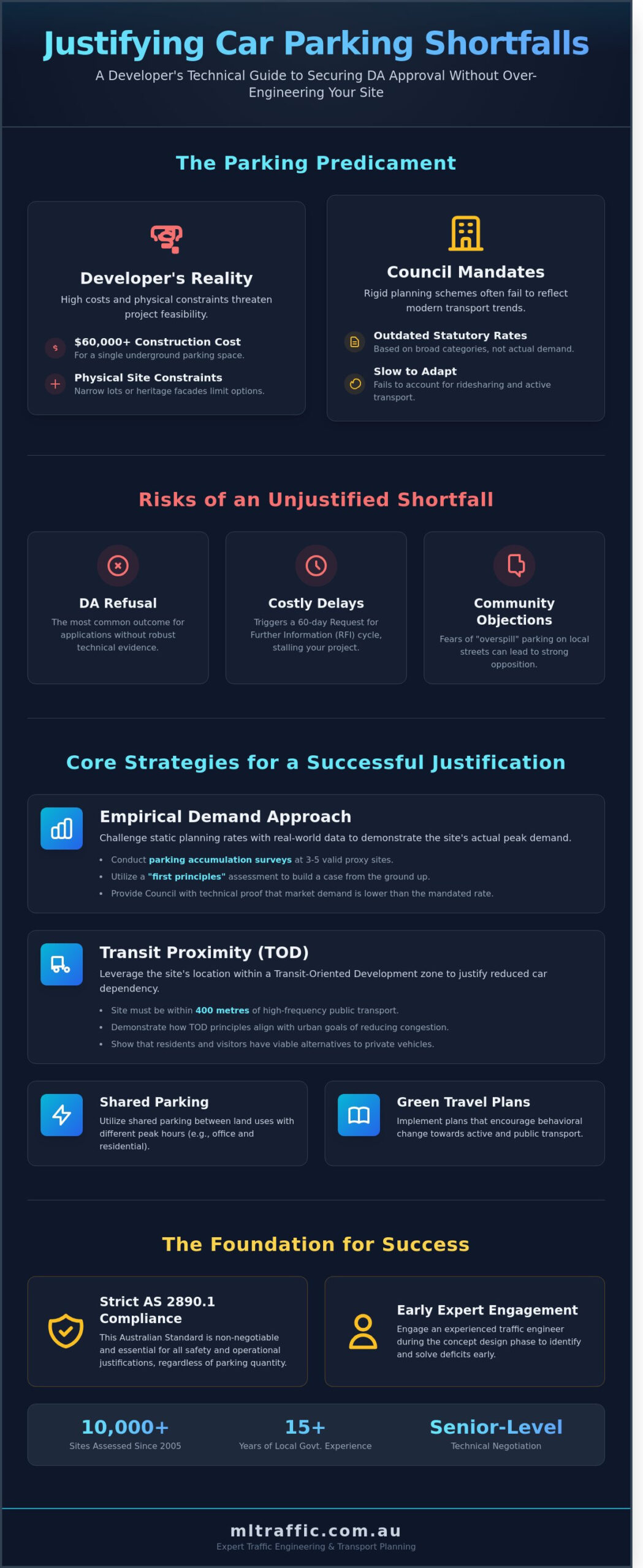

A single underground parking space in a 2026 development can cost over $60,000 to construct, yet many of these spaces remain vacant because local planning rates fail to account for actual site demand. If you’re facing a potential DA refusal, you shouldn’t have to choose between a million-dollar basement and a rejected application. Engaging an experienced traffic engineer Gold Coast developers trust is the first step toward a technical justification that satisfies Council requirements without over-engineering your site.
It’s common to feel stuck between rigid Australian Standards like AS 2890.1 and conflicting Local Council rates, especially when the cost of compliance threatens your project’s feasibility. You’ll learn the technical strategies and data-driven methods our principals use to secure approvals for car parking shortfalls. This guide provides a clear roadmap for the justification process, ensuring you secure planning approval without a total site redesign. We’ll show you how we’ve applied these methods across more than 10,000 sites since 2005, ensuring the consultant who quotes your job is the one who actually delivers the work.
Key Takeaways
-
Learn how to utilize empirical data and parking accumulation surveys from proxy sites to justify providing fewer spaces than local planning schemes mandate.
-
Discover how leveraging proximity to high-frequency public transport and Transit-Oriented Development (TOD) principles can significantly strengthen your DA approval prospects.
-
Understand why maintaining strict AS 2890.1 compliance is essential for safety justifications when your development’s parking quantity falls below standard requirements.
-
Engaging a traffic engineer Gold Coast during the concept design phase allows for site-specific demand assessments that identify and address potential deficits early.
-
Gain insight into how senior-level technical negotiation and 15+ years of experience with local government authorities lead to higher success rates for complex shortfalls.
Table of Contents
-
Understanding Car Parking Shortfalls in Australian Developments
-
Technical Analysis: Car Parking Demand vs. Australian Standards
Understanding Car Parking Shortfalls in Australian Developments
A car parking shortfall occurs when a development proposal provides fewer on-site spaces than the minimum number mandated by a local planning scheme. In 2024, the Gold Coast City Plan serves as the primary benchmark for these requirements. Shortfalls typically arise from physical site constraints, such as narrow lot widths or the preservation of heritage-listed facades. High-density urban requirements often clash with rigid parking space standards that were drafted before the rise of modern transport alternatives. An experienced traffic engineer Gold Coast identifies these discrepancies by comparing statutory mandates against the actual peak demand of a specific land use.
To better understand how modern infrastructure manages these demands, watch this video:
Councils are increasingly receptive to justified shortfalls, particularly in transit-oriented developments (TODs). When a site is located within 400 metres of a high-frequency bus or light rail station, the reliance on private vehicle ownership drops significantly. We use technical data to demonstrate that providing excessive parking in these zones contradicts modern urban planning goals of reducing traffic congestion and promoting active transport.
Statutory Planning Rates vs. Market Reality
Local planning schemes determine parking rates based on broad land-use categories. These rates often lag behind current transport trends. For example, ridesharing usage in Australian metropolitan areas has increased by over 20% since 2019, yet many planning codes don’t account for reduced resident car ownership. A professional Traffic Impact Assessment is essential here. It utilizes empirical data from similar developments to prove that the market demand is lower than the outdated statutory minimum. This technical evidence allows developers to repurpose space for more valuable uses without compromising site functionality.
The Consequences of an Unjustified Shortfall
Submitting a Development Application (DA) without a robust technical justification is a high-risk move. It almost certainly triggers a 60-day Request for Further Information (RFI) cycle or leads to a flat refusal. Community objections often focus on "overspill" parking, where residents or visitors occupy limited street parking in surrounding neighborhoods. A traffic engineer Gold Coast mitigates these risks by conducting a Car Parking Demand Assessment. This study ensures the project complies with Australian Standard AS 2890.1 while proving to Council that the proposed supply won’t negatively impact local street capacity. Our approach focuses on technical compliance and factual evidence to secure approvals for private clients.
Core Strategies for Justifying a Car Parking Shortfall
Justifying a parking shortfall in 2026 requires a technical argument backed by empirical evidence and localized data. A traffic engineer Gold Coast developers rely on will focus on four primary pillars: empirical demand, transit proximity, behavioral change through Green Travel Plans, and shared parking efficiencies. These strategies move the conversation away from rigid planning codes and toward the actual operational needs of a site.
The Empirical Demand Approach
Planning schemes often rely on static rates that don’t reflect modern mobility trends or specific site nuances. We use "first principles" assessments to challenge these figures when the Gold Coast City Plan or similar local frameworks feel outdated. This process involves conducting parking accumulation surveys at 3 to 5 proxy sites. These sites must share identical land-use characteristics, gross floor area (GFA), and geographic constraints to be considered valid by Council. Peak parking demand is the maximum number of vehicles parked at a specific site during a continuous 24-hour period, typically measured in 15-minute intervals. If data shows a 1,500sqm medical center in a similar precinct consistently peaks at 3.5 spaces per 100sqm instead of the mandated 5, the empirical evidence provides a defensible basis for a reduction.
Sustainable Transport Credits
The proximity of a development to high-frequency public transport significantly lowers car dependency. For projects located within 400 meters of the G:link light rail or major bus corridors like the 700 or 777 routes, we calculate a demand reduction based on the accessibility of the site. A Walk Score above 85 indicates that residents or staff can complete most daily errands without a private vehicle. We also quantify the impact of end-of-trip (EoT) facilities. Providing 25% more bicycle lockers or secure racks than the minimum requirement can directly offset the need for onsite car bays. Integrating dedicated car-share bays for providers like GoGet or Uber Carshare further reduces the required parking ratio, as one car-share vehicle can replace up to 10 private cars in high-density areas.
Mixed-use developments offer the most effective opportunity for shared parking justifications. We analyze the temporal distribution of demand across different users. A commercial gym might peak at 6:00 AM, while a professional office peaks at 11:00 AM. By overlapping these demand curves, we often reduce the total required bays by 20% to 30% compared to the sum of individual requirements. A Green Travel Plan (GTP) reinforces this by outlining operational strategies to discourage private vehicle use. This includes subsidized transit passes or carpooling incentives. Our experienced consultants provide the technical Car Parking Demand Assessment needed to secure these concessions from Council authorities.
Technical Analysis: Car Parking Demand vs. Australian Standards
A shortfall proposal fails immediately if the remaining spaces don’t function correctly. When a traffic engineer Gold Coast evaluates a site, the priority shifts from quantity to quality. Council assessors look for strict adherence to AS 2890.1 compliance to ensure safety isn’t compromised by the reduced supply. If you’re asking for a concession on numbers, the remaining layout must be flawless.
Compliance with AS 2890.1 and AS 2890.2
Councils rarely approve a shortfall if the layout is substandard. A 15% reduction in parking numbers won’t be accepted if the remaining 85% of spaces require complex multi-point turns to exit. We verify driveway ramp grades don’t exceed the 1:4 (25%) limit for private residential use or 1:5 (20%) for commercial sites. Aisle widths must meet the minimum 5.8 metres for User Class 1A to ensure operational efficiency. We use Swept Path Analysis to prove that vehicles can enter and leave in a single forward motion. This technical proof is the difference between a refusal and an approval in 2026. Without it, the Council assumes the site is congested and unsafe.
Parking Layout and Manoeuvrability
Efficient design helps "find" spaces within tight footprints. We utilize B85 and B99 vehicle templates to test every corner of the basement or surface lot. The B85 template represents the 85th percentile vehicle; the B99 ensures the largest cars on the road can navigate the site. If a layout is tight, we certify that the reduced provision still allows for 12.5-metre Heavy Rigid Vehicles (HRVs) if the site requires loading or emergency access.
PWD (People with Disabilities) ratios are non-negotiable under AS 2890.6. A site with 20 spaces usually requires at least one dedicated PWD space with a 2.4-metre wide shared zone. Shortfalls shouldn’t impact these essential accessibility requirements. Our traffic engineer Gold Coast experts ensure that while general parking numbers drop, the site remains fully inclusive and accessible. We focus on these technicalities to protect the development’s viability during the RPEQ certification process. You can view our full range of traffic engineering services to see how we handle these specific design challenges.
Layout efficiency often dictates the success of a shortfall justification. We look for:
-
Dead-end aisle extensions of at least 1.0 metre to allow for B85 vehicle turnarounds.
-
Headroom clearances of 2.2 metres for general areas and 2.5 metres for PWD spaces.
-
Sight distance compliance at the property boundary to ensure pedestrian safety.
A Step-by-Step Guide to Preparing Your Justification Report
Securing approval for a parking shortfall requires a methodical approach backed by technical data. It’s not about asking for leniency; it’s about proving that the proposed supply meets the actual demand of the specific land use. A qualified traffic engineer Gold Coast follows a five-step process to build a defensible case for Council submission.
-
Step 1: Early Engagement. Involve a consultant during the concept design phase to identify potential deficits before plans are finalized. This prevents expensive redesigns later.
-
Step 2: Parking Demand Assessment. Conduct site-specific surveys or use historical data to establish real-world needs. Generic planning scheme rates often overestimate demand for modern, transit-oriented developments.
-
Step 3: Policy Review. Analyze local government planning policies to identify "performance-based" alternative solutions. These allow for deviations from standard requirements if the intent of the code is still met.
-
Step 4: Formal Documentation. Compile findings into a professional Traffic Impact Statement (TIS) or Traffic Impact Assessment (TIA). This document serves as the primary evidence for your application.
-
Step 5: Council Liaison. Present the data during pre-lodgement meetings or as part of the formal Development Application (DA). Direct communication with Council officers helps resolve technical concerns before they become formal objections.
Early Intervention and Design Optimization
Efficiency starts at the quoting stage. At ML Traffic Engineers, the consultant who provides the quote is the same senior expert who performs the technical work. This ensures high-level oversight from the first day, which is vital for early-stage accuracy. You can view our full range of traffic engineering services to see how we integrate with your design team. Small adjustments to driveway grades or internal circulation often recover "lost" spaces or justify a lower count by improving site efficiency. Early intervention by a traffic engineer Gold Coast prevents the need for massive redesigns after a Council Information Request (IR) is issued.
The Structure of a Successful Justification Report
A successful report follows a logical, evidence-based structure. It begins with site context, detailing the existing transport network and proximity to high-frequency public transit. The methodology section must explain how data was collected, whether through manual counts at similar sites or historical database analysis. Clear visual evidence is mandatory. This includes AutoTURN swept path diagrams to prove vehicle maneuverability and survey charts that visualize peak demand periods. The concluding statement is the most critical element. It must explicitly address the Council’s planning objectives, proving the shortfall won’t result in "overspill" parking on public streets. We rely on data from over 10,000 completed sites to ensure every recommendation is grounded in technical precedent.
Ready to finalize your development plans? Contact our senior engineers for a technical review of your site.
Securing DA Approval with Expert Traffic Engineering
Securing a Development Application (DA) approval for a parking shortfall requires more than just raw data. It demands strategic negotiation with local government authorities based on technical merit and historical precedent. ML Traffic Engineers has been trading since 2005. Our principals bring between 30 and 40 years of individual experience to every project. This longevity is critical when you’re dealing with a traffic engineer Gold Coast council officers trust. We’ve completed over 10,000 sites across Australia, covering everything from high-density apartments to specialized industrial warehouses. Senior staff involvement isn’t a luxury; it’s our standard operating procedure. This level of seniority ensures that complex shortfalls are justified using RPEQ-certified logic that stands up to rigorous Council scrutiny.
The ML Traffic Advantage: Direct Access to Principals
Large consultancy firms often delegate technical reports to junior staff after the initial handshake. This creates a disconnect that leads to bureaucratic delays and errors during the Request for Further Information (RFI) stage. At ML Traffic Engineers, the traffic consultant who provides your quote is the same expert who writes your report. You get direct access to Michael Lee and Benny Chen. You can learn more about our specific qualifications and professional history on our About ML Traffic page. This hands-on approach means your site constraints are understood from day one. We don’t guess. We apply Australian Standards like AS 2890.1 and specific local planning schemes to ensure your parking demand assessment is bulletproof. Our focus is private clients who need reliable results without the overhead of larger, impersonal firms.
Next Steps for Your Development Application
Moving from a technical justification to project commencement starts with a clear fee proposal. We provide fixed-fee quotes so your project budget remains predictable. Once you provide the site plans, we typically deliver a comprehensive Traffic Impact Statement (TIS) or Parking Demand Assessment within 10 to 14 business days. Council response times vary, but having a report signed off by a registered traffic engineer Gold Coast specialist often streamlines the review process. We handle the technical back-and-forth so you can focus on construction. To begin your assessment, Contact ML Traffic Engineers to discuss your specific site constraints and receive a tailored proposal.
Secure Your DA Approval with Precise Parking Data
Justifying a car parking shortfall in 2026 requires a technical approach rooted in Australian Standards (AS 2890.1) and empirical demand analysis. You’ll need to prove that your development’s actual requirements differ from generic council rates through vehicle swept path assessments and RPEQ certified reporting. Since 2005, ML Traffic Engineers has delivered this technical expertise for more than 10,000 sites. If you’re looking for a traffic engineer Gold Coast councils respect, we provide the data-driven reports needed to clear regulatory hurdles.
Our firm operates on a direct accountability model where the traffic consultant who provides your quote is the same senior expert who performs the technical work. We’ve built over 15 years of experience in Australian traffic planning; this ensures senior staff involvement in every parking assessment. This hands-on method eliminates communication gaps and ensures your justification report is accurate. Your development application needs a factual foundation that withstands scrutiny. We’re prepared to provide the professional support your project requires.
Get a Professional Traffic Engineering Quote for Your DA
Frequently Asked Questions
What is a car parking shortfall in a development application?
A car parking shortfall occurs when the number of spaces provided on-site is less than the minimum requirement specified in the local planning scheme or the City of Gold Coast Transport Code. For example, if a 500 square meter office requires 10 spaces but only provides 8, a 2-space shortfall exists. This requires a formal justification report from a traffic engineer Gold Coast to demonstrate that the actual demand will be lower than the code requirement.
Can a Council refuse a DA solely based on a parking shortfall?
Council can refuse a Development Application if the parking deficit creates unacceptable impacts on local amenity or road safety. In 2024, approximately 15% of refusals in urban areas cite inadequate parking as a primary or secondary reason. A qualified RPEQ engineer can often mitigate this risk by providing empirical evidence of lower demand or proposing alternative transport solutions that meet the performance outcomes of the planning scheme.
How does a traffic engineer calculate actual parking demand?
Traffic engineers calculate demand using empirical data from similar sites and industry databases like the RTA Guide to Traffic Generating Developments. We conduct 12-hour parking surveys at three comparable locations to establish a peak demand rate per 100 square meters of Gross Floor Area. This data-driven approach replaces generic rates in the planning scheme with site-specific evidence, often reducing the required parking by 20% or more.
What is a Green Travel Plan and can it help justify a shortfall?
A Green Travel Plan is a formal strategy that encourages occupants to use sustainable transport modes instead of private vehicles. It includes specific measures such as bicycle parking, end-of-trip facilities, and subsidized transit passes. Implementing this plan can reduce parking demand by 10% to 15% in transit-oriented developments. This document serves as a key piece of evidence when justifying a parking deficit to local authorities.
Do I need a Swept Path Analysis if I have a parking deficit?
You need a Swept Path Analysis regardless of a parking deficit to prove that the remaining spaces are functional and compliant with AS 2890.1. We use software like AutoCAD Vehicle Tracking to simulate the movement of a B99 vehicle or an 8.8m Medium Rigid Vehicle through your site. If your parking layout is tight due to a shortfall, Council will scrutinize your driveway ramp grades and turning circles more closely.
Is a 10% parking shortfall usually acceptable to most Councils?
A 10% shortfall is often considered manageable if the site is located within 400 meters of a high-frequency public transport node. Most planning schemes allow for flexibility if the developer can prove that the operational requirements of the specific land use don’t warrant the full code allocation. For a retail site in a busy precinct, a 10% reduction is frequently approved when supported by a parking demand assessment from a traffic engineer Gold Coast.
How long does it take to prepare a parking justification report?
A standard parking justification report typically takes 10 to 15 business days to complete from the date of instruction. This timeframe allows for site inspections, data collection, and the technical drafting of the report. At ML Traffic Engineers, the traffic consultant who provides the quote does the work. This ensures that your project doesn’t get delayed by internal bureaucracy or junior staff handovers during the assessment process.
What is the difference between a Traffic Impact Statement and a full TIA?
A Traffic Impact Statement is a concise report for smaller developments with less than 50 vehicle trips per peak hour. A Traffic Impact Assessment is a comprehensive study required for larger projects that generate significant volumes of traffic. A TIA includes detailed intersection modeling using SIDRA software and long-term impact projections, whereas a Statement focuses on site-specific issues like parking supply and driveway safety.
What areas do you cover?
We are traffic engineers servicing Advancetown, Alberton, Arundel, Ashmore, Austinville, Beechmont, Benobble, Benowa, Biddaddaba, Biggera Waters, Bilinga, Birnam, Bonogin, Broadbeach, Broadbeach Waters, Bundall, Burleigh Heads, Burleigh Waters, Carrara, Cedar Creek, Clagiraba, Clear Island Waters, Coolangatta, Coombabah, Coomera, Currumbin, Currumbin Valley, Currumbin Waters, Elanora, Gaven, Gilberton, Gilston, Guanaba, Helensvale, Highland Park, Hollywell, Hope Island, Jacobs Well, Kingsholme, Labrador, Lower Beechmont, Luscombe, Main Beach, Maudsland, Mermaid Beach, Mermaid Waters, Merrimac, Miami, Molendinar, Mount Nathan, Mudgeeraba, Natural Bridge, Nerang, Neranwood, Norwell, Numinbah Valley, Ormeau, Ormeau Hills, Oxenford, Pacific Pines, Palm Beach, Paradise Point, Parkwood, Pimpama, Reedy Creek, Robina, Runaway Bay, South Stradbroke, Southport, Southern Moreton Bay Islands, Springbrook, Stapylton, Steiglitz, Surfers Paradise, Tallai, Tallebudgera, Tallebudgera Valley, Tugun, Upper Coomera, Varsity Lakes, Willow Vale, Wongawallan, Woongoolba, Worongary, Yatala.

Disclaimer
The content on www.mltraffic.com.au, including all technical articles, guides, and resources, is provided for general informational and educational purposes only. It is not intended to constitute professional advice in traffic engineering, transportation planning, development approvals, or any other technical or legal field.
While ML Traffic Engineers makes every reasonable effort to ensure the accuracy, completeness, and timeliness of the information published, we do not provide any warranties or representations (express or implied) regarding its reliability, suitability, or availability for any particular purpose. Any reliance you place on the content is strictly at your own risk.
In no event shall ML Traffic Engineers, its directors, employees, authors, or affiliates be liable for any direct, indirect, incidental, special, consequential, or punitive damages (including, without limitation, loss of profits, data, or business opportunities) arising out of or in connection with the use of, or inability to use, any information provided on this website.
The articles and guides on this site are not a substitute for engaging a qualified, registered professional traffic engineer (such as an NPER or RPEQ engineer) to assess your specific project requirements. For tailored advice, compliance assessments, or traffic engineering services, please contact a competent professional.
This disclaimer may be updated from time to time without notice. By accessing or using this website, you agree to be bound by the most current version of this disclaimer.