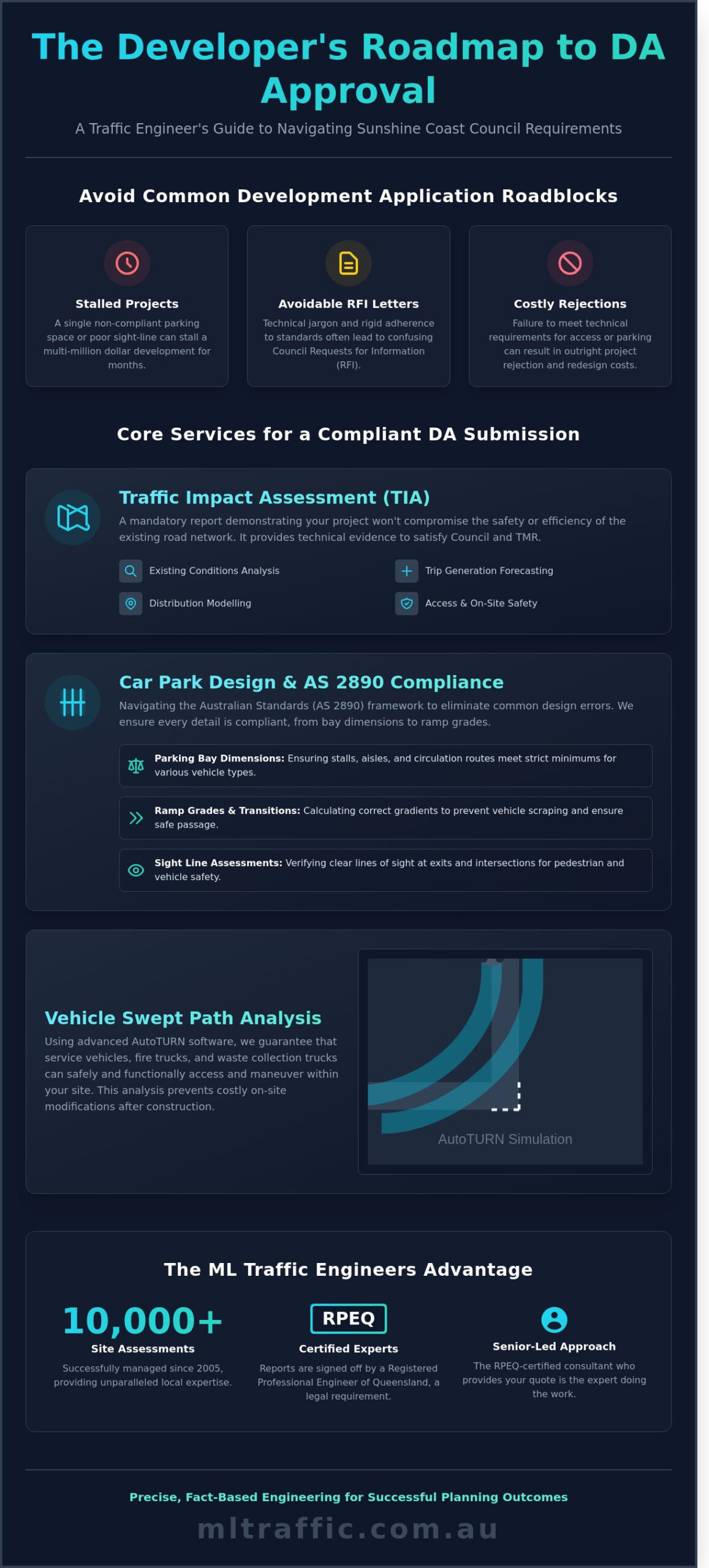

A single non-compliant parking space or a poorly calculated sight-line assessment can stall a multi-million dollar development application for months. Engaging a qualified traffic engineer Sunshine Coast ensures that your project remains on schedule and compliant with the latest local government planning schemes. You likely understand that meeting the Sunshine Coast Council’s transport requirements is often the most complex hurdle in the DA process. Technical jargon and rigid adherence to Australian Standards like AS 2890.1 frequently lead to avoidable RFI letters or costly project rejections.
At ML Traffic Engineers, we believe the consultant who provides your quote should be the one doing the work, ensuring no technical detail is lost in a corporate hierarchy. We provide the technical clarity needed to bypass bureaucratic delays, offering direct access to senior RPEQ-certified experts who’ve successfully managed over 10,000 site assessments since 2005. This article details how professional Traffic Impact Statements (TIS), vehicle swept path analysis, and compliant car park designs move your project from a blueprint to an approved reality. You’ll learn how to mitigate council concerns and secure a successful planning outcome through precise, fact-based engineering reports.
Key Takeaways
-
Identify why council mandates professional certification for site access and parking to streamline your development application process.
-
Understand the critical role of a Traffic Impact Assessment (TIA) in evaluating road network capacity and infrastructure requirements.
-
Learn how to navigate AS 2890 compliance to eliminate the most common design errors that trigger council Requests for Information (RFI).
-
Discover how a professional traffic engineer Sunshine Coast utilizes AutoTURN swept path analysis to guarantee functional vehicle movements on-site.
-
Benefit from a senior-led approach to planning approvals where the consultant who quotes your project is the one performing the technical work.
Table of Contents
-
Understanding the Role of a Traffic Engineer in Modern Developments
-
The Critical Components of a Traffic Impact Assessment (TIA)
Understanding the Role of a Traffic Engineer in Modern Developments
Traffic engineering for private development focuses on the safe and efficient movement of people and goods within and around a site. A traffic engineer Sunshine Coast bridges the gap between architectural vision and local government compliance. While general civil engineering addresses structural integrity and drainage, specialized transport planning applies Traffic Engineering Principles to manage vehicle dynamics, pedestrian safety, and parking logistics. It’s a discipline that prioritizes the functional interaction between a specific land use and the public road network.
Councils require professional certification for access and parking because poor design leads to traffic congestion and safety hazards. Professional reports ensure that a site doesn’t negatively impact the surrounding infrastructure. Engaging a consultant during the concept phase prevents costly design revisions. These revisions often occur when architectural plans fail to meet technical sweep path requirements or driveway gradient limits. Since 2005, ML Traffic Engineers has focused on providing this technical clarity for private clients.
The following video outlines transport planning priorities that impact local development projects:
When Should You Engage a Traffic Consultant?
Trigger points for a Development Application (DA) typically include changes in land use, increased gross floor area, or modifications to site access. Pre-lodgement advice allows developers to identify potential "deal-breakers" regarding site feasibility before committing to full architectural drawings. Integrating traffic design early ensures that driveway locations and parking layouts are optimized for both compliance and yield. It’s about getting the layout right the first time.
Navigating National Engineering Standards
Compliance relies on the Australian Standards (AS 2890) framework. This code dictates everything from parking bay dimensions to ramp grades. Accessing specialized services is necessary to navigate these technical requirements accurately. In Queensland, reports must be signed off by a Registered Professional Engineer of Queensland (RPEQ). This registration is a legal requirement for engineering reports submitted to council. It ensures the traffic engineer Sunshine Coast has the verified expertise to handle complex technical assessments. Senior staff with 30 to 40 years of experience provide the reliability needed for successful project approvals.
The Critical Components of a Traffic Impact Assessment (TIA)
A Traffic Impact Assessment (TIA) is a mandatory technical report for developments on the Sunshine Coast that exceed specific density or traffic thresholds. Its primary objective is to demonstrate that a proposed project won’t compromise the safety or efficiency of the existing road network. A qualified traffic engineer Sunshine Coast developers trust will analyze current road capacity and identify if the infrastructure can absorb the additional load. This process involves on-site data collection, including 7-day traffic counts and turn-movement surveys at key intersections within a 500-meter radius of the site.
The assessment focuses on four pillars: existing conditions, trip generation, distribution modelling, and access safety. By identifying potential bottlenecks before construction begins, developers avoid costly retrofits or permit denials. We provide the technical evidence required to satisfy the Sunshine Coast Council’s planning scheme and the Department of Transport and Main Roads (TMR) requirements.
Traffic Generation and Distribution Modelling
Engineers use empirical data from the Austroads Guide to Traffic Management and the TfNSW Guide to Traffic Generating Developments to forecast trip rates. We calculate the exact number of vehicle movements during the AM and PM peak hours. This data determines the "distribution," which maps where traffic originates and where it exits. This modelling addresses council concerns regarding localized congestion and ensures the development complies with the Transport Planning and Coordination Act 1994. Accurate modelling prevents the over-design of infrastructure, saving clients significant capital expenditure.
Intersection and Sight-Line Assessments
Safety at site access points is a non-negotiable requirement for RPEQ certification. We evaluate Safe Intersection Sight Distance (SISD) to ensure drivers exiting the site have sufficient visibility to see oncoming traffic and react safely. If a site has restricted visibility due to topography or existing structures, our traffic engineer Sunshine Coast team develops mitigation strategies. These strategies include:
-
Relocating the driveway to a point with superior sight-lines.
-
Implementing Left-In, Left-Out (LILO) restrictions to reduce conflict points.
-
Adjusting driveway ramp grades to comply with AS 2890.1.
-
Installing convex mirrors or warning signage where physical obstructions cannot be moved.
Our team at ML Traffic Engineers ensures these assessments satisfy both the state authorities and local council planners. You can view our full range of traffic engineering services to see how we manage complex site constraints and visibility issues.
Navigating Car Park Design and AS 2890 Compliance
Sunshine Coast Council frequently issues Requests for Information (RFI) because of non-compliant car park designs. These delays often occur when a site layout fails to meet the strict technical requirements of the Australian Standards. ML Traffic Engineers has been trading since 2005; we have seen how a single overlooked dimension can stall a development application for months. Most RFI issues involve inadequate aisle widths, poor maneuvering space, or non-compliant ramp grades.
A thorough understanding of AS 2890.1 Explained is essential for any off-street parking project. This standard dictates the minimum requirements for bay lengths, widths, and clearance heights. When a site cannot meet the prescriptive requirements of the local planning scheme, we provide a Car Parking Demand Assessment. This assessment uses empirical data to justify a reduction in the required number of bays. This approach often saves developers significant floor area. A qualified traffic engineer Sunshine Coast ensures these justifications are technically sound and RPEQ certified.
Parking Geometry and Bay Dimensions
Designers must classify parking users correctly to determine the necessary bay sizes. Class 1 covers residential or long-term employee parking, while Class 3A is for high-turnover retail environments like supermarkets. Each class requires different aisle widths to ensure safe vehicle movement and ease of entry.
-
Class 1: 2.4m width for residential or staff use.
-
Class 3A: 2.7m width for high-turnover retail use.
-
Aisle widths: Typically range from 5.8m to 6.2m depending on the parking angle.
-
Blind-aisle extensions: These must extend 1.0m beyond the last parking space to allow for vehicle maneuvering.
-
Accessible parking: AS 2890.6 requires specific shared zones and 2.5m vertical clearances for disabled parking spaces.
Driveway Ramp Grade Design
Steep sites across the Sunshine Coast present significant challenges for driveway compliance. Maximum gradients must not exceed 1 in 4 (25%) for private residential use or 1 in 5 (20%) for other developments. We conduct technical checks to prevent vehicle scraping at the break of grade. A traffic engineer Sunshine Coast is required to verify these levels before construction begins.
Transition zones are necessary for steep driveways. A 2.0m long transition at 1 in 10 (10%) is typically required between the flat street and a steep ramp. This prevents the front or rear of the vehicle from hitting the pavement. We perform vehicle swept path assessments and longitudinal section checks to verify ground clearance on complex sites. This data-driven approach ensures the design is functional and meets council’s engineering standards.
Ensuring Access Compliance with Vehicle Swept Path Analysis
Swept Path Analysis (SPA) is the technical simulation of a vehicle’s footprint as it moves through a specific turn or maneuver. It’s a mandatory requirement for most development applications across Queensland. At ML Traffic Engineers, we utilize AutoTURN software to create these simulations, mapping the exact path of a vehicle’s body and wheels. This process identifies potential "pinch points" where a vehicle might strike a curb, wall, or parked car. By using the 99.8th percentile vehicle profiles defined in AS 2890.1, we ensure that the design accommodates virtually all vehicles in a specific class.
A qualified traffic engineer Sunshine Coast uses these simulations to verify that a site layout is functional before any construction begins. One of the primary goals is demonstrating that vehicles can enter and exit the property in a forward direction. Reversing onto public roads is a major safety risk and is generally prohibited by councils for anything larger than a standard driveway. SPA provides the empirical proof needed to satisfy council assessors that the proposed driveway widths and internal circulation areas are safe and compliant with Australian Standards.
Swept Path Analysis for Removalist Trucks
Councils often require proof that a Medium Rigid Vehicle (MRV), which is typically 8.8 meters long, can access residential sites. We design loading zones that allow these trucks to stop without impeding the flow of general traffic. Vertical clearance is another factor we assess. Basement entries must maintain a clear height, often 3.5 meters or more, to accommodate removalist trucks without risking structural damage.
Waste Collection and Emergency Vehicle Access
Commercial developments must accommodate the Heavy Rigid Vehicle (HRV) for waste management. These 12.5-meter vehicles require substantial turning radii and reinforced pavements. A traffic engineer Sunshine Coast also ensures that fire trucks have sufficient access. Queensland Fire and Emergency Services (QFES) standards require specific turn-around areas to prevent trucks from getting trapped. We optimize these layouts to maintain high site yield while meeting all safety codes.
Get technical certainty for your development by contacting our experts for traffic engineering services today.
Expert Traffic Engineering for Planning Approvals
Securing development approval on the Sunshine Coast requires technical precision and strict compliance with local planning schemes. ML Traffic Engineers has operated since 2005, assisting private developers across Australia with more than 10,000 completed projects. Engaging a specialized traffic engineer Sunshine Coast is critical for identifying potential access issues or parking shortfalls before they become costly roadblocks during the council assessment phase. We provide the technical evidence required to satisfy council queries and mitigate traffic-related risks through professional reporting.
Our Proven Process for Development Success
Our methodology focuses on technical accuracy and submission readiness. We begin with a thorough review of architectural plans and specific council requirements for your site. Our team conducts detailed data collection, including traffic counts and parking surveys, followed by technical analysis using industry-standard software. The final output is a comprehensive Traffic Impact Assessment (TIA) or statement that adheres to AS 2890.1 and local government guidelines. We don’t just provide data; we provide solutions that work for developers and regulators alike.
Direct Access to Senior Engineering Expertise
Clients benefit from working directly with our principal engineers, who possess between 30 and 40 years of individual experience. You can learn more about our leadership team and their extensive project history across various land uses. We avoid the junior engineer trap common in larger firms; at ML Traffic Engineers, the consultant who quotes your project is the one who performs the technical work. This ensures accountability and high-level problem-solving for every development application, regardless of project size.
Technical insights from a traffic engineer Sunshine Coast help prevent delays and ensure your site layout is functional. We’ve worked on diverse land uses including apartments, medical centers, schools, and industrial hubs. Our reports are designed to be submission-ready to streamline the path to council approval. Contact us today for a direct consultation on your site. We provide fixed-fee quotes based on your specific architectural plans to help you budget accurately for your development application. Reach out to Michael Lee or Benny Chen directly to discuss your project requirements and receive a professional assessment.
Secure Your Sunshine Coast Development Approval
Successful Australian developments rely on precise technical data and strict adherence to AS 2890 standards. From conducting detailed Traffic Impact Assessments to performing accurate vehicle swept path analysis, every component must align with council requirements. Navigating these bureaucratic processes demands a partner who understands the local landscape. ML Traffic brings over 15 years of specialized experience to your project. We’ve assessed more than 10,000 sites across Australia, ensuring each one meets the necessary compliance markers for planning approval.
Choosing the right traffic engineer Sunshine Coast developers rely on means gaining direct access to our Principal Engineers. We don’t hand your project off to juniors; the consultant who provides your quote is the expert who completes the work. This hands-on approach minimizes errors and accelerates your application timeline. You’ll receive technical reports that are ready for submission, backed by decades of industry knowledge. Get your project moving with a team that values technical accuracy and professional accountability.
Get a Professional Traffic Engineering Quote from ML Traffic
Your development’s success starts with reliable engineering and we’re ready to help you achieve it.
Frequently Asked Questions
What is a Traffic Impact Assessment (TIA) and do I need one?
A TIA is a technical report that evaluates how a proposed development affects the surrounding transport network. You’ll need one if your development exceeds thresholds set in the Sunshine Coast Planning Scheme 2014, such as generating over 30 vehicle trips per hour. A traffic engineer Sunshine Coast ensures the TIA complies with Department of Transport and Main Roads (TMR) guidelines to facilitate council approval.
How long does it take to prepare a professional traffic report?
We typically complete a professional traffic report within 10 to 15 business days after receiving the final architectural plans. Complex sites requiring intersection modeling or 24-hour traffic counts may take up to 21 days to allow for accurate data collection. We focus on meeting your DA submission deadlines to prevent project delays. The engineer who quotes your project will be the one performing the technical work.
What information do I need to provide for a traffic engineering quote?
You must provide the site address, a description of the proposed land use, and the most recent architectural site plan. Including the number of residential units, gross floor area (GFA) for commercial builds, and any previous council correspondence helps us provide an accurate fixed-fee proposal. We’ve provided quotes for over 10,000 sites since 2005, ensuring we understand the specific requirements of your development type immediately.
Is a swept path analysis required for all developments?
Swept path analysis is required for 95% of developments where vehicles must maneuver in tight spaces or use on-site loading bays. We use industry-standard software to simulate the movements of an 8.8-meter medium rigid vehicle or a 12.5-meter heavy rigid vehicle. This proves to council that your design allows for safe entry and exit in a forward gear, complying with local safety standards.
Can a traffic engineer help reduce the number of parking spaces required by council?
Yes, we use empirical data and the RTA Guide to Traffic Generating Developments to justify parking reductions. If your site is within 400 meters of a high-frequency bus stop or train station, we can often argue for lower rates. We have successfully reduced parking requirements for thousands of projects by demonstrating actual demand through local surveys rather than relying on generic council rates.
What is the difference between a Traffic Management Plan and a Traffic Impact Assessment?
A Traffic Impact Assessment (TIA) evaluates permanent operational effects, while a Traffic Management Plan (TMP) focuses on temporary safety during construction. The TIA supports your initial development application. The TMP, often required by council as a condition of approval, details how 19-meter semi-trailers or cranes will safely access the site without disrupting local traffic flow during the building phase.
Why does council require my driveway to be designed to AS 2890.1?
Council mandates AS 2890.1 compliance to ensure driveway gradients don’t cause vehicle scraping or limit visibility for pedestrians. This standard specifies a maximum grade of 1 in 4 for residential ramps and requires specific transitions. Our assessments verify that your design meets these 2004 Australian Standards, preventing costly redesigns after you’ve already submitted your plans to the authorities.
Can you help if council has already issued an RFI regarding traffic?
We specialize in responding to Information Requests (RFIs) from the Sunshine Coast Council and have resolved issues for 100% of our RFI clients. We review the specific concerns raised by council officers and provide the technical data or design modifications needed to clear the objection. Our traffic engineer Sunshine Coast team deals directly with council to ensure your project moves to the next stage without further delays.
Which suburbs do you cover?
We are traffic engineers servicing Alexandra Headland, Aroona, Bald Knob, Balmoral Ridge, Banya, Baringa, Battery Hill, Beerburrum, Beerwah, Belli Park, Bells Creek, Birtinya, Bli Bli, Bokarina, Booroobin (part), Bribie Island North, Bridges, Buddina, Buderim, Burnside, Caloundra, Caloundra West, Cambroon, Chevallum, Coes Creek, Conondale, Coochin Creek, Coolabine, Cooloolabin, Coolum Beach, Crohamhurst, Curramore, Currimundi, Diamond Valley, Dicky Beach, Diddillibah, Doonan (part), Dulong, Eerwah Vale, Elaman Creek, Eudlo, Eumundi, Flaxton, Forest Glen, Gheerulla, Glass House Mountains, Glenview, Golden Beach, Highworth, Hunchy, Ilkley, Image Flat, Kenilworth, Kiamba, Kidaman Creek, Kiels Mountain, Kings Beach, Kulangoor, Kuluin, Kunda Park, Kureelpa, Landers Shoot, Landsborough, Little Mountain, Maleny, Mapleton, Marcoola, Maroochy River, Maroochydore, Meridan Plains, Minyama, Moffat Beach, Mons, Montville, Mooloolaba, Mooloolah Valley, Mount Coolum, Mount Mellum, Mountain Creek, Mudjimba, Nambour, Ninderry, North Arm, North Maleny, Obi Obi, Pacific Paradise, Palmview, Palmwoods, Parklands, Parrearra, Peachester, Pelican Waters, Peregian Beach (part), Peregian Springs, Perwillowen, Point Arkwright, Reesville, Rosemount, Shelly Beach, Sippy Downs, Tanawha, Towen Mountain, Twin Waters, Valdora, Verrierdale, Warana, West Woombye, Weyba Downs, Witta, Woombye, Wootha, Wurtulla, Yandina, Yandina Creek, Yaroomba.

Disclaimer
The content on www.mltraffic.com.au, including all technical articles, guides, and resources, is provided for general informational and educational purposes only. It is not intended to constitute professional advice in traffic engineering, transportation planning, development approvals, or any other technical or legal field.
While ML Traffic Engineers makes every reasonable effort to ensure the accuracy, completeness, and timeliness of the information published, we do not provide any warranties or representations (express or implied) regarding its reliability, suitability, or availability for any particular purpose. Any reliance you place on the content is strictly at your own risk.
In no event shall ML Traffic Engineers, its directors, employees, authors, or affiliates be liable for any direct, indirect, incidental, special, consequential, or punitive damages (including, without limitation, loss of profits, data, or business opportunities) arising out of or in connection with the use of, or inability to use, any information provided on this website.
The articles and guides on this site are not a substitute for engaging a qualified, registered professional traffic engineer (such as an NPER or RPEQ engineer) to assess your specific project requirements. For tailored advice, compliance assessments, or traffic engineering services, please contact a competent professional.
This disclaimer may be updated from time to time without notice. By accessing or using this website, you agree to be bound by the most current version of this disclaimer.