

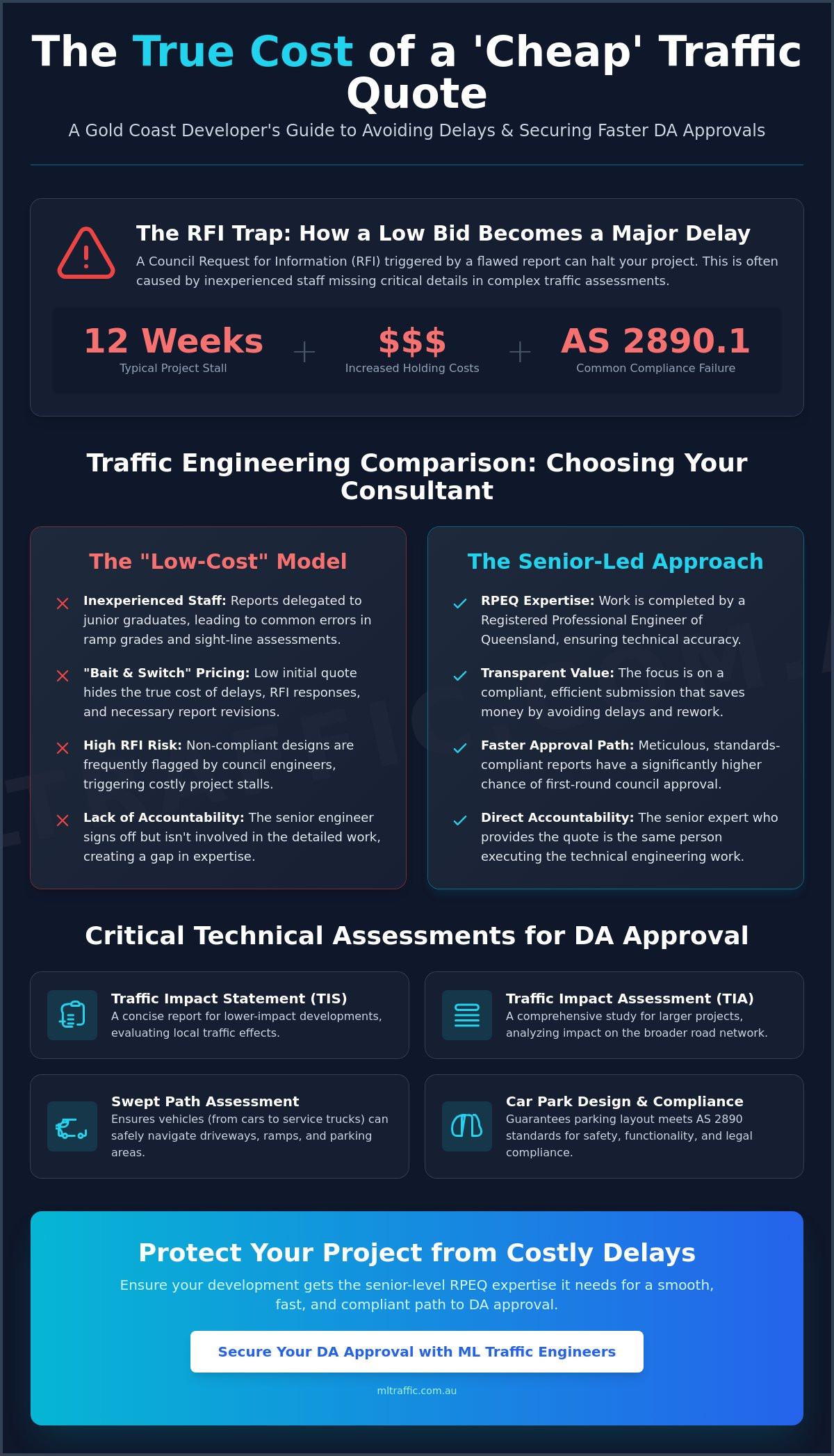
The cheapest traffic engineering quote often becomes your most expensive project delay. You likely understand the frustration of receiving a Council Request for Information (RFI) that stalls your Gold Coast development for 12 weeks because a junior staff member missed a technical detail. It’s a common issue where firms delegate complex reports to inexperienced graduates, leading to errors in driveway ramp grades or Sight-Line Assessments that fail to meet AS 2890.1 standards.
This guide provides a rigorous traffic engineering comparison Gold Coast developers need to evaluate consultants based on technical RPEQ expertise and proven results. You’ll learn how to avoid hidden fees and ensure your car park design is both compliant and cost-effective from the first submission. We’ll show you how to verify that the senior engineer who signs your quote is the one actually completing your Traffic Impact Statement (TIS). This approach ensures direct accountability, fewer errors, and a significantly faster path to council approval.
Key Takeaways
- Understand why councils require specialized traffic reports for all land-use changes and how these assessments facilitate a smoother DA approval process.
- Identify the critical technical benchmarks, including TIA and Swept Path assessments, that ensure your development meets rigorous Australian Standards.
- Perform a strategic traffic engineering comparison Gold Coast developers can use to identify high-value expertise over low-cost “bait and switch” consultancy models.
- Learn how mastering AS 2890 compliance protects your project from legal challenges and ensures the functional safety of off-street parking and commercial facilities.
- Discover the benefits of a senior-led approach where the consultant providing your quote is the same expert executing the technical engineering work.
Table of Contents
-
The Role of Traffic Engineering in Securing Development Approvals
-
Traffic Engineering Comparison: How to Evaluate Consultancy Quotes
-
National Compliance: Mastering Australian Standards and AS 2890
The Role of Traffic Engineering in Securing Development Approvals
Traffic engineering within the Australian private development sector is the technical application of transport principles to ensure safe, functional site access and internal circulation. It’s the process of proving to local authorities that a project won’t compromise the existing road network or public safety. When conducting a traffic engineering comparison Gold Coast developers must prioritise consultants who understand the specific technicalities of the City Plan and Department of Transport and Main Roads (TMR) requirements. Every private development, from a small medical suite to a large industrial warehouse, must demonstrate it can handle the vehicles it attracts.
A poorly prepared report often triggers the "RFI Trap." This is a Request for Further Information from the council that can stall a project for 60 days or more while you scramble to provide missing data. These delays are costly. Traffic assessments are a mandatory component of your Statement of Environmental Effects (SEE). They provide the technical evidence that the proposed development is compatible with its surroundings and won’t create a "bottleneck" or safety hazard for the community.
To better understand the distinction between different engineering roles in this field, watch this helpful video:
When is a Professional Traffic Report Mandatory?
You’ll need a professional traffic assessment for various development triggers. Council requirements often kick in during these specific scenarios:
-
A formal change of use for an existing building (e.g., converting a warehouse into a gym).
-
Increasing the gross floor area (GFA) of a commercial or industrial site.
-
Proposing fewer parking spaces than the local planning scheme requires.
-
Developing high-turnover sectors like childcare centres, medical clinics, or 24-hour service stations.
There’s a significant difference between a Traffic Impact Statement (TIS) and a Traffic Impact Assessment (TIA). A TIS is a concise report for lower-impact developments. A TIA is a comprehensive study required for larger projects that may affect the broader road network. Our services cover both levels of reporting to ensure your application meets exact council specifications.
The Consequences of Non-Compliant Traffic Planning
Non-compliant traffic planning directly increases project holding costs through delayed approvals and lost opportunity during the 60-day RFI response period.
Safety risks represent a major liability for developers. If a driveway or parking layout doesn’t meet Australian Standards (AS 2890.1), you face potential legal exposure and expensive retrofits after construction. Council engineers vet every report for strict adherence to local planning schemes. Uncertified designs from inexperienced consultants rarely pass this scrutiny. At ML Traffic Engineers, the consultant who provides the quote does the work, ensuring senior-level accountability for every design detail and a higher likelihood of first-round approval.
Technical Benchmarks: TIA, Swept Path, and Car Park Design
A successful development application requires a precise alignment of technical assessments. These reports don’t just exist in isolation; they function as a data-driven narrative that proves a project’s viability to local authorities. When conducting a traffic engineering comparison Gold Coast developers should look for consultants who integrate TIA, swept path, and parking demand into a singular, cohesive strategy. This technical synergy ensures that the site’s internal layout doesn’t conflict with the external road network’s capacity.
Traffic Impact Assessments (TIA) and Statements
The TIA is the foundation of your submission. It begins with rigorous data collection, including 24-hour traffic counts and peak-hour trip generation rates specific to the land use. Engineers analyze intersection performance to determine if the existing road network can absorb the additional load. In complex urban environments, we utilize SIDRA modeling to simulate traffic flow and delay. This analysis must align with the Austroads’ Guide to Traffic Management to meet national engineering benchmarks. A Traffic Impact Statement (TIS) is often sufficient for smaller developments, focusing on localized access and safety rather than regional network shifts.
Vehicle Swept Path and Access Assessment
Swept path analysis acts as the digital footprint of a moving vehicle. It’s a non-negotiable requirement for demonstrating that service vehicles can enter and exit the site in a forward gear. Council planners focus heavily on loading docks and waste collection areas. We use specialized software like AutoTURN to model the movements of B99 cars and Heavy Rigid Vehicles (HRV) with centimetre-level accuracy. This prevents costly design errors where trucks might clip kerbs or block thoroughfares. For a deeper look at these requirements, see our Swept Path Analysis Guide.
Car Park Design and Demand Assessments
While councils set minimum parking rates, these figures don’t always reflect real-world usage. An empirical demand assessment allows engineers to justify parking shortfalls by presenting data from similar existing developments. We analyze peak demand periods to prove that a lower parking provision won’t result in overspill onto public streets. All designs must strictly adhere to Australian Standards for off-street parking. You can find detailed compliance requirements in our AS 2890.1 Guide. If your project faces tight spatial constraints, consulting with an RPEQ engineer early can identify design efficiencies that save significant floor area.
Traffic Engineering Comparison: How to Evaluate Consultancy Quotes
A low quote for traffic engineering services often masks hidden costs that emerge during the Council assessment phase. When performing a traffic engineering comparison Gold Coast developers should look beyond the initial fee. A cheap report that fails to address specific Council concerns results in expensive Requests for Further Information (RFIs) and project delays. True value is found in reports that facilitate immediate approval and minimize time spent in the planning queue.
The Principal-Led vs. Junior-Led Service Model
Large consultancies frequently use a "bait and switch" approach. A senior director or principal engineer meets the client and provides the quote, but the actual technical work is delegated to a junior graduate or an intern. This leads to communication gaps and technical oversights during complex Council negotiations. At ML Traffic Engineers, we operate on a model of direct accountability. Our principal-led model ensures that the traffic consultant who provides the quote, does the work. This direct access to senior expertise reduces errors and ensures every Traffic Impact Statement (TIS) is technically sound from the first draft.
Working directly with an RPEQ (Registered Professional Engineer of Queensland) is essential for Gold Coast developments. Senior engineers understand the nuances of local planning schemes and can defend their findings during meetings with Council officers. You shouldn’t have your project’s success resting on the shoulders of an inexperienced staff member who lacks the authority to make critical design decisions on the fly. Direct principal access means faster response times and more reliable advice throughout the life of your development application.
Assessing Experience Across Land-Use Types
Specific project experience is a critical metric for any traffic engineering comparison Gold Coast. A consultant who specializes in residential subdivisions might struggle with the specific requirements of a childcare center or a large-scale industrial warehouse. Each land use has unique demands for vehicle swept paths, parking turnover, and peak-hour traffic generation. We have completed over 10,000 sites across various sectors, providing us with the data needed to support diverse applications. Our experience includes:
-
Childcare centres and educational facilities
-
High-rise residential and mixed-use developments
-
Industrial warehouses and distribution hubs
-
Medical centres and allied health facilities
-
Service stations and fast-food outlets
Verification of a consultant’s track record is vital. Look for "Council-ready" report formatting that adheres to Australian Standards (AS 2890.1) and specific local government requirements. Professional reports use precise technical terminology and clear data visualization to minimize friction with assessing officers. A consultant’s history of 10,000 successful applications demonstrates they know exactly what Council needs to see to grant an approval without unnecessary back-and-forth correspondence.
National Compliance: Mastering Australian Standards and AS 2890
Compliance with Australian Standards serves as a developer’s primary defense against legal challenges and project delays. Adherence to AS 2890.1 (Off-street car parking) and AS 2890.2 (Off-street commercial vehicle facilities) is mandatory for achieving Development Application (DA) approval. When performing a traffic engineering comparison Gold Coast firms often differ in their depth of technical application. A consultant who overlooks a minor standard detail risks the entire project’s viability. For a deeper look at these requirements, see our Traffic Engineering Guide.
Driveway Ramp Grades and Sight Distance
Ramp grades are a frequent point of failure in suburban and high-density developments. If a ramp is too steep or lacks appropriate transitions, vehicles will "bottom out," leading to property damage and immediate DA refusal. AS 2890.1 specifies maximum gradients and transition lengths that must be calculated with precision. We’ve seen projects delayed for months because a 1:20 transition was omitted where a grade exceeded 12.5 percent.
Sight-line assessments are equally critical. Engineers must verify that drivers exiting a property have a clear view of pedestrians and oncoming traffic. This involves:
-
Evaluating "blind spots" created by boundary fences, signage, or landscaping.
-
Applying the specific 2.0m x 2.5m sight triangles required by the standards at the property boundary.
-
Ensuring compliance with AS 2890.6 for disabled parking access, which requires specific shared zones and level surfaces with a maximum 1:40 grade for outdoor areas.
Traffic Guidance Schemes (TGS) and Management Plans
There’s a distinct difference between a TGS and a Traffic Management Plan (TMP). A TGS is a technical diagram showing the exact placement of signs, bollards, and cones for a specific work site. A TMP is a broader, comprehensive document outlining the strategic approach to managing all road users, including pedestrians and cyclists, during the life of a project. It’s the "why" and "how" behind the safety measures.
The project transitions from DA approval to construction traffic management once the initial planning phase is complete. A robust Traffic Management Plan ensures the safety of the public and contractors while maintaining traffic flow on adjacent roads. This is where a traffic engineering comparison Gold Coast becomes vital; you need a firm that understands both the planning phase and the practical, boots-on-the-ground requirements of construction. Mistakes at this stage don’t just cause delays; they create significant safety liabilities.
Ensure your project meets every regulatory hurdle by consulting with our senior staff. Contact us for a detailed compliance assessment of your development site.
Securing Your DA Approval with ML Traffic Engineers
ML Traffic Engineers represents the logical choice for developers who prioritize project speed and technical security. Since 2005, our firm has delivered over 10,000 successful site assessments across Australia. This volume of work provides us with a deep understanding of complex planning schemes. When performing a traffic engineering comparison Gold Coast developers often find that our experience with local council requirements is the deciding factor in achieving a smooth Development Application (DA) process.
Our firm handles a diverse range of land-use types, including residential apartments, childcare centres, medical clinics, and industrial warehouses. We don’t just provide a report; we provide a pathway to approval. Our technical expertise ensures that your project meets all necessary Australian Standards, including AS 2890.1 for parking facilities. This meticulous approach minimizes the risk of costly delays or redesigns late in the planning phase.
The ML Traffic Advantage: Senior Expertise on Every Project
We operate under a strict "Principal quotes, Principal works" guarantee. This means you have direct access to Michael Lee and Benny Chen throughout the life of your project. In many larger consultancy firms, senior staff provide the initial quote, but junior engineers perform the actual technical work. At ML Traffic Engineers, the expert who understands your project’s nuances is the one performing the Vehicle Swept Path Assessment and Sight-Line Analysis.
This senior oversight is critical for preventing common council Requests for Information (RFIs). We identify potential access, loading, or parking bottlenecks before they reach the council’s desk. While we have deep roots in Queensland, our national service capability supports developers with interstate portfolios. Whether your project is in Brisbane, Sydney, or Melbourne, you receive the same level of RPEQ-certified authority and technical precision.
Next Steps: Getting a Traffic Engineering Quote
Obtaining an accurate fee proposal is a straightforward process. To ensure we provide a precise quote for your Traffic Impact Statement (TIS) or Car Parking Demand Assessment, we require specific documentation. Please prepare the following materials for our review:
-
Current and proposed site plans showing all entry and exit points.
-
A clear description of the proposed land use and Gross Floor Area (GFA).
-
Any relevant council correspondence or pre-lodgement meeting minutes.
-
Project deadlines or specific staging requirements.
We pride ourselves on a fast turnaround for fee proposals and professional traffic reports. Our focus is on providing private clients with the technical documentation they need to move their developments forward without unnecessary bureaucracy. If you value accountability and seasoned expertise, we’re ready to assist with your next project.
Ready to secure your project’s future? Contact ML Traffic Engineers for a Quote to receive a no-obligation fee proposal for your development.
Secure Your Development Approval with Proven Technical Expertise
Choosing the right consultant involves more than a simple price check. A detailed traffic engineering comparison Gold Coast developers conduct should prioritise technical precision in TIA reports, swept path analysis, and car park design. Errors in these foundational documents often result in expensive project delays and multiple requests for information from Council. You need a specialist who understands the nuances of Australian Standards and local planning requirements from the outset.
ML Traffic Engineers offers direct access to senior professionals with over 30 years of industry experience. We’ve completed more than 10,000 site assessments, ensuring every report is fully compliant with AS 2890. We don’t delegate to junior staff; the senior engineer who quotes your project is the one who performs the technical work. This hands-on approach eliminates communication gaps and secures your DA approval efficiently. It’s the most reliable way to navigate complex transport planning requirements.
Get a Professional Traffic Engineering Quote for Your DA
Your project deserves the certainty that only decades of technical expertise can provide.
Frequently Asked Questions
What is the difference between a Traffic Impact Statement and a Traffic Impact Assessment?
A Traffic Impact Statement (TIS) is a concise report designed for small-scale developments that generate fewer than 30 peak-hour vehicle trips. A Traffic Impact Assessment (TIA) is a more comprehensive technical study required for larger projects that significantly alter road network performance. Our senior engineers determine the necessary report level based on the 10,000 sites we’ve assessed since 2005.
How much does a traffic engineering report cost for a standard DA?
Costs for a standard Development Application report vary based on land-use type and the technical complexity of the site. When conducting a traffic engineering comparison Gold Coast developers should ensure quotes include RPEQ certification and all necessary Council revisions. We provide fixed-fee proposals after reviewing your specific architectural plans to ensure there are no hidden expenses during the application process.
Why did council issue an RFI for my car park design?
Councils issue a Request for Information (RFI) when a car park design fails to meet the 5.8-metre aisle width or the 2.4-metre minimum height clearance standards. These requests often target non-compliant driveway ramp grades or inadequate sight-lines at the property boundary. Resolving an RFI requires a professional assessment to ensure the layout aligns with the local planning scheme and Australian Standards.
Does a traffic engineer need to visit my site in person?
Yes, a physical site visit is essential to accurately measure sight-lines and observe 85th percentile vehicle speeds on the adjacent road. Desk-based assessments cannot identify physical obstructions like utility poles or vegetation that impact safety. Our principals personally visit every site to ensure the data used in your report is 100% accurate and defensible during the Council review.
What is AS 2890.1 and why is it important for my development?
AS 2890.1 is the Australian Standard for off-street car parking and serves as the primary compliance benchmark for all private developments. It dictates the mandatory dimensions for parking bays, circulation aisles, and driveway gradients to ensure functional vehicle movement. Failure to adhere to these 2004 standards will result in a refusal from Council or significant redesign costs later in the project.
Can a traffic engineer help justify a parking shortfall to council?
Traffic engineers justify parking shortfalls by conducting a Car Parking Demand Assessment based on empirical data from similar land-use types. If your development provides 20% fewer spaces than the planning scheme requires, we use peak-hour occupancy surveys to prove the actual demand is lower. This evidence-based approach allows Council to approve the shortfall without compromising the local parking supply.
How long does it take to prepare a Swept Path Analysis?
A standard Swept Path Analysis typically takes between 2 and 5 hours to complete once the final architectural CAD files are received. We use AutoTURN software to simulate the movement of specific design vehicles, such as 12.5-metre Heavy Rigid Vehicles (HRV) or B99 cars. This analysis confirms that vehicles can enter and exit the site in a forward direction without striking curbs or structural columns.
What is the difference between a TGS and a TMP?
A Traffic Guidance Scheme (TGS) is a technical diagram showing the exact placement of signs and devices for a specific work site. A Traffic Management Plan (TMP) is a high-level strategic document that outlines the overall risks and coordination required for a project. While a TGS shows where the cones go, the TMP explains the broader safety logic and legislative compliance for the entire development.
Which areas do you cover?
We are traffic engineers servicing Advancetown, Alberton, Arundel, Ashmore, Austinville, Beechmont, Benobble, Benowa, Biddaddaba, Biggera Waters, Bilinga, Birnam, Bonogin, Broadbeach, Broadbeach Waters, Bundall, Burleigh Heads, Burleigh Waters, Carrara, Cedar Creek, Clagiraba, Clear Island Waters, Coolangatta, Coombabah, Coomera, Currumbin, Currumbin Valley, Currumbin Waters, Elanora, Gaven, Gilberton, Gilston, Guanaba, Helensvale, Highland Park, Hollywell, Hope Island, Jacobs Well, Kingsholme, Labrador, Lower Beechmont, Luscombe, Main Beach, Maudsland, Mermaid Beach, Mermaid Waters, Merrimac, Miami, Molendinar, Mount Nathan, Mudgeeraba, Natural Bridge, Nerang, Neranwood, Norwell, Numinbah Valley, Ormeau, Ormeau Hills, Oxenford, Pacific Pines, Palm Beach, Paradise Point, Parkwood, Pimpama, Reedy Creek, Robina, Runaway Bay, South Stradbroke, Southport, Southern Moreton Bay Islands, Springbrook, Stapylton, Steiglitz, Surfers Paradise, Tallai, Tallebudgera, Tallebudgera Valley, Tugun, Upper Coomera, Varsity Lakes, Willow Vale, Wongawallan, Woongoolba, Worongary, Yatala

Disclaimer
The content on www.mltraffic.com.au, including all technical articles, guides, and resources, is provided for general informational and educational purposes only. It is not intended to constitute professional advice in traffic engineering, transportation planning, development approvals, or any other technical or legal field.
While ML Traffic Engineers makes every reasonable effort to ensure the accuracy, completeness, and timeliness of the information published, we do not provide any warranties or representations (express or implied) regarding its reliability, suitability, or availability for any particular purpose. Any reliance you place on the content is strictly at your own risk.
In no event shall ML Traffic Engineers, its directors, employees, authors, or affiliates be liable for any direct, indirect, incidental, special, consequential, or punitive damages (including, without limitation, loss of profits, data, or business opportunities) arising out of or in connection with the use of, or inability to use, any information provided on this website.
The articles and guides on this site are not a substitute for engaging a qualified, registered professional traffic engineer (such as an NPER or RPEQ engineer) to assess your specific project requirements. For tailored advice, compliance assessments, or traffic engineering services, please contact a competent professional.
This disclaimer may be updated from time to time without notice. By accessing or using this website, you agree to be bound by the most current version of this disclaimer.
