

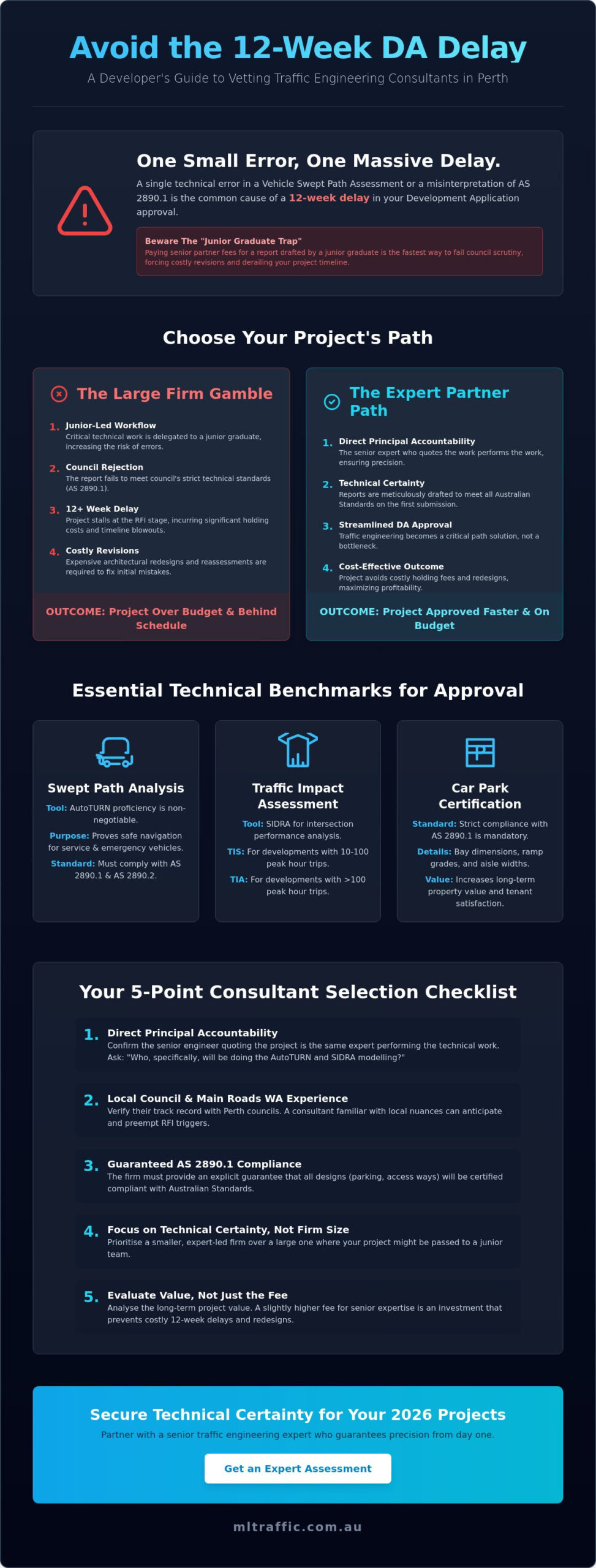
A 12-week delay in your development application often traces back to a single technical error in a Vehicle Swept Path Assessment or a misinterpretation of AS 2890.1. You understand that in the Perth property market, time is capital. It’s frustrating to pay for a senior partner’s expertise only to receive a report drafted by a junior graduate that fails council scrutiny on the first submission.
This traffic engineering consultants comparison Perth provides the specific framework you need to vet firms based on technical precision and direct principal accountability. We’ll show you how to evaluate consultants to ensure your Traffic Impact Assessment (TIA) meets every Australian Standard without the need for costly revisions. You’ll discover how to secure a partner who guarantees that the senior engineer providing the quote is the same expert performing the work. This guide outlines how to achieve faster DA approvals and cost-effective outcomes for your 2026 projects by prioritizing technical accuracy over firm size.
Key Takeaways
- Understand why traffic engineering is a critical path item and how expert assessments streamline the Development Application (DA) process for faster approvals.
- Perform an effective traffic engineering consultants comparison Perth by prioritizing direct principal access and accountability over large-firm junior-led workflows.
- Identify the essential technical benchmarks for SIDRA and AutoTURN software to ensure your Swept Path Analysis complies with Australian Standards.
- Avoid the “Junior Graduate Trap” and the associated 12-week council delays by ensuring the consultant who quotes the work is the one performing the technical assessment.
- Utilise a 5-point selection checklist to evaluate firms based on technical certainty and long-term project value rather than just the lowest initial fee.
Table of Contents
-
Understanding the Role of Traffic Engineering Consultants in Australian Developments
-
Key Criteria for Comparing Traffic Engineering Consultants in Perth
-
Technical Benchmarks: Evaluating TIA and Swept Path Analysis Quality
-
Avoiding the Junior Graduate Trap in Traffic Impact Statements
-
Selecting the Right Consultant for Your Development Application
Understanding the Role of Traffic Engineering Consultants in Australian Developments
Traffic engineering consultants manage the technical interface between a proposed development and the public transport network. Within the Development Application (DA) process, their role is essential for securing approvals from local councils and Main Roads Western Australia. Developers conducting a traffic engineering consultants comparison Perth should prioritize firms that understand the 2026 regulatory environment and the specific requirements of the Western Australian Planning Commission (WAPC).
To understand the technical foundations, it helps to ask What is Traffic Engineering? and how it applies to civil infrastructure. Traffic engineering is a critical path item because delays in traffic assessments often stall the entire project timeline. A poorly designed access point or insufficient parking can lead to a refusal at the RFI (Request for Information) stage. This results in significant holding costs and potential project failure. The consultant’s job is to balance the architect’s vision with strict council requirements and road safety standards.
To better understand this concept, watch this helpful video:
When is a Traffic Engineering Consultant Required?
Projects usually trigger the need for a consultant when there’s a change in land use, an increase in residential density, or a modification to site access. For instance, converting a warehouse into a multi-unit residential complex requires a formal assessment of how new vehicle trips affect local intersections. Early-stage involvement is vital. Waiting until the RFI stage to address sight-line issues or driveway gradients often necessitates expensive architectural redesigns that could’ve been avoided. The type of report required depends on the scale of the impact:
-
Traffic Impact Statement (TIS): This is required for smaller developments with moderate traffic increases, typically between 10 and 100 vehicle trips during peak hours.
-
Traffic Impact Assessment (TIA): This more rigorous document is necessary for larger projects generating over 100 peak-hour trips.
Core Deliverables for Successful Approvals
A professional consultant provides technical documentation that serves as legal evidence during planning tribunals or State Administrative Tribunal (SAT) hearings. When performing a traffic engineering consultants comparison Perth, ensure the firm provides senior-level oversight on all deliverables. High-quality parking design doesn’t just satisfy council; it increases property value by ensuring long-term usability for tenants. Key deliverables include:
-
TIA Reports: Detailed analysis of traffic generation, distribution, and impact on the surrounding road network. For large-scale projects, a comprehensive Traffic Impact Assessment is the primary document used to negotiate with authorities.
-
Swept Path Analysis: Using software like AutoTURN to prove that waste trucks, delivery vans, and emergency vehicles can safely navigate the site.
-
Car Park Certifications: Technical confirmation that the layout, ramp grades, and bay dimensions comply with Australian Standard AS 2890.1.
The long-term impact of these documents is significant. Meticulous parking design reduces the risk of vehicle damage and improves the flow of traffic within the site. This directly affects the commercial viability and tenant satisfaction of the completed development.
Key Criteria for Comparing Traffic Engineering Consultants in Perth
Choosing the right partner for your development application requires more than just looking at a company logo. A thorough traffic engineering consultants comparison Perth reveals that firm structure directly dictates project outcomes. Large multi-disciplinary firms carry heavy overheads and often assign technical drafting to junior staff. In contrast, specialized boutique consultancies offer concentrated expertise with direct accountability. Developers must weigh the "one-stop-shop" convenience of Tier-1 firms against the precision and senior-level involvement of specialists.
Accountability: The Principal-Led Advantage
A "no-gatekeeper" policy is essential for maintaining project momentum. You need to speak directly to the engineer drafting your report, not a project manager or a junior graduate. This direct access reduces communication errors during the RFI (Request for Information) stage. Senior engineers with 30 to 40 years of experience understand the nuances of local government requirements better than anyone else. They ensure every report aligns with WA’s official Transport Impact Assessment guidelines from the first draft. At ML Traffic Engineers, the consultant who provides the quote is the one who does the work. This eliminates the risk of technical details being lost in translation between departments.
The Exhaustive Experience List
Experience should be measured by site volume and variety, not just years in business. A consultant who has assessed 10,000+ sites has likely encountered every possible council objection. This breadth of knowledge provides the technical certainty developers need to secure approvals. Versatility across land-use types is a primary factor in any traffic engineering consultants comparison Perth. A seasoned firm should demonstrate a track record involving:
-
Apartments, bars, cafes, and childcare centres.
-
Churches, clubs, fast food outlets, and gymnasiums.
-
Hospitals, hotels, medical centres, and motels.
-
Offices, reception centres, schools, and service stations.
-
Shops, showrooms, taverns, temples, and warehouses.
This exhaustive list proves a consultant can handle the specific traffic generation and parking requirements of any project. You can review the full scope of these capabilities on the ML Traffic Services page.
Pricing Models and Transparency
Avoid billable hour models that lead to budget blowouts. They create unnecessary uncertainty for development feasibility studies. Transparent, fixed-fee quotes are the industry gold standard. This ensures the price you agree on is the price you pay, even if a council officer requests minor technical revisions. Fixed-fee transparency protects your ROI and ensures the consultant is incentivised to produce accurate, compliant work the first time. If you require a reliable assessment for your next development, contact our senior engineers for a direct, fixed-fee quote.
Technical Benchmarks: Evaluating TIA and Swept Path Analysis Quality
Technical precision distinguishes a reliable Traffic Impact Assessment (TIA) from one that fails during the council review stage. When conducting a traffic engineering consultants comparison Perth, developers must scrutinize the software tools and methodology used. Professional firms rely on SIDRA INTERSECTION for capacity analysis and AutoTURN for vehicle maneuverability. These tools provide the empirical data needed to justify development intensity to local government authorities.
Compliance with AS 2890.1 and AS 2890.2
AS 2890.1 is the benchmark for off-street parking facilities. This standard dictates everything from the width of a parking bay to the specific gradient of a driveway ramp. Achieving AS 2890.1 compliance is increasingly complex as modern vehicle dimensions evolve. A report must demonstrate that sight distances at the property boundary meet safety requirements, ensuring exiting drivers can see pedestrians and oncoming traffic clearly. Failure to meet these metrics often results in immediate planning rejections.
-
Ramp grades: Maximum gradients shouldn’t exceed 1:5 for private car parks to prevent vehicle scraping.
-
Sight lines: Compliance with Figure 3.2 of AS 2890.1 is mandatory for all new crossovers.
-
Headroom: Minimum vertical clearances of 2.2 metres for general parking and 2.5 metres for accessible spaces are strictly enforced.
AutoTURN and Digital Maneuverability
Digital swept path analysis prevents physical access failures once construction is complete. Manual turning circles aren’t accepted by most Australian councils because they lack the precision of computer-aided design. Consultants must test for specific vehicle classes based on the development type. For residential projects, this usually involves the B99 vehicle, representing the 99th percentile car. Commercial or industrial sites require testing for Small Rigid Vehicles (SRVs), Heavy Rigid Vehicles (HRVs), or even 19-metre semi-trailers and concrete trucks.
A templated report is easy to spot and often leads to council objections. These documents usually contain generic data and fail to account for the specific geometry of the Perth site. If a report doesn’t include detailed AutoTURN overlays showing the wheel paths and body clearance of the design vehicle, it’s likely to be flagged. Quality traffic engineering consultants comparison Perth should focus on firms that provide site-specific analysis rather than recycled text blocks. Accurate technical benchmarks ensure the project moves from the planning phase to the construction phase without costly redesigns or operational failures.
Avoiding the Junior Graduate Trap in Traffic Impact Statements
Many developers assume a prestigious firm name guarantees a seamless approval process. In reality, large consultancies often operate on a "Senior Signature, Junior Draft" model. A graduate with less than 24 months of experience drafts the Traffic Impact Statement (TIS), while a senior engineer spends ten minutes reviewing and signing it. This workflow is a primary point of failure in any
**traffic engineering consultants comparison Perth
**developers perform.
Junior errors aren’t just clerical; they’re financial. An overlooked driveway sight-line or an incorrect parking bay grade can trigger a formal Request for Information (RFI) from councils like the City of Stirling or City of Wanneroo. This typically adds 12 weeks to the planning approval cycle. For a multi-million dollar development, three months of additional holding costs and interest payments can exceed A$50,000. You’re often paying for the firm’s CBD office lease and extensive marketing team rather than the actual engineering expertise applied to your site.
Red Flags During the Quoting Process
Identifying a high-risk consultant starts before the engagement letter is signed. Watch for these indicators:
-
Absence of a named senior engineer: If the quote doesn’t explicitly state that a senior engineer with 20+ years of experience will personally conduct the assessment, expect graduate-level work.
-
Omitted technical requirements: Quotes that fail to mention specific swept path analysis requirements for waste or delivery vehicles are incomplete. These are mandatory for most Perth metropolitan councils.
-
Low-ball initial fees: Some firms quote low to win the job, then charge excessive hourly rates for RFI responses. A quality traffic engineering consultants comparison Perth should look at the total cost to reach "Approval in Principle," not just the initial report fee.
The Value of Meticulous Technical Review
Technical precision directly impacts a developer’s bottom line. Every report must be rigorously checked against the Western Australian Planning Commission (WAPC) guidelines and AS 2890.1 standards. Senior-led firms maintain higher success rates because they anticipate council objections before the report is submitted.
A meticulous review ensures that the proposed parking layout maximizes yield without violating local planning schemes. When an engineer with 30 years of experience handles the file, they don’t just report on the traffic; they defend the design. This level of accountability is only possible when the person who provides the quote is the person who does the work.
[Contact our senior engineers directly to discuss your Perth development project.
](https://www.mltraffic.com.au/contact/)
Selecting the Right Consultant for Your Development Application
Choosing the final partner for your project requires more than a simple fee comparison. When performing a traffic engineering consultants comparison Perth developers must look beyond the bottom line to evaluate technical reliability. A low initial quote often masks the risk of substantial downstream costs. If a report is rejected by a local council or the Department of Planning, Lands and Heritage, the resulting delays can cost tens of thousands of dollars in holding costs and lost time. Technical certainty is the only metric that protects your ROI.
The Final Selection Checklist
Before signing a service agreement, verify these five critical factors to ensure your application stands up to regulatory scrutiny:
-
Specific Land-Use Expertise: Confirm the consultant has successfully handled your specific project type, whether it’s a high-density apartment block, a medical centre, or a complex industrial warehouse.
-
Senior Engineer Involvement: Ensure the professional who provides the quote is the same person performing the assessment. Many large firms use senior names to win bids but delegate the actual work to junior graduates.
-
Trading History: Prioritize firms with over 15 years of continuous trading history. This longevity proves they understand the evolving Australian Standards and local Perth planning codes.
-
Direct Access: You should have a direct mobile number for the lead engineer. Avoid firms where you’re forced to navigate through administrative gatekeepers or project managers.
-
Compliance Knowledge: The consultant must demonstrate total mastery of AS 2890.1 (Off-street car parking) and relevant WAPC guidelines.
To get the most accurate quote, prepare a detailed brief. Include your latest architectural site plans, the total Gross Floor Area (GFA), and a clear description of the proposed land use. This transparency prevents "scope creep" and ensures the fee you’re quoted is the fee you’ll pay.
Partnering with ML Traffic Engineers
ML Traffic Engineers eliminates the uncertainty of the development application process. Our principal engineers, Michael Lee and Benny Chen, each bring between 35 and 40 years of specialized experience to every project. We’ve been trading since 2005 and have completed assessments for over 10,000 sites across Australia. This volume of work gives us an unparalleled database of precedents to support your application.
We operate on a "No Bureaucracy" promise. When you engage us, you get direct mobile access to the experts. We don’t use juniors; the traffic consultant who provides your quote is the one who does the work. This ensures that every Vehicle Swept Path Assessment and Traffic Impact Statement (TIS) meets the highest professional standards from the first draft. It’s a hands-on, accountable approach designed to get your project approved without unnecessary revisions.
Ready to secure a national-standard assessment for your Perth project? Contact ML Traffic today to speak directly with our senior principals and receive a direct, fact-based quote for your development.
Secure Your Development Approval with Proven Technical Expertise
Navigating a traffic engineering consultants comparison Perth requires a focus on technical accountability and direct experience. Your development application depends on precise TIA reporting and specialized AutoTURN analysis that adheres strictly to AS 2890 standards. Selecting a firm that avoids the junior graduate trap ensures your project doesn’t stall during the council review phase. At ML Traffic Engineers, the consultant who provides your quote is the one who performs the work. We’ve assessed over 10,000 sites since 2005, providing developers with reliable data and clear pathways to approval. You’ll work directly with principals who possess over 35 years of industry experience. This ensures every swept path assessment and parking study is handled with professional authority. Don’t risk your project timeline with outsourced or entry-level reporting. Our principal-led approach delivers the technical certainty required for complex Australian developments. We look forward to helping you achieve a successful project outcome.
Get a Principal-Led Traffic Assessment Quote Today
Frequently Questions and Answers
What is the difference between a Traffic Impact Assessment (TIA) and a Traffic Impact Statement (TIS)?
A Traffic Impact Statement (TIS) is a concise report for smaller developments that generate fewer than 10 to 100 vehicle trips during peak hours. It focuses on immediate site access and basic parking requirements. A Traffic Impact Assessment (TIA) is a detailed study for larger projects that significantly alter the surrounding road network. TIAs require complex SIDRA intersection modeling and long-term traffic forecasting to meet Western Australian planning standards.
How much does a traffic engineering report cost for a standard development application?
Fees for a traffic engineering report depend entirely on the scale and complexity of the proposed development. Small residential or commercial applications have lower technical requirements, while major shopping centres or industrial hubs require a higher investment for data collection and modeling. To get an accurate figure, you should request a site-specific quote. At ML Traffic Engineers, the senior consultant who provides your quote is the same expert who completes the technical work.
Why does my car park design need to comply with AS 2890.1?
AS 2890.1 is the mandatory Australian Standard for Off-Street Car Parking that dictates specific dimensions for bays, aisles, and ramps. Perth local councils will reject development applications that fail to meet these technical requirements. Compliance ensures that 99% of B99 vehicles can safely navigate your facility without property damage or safety risks. Adhering to these standards protects developers from future liability and ensures the functional longevity of the asset.
How long does it take for a traffic engineering consultant to complete a TIA?
A standard TIA typically takes 10 to 15 business days to complete once the final site plans are provided. This timeframe includes necessary data collection, trip generation calculations, and intersection analysis. More complex projects involving historical data or extensive council consultation might require up to 20 business days. Early engagement with traffic engineering consultants comparison Perth experts helps prevent delays in the development application submission process.
What is Swept Path Analysis and why is it required for concrete trucks?
Swept Path Analysis uses specialized software to simulate the physical space a vehicle requires while turning. It’s required for concrete trucks to verify that heavy rigid vehicles (HRV) can access the site without striking curbs, walls, or parked cars. For a standard 10.5-metre concrete truck, the analysis confirms the driveway and internal roads accommodate the vehicle’s specific turning radius. This prevents costly structural modifications during the construction phase.
Can a traffic engineer help justify a reduction in required parking spaces?
Yes, a traffic engineer can justify a parking reduction through a formal Car Parking Demand Assessment. We analyze local census data, proximity to high-frequency public transport, and reciprocal parking opportunities to prove that statutory requirements exceed actual needs. Councils often accept a 20% to 30% reduction if the report demonstrates that the development won’t cause overspill into residential streets. This assessment often saves developers significant costs in basement excavation.
What happens if my traffic report is rejected by the local council?
If a council rejects your report, it usually results in a Request for Further Information (RFI) or a formal refusal of the DA. This typically adds 4 to 8 weeks to your project timeline and increases holding costs. Most rejections occur due to non-compliance with AS 2890.1 or the use of outdated traffic data. Our senior engineers handle council negotiations directly to resolve technical objections and secure approval without requiring a total project redesign.
Is a traffic management plan the same as a traffic impact assessment?
A Traffic Management Plan (TMP) is not the same as a Traffic Impact Assessment. A TIA evaluates the permanent, long-term impact of a new development on the existing road network and parking supply. In contrast, a TMP focuses on temporary safety measures required during the construction phase, such as lane closures, signage, and pedestrian detours. Both documents are essential for compliance, but they serve different stages of the development lifecycle and follow different regulations.
Which areas do you cover?
We are traffic engineers servicing Alexander Heights, Alfred Cove, Alkimos, Anketell, Applecross, Ardross, Armadale, Ascot, Ashby, Ashendon, Ashfield, Attadale, Atwell, Aubin Grove, Aveley, Balcatta, Baldivis, Balga, Ballajura, Banksia Grove, Bassendean, Bateman, Bayswater, Beaconsfield, Beckenham, Bedford, Beechboro, Beeliar, Beldon, Bellevue, Belmont, Bentley, Bertram, Bibra Lake, Bicton, Booragoon, Brentwood, Brigadoon, Brookdale, Bull Creek, Bullsbrook, Burns Beach, Burswood, Butler, Byford, Canning Vale, Cannington, Carine, Carlisle, Carramar, Casuarina, Caversham, Champion Lakes, Chidlow, Churchlands, City Beach, Claremont, Clarkson, Cloverdale, Cockburn Central, Connolly, Coogee, Coolbellup, Coolbinia, Cottesloe, Craigie, Crawley, Currambine, Dalkeith, Darch, Doubleview, East Perth, Edgewater, Ellenbrook, Floreat, Fremantle, Girrawheen, Greenwood, Guildford, Hamilton Hill, Heathridge, Hillarys, Inglewood, Joondalup, Kallaroo, Kingsley, Leeming, Mandurah, Maylands, Melville, Midland, Mindarie, Morley, Mosman Park, Mount Hawthorn, Mount Lawley, Mullaloo, Nedlands, North Perth, Northbridge, Ocean Reef, Osborne Park, Padbury, Perth, Piara Waters, Rockingham, Scarborough, South Perth, Subiaco, Swanbourne, Thornlie, Tuart Hill, Victoria Park, Wangara, Wanneroo, Warwick, Wembley, West Perth, Willetton, Woodvale, Yokine.

Disclaimer
The content on www.mltraffic.com.au, including all technical articles, guides, and resources, is provided for general informational and educational purposes only. It is not intended to constitute professional advice in traffic engineering, transportation planning, development approvals, or any other technical or legal field.
While ML Traffic Engineers makes every reasonable effort to ensure the accuracy, completeness, and timeliness of the information published, we do not provide any warranties or representations (express or implied) regarding its reliability, suitability, or availability for any particular purpose. Any reliance you place on the content is strictly at your own risk.
In no event shall ML Traffic Engineers, its directors, employees, authors, or affiliates be liable for any direct, indirect, incidental, special, consequential, or punitive damages (including, without limitation, loss of profits, data, or business opportunities) arising out of or in connection with the use of, or inability to use, any information provided on this website.
The articles and guides on this site are not a substitute for engaging a qualified, registered professional traffic engineer (such as an NPER or RPEQ engineer) to assess your specific project requirements. For tailored advice, compliance assessments, or traffic engineering services, please contact a competent professional.
This disclaimer may be updated from time to time without notice. By accessing or using this website, you agree to be bound by the most current version of this disclaimer.
