

A single non-compliant driveway ramp grade can trigger a council rejection that stalls a Sydney development for over 180 days. You’re likely aware that the DA process in high-pressure urban environments is increasingly technical, and a report drafted by an unsupervised junior staffer often leads to expensive redesigns. Conducting a rigorous traffic engineering consultants comparison Sydney is the only way to protect your project from these common bureaucratic bottlenecks.
This article provides a professional framework for selecting experts who guarantee AS 2890.1 compliance and bring experience from over 10,000 successful site assessments. We’ll show you how to vet for senior-level involvement to ensure the traffic consultant who provides the quote is the one actually doing the work. You’ll gain the specific criteria needed to secure fast council approvals while maintaining direct, gatekeeper-free communication with the engineers responsible for your project’s success.
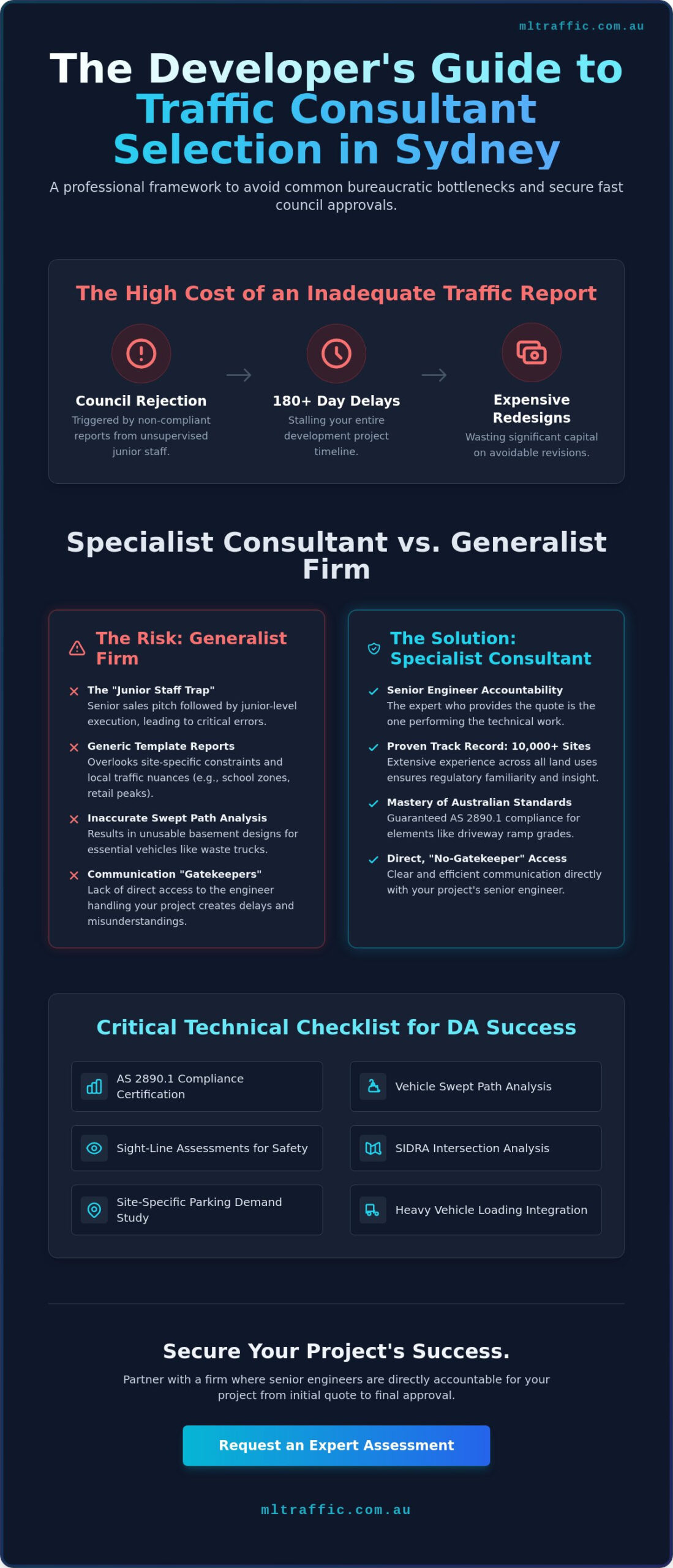
Key Takeaways
- Understand why generic traffic reports fail in high-density Australian urban environments without site-specific data and specialized technical analysis.
- Apply a professional framework for a traffic engineering consultants comparison Sydney to accurately assess firm experience and regulatory compliance.
- Avoid the “junior staff” trap by identifying firms where senior engineers remain directly accountable for your project from the initial quote to completion.
- Identify critical technical requirements for a successful DA, including comprehensive Vehicle Swept Path Analysis and certification against current Australian Standards (AS 2890.1).
- Learn how direct access to seasoned principals and a proven track record across 10,000+ sites can streamline complex development application processes.
##Table of Contents
-
Why Traffic Solutions for Congested Areas Require Specialized Consulting
-
Key Criteria for Comparing Traffic Engineering Consultants in Sydney
-
Comparing Boutique vs. Large-Scale Traffic Engineering Firms
-
Checklist: Evaluating Traffic Impact Assessments for High-Density Projects
-
Why ML Traffic Engineers is the Preferred Choice for Australian Developers
##Why Traffic Solutions for Congested Areas Require Specialized Consulting
Traffic engineering in high-density Australian urban environments involves the application of scientific techniques to facilitate the safe and efficient movement of people and goods. In Sydney, where 2023 data shows congestion levels reaching 92% of pre-pandemic peaks in key corridors, standard assessments are insufficient. A comprehensive traffic engineering consultants comparison Sydney reveals that specialized firms focus on site-specific constraints rather than generic modeling. Effective planning relies on fundamental traffic engineering principles to address the friction between private development and public infrastructure.
The success of a Development Application (DA) frequently hinges on the quality of the Traffic Impact Assessment (TIA). Local councils, such as the City of Sydney or North Sydney Council, scrutinize how new projects affect existing congestion. Inadequate reports result in RFI (Request for Further Information) letters or outright refusals. High-density zones require precise parking demand assessments because a 10% error in peak hour calculations can lead to permanent gridlock on residential streets. Congestion directly impacts vehicle access requirements, often necessitating complex driveway ramp grade calculations to comply with AS 2890.1 standards.
To better understand the distinction between broad transport planning and technical traffic engineering, watch this helpful video:
The Complexity of High-Density Traffic Planning
Managing high-density environments requires balancing the needs of pedestrians, cyclists, and heavy vehicles within fixed road boundaries. Established Sydney suburbs often feature limited sight distances due to heritage structures and narrow road reserves. Technical intersection analysis using software like SIDRA is mandatory to maintain local road network flow. Key challenges include:
-
Ensuring vehicle access points don’t compromise the safety of the 1,500+ pedestrians crossing a city-fringe intersection during a single morning peak.
-
Developing Sight-Line Assessments that account for existing street furniture and mature vegetation.
-
Integrating heavy vehicle loading requirements without disrupting the flow of light passenger traffic.
Common Pitfalls in Generalist Traffic Reports
Generalist firms often overlook localized traffic peaks, such as school zones or Saturday morning retail traffic, which trigger council objections. When performing a traffic engineering consultants comparison Sydney, it’s vital to identify firms that account for the cumulative impact of multiple neighboring developments under construction simultaneously. Specialist traffic engineering services provide the technical rigor needed to avoid these costly design revisions. Common errors include:
-
Inaccurate swept path analysis for tight urban footprints, leading to basement designs that are physically impossible for waste collection vehicles to navigate.
-
Failing to provide a "no-gatekeepers" approach where the senior engineer who quotes the work also performs the technical assessment.
-
Ignoring the specific parking requirements of varied land uses, from apartments and medical centers to bars and warehouses.
##Key Criteria for Comparing Traffic Engineering Consultants in Sydney
Selecting the right firm requires a detailed traffic engineering consultants comparison Sydney. You need experts who understand the Australian regulatory framework from the ground up. Experience isn’t just a number; it’s a record of successful DA approvals. Look for consultants with between 30 and 40 years of experience who have handled over 10,000 sites. This breadth of land-use experience should cover everything: apartments, bars, boarding houses, child care centres, clubs, dwelling houses, industrial units, medical centres, motels, offices, reception centres, schools, shops, temples, and warehouses.
Professional accreditation is the baseline for reliability. Senior engineers must hold RPEQ (Registered Professional Engineer of Queensland) or equivalent senior qualifications to sign off on formal reports. This ensures the work aligns with the professional expectations of the Institute of Transportation Engineers ANZ, the region’s leading body for transport professionals. High-level qualifications guarantee that the engineer understands the technicalities and bureaucratic hurdles of the Sydney planning environment. It’s about ensuring your project meets every legal and safety benchmark before it reaches the council desk.
Qualifications and Regulatory Compliance
Adherence to AS 2890.1 (Off-street car parking) and AS 2890.2 (Off-street commercial vehicle facilities) is non-negotiable. These standards dictate the physical constraints of your development. A consultant must also master state-based traffic guidance schemes and have a documented history of meeting local council requirements. We believe in direct accountability. The traffic consultant who provides the quote is the one who does the work. There are no gatekeepers or junior staff members handling your critical compliance documents. This hands-on approach ensures that technical advice is consistent from the initial site visit to the final report signing.
Technical Depth vs. Surface-Level Statements
A surface-level report will lead to Council RFIs (Requests for Further Information) and costly delays. A robust traffic engineering consultants comparison Sydney should evaluate the following technical components:
-
TIS vs. TIA: Distinguish between a basic Traffic Impact Statement and a comprehensive Traffic Impact Assessment. Larger projects in congested areas require the latter to model complex traffic flows and intersection performance.
-
Driveway Ramp Grades: The consultant must provide detailed assessments of driveway ramp grades. This prevents vehicle scraping and ensures compliance with Australian Standards.
-
Car Parking Demand: Generic code requirements often don’t reflect reality. Assessments should be based on actual usage data to justify parking provisions that differ from standard rates.
-
Software Proficiency: Availability of specialized software like AutoTURN is vital. This allows for precise vehicle swept path analysis, proving that trucks, waste vehicles, or emergency services can navigate the site safely.
Accurate data and technical precision are the only ways to navigate Sydney’s complex traffic requirements. You can review our specific traffic engineering services to see how we address these criteria for private developers and commercial projects.
##Comparing Boutique vs. Large-Scale Traffic Engineering Firms
Choosing between a multinational consultancy and a boutique firm is a critical decision for developers in New South Wales. The outcome of your Development Application (DA) often hinges on the technical precision and responsiveness of your consultant. A traffic engineering consultants comparison Sydney reveals that while large firms have high brand recognition, they often lack the agility required for private development projects.
Large agencies often fall into the ‘junior staff’ trap. A senior partner might attend the initial meeting to secure the contract, but the actual technical work is frequently delegated to graduate engineers. This creates a disconnect. If a junior engineer lacks experience with specific Council requirements or Australian Standards like AS 2890.1, the resulting report may contain errors that lead to costly Requests for Information (RFIs). In a boutique firm, the senior expert you speak with is the person performing the calculations and drafting the Traffic Impact Statement (TIS).
Responsiveness is another differentiator. Sydney’s planning environment is fast-paced. When a Council officer requests a clarification on a driveway ramp grade or a parking assessment, you can’t afford to wait. Large firms often have multiple layers of management and administrative gatekeepers. This bureaucracy slows down communication. Boutique consultants provide direct access to principals, ensuring technical answers are delivered immediately to keep the DA process moving.
Cost-effectiveness is driven by overhead structures. Large firms maintain expensive CBD offices and extensive non-engineering departments. These costs are reflected in their hourly rates. Boutique firms operate with lower overheads, allowing them to provide senior-level expertise at a more competitive price point. You pay for engineering hours, not corporate infrastructure.
The Boutique Advantage: Accountability and Expertise
The core philosophy of a boutique firm is that the traffic consultant who provides the quote, does the work. This creates total accountability. Technical rigor remains consistent across every project because the principal engineer is personally involved in every swept path analysis and sight-line assessment. Building a long-term relationship with a senior engineer provides stability for your future developments. They understand your portfolio and your specific operational needs, leading to more tailored and effective traffic solutions.
When Large Agencies Might (or Might Not) Be Necessary
Large agencies are typically designed for massive government infrastructure projects, such as new motorways or rail networks worth over A$100 million. For private residential, commercial, or industrial developments, these firms often deprioritise smaller projects. Your A$5 million development is a priority for a boutique firm, whereas it might be at the bottom of the pile in a global agency. Understanding The Role of a Traffic Engineer in Developments is essential to ensure you choose a partner whose scale matches your project’s specific requirements.
##Checklist: Evaluating Traffic Impact Assessments for High-Density Projects
High-density developments in urban centres demand rigorous technical scrutiny. A standard Traffic Impact Assessment (TIA) that merely skims the surface won’t survive the Council or Transport for NSW (TfNSW) review process. When performing a traffic engineering consultants comparison Sydney, developers must evaluate the technical depth of previous reports. A professional assessment must do more than count cars; it must prove the site functions safely under peak pressure.
Every high-density project assessment should be measured against these four technical requirements:
-
Vehicle Swept Path Analysis: Does the report use CAD-based software to simulate real-world movements for the largest expected vehicles?
-
Standard Compliance: Are all parking spaces, ramp grades, and aisle widths certified against AS 2890.1 and AS 2890.2?
-
Construction Management: Is there a viable Traffic Guidance Scheme (TGS) to manage heavy vehicle movements during the build phase?
-
Future-Proofing: Does the modeling account for cumulative traffic growth from other approved developments in the immediate area?
Swept Path and Access Verification
In congested Sydney corridors, millimetres matter. We ensure that service vehicles, such as 8.8m medium rigid vehicles (MRV) or waste collection trucks, can enter and exit the site in a forward direction. This is a non-negotiable safety requirement for most local councils. Our engineers use industry-standard software to produce a detailed Swept Path Analysis Guide compliant report. We verify that driveway crossovers don’t conflict with existing utility poles or street trees and that sight-lines for exiting drivers meet the requirements of AS 2890.1:2004.
Parking and Pedestrian Safety
High-density sites often feature complex basement levels. A professional traffic engineering consultants comparison Sydney will show that experienced firms prioritise internal circulation. We check that car park designs meet the specific dimensions for B85 and B99 vehicles. This includes assessing headroom clearances for disabled parking spaces and ensuring ramp grades don’t cause vehicle scraping. Pedestrian safety is equally critical. The assessment must identify clear, separated walking paths from parking bays to lift cores to prevent accidents in high-traffic basement zones. We also review loading dock provisions to ensure delivery drivers don’t block thoroughfares or create hazards for residents.
Effective assessments also utilise SIDRA Intersection modeling to predict how the development affects local wait times. If a consultant can’t explain the Level of Service (LoS) changes at nearby intersections, the report is incomplete. We’ve managed over 10,000 sites since 2005, ensuring every technical detail stands up to authority questioning.
Speak directly with our senior engineers for a detailed project assessment.
##Why ML Traffic Engineers is the Preferred Choice for Australian Developers
Since 2005, ML Traffic Engineers has assessed over 10,000 sites across Australia. This volume of work provides a deep understanding of varied land-use types, from high-density apartments and medical centres to industrial warehouses and places of public worship. When performing a traffic engineering consultants comparison Sydney developers often prioritize reliability and technical accuracy. Our firm delivers on both by ensuring senior engineers manage every project phase.
We operate on a specific principle: the traffic consultant who provides your quote is the one who performs the technical work. This eliminates the risk of technical details being lost between sales teams and junior staff. Our comprehensive service suite includes:
-
Traffic Impact Assessments (TIA) and Statements (TIS)
-
Car Parking Demand Assessments
-
Vehicle Swept Path Analysis
-
Driveway ramp grade assessments according to AS 2890.1
-
Construction Traffic Management Plans (CTMP)
-
Sight-Line Assessments and RPEQ certification
We’ve successfully navigated complex council approvals for diverse developments. Our reports are designed to withstand the rigors of local government scrutiny, particularly in congested urban zones where traffic flow and safety are under constant pressure.
Our Direct Principal Access Model
Clients get direct mobile access to our principals, Michael Lee and Benny Chen. There are no gatekeepers or administrative layers to navigate. This model removes corporate bureaucracy, allowing us to deliver technical reports faster and with higher precision. Every assessment is backed by 30 to 40 years of individual engineering expertise. It’s a hands-on approach that ensures total accountability from the first quote to the final council submission.
National Reach with Local Technical Knowledge
While we operate nationally, our localized knowledge of congested urban environments is a critical asset. We understand how to mitigate traffic impacts in high-density areas where space is at a premium. Our reporting meets the strict requirements of Australian Standards and state-specific regulations. This technical precision is why we remain a top choice in any traffic engineering consultants comparison Sydney search. We don’t just provide data; we provide solutions that facilitate development approval.
Contact ML Traffic Engineers for a professional quote today
##Secure Your Development Approval in High-Density Zones
Navigating Sydney’s congested road networks requires technical precision and a deep understanding of AS 2890.1 standards. When performing a traffic engineering consultants comparison Sydney developers should focus on firms that offer direct accountability rather than delegating work to junior staff. A robust Traffic Impact Assessment is the difference between a seamless council approval and costly project delays. Experience in high-density sectors ensures your project meets rigorous compliance hurdles without compromising on design efficiency.
ML Traffic Engineers brings over 15 years of operational history to your project. We’ve assessed over 10,000 sites across Australia, providing reliable data for everything from residential apartments to complex industrial warehouses. You’ll work directly with senior principals who possess 30 to 40 years of individual industry experience. Our philosophy is simple; the consultant who provides your quote is the one who performs the technical work. This hands-on approach eliminates bureaucratic friction and ensures your TIA or TIS is technically sound from the start.
Take the next step in your development application with confidence. Get a Traffic Engineering Quote from a Senior Principal today and benefit from proven expertise.
##Frequently Asked Questions
What is the difference between a Traffic Impact Statement and a Traffic Impact Assessment?
A Traffic Impact Statement (TIS) is a concise report for small-scale developments with low trip generation. A Traffic Impact Assessment (TIA) is a comprehensive technical study required for larger projects that significantly alter local traffic flow. TIAs involve detailed data collection, SIDRA intersection modelling, and long-term impact forecasts. Most councils require a TIA when a development exceeds specific trip generation thresholds defined in the RMS Guide to Traffic Generating Developments.
How much does a traffic engineering consultant typically cost for a DA?
Professional fees for traffic engineering services are calculated based on the technical hours required for your specific project. A Traffic Impact Statement for a minor development requires fewer resources than a full Traffic Impact Assessment for a high-rise complex. Costs are influenced by the need for physical traffic counts, SIDRA modelling, and the number of intersections analyzed. You should ensure the consultant who provides the quote is the one performing the technical work to maintain accountability.
Why does council require a Swept Path Analysis for my development?
Councils require a Swept Path Analysis to verify that specific vehicles can safely maneuver within your site without hitting curbs or structures. This digital simulation uses software like AutoTURN to plot the path of a B99 car or a heavy rigid vehicle (HRV). It confirms compliance with AS 2890.1 and AS 2890.2. Without this analysis, you risk rejection if a driveway or loading dock is too narrow for standard service vehicles to turn safely.
Can a traffic engineer help with car park design compliance?
Traffic engineers ensure car park designs comply with Australian Standard AS 2890.1. We assess driveway ramp grades, aisle widths, and blind spots to prevent structural issues after construction. Our team reviews your architectural plans to identify non-compliant elements early. This process reduces the risk of costly redesigns and ensures the parking layout maximizes space while maintaining safety for all users.
What are the common reasons traffic reports get rejected by councils?
Traffic reports are frequently rejected because they use outdated traffic count data or fail to address specific council DCP requirements. Approximately 30% of rejections occur because the report doesn’t adequately model the impact on nearby signalised intersections during peak hours. Other common issues include incorrect vehicle classifications or failing to demonstrate that a B99 vehicle can enter and exit the site in a forward direction.
How long does it take to prepare a standard Traffic Impact Assessment report?
A standard Traffic Impact Assessment report typically takes between 10 and 15 business days to complete. This timeframe allows for site inspections, data analysis, and the drafting of the technical document. If your project requires new traffic counts or complex SIDRA modelling, the duration may extend to 20 business days. Providing your architectural plans and project brief early helps expedite the assessment process.
Is a Traffic Guidance Scheme (TGS) the same as a Traffic Management Plan (TMP)?
A Traffic Guidance Scheme (TGS) is not the same as a Traffic Management Plan (TMP). A TGS is a specific technical diagram, formerly called a Traffic Control Plan (TCP), showing the exact placement of signs and bollards. A TMP is a strategic document describing the broader impact of a project on the road network. When conducting a traffic engineering consultants comparison Sydney, ensure the firm can provide both for your construction phase.
Do I need a traffic engineer for a small residential development in a congested area?
You often need a traffic engineer for residential developments in congested areas if the site sits on a classified road or lacks sufficient off-street parking. Sydney councils frequently request a Traffic Impact Statement for dual occupancies or small apartment blocks to manage local street saturation. Our consultants analyze local traffic density to prove your development won’t worsen existing congestion. This expert evidence is vital for securing DA approval in competitive urban environments during any traffic engineering consultants comparison Sydney.
What areas do you cover?
We are traffic engineers servicing Abbotsbury, Abbotsford, Acacia Gardens, Agnes Banks, Airds, Alexandria, Alfords Point, Allambie Heights, Allawah, Ambarvale, Angus, Annandale, Annangrove, Arcadia, Arncliffe, Arndell Park, Artarmon, Ashbury, Ashcroft, Ashfield, Asquith, Auburn, Austral, Avalon Beach, Badgerys Creek, Balgowlah, Balgowlah Heights, Balmain, Balmain East, Bangor, Banksia, Banksmeadow, Bankstown, Bankstown Aerodrome, Barangaroo, Barden Ridge, Bardia, Bardwell Park, Bardwell Valley, Bass Hill, Baulkham Hills, Bayview, Beacon Hill, Beaconsfield, Beaumont Hills, Beecroft, Belfield, Bella Vista, Bellevue Hill, Belmore, Belrose, Berala, Berkshire Park, Berowra, Berowra Heights, Berowra Waters, Berrilee, Beverley Park, Beverly Hills, Bexley, Bexley North, Bidwill, Bilgola Beach, Bilgola Plateau, Birchgrove, Birrong, Blackett, Blacktown, Blair Athol, Blairmount, Blakehurst, Bligh Park, Bondi, Bondi Beach, Bondi Junction, Bonnet Bay, Bonnyrigg, Bonnyrigg Heights, Bossley Park, Botany, Bow Bowing, Box Hill, Bradbury, Bradfield, Breakfast Point, Brighton-Le-Sands, Bringelly, Bronte, Brooklyn, Brookvale, Bundeena, Bungarribee, Burraneer, Burwood, Burwood Heights, Busby, Cabarita, Cabramatta, Cabramatta West, Caddens, Cambridge Gardens, Cambridge Park, Camellia, Cammeray, Campbelltown, Camperdown, Campsie, Canada Bay, Canley Heights, Canley Vale, Canoelands, Canterbury, Caringbah, Caringbah South, Carlingford, Carlton, Carnes Hill, Carramar, Carss Park, Cartwright, Castle Cove, Castle Hill, Castlecrag, Castlereagh, Casula, Catherine Field, Cattai, Cecil Hills, Cecil Park, Centennial Park, Chatswood, Chatswood West, Cheltenham, Cherrybrook, Chester Hill, Chifley, Chippendale, Chipping Norton, Chiswick, Chullora, Church Point, Claremont Meadows, Clarendon, Clareville, Claymore, Clemton Park, Clontarf, Clovelly, Clyde, Coasters Retreat, Cobbitty, Colebee, Collaroy, Collaroy Plateau, Colyton, Como, Concord, Concord West, Condell Park, Connells Point, Constitution Hill, Coogee, Cottage Point, Cowan, Cranebrook, Cremorne, Cremorne Point, Cromer, Cronulla, Crows Nest, Croydon, Croydon Park, Curl Curl, Currans Hill, Currawong Beach, Daceyville, Dangar Island, Darling Point, Darlinghurst, Darlington, Davidson, Dawes Point, Dean Park, Dee Why, Denham Court, Denistone, Denistone East, Denistone West, Dharruk, Dolans Bay, Dolls Point, Doonside, Double Bay, Dover Heights, Drummoyne, Duffys Forest, Dulwich Hill, Dundas, Dundas Valley, Dural, Eagle Vale, Earlwood, East Hills, East Killara, East Lindfield, East Ryde, Eastern Creek, Eastgardens, Eastlakes, Eastwood, Edensor Park, Edgecliff, Edmondson Park, Elanora Heights, Elderslie, Elizabeth Bay, Elizabeth Hills, Elvina Bay, Emerton, Enfield, Engadine, Englorie Park, Enmore, Epping, Ermington, Erskine Park, Erskineville, Eschol Park, Eveleigh, Fairfield, Fairfield East, Fairfield Heights, Fairfield West, Fairlight, Fiddletown, Five Dock, Forest Glen, Forest Lodge, Forestville, Frenchs Forest, Freshwater, Gables, Galston, Georges Hall, Gilead, Girraween, Gladesville, Glebe, Gledswood Hills, Glen Alpine, Glendenning, Glenfield, Glenhaven, Glenmore Park, Glenorie, Glenwood, Gordon, Grantham Farm, Granville, Grays Point, Great Mackerel Beach, Green Valley, Greenacre, Greendale, Greenfield Park, Greenhills Beach, Greenwich, Gregory Hills, Greystanes, Guildford, Guildford West, Gymea, Gymea Bay, Haberfield, Hammondville, Harrington Park, Harris Park, Hassall Grove, Haymarket, Heathcote, Hebersham, Heckenberg, Henley, Hillsdale, Hinchinbrook, Hobartville, Holroyd, Holsworthy, Homebush, Homebush West, Horningsea Park, Hornsby, Hornsby Heights, Horsley Park, Hoxton Park, Hunters Hill, Huntingwood, Huntleys Cove, Huntleys Point, Hurlstone Park, Hurstville, Hurstville Grove, Illawong, Ingleburn, Ingleside, Jamisontown, Jannali, Jordan Springs, Kangaroo Point, Kareela, Kearns, Kellyville, Kellyville Ridge, Kemps Creek, Kensington, Kenthurst, Kentlyn, Killara, Killarney Heights, Kings Langley, Kings Park, Kingsford, Kingsgrove, Kingswood, Kirkham, Kirrawee, Kirribilli, Kogarah, Kogarah Bay, Ku-ring-gai Chase, Kurnell, Kurraba Point, Kyeemagh, Kyle Bay, La Perouse, Lakemba, Lalor Park, Lane Cove, Lane Cove North, Lane Cove West, Lansdowne, Lansvale, Laughtondale, Lavender Bay, Leets Vale, Leichhardt, Len Waters Estate, Leppington, Lethbridge Park, Leumeah, Lewisham, Liberty Grove, Lidcombe, Lilli Pilli, Lilyfield, Lindfield, Linley Point, Little Bay, Liverpool, Llandilo, Loftus, Londonderry, Long Point, Longueville, Lovett Bay, Lower Portland, Lucas Heights, Luddenham, Lugarno, Lurnea, Macquarie Fields, Macquarie Links, Macquarie Park, Maianbar, Malabar, Manly, Manly Vale, Maraylya, Marayong, Maroota, Maroubra, Marrickville, Marsden Park, Marsfield, Mascot, Matraville, Mays Hill, McCarrs Creek, McGraths Hill, McMahons Point, Meadowbank, Melonba, Melrose Park, Menai, Menangle Park, Merrylands, Merrylands West, Middle Cove, Middle Dural, Middleton Grange, Miller, Millers Point, Milperra, Milsons Passage, Milsons Point, Minchinbury, Minto, Minto Heights, Miranda, Mona Vale, Monterey, Moore Park, Moorebank, Morning Bay, Mortdale, Mortlake, Mosman, Mount Annan, Mount Colah, Mount Druitt, Mount Kuring-Gai, Mount Lewis, Mount Pritchard, Mount Vernon, Mulgoa, Mulgrave, Narellan, Narellan Vale, Naremburn, Narrabeen, Narraweena, Narwee, Nelson, Neutral Bay, Newington, Newport, Newtown, Nirimba Fields, Normanhurst, North Balgowlah, North Bondi, North Curl Curl, North Epping, North Kellyville, North Manly, North Narrabeen, North Parramatta, North Rocks, North Ryde, North St Marys, North Strathfield, North Sydney, North Turramurra, North Wahroonga, North Willoughby, Northbridge, Northmead, Northwood, Norwest, Oakhurst, Oakville, Oatlands, Oatley, Old Guildford, Old Toongabbie, Oran Park, Orchard Hills, Oxford Falls, Oxley Park, Oyster Bay, Paddington, Padstow, Padstow Heights, Pagewood, Palm Beach, Panania, Parklea, Parramatta, Peakhurst, Peakhurst Heights, Pemulwuy, Pendle Hill, Pennant Hills, Penrith, Penshurst, Petersham, Phillip Bay, Picnic Point, Pitt Town, Pleasure Point, Plumpton, Point Piper, Port Botany, Port Hacking, Potts Hill, Potts Point, Prairiewood, Prestons, Prospect, Punchbowl, Putney, Pymble, Pyrmont, Quakers Hill, Queens Park, Queenscliff, Raby, Ramsgate, Ramsgate Beach, Randwick, Redfern, Regents Park, Regentville, Revesby, Revesby Heights, Rhodes, Richards, Richmond, Riverstone, Riverview, Riverwood, Rockdale, Rodd Point, Rookwood, Rooty Hill, Ropes Crossing, Rose Bay, Rosebery, Rosehill, Roselands, Rosemeadow, Roseville, Roseville Chase, Rossmore, Rouse Hill, Rozelle, Ruse, Rushcutters Bay, Russell Lea, Rydalmere, Ryde, Sackville North, Sadleir, Sandringham, Sandy Point, Sans Souci, Schofields, Scotland Island, Seaforth, Sefton, Seven Hills, Shalvey, Shanes Park, Silverwater, Singletons Mill, Smeaton Grange, Smithfield, South Coogee, South Granville, South Hurstville, South Maroota, South Penrith, South Turramurra, South Wentworthville, South Windsor, Spring Farm, St Andrews, St Clair, St Helens Park, St Ives, St Ives Chase, St Johns Park, St Leonards, St Marys, St Peters, Stanhope Gardens, Stanmore, Strathfield, Strathfield South, Summer Hill, Surry Hills, Sutherland, Sydenham, Sydney, Sydney Olympic Park, Sylvania, Sylvania Waters, Tallawong, Tamarama, Taren Point, Telopea, Tempe, Tennyson Point, Terrey Hills, The Ponds, The Rocks, Thornleigh, Toongabbie, Tregear, Turramurra, Turrella, Ultimo, Varroville, Vaucluse, Villawood, Vineyard, Voyager Point, Wahroonga, Waitara, Wakeley, Wareemba, Warrawee, Warriewood, Warwick Farm, Waterfall, Waterloo, Watsons Bay, Wattle Grove, Waverley, Waverton, Wedderburn, Wentworth Point, Wentworthville, Werrington, Werrington County, Werrington Downs, West Hoxton, West Pennant Hills, West Pymble, West Ryde, Westleigh, Westmead, Wetherill Park, Whalan, Whale Beach, Wheeler Heights, Wiley Park, Willmot, Willoughby, Willoughby East, Windsor, Windsor Downs, Winston Hills, Wisemans Ferry, Wolli Creek, Wollstonecraft, Woodbine, Woodcroft, Woodpark, Woollahra, Woolloomooloo, Woolooware, Woolwich, Woronora, Woronora Heights, Yagoona, Yarrawarrah, Yennora, Yowie Bay, Zetland.

Disclaimer
The content on www.mltraffic.com.au, including all technical articles, guides, and resources, is provided for general informational and educational purposes only. It is not intended to constitute professional advice in traffic engineering, transportation planning, development approvals, or any other technical or legal field.
While ML Traffic Engineers makes every reasonable effort to ensure the accuracy, completeness, and timeliness of the information published, we do not provide any warranties or representations (express or implied) regarding its reliability, suitability, or availability for any particular purpose. Any reliance you place on the content is strictly at your own risk.
In no event shall ML Traffic Engineers, its directors, employees, authors, or affiliates be liable for any direct, indirect, incidental, special, consequential, or punitive damages (including, without limitation, loss of profits, data, or business opportunities) arising out of or in connection with the use of, or inability to use, any information provided on this website.
The articles and guides on this site are not a substitute for engaging a qualified, registered professional traffic engineer (such as an NPER or RPEQ engineer) to assess your specific project requirements. For tailored advice, compliance assessments, or traffic engineering services, please contact a competent professional.
This disclaimer may be updated from time to time without notice. By accessing or using this website, you agree to be bound by the most current version of this disclaimer.
