

We provide traffic engineering services to suburbs within City of Hobart, City of Glenorchy, City of Clarence, Kingborough Council, Brighton Council and Sorell Council.
A development application in Hobart should be a straightforward process, yet it is often derailed by council Requests for Further Information (RFIs) and vague communication from large consulting firms. Securing approval requires more than just a standard report; it demands precise, compliant traffic engineering. The right traffic engineering consultants Hobart developers trust understand that direct accountability and clear communication are non-negotiable for avoiding costly delays and hidden fees. This approach ensures your project maintains momentum, moving efficiently from submission to approval without the common frustrations that plague the DA process.
This guide outlines the critical role of expert traffic engineering in navigating the DA process for 2026. We will detail how to achieve streamlined council compliance, secure cost-effective design solutions, and benefit from a model where the senior consultant who provides your quote is the same expert who completes the work and answers your calls. Discover how to eliminate communication gaps and gain a faster, more predictable path to approval for your next Hobart development.
Key Takeaways
-
Discover why a professional traffic assessment from expert traffic engineering consultants Hobart is the key to proving your project’s viability and satisfying City of Hobart council requirements.
-
Understand which specific traffic reports your development needs, and how a strategic assessment could potentially reduce your required parking spaces.
-
Learn the critical difference between firms that delegate to junior staff and dedicated traffic engineering consultants Hobart who provide direct, senior-level accountability.
-
Uncover a clear strategy to streamline your DA process, starting with the single most important step to take before you finalise site plans.
Table of Contents
Why Traffic Engineering is the Make-or-Break Factor for Hobart Developments
In Hobart’s competitive development landscape, a Traffic Impact Assessment is far more than a formality; it is the critical evidence that proves your project’s viability to the City of Hobart or Glenorchy Council. While some developers see it as just counting cars, a professional understanding of what traffic engineering is reveals its true purpose: to ensure a development functions safely and efficiently within the existing transport network. The right team of traffic engineering consultants in Hobart bridges the gap between your architectural vision and the rigid technical requirements of Australian Standards (AS 2890), turning a potential roadblock into a key asset for your approval.
The stakes are getting higher. With new urban density targets set to reshape Hobart’s transport planning by 2026, council scrutiny on traffic impacts will only intensify. This makes proactive, expert planning more critical than ever.
Attempting to cut corners with a "cheap" report is a false economy that often leads to significant financial loss. An inadequate assessment that fails to address council concerns will trigger expensive delays, redesign costs, and mounting holding fees. Professional traffic engineering is not an expense; it is an investment in certainty and project momentum.
The Role of a Traffic Consultant in Your DA
An experienced consultant is an essential member of your development team, providing more than just a report. Their primary role is to:
-
Translate complex council requirements and the Tasmanian Planning Scheme into actionable, commercially-sensible design changes.
-
Serve as your expert advocate, professionally addressing concerns raised by council planners and traffic engineers during the assessment phase.
-
Ensure the final design achieves a critical balance between regulatory compliance, public safety, and your project’s commercial objectives.
Hobart’s Unique Planning Landscape
Hobart is not a generic city, and its traffic challenges require localised expertise. Standard solutions that may work on the mainland often fail when applied to the city’s unique constraints, such as the steep, narrow heritage streets of Battery Point or the constrained parking environment of North Hobart. Navigating the specific nuances of Hobart’s hilly topography and local planning schemes is essential for a smooth and successful Development Application.
Essential Traffic Reports for Your Hobart Council Approval
Navigating the Hobart City Council’s development approval process requires more than just architectural plans. You need a suite of specialised traffic engineering reports to demonstrate your project is safe, accessible, and compliant. These documents are not just bureaucratic hurdles; they are critical tools that, when prepared by experienced professionals, can unlock your site’s full potential and prevent costly delays. As your dedicated traffic engineering consultants in Hobart, we ensure every report is meticulously prepared to satisfy council requirements.
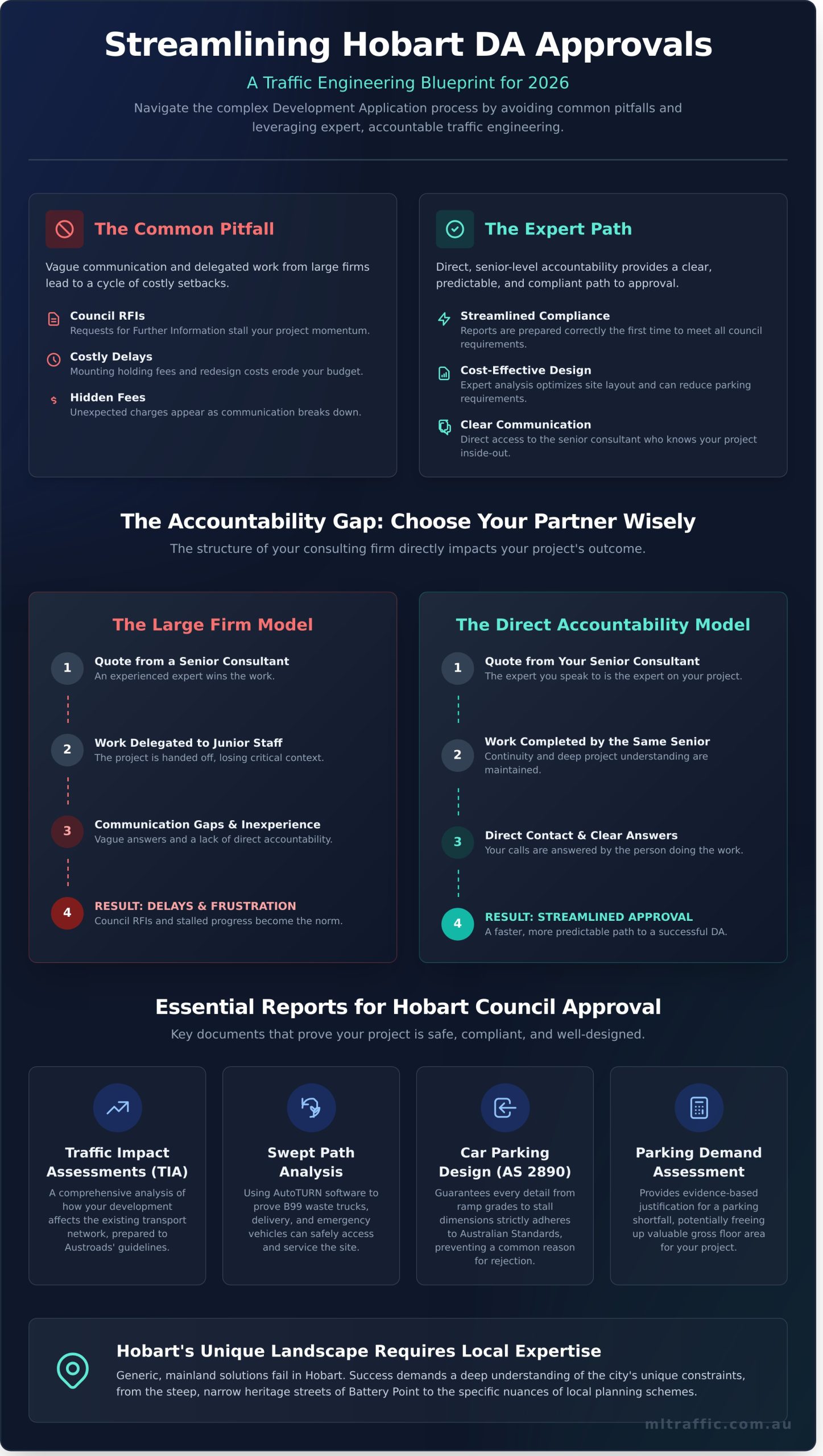
Traffic Impact Assessments (TIA) & Statements
A Traffic Impact Assessment is a comprehensive analysis of how a new land use affects the existing transport network. For major developments, a full TIA is the heavy lifter of your application, examining everything from trip generation to impacts on key Hobart arterial roads. Smaller projects may only require a simpler Traffic Impact Statement. Our assessments are prepared in line with Austroads’ national guidelines, giving Council the confidence to approve your proposal.
Maximizing Site Yield with Swept Path Analysis
Can an SrV waste collection truck service your site? Can residents safely navigate your proposed basement car park with a B85 car? Swept Path Analysis provides definitive answers. Using industry-standard AutoTURN software, we simulate vehicle movements to prove compliance for delivery, waste, and emergency vehicle access, which is essential in tight Hobart CBD spaces. Clever design informed by this analysis can optimize your layout, potentially saving you thousands of dollars in unnecessary excavation costs.
Car Parking Design and AS 2890 Compliance
A non-compliant car park is a guaranteed reason for council rejection. We ensure every aspect of your design-from ramp grades and stall dimensions to sight lines-strictly adheres to Australian Standards (AS 2890). Furthermore, if council parking rates seem excessive for your development, a professional Parking Demand Assessment can provide the evidence-based justification for a parking shortfall, freeing up valuable gross floor area. You can find more on our specific design certifications and services that prove compliance.
Finally, once your project is approved, a Traffic Guidance Scheme (TGS) becomes essential to manage traffic safely during the construction phase, ensuring a smooth transition from plan to reality.
The ML Traffic Advantage: Direct Accountability in Hobart
When you engage a large consultancy, a common risk is the "bait and switch." A senior director provides the quote, but your project is handed to a junior graduate engineer. This disconnect leads to delays, miscommunication, and reports that may not withstand Council scrutiny. At ML Traffic, we operate on a core principle of direct accountability: the consultant who provides your quote is the one who does the work.
This hands-on approach is critical for navigating the complexities of your Hobart Development Application. With over 30 years of specialised experience across more than 10,000 sites, our senior engineers bring a level of insight that only comes from direct, sustained involvement. We understand the specific requirements of local councils and know what it takes to get your project approved. When you need expert traffic engineering consultants in Hobart, you get an expert from start to finish.
No Gatekeepers, Just Results
Direct access to senior engineers like Michael Lee eliminates unnecessary layers of communication. This streamlined process results in faster turnaround times and a significant reduction in errors. When Council raises a technical question about your traffic impact assessment, the person who wrote the report is the one who answers it-with authority and clarity. This level of accountability is what sets us apart from larger firms and provides you with complete confidence in our work.
A Proven Track Record Across All Land Uses
Our extensive project history in Tasmania demonstrates our capability to handle any development type. We have provided traffic and parking assessments for a diverse range of projects, from boutique apartment developments in Sandy Bay to large-scale industrial warehouses in Derwent Park. Our portfolio includes successful outcomes for:
-
Child care centres
-
Medical clinics and allied health facilities
-
Retail and commercial developments
-
Places of worship and community centres
This breadth of experience ensures we apply proven, practical solutions to your specific land use challenges. You can check out our about page to see our history of over 10,000 successful assessments across Australia.
How to Streamline Your Hobart Traffic Assessment Process
A successful Development Application (DA) depends on a traffic impact assessment that is robust, accurate, and addresses all of Council’s requirements from the outset. A strategic approach not only improves your chances of approval but can significantly reduce project timelines and costs. The key is to treat traffic engineering not as a final hurdle, but as an integral part of your planning from day one.
Our process is designed for maximum efficiency, focusing on four critical steps:
-
Step 1: Early Engagement. Involve a traffic engineer before your site plans are finalised. This allows us to identify potential access or layout issues that are far simpler and cheaper to resolve on paper than during construction.
-
Step 2: Comprehensive Data Collection. We use current and accurate traffic counts and survey data. This robust evidence base is crucial for substantiating our recommendations and preventing skepticism from Council planners.
-
Step 3: Proactive Council Liaison. With decades of experience, we understand the specific concerns of Hobart City Council. We proactively address potential objections in our initial report, minimising delays.
-
Step 4: Design Optimisation. We analyse and refine driveway grades, parking layouts, and vehicle swept paths to ensure full compliance with Australian Standards (AS 2890.1) and maximum operational efficiency.
Avoiding the Dreaded Request for Further Information (RFI)
A council RFI is the most common cause of delay in the DA process. Hobart Council often issues traffic-related RFIs for inadequate parking justifications, poor vehicle sight lines, or non-compliant access designs. A high-quality, comprehensive initial report from experienced traffic engineering consultants in Hobart can pre-empt these questions, saving you 4-8 weeks. Should a project proceed to a planning appeal, we also provide expert witness services to defend the technical merits of your proposal.
Integrating Traffic with Other Planning Needs
Traffic engineering does not exist in a vacuum. Vehicle access directly impacts civil design for stormwater and site levels, while waste management plans depend on workable access for collection vehicles. This is why constant communication between your architect and traffic engineer is essential. A coordinated approach ensures design elements work together seamlessly, avoiding costly late-stage revisions. For more insights, explore our older articles or contact us to discuss your project’s specific needs.
Partnering with ML Traffic for Your Next Hobart Project
Moving your development from concept to reality requires precise coordination. The traffic engineering component is a critical step, but it does not have to be a complex one. At ML Traffic, we provide the clarity and expertise needed to navigate council requirements efficiently, ensuring your project maintains momentum. Don’t let traffic reports or car parking assessments become the hurdle that delays your Hobart development.
Engaging with the right team provides the peace of mind that comes from decades of specialised experience. We are registered, highly experienced professionals dedicated to delivering technically sound and commercially astute traffic engineering solutions that satisfy all local and state planning requirements.
What to Expect When You Contact Us
We eliminate the guesswork and administrative layers common in larger firms. When you partner with us for your traffic report, you receive a direct and streamlined service designed for results:
-
Direct Consultation: You will have a direct conversation with a senior engineer to discuss the specific requirements of your Hobart site. We listen to your objectives to provide targeted, effective advice.
-
Transparent Quoting: You will receive a clear, itemised quote detailing all work. We do not charge hidden "admin" or "sundry" fees. The price we quote is the price you pay.
-
Deadline Commitment: We understand the commercial pressures of development timelines. We commit to meeting your project deadlines, regardless of the report’s complexity.
Start Your Hobart DA on the Right Foot
Successful development applications are built on proactive planning. With major projects often planned years in advance, now is the time to secure your expert partners for developments targeting 2026 and beyond. Engaging professional traffic engineering consultants hobart early in the process is the most effective way to identify and resolve potential issues before they cause costly delays.
Our unique "quote-to-completion" promise means the senior engineer who assesses your needs and provides your quote is the same expert who will complete the technical work and sign off on the final report. This guarantees accountability and a seamless process from start to finish. To discuss your site and get your project started correctly, contact us to speak directly with an engineer today.
Your Next Step to a Successful Hobart Development Application
Navigating the Development Application process in Hobart requires precision, and as we’ve explored, your traffic engineering strategy is a critical component for success. A thorough, compliant traffic assessment is not just a box to tick-it’s the key to avoiding costly delays and ensuring your project moves forward smoothly. The difference between approval and rejection often lies in the expertise of your chosen consultant.
This is where ML Traffic provides a decisive advantage. With over 15 years of dedicated experience and more than 10,000 sites assessed, we are the traffic engineering consultants hobart developers trust for results. Our unique model guarantees that you work directly with our senior principal, Michael Lee. The expert who provides your quote is the expert who completes the work, ensuring direct accountability and unparalleled insight for your project.
Don’t leave your DA approval to chance. Secure the expertise your project deserves. Get a Direct Quote from a Senior Traffic Engineer today and let’s ensure your Hobart development is a success.
Frequently Asked Questions
How much does a traffic impact assessment cost in Hobart?
The cost of a traffic impact assessment is based on the project’s scale and complexity. A concise report for a small-scale development typically starts from A$2,500, while a comprehensive assessment for a large project requiring detailed intersection data collection and analysi can exceed A$6,000. We provide a fixed-fee proposal based on your specific plans, ensuring you have a clear understanding of the investment required to support your development application and prevent costly delays with Council.
Do I really need a traffic engineer for a small residential development?
Yes, in most cases, a traffic engineering report is a mandatory Council requirement, even for small residential projects. Developments that involve creating or modifying a vehicle crossover, adding a second dwelling, or changing the site’s use will need to demonstrate compliance with safety and access standards. Engaging a professional ensures your plans meet all technical requirements from the outset, facilitating a smoother, faster approval for your Development Application (DA).
What is the difference between a TIA and a TIS?
A Traffic Impact Statement (TIS) is a concise report prepared for smaller developments with limited traffic generation. In contrast, a Traffic Impact Assessment (TIA) is a more comprehensive and detailed study required for larger projects, such as subdivisions or commercial centres, that will have a significant effect on the surrounding road network. A TIA often involves traffic modelling and in-depth analysis, while a TIS focuses primarily on site access, parking, and safety compliance.
How long does it take to get a traffic report ready for a Hobart DA?
For a standard development, a traffic engineering report is typically completed within 2 to 3 weeks from engagement. This allows sufficient time for a detailed review of architectural plans, a site inspection, and the preparation of a comprehensive report that addresses all Council requirements. As experienced traffic engineering consultants in Hobart, we understand project timelines and work efficiently to ensure your DA submission is not delayed.
What Australian Standards do traffic engineers in Hobart follow?
Our work is rigorously guided by national and state-level regulations. We adhere strictly to Australian Standards, primarily the AS 2890 series, which governs parking facility design-including AS 2890.1 (Off-street car parking) and AS 2890.6 (Parking for people with disabilities). Furthermore, we apply the principles and technical direction found in the Austroads Guides to ensure all access, geometry, and safety aspects of a project align with industry best practice.
Can a traffic engineer help if Council has already rejected my parking layout?
Absolutely. A Council rejection related to parking or access is a common issue we are engaged to resolve. Our process involves analysing the specific reasons for rejection and redesigning the layout to be fully compliant with Australian Standards. We use vehicle swept path analysis software to prove the design works safely and efficiently. A professionally prepared report from a traffic engineer provides Council with the technical evidence needed to grant approval.
Which suburbs do you cover?
We are traffic engineers servicing Abbotsfield, Acton Park, Adventure Bay, Alonnah, Austins Ferry, Bellerive, Berriedale, Blackmans Bay, Bonnet Hill, Bridgewater, Brighton, Cambridge, Campania, Cascades, Chigwell, Claremont, Clarendon Vale, Clifton Beach, Colebrook, Collinsvale, Coningham, Connellys Marsh, Cornelian Bay, Cremorne, Derwent Park, Dowsing Point, Dromedary, Dulcot, Dynnyrne, Fern Tree, Firthside, Flagstaff Gully, Forcett, Gagebrook, Geilston Bay, Glebe, Glenlusk, Glenorchy, Goodwood, Granton, Grasstree Hill, Hobart, Honeywood, Howden, Howrah, Huntingfield, Kingston, Kingston Beach, Lauderdale, Lenah Valley, Lewisham, Lindisfarne, Lutana, Margate, Maranoa Heights, Merton, Midway Point, Montagu Bay, Montrose, Moonah, Mornington, Mount Nelson, Mount Rumney, Mount Stuart, New Town, North Hobart, Opossum Bay, Otago, Penna, Pontville, Primrose Sands, Queens Domain, Richmond, Ridgeway, Risdon, Risdon Vale, Roches Beach, Rokeby, Rosny, Rosetta, Sandy Bay, Seven Mile Beach, Snug, South Arm, South Hobart, Sorell, Taroona, Tolmans Hill, Tranmere, Warrane, Wellington Park, West Hobart, West Moonah, Woodbridge.
