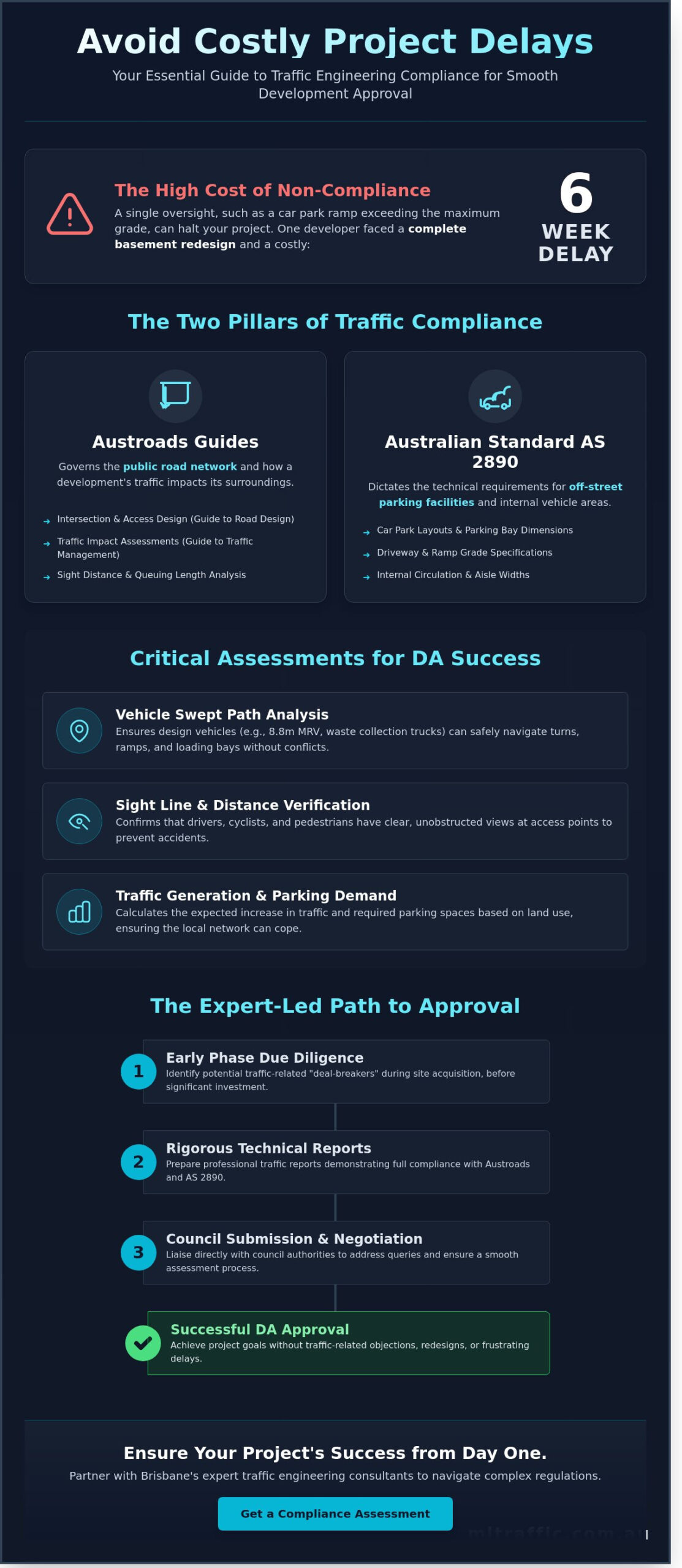

Last November, a developer saw their project timeline slip by six weeks because their car park ramp exceeded the maximum grade specified in the Austroads Guide to Road Design. This single oversight resulted in a local council RFI that demanded a complete basement redesign. You likely understand that the nuance between Australian Standard AS 2890.1 and Austroads requirements is where most development applications stall. Working with expert traffic engineering consultants in Brisbane prevents these technical errors from eroding your project’s profit margin through unexpected redesigns.
ML Traffic Engineers Australia provides rigorous technical compliance and assessments by certified professional engineers to guarantee your DA moves through council without traffic-related objections. This article details how we break down the essential Austroads standards you need to know, from vehicle swept path assessments to sight-line requirements. You’ll learn how to ensure your car park and access designs remain cost-effective and fully compliant with all local and national regulations. Our focus is providing the technical clarity you need to achieve a successful approval without the frustration of council delays or bureaucratic confusion.
Key Takeaways
-
Understand how Austroads standards set the national benchmarks for road design and traffic management to ensure your development meets rigorous technical compliance.
-
Learn why a professionally prepared traffic report is a mandatory requirement for your Statement of Environmental Effects to secure council approval.
-
Gain insights into critical technical assessments, including Vehicle Swept Path Analysis and AS 2890.1 compliance for efficient car park layouts.
-
Discover how engaging experienced traffic engineering consultants in Brisbane can help identify potential project "deal-breakers" during the early site acquisition phase.
-
Recognize the value of a principal-led approach where senior experts handle your project directly to ensure higher quality, accountability, and technical accuracy.
Table of Contents
What is Austroads Traffic Engineering?
Austroads is the collective organization of Australasian transport agencies. It functions as the peak body providing technical research and standardizing road design across Australia and New Zealand. For traffic engineering consultants in Brisbane, Austroads guides represent the mandatory technical framework for every project. These documents bridge the gap between theoretical Traffic engineering and the practical requirements of land-use planning. They provide the scientific basis for how vehicles, cyclists, and pedestrians interact safely on public infrastructure.
To better understand the distinction between different engineering roles in this field, watch this video:
Local authorities, including Brisbane City Council and relevant state transport agencies, rely on these guides to assess private development applications. When a developer proposes a new shopping centre or residential complex, the council uses Austroads benchmarks to determine if the local network can handle the increased volume. Consultants apply these standards to calculate intersection capacity, queuing lengths, and Level of Service (LOS) ratings. This rigorous approach ensures that new developments don’t compromise the existing flow of the city.
The Purpose of National Standards
National standards ensure consistency across all Australian jurisdictions. A driver in Queensland should experience the same road logic and signage as a driver in New South Wales. This uniformity is a critical safety feature that reduces driver confusion and potential accidents. For developers, following these benchmarks provides a layer of protection against future liability. By meeting the scientific requirements for sight distances and turn treatments, the risk of infrastructure failure is minimized. It ensures that the project is built on proven data rather than guesswork.
Austroads vs. Australian Standards (AS 2890)
Understanding the difference between Austroads and the AS 2890 series is essential for project compliance. While Austroads focuses on the broader road network and intersection analysis, the AS 2890 series specifically governs off-street parking facilities. For instance, AS 2890.1:2004 dictates the technical requirements for driveway ramp grades and parking bay dimensions. Austroads takes precedence when analyzing how a site’s traffic impacts the external street network. Competent traffic engineering consultants in Brisbane must be proficient in both frameworks to ensure a development is compliant from the basement parking level to the primary highway connection.
Core Austroads Guides for Private Developments
Professional traffic engineering consultants in Brisbane rely on the Austroads Guide series to ensure every development application meets national standards. These documents provide the technical framework for designing infrastructure that integrates safely with the existing road network. Adherence to these guides is mandatory for achieving compliance with Brisbane City Council and Department of Transport and Main Roads (TMR) requirements.
Guide to Traffic Management (Part 12)
Part 12 focuses on Traffic Impacts of Development. It’s the primary tool for assessing how a new project changes local traffic flow. Engineers use this volume to determine trip generation rates for various land-use types. For instance, a fast-food outlet with a drive-through might generate 50 trips per 100sqm of Gross Floor Area during peak periods, while a warehouse generates significantly less. When the data shows a site will increase traffic volume near site boundaries, we develop mitigation strategies. These may include intersection upgrades or revised entry points to prevent queuing on public roads.
Guide to Road Design (Part 4)
This volume dictates the geometric design of intersections and site access points. It’s essential for ensuring driveway crossovers and internal road layouts can accommodate the design vehicle, such as an 8.8-meter Medium Rigid Vehicle (MRV). Sight distance is the unobstructed view required for a driver to detect a hazard. We perform rigorous sight-line assessments to ensure exiting vehicles have a clear view of oncoming traffic. This involves calculating Safe Intersection Sight Distance (SISD) based on the 85th percentile operating speed of the frontage road. Our traffic engineering services ensure all access points comply with these geometric requirements to prevent collisions.
Guide to Road Safety
Managing risk for pedestrians and vulnerable road users is a core component of any traffic report. The Guide to Road Safety provides the methodology for identifying potential conflict points within a development. We apply these principles to protect cyclists and pedestrians through the following measures:
-
Implementation of the Safe System approach to reduce crash severity.
-
Design of dedicated pedestrian crossings and refuge islands.
-
Review of lighting and signage to improve visibility at night.
-
Assessment of vehicle swept paths to ensure trucks don’t mount kerbs where pedestrians wait.
Qualified traffic engineering consultants in Brisbane apply these specific volumes to generate a compliant traffic report. Every Traffic Impact Assessment (TIA) or Traffic Impact Statement (TIS) must demonstrate how the proposed development aligns with these national standards. This meticulous approach ensures the project is functional, safe, and ready for RPEQ certification. We use our experience across more than 10,000 sites to translate these technical guides into practical site layouts.
Why Traffic Engineering is Critical for DA Approvals
In Brisbane, a development application (DA) requires a Statement of Environmental Effects (SEE). A formal traffic report is a mandatory component of this document for most commercial, industrial, and multi-residential projects. Engaging traffic engineering consultants in Brisbane during the initial site acquisition phase identifies potential "deal-breakers" before capital is committed. These issues often include insufficient frontage for required driveway widths or sight-line obstructions that can’t be remediated. Early identification prevents developers from purchasing sites that are functionally undevelopable under current Brisbane City Council (BCC) City Plan 2014 requirements.
Expert traffic engineering services streamline the approval process by addressing technical requirements upfront. This proactive approach prevents costly Council Requests for Information (RFIs), which often delay projects by 30 to 90 days. Professional representation is also vital during Council negotiations or Planning and Environment Court appeals. Having an experienced engineer who provides the quote and does the work ensures that technical arguments remain robust under cross-examination or intense council scrutiny. It’s about providing certainty in a bureaucratic environment.
Risk Mitigation and Planning Certainty
We use data-driven evidence to support parking variations. If a project can’t meet the exact car parking rates specified in the transport code, a Car Parking Demand Assessment provides the justification needed for a reduction. This is common in high-density areas like Fortitude Valley or South Brisbane where site area is limited. Every report must be certified by a Registered Professional Engineer of Queensland (RPEQ). This certification provides Council with the assurance that the proposed designs meet Australian Standards (AS 2890.1) and manage community concerns regarding local congestion and pedestrian safety.
The Cost of Non-Compliance
Ignoring traffic requirements early leads to expensive site re-works. If a driveway ramp grade is non-compliant, Council may refuse an occupancy certificate until the concrete is ripped out and replaced. These delays can cost developers thousands in additional holding costs and liquidated damages. For a detailed breakdown of these requirements, refer to our Traffic Impact Assessment guide. Technical errors in vehicle swept path assessments often lead to basement layouts that don’t function, forcing a complete redesign after the DA is already lodged. Experienced traffic engineering consultants in Brisbane ensure these technical parameters are met the first time, protecting the project’s bottom line.
Technical Requirements: From Swept Paths to AS 2890.1
Development applications in South East Queensland demand rigorous technical substantiation. Brisbane City Council and surrounding LGAs don’t accept guesswork regarding vehicle movements or parking layouts. Our traffic engineering consultants in Brisbane apply precise mathematical modeling to ensure every design element functions safely and meets statutory requirements.
The Science of Swept Path Analysis
We use AutoTURN software to simulate the exact movement of vehicles through a site. This isn’t just about standard B99 cars; we model delivery vans, Medium Rigid Vehicles (MRV), and Heavy Rigid Vehicles (HRV) for industrial and commercial projects. A critical requirement for most Brisbane developments is ensuring waste collection vehicles can enter and exit the site in a forward direction. We provide detailed overlays that prove clearance from structural columns, landscaping, and parked cars. For a deeper look at how this software functions in local projects, refer to this Swept Path Analysis guide.
Compliant Car Park Design
Adherence to AS 2890.1 (off-street car parking) and AS 2890.2 (commercial vehicle facilities) is the baseline for any successful application. We design layouts that optimize space while maintaining mandatory dimensions. This includes:
-
Aisle Widths and Bay Dimensions: Ensuring 2.4m to 2.7m bay widths and 5.8m aisle widths are maintained based on the specific user class.
-
Blind Aisle Extensions: Incorporating the required 1m extension to allow vehicles to maneuver out of the final bay in a row.
-
Accessible Parking: Designing for AS 2890.6 compliance, including dedicated shared zones and bollard placements.
-
Pedestrian Integration: Mapping clear, safe paths that separate foot traffic from vehicle aisles to reduce conflict points.
Parking Demand and Ramp Grades
Standard planning schemes often mandate more parking than a specific project actually requires. We conduct parking demand assessments using empirical data and ITE rates to justify lower provision where appropriate. This can save developers significant construction costs by reducing basement excavation depth. Additionally, we perform driveway ramp grade assessments. We check longitudinal sections against B85 and B99 vehicle templates to prevent scraping. If a ramp exceeds a 12.5% grade, we design the necessary 2m transition zones to ensure the vehicle undercarriage remains clear of the pavement. Our traffic engineering consultants in Brisbane provide the RPEQ certification often required to finalize these technical drawings.
Get a technical review of your site layout before you lodge with Council. Contact our senior engineers for a technical assessment.
Partnering with Expert Traffic Engineering Consultants
Selecting the right traffic engineering consultants in Brisbane determines the speed and success of your development application. ML Traffic Engineers Australia has operated since 2005, bringing over 15 years of specific experience to the Australian development landscape. Our team has completed assessments for over 10,000 sites across diverse land uses. This history ensures we understand the technicalities of AS 2890.1 and local council requirements. Experience matters because it prevents costly redesigns and delays during the planning approval phase.
A principal-led approach provides a level of accountability that larger firms often lack. At ML Traffic Engineers Australia, we maintain established relationships with local authorities and industry professionals. These connections streamline the path to approval. We focus on private clients and their specific development needs, ensuring every assessment is technically sound and compliant with current regulations. Our expertise covers everything from apartments and bars to temples and warehouses.
Direct Access to Senior Expertise
The ML Traffic Engineers Australia promise is simple: the consultant who provides the quote, does the work. Many larger firms use senior staff to win projects before handing the actual technical work to junior engineers. We don’t do that. You get direct communication with RPEQ-qualified principals for every stage of your project. Michael Lee and Benny Chen bring between 30 and 40 years of experience each to the table. This seniority ensures that complex issues like Sight-Line Assessments or Vehicle Swept Path Assessments are handled correctly the first time. You aren’t paying for a junior’s learning curve.
Getting Started with Your Project
To provide an accurate quote, our traffic engineering consultants in Brisbane require specific project details. Please provide your site plans and proposed land-use information. We need to know the scale of the development, whether it’s a childcare center, warehouse, or residential apartment complex. This data allows us to determine the necessary scope for a Traffic Impact Assessment (TIA) or a simpler Traffic Impact Statement (TIS). We also evaluate requirements for car parking demand and driveway ramp grades.
The timeline for delivering a comprehensive TIA depends on the project’s complexity. However, our direct-access model minimizes bureaucratic delays. You can contact ML Traffic Engineers Australia for a direct consultation and a transparent quote. We provide the technical expertise required to navigate RPEQ requirements and Australian Standards effectively. Our results-oriented approach focuses on getting your project through the council approval process without unnecessary friction.
Secure Your Development Approval with Technical Precision
Navigating Austroads standards and AS 2890.1 requirements is a critical step for any private development in Queensland. Achieving a successful DA approval depends on technical accuracy in swept path assessments and parking demand studies. When these reports fail to meet Council expectations, projects face costly delays and repeated RFIs. Partnering with traffic engineering consultants in Brisbane ensures your application meets every regulatory benchmark from the outset.
ML Traffic Engineers brings a proven track record of assessing over 10,000 sites nationwide. You won’t deal with junior staff or administrative gatekeepers. Our model ensures you have direct access to principals who possess between 30 and 40 years of industry experience. The consultant who provides your quote is the expert who completes the work. This hands-on approach guarantees that your technical reports are meticulous, compliant, and ready for submission to authorities.
Don’t leave your project’s timeline to chance. Get an approval-ready traffic report from ML Traffic Engineers today and move your development forward with confidence.
Frequently Asked Questions
What is the difference between a Traffic Impact Assessment (TIA) and a Traffic Statement?
A Traffic Impact Assessment is a comprehensive study required for large-scale developments, while a Traffic Statement is a concise report for smaller projects with minimal impact. TIAs include detailed intersection modelling and long-term network analysis for the surrounding road system. Traffic Statements focus primarily on site access and parking compliance. Brisbane City Council typically requires a TIA for developments exceeding 50 residential units or 1,000 square metres of commercial floor space.
When is an Austroads-compliant traffic report required for my development?
An Austroads-compliant report is mandatory when a development impacts state-controlled roads or requires Department of Transport and Main Roads approval. These reports follow the Guide to Traffic Management Part 12 to ensure national safety and efficiency standards are met. Most traffic engineering consultants in Brisbane provide these assessments for projects involving new intersections or high-volume traffic generators. Compliance ensures the proposed road geometry handles expected vehicle loads safely.
Can a general civil engineer prepare my traffic and parking reports?
A general civil engineer can technically prepare reports, but most Queensland Councils require certification from a Registered Professional Engineer of Queensland specializing in traffic. Specialist traffic engineers possess specific software skills for modelling and deep knowledge of AS 2890.1 parking standards. Using a specialist reduces the risk of Information Requests from Council. These requests can delay projects by 20 to 40 business days if the initial report lacks technical depth.
How much does a traffic engineering consultant cost for a small development?
The cost of hiring traffic engineering consultants in Brisbane depends on the project scope, site location, and specific Council requirements. Fees cover site inspections, data collection, and technical report drafting. For a small development like a dual occupancy or minor subdivision, costs are based on the complexity of access arrangements and the number of parking spaces involved. It’s best to request a fixed-fee quote based on your specific site plan.
What is a vehicle swept path analysis and why does Council ask for it?
Vehicle swept path analysis is a computer-generated simulation showing the exact path a vehicle takes while turning or reversing. Council requires this to prove that waste collection vehicles, delivery trucks, or B-99 cars can safely enter and exit the site without hitting curbs or structures. We use specialized software like AutoTURN to verify compliance with AS 2890.2. This analysis ensures that the proposed driveway and internal aisles are functional for all expected users.
How long does it take to get a traffic report ready for a DA submission?
A standard traffic report for a Development Application typically takes 5 to 10 business days to complete once all site plans are provided. Complex projects requiring intersection modelling or extensive traffic counts may take 15 to 20 business days. Providing finalized architectural drawings early in the process ensures the consultant can meet tight submission deadlines. Delays often occur when site plans change mid-way through the assessment process.
Does a traffic engineer help with car park design or just the report?
Experienced traffic engineers actively assist with car park design to ensure the layout complies with Australian Standard AS 2890. We review driveway gradients, aisle widths, and column placements during the initial design phase. This proactive approach prevents costly redesigns after the DA is lodged. It’s better to fix a tight turning circle on paper than to have Council reject the application because a vehicle can’t physically make the turn.
What happens if Council objects to my traffic assessment?
If Council objects or issues an Information Request, the traffic engineer prepares a formal technical response to address the specific concerns. This response often involves providing additional data, refining the swept path analysis, or proposing mitigation measures like upgraded signage or line marking. Our team has handled over 10,000 sites, providing the expertise needed to negotiate effectively with Council officers. We focus on finding technical solutions that satisfy regulatory requirements while maintaining project viability.
Which areas do you cover?
We are traffic engineers servicing Brisbane, Brisbane City, Fortitude Valley, New Farm, Teneriffe, Kangaroo Point, East Brisbane, South Brisbane, West End, Highgate Hill, Dutton Park, Woolloongabba, Ascot, Clayfield, Albion, Bowen Hills, Newstead, Bulimba, Hawthorne, Morningside, Balmoral, Indooroopilly, Taringa, Toowong, Auchenflower, Milton, Paddington, Red Hill, Bardon, Ashgrove, The Gap, Enoggera, Mitchelton, Aspley, Chermside, Kedron, Stafford, Everton Park, Gordon Park, Wilston, Grange, Alderley, Kelvin Grove, Herston, Lutwyche, Windsor, Nundah, Wavell Heights, Chermside West, Zillmere, Carseldine, Bald Hills, Bracken Ridge, Brighton, Sandgate, Shorncliffe, Deagon, Taigum, Fitzgibbon, Boondall, Virginia, Banyo, Nudgee, Northgate, Hamilton, Hendra, Eagle Farm, Murarrie, Cannon Hill, Seven Hills, Norman Park, Coorparoo, Camp Hill, Carina, Carindale, Mount Gravatt, Upper Mount Gravatt, Mansfield, MacGregor, Robertson, Sunnybank, Sunnybank Hills, Acacia Ridge, Inala, Oxley, Corinda, Graceville, Sherwood, Yeronga, Annerley, Moorooka, Tarragindi, Holland Park, Holland Park West, Coopers Plains, Greenslopes, Fairfield, Yeerongpilly, Stones Corner, Wynnum, Wynnum West, Manly, Manly West, Tingalpa, Hemmant, Lota, Wakerley, Rochedale, Eight Mile Plains, Runcorn, Calamvale, Parkinson, Algester, Doolandella, Forest Lake, Richlands, Darra, Wacol, Archerfield, Rocklea, Salisbury, Nathan, Mount Gravatt East, Wishart, Karawatha, Stretton, Kuraby, Belmont, Chandler, Gumdale, Lytton, Port of Brisbane, Kenmore, Jindalee, Mount Ommaney, Sinnamon Park, Fig Tree Pocket, Chapel Hill, St Lucia, Petrie Terrace, Spring Hill, Wooloowin, Newmarket, Gaythorne, Keperra, Ferny Grove, Upper Kedron, Bridgeman Downs, McDowall, Stafford Heights, Geebung, Pinkenba, Brisbane Airport, Nudgee Beach, Kalinga, Albion (duplicate avoided), Anstead, Bellbowrie, Brookfield, Chelmer, Chuwar, England Creek, Enoggera Reservoir, Jamboree Heights, Karana Downs, Kenmore Hills, Kholo, Lake Manchester, Middle Park, Moggill, Mount Coot-tha, Mount Crosby, Pinjarra Hills, Pullenvale, Riverhills, Seventeen Mile Rocks, Upper Brookfield, Westlake, Banks Creek, Burbank, Drewvale, Durack, Ellen Grove, Heathwood, Larapinta, Mackenzie, Pallara, Sumner, Tennyson, Willawong, Carina Heights, Ransome, Cannon Hill (duplicate avoided), Carindale, Manly, Moreton Island, Bulwer, Cowan Cowan, Kooringal.
Can you help with developments outside of Brisbane, like the Gold Coast or Sunshine Coast?
Yes. While we have deep expertise in Brisbane, our senior engineers have extensive experience securing DA approvals with councils across Queensland, including the Gold Coast, Sunshine Coast, Moreton Bay, Logan, and Ipswich.

Disclaimer
The content on www.mltraffic.com.au, including all technical articles, guides, and resources, is provided for general informational and educational purposes only. It is not intended to constitute professional advice in traffic engineering, transportation planning, development approvals, or any other technical or legal field.
While ML Traffic Engineers makes every reasonable effort to ensure the accuracy, completeness, and timeliness of the information published, we do not provide any warranties or representations (express or implied) regarding its reliability, suitability, or availability for any particular purpose. Any reliance you place on the content is strictly at your own risk.
In no event shall ML Traffic Engineers, its directors, employees, authors, or affiliates be liable for any direct, indirect, incidental, special, consequential, or punitive damages (including, without limitation, loss of profits, data, or business opportunities) arising out of or in connection with the use of, or inability to use, any information provided on this website.
The articles and guides on this site are not a substitute for engaging a qualified, registered professional traffic engineer (such as an NPER or RPEQ engineer) to assess your specific project requirements. For tailored advice, compliance assessments, or traffic engineering services, please contact a competent professional.
This disclaimer may be updated from time to time without notice. By accessing or using this website, you agree to be bound by the most current version of this disclaimer.