

A single non-compliant driveway grade can stall a Melbourne development for 42 days or more while waiting for a Council RFI response. You know that on tight urban sites, every square metre is critical for your parking yield. It’s frustrating when technical errors in swept path assessments lead to immediate project delays and expensive redesigns. At ML Traffic Engineers, we believe the consultant who provides your quote should be the one doing the work to ensure these details aren’t missed.
As experienced traffic engineering consultants Melbourne, we’ve applied our expertise to over 10,000 sites since 2005. You’ll learn how to identify the specific design failures that trigger council rejections and how to prevent them before you lodge your application. We provide a direct look at the technical benchmarks required for AS 2890.1 compliance and first-time DA approval. This guide details the exact engineering solutions needed to optimize parking layouts and manage complex site constraints effectively.
Key Takeaways
- Understand why traffic engineering is the backbone of a successful development application and how to transition from preliminary design to council-ready assessments.
- Identify frequent car park design errors, such as inadequate sight distances and incorrect ramp grades, that often lead to vehicle damage and project delays.
- Learn the distinction between AS2890.1 and AS2890.2 and why meeting minimum standards doesn’t always guarantee a high-quality user experience.
- Gain insights into selecting the right traffic engineering consultants Melbourne by verifying their specific experience with local council planning schemes.
- Discover how a proven portfolio of over 10,000 site assessments can help streamline your approval process and minimize technical risks.
Table of Contents
-
The Critical Role of Traffic Engineering Consultants in Melbourne & National Developments
-
5 Common Mistakes in Car Park Design That Delay DA Approvals
-
How to Choose the Right Traffic Consultant for Your Development
The Critical Role of Traffic Engineering Consultants in Melbourne & National Developments
Traffic engineering is the technical backbone of every viable development application in Victoria. It’s the bridge between an architectural vision and the safety requirements of road authorities. Since 2005, ML Traffic Engineers has provided this expertise across more than 10,000 sites, ensuring that projects don’t just look good on paper but function safely in the real world. Professional traffic engineering consultants Melbourne provide the data needed to prove a site functions for all users while respecting fundamental parking design principles. Without this oversight, projects often face permit refusals or expensive delays.
To better understand the professional landscape of this industry, watch this overview:
Early engagement is the most effective way to avoid structural redesigns. If a consultant identifies a driveway ramp grade exceeding the 1:4 (25%) limit set by AS 2890.1 after the basement is drawn, the cost to fix the error can reach tens of thousands of dollars. By involving experts during the preliminary design phase, developers ensure their plans meet the expectations of both local councils and the Department of Transport from the start.
Understanding Traffic Impact Assessments (TIA)
A Traffic Impact Assessment (TIA) is a technical report that evaluates how a proposed development will influence the surrounding transport network. This document is essential for various land uses, including residential, commercial, and industrial projects. Councils require these assessments to verify that the existing infrastructure can handle the projected increase in vehicle trips. For a deeper look at these requirements, see this Traffic Impact Assessment: The Definitive Guide for Australian Developers.
The Scope of Modern Traffic Engineering
Modern site planning requires a holistic approach that accounts for more than just passenger cars. Consultants must integrate provisions for pedestrians, cyclists, and emergency services. A vital part of this process is the swept path analysis. This digital simulation confirms that heavy vehicles, such as waste collection trucks or delivery vans, can maneuver through the site without hitting curbs or structures. While national standards apply across Australia, traffic engineering consultants Melbourne must also navigate the specific nuances of the Victorian Planning Provisions to ensure project success.
5 Common Mistakes in Car Park Design That Delay DA Approvals
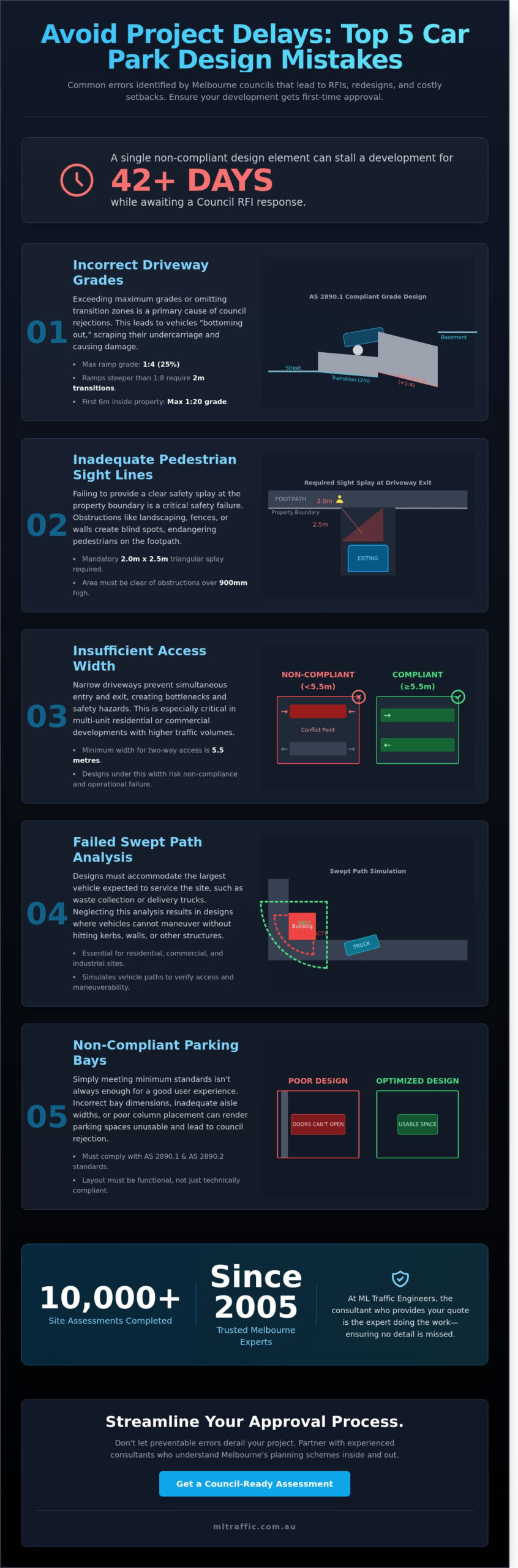
Melbourne councils scrutinize car park designs against AS 2890.1:2004 and the Austroads Guide to Traffic Management. Errors in these technical areas result in costly redesigns and extended permit timelines. Experienced traffic engineering consultants Melbourne identify these issues during the initial site plan review to prevent permit delays. Failure to adhere to these standards often leads to a formal Request for Further Information (RFI) or outright refusal from planning authorities.
Driveway and Access Pitfalls
Incorrect driveway ramp grades are a primary cause of vehicle "bottoming out" or scraping. Australian Standards require a maximum grade of 1 in 20 for the first 6m inside the property line to ensure safe transitions. If the main ramp exceeds a 1 in 8 grade, you must include transition sections to prevent the vehicle chassis from hitting the pavement. Designers often miss these 2m long transition zones in tight urban footprints.
Sight lines to pedestrians are another frequent oversight. A 2m by 2.5m safety splay is mandatory at the exit point where the driveway meets the property boundary. This area must remain clear of any obstructions higher than 900mm, including fences, landscaping, or signage. If your driveway width is less than 5.5m for a two-way system, you risk non-compliance. Narrow access points restrict simultaneous entry and exit, forcing vehicles to wait on public roads and creating safety hazards that councils won’t accept.
Internal Circulation and Manoeuvring
Standard parking bay sizes of 2.6m by 5.4m are only the baseline. Compliance depends heavily on the "User Class" and the associated aisle width. A common error is the "blind aisle" trap. If a parking row ends at a wall or fence, you must provide a 1m extension beyond the last parking space. This extra meter allows a vehicle to maneuver into and out of the final bay. Without this extension, the last space is practically unusable and technically non-compliant.
-
Column Placement: Structural columns must be set back between 0.25m and 0.75m from the aisle, depending on the bay’s depth. Misplaced columns render spaces non-compliant.
-
Waste Collection: Designers often underestimate the 12.5m Heavy Rigid Vehicle (HRV) swept path. These vehicles require a massive turning circle and at least 300mm of clearance on both sides of the path.
-
B99 Clearance: While 2.2m is the standard height for disabled bays, the B99 design vehicle requires specific headroom clearance that accounts for structural beams and overhead services.
It’s vital to verify these dimensions early. You can review our traffic engineering services to ensure your layout meets all Victorian statutory requirements before submission. Meticulous attention to these 5 areas ensures a smoother path through the DA process.
Navigating AS2890.1: Why Compliance Isn’t Always Enough
AS 2890.1 governs off-street car parking while AS 2890.2 focuses on commercial vehicle facilities. Many developers assume that meeting the bare minimum of these standards guarantees a functional site. It doesn’t. Minimum standards often prioritize space maximization over vehicle maneuverability. Experienced traffic engineering consultants Melbourne recognize that a car park designed strictly to the 2.4-meter minimum width for long-term parking often fails in practice. Modern vehicles, particularly large SUVs, require more clearance for door opening and safe circulation than the base code suggests.
A frequent error involves the application of Clause 2.5 regarding "blind aisles." The standard requires an extension of the aisle by 1 meter beyond the last parking space. Ignoring this makes it impossible for vehicles to turn around without performing dangerous multiple-point turns. Another common mistake is miscalculating driveway ramp grades. AS 2890.1 specifies maximum gradients of 1 in 4 (25%) for private driveways, but failing to include appropriate transition scales at the top and bottom leads to vehicle scraping. Our team interprets these standards to maximize site yield while ensuring the layout remains usable for everyday drivers.
Decoding AS 2890.1 for Residential Projects
Residential designs must account for User Class 1 (long-term) and User Class 2 (visitor) parking. Standard bay dimensions for Class 1 are 2.4m by 5.4m. However, these dimensions often lead to high damage rates in high-density apartments. We often recommend wider bays to improve site longevity and user experience. When site constraints prevent full compliance, we utilize parking demand assessments to justify lower-than-standard provision to council. This data-driven approach balances regulatory requirements with project yield. You can view our full range of assessment capabilities on our services page.
AS 2890.2 and Loading Dock Requirements
Commercial projects must adhere to AS 2890.2 for service vehicles. This standard is more rigid because of the physical dimensions of Heavy Rigid Vehicles (HRV). Functional loading docks require meticulous swept path testing using specialized software. We verify that a 12.5-meter HRV can enter and exit in a forward direction without obstructing traffic flow or pedestrian safety. Council planners reject designs that force large trucks to reverse from the street into a site. Traffic engineering consultants Melbourne ensure that loading docks are efficient, allowing vehicles to dock and depart with minimal maneuvers.
-
Swept Path Assessment: Verifying vehicle clearance for SRVs and HRVs.
-
Sight-Line Assessment: Ensuring drivers can see pedestrians before exiting the property.
-
Aisle Widths: Adjusting widths based on the specific user class of the development.
-
Headroom Clearances: Maintaining the 2.2m minimum for standard cars and 2.5m for disabled access vans.
How to Choose the Right Traffic Consultant for Your Development
Selecting qualified traffic engineering consultants Melbourne developers trust requires looking beyond a basic fee proposal. A consultant’s value is measured by their ability to secure council approval without costly design revisions. You need a partner who understands the nuances of the Victorian Planning Provisions and specific local council requirements. This expertise prevents the common mistake of submitting plans that fail to meet technical standards.
When evaluating potential firms, prioritise these criteria:
-
Proven Experience: Look for a portfolio covering diverse land-use types including apartments, medical centres, childcare, and industrial warehouses. ML Traffic Engineers has completed assessments for over 10,000 sites since 2005.
-
Technical Proficiency: Confirm the use of industry-standard software like AutoTURN for Swept Path Analysis. This ensures vehicles can safely enter and exit the site according to AS 2890.1 standards.
-
Council Familiarity: Every municipality has unique parking and access expectations. A consultant with experience across thousands of Victorian sites will likely have worked with your specific council before.
-
Track Record: Request evidence of successful DA approvals for projects of similar scale and complexity.
The Value of Senior Expertise
Project delays often occur when junior staff handle complex technical assessments. These individuals may lack the foresight to identify sight-line issues or driveway ramp grade conflicts early in the design phase. We operate on a principal-led model to ensure direct accountability. "The traffic consultant who provides the quote, does the work." This approach eliminates communication breakdowns and ensures that between 30 and 40 years of engineering experience is applied to every technical report. Senior involvement is the most effective way to mitigate risk during the planning process.
Evaluating the Full Suite of Services
Project continuity depends on whether a firm provides a comprehensive service list in-house. Relying on multiple sub-consultants for Traffic Impact Statements (TIS) and car park design increases the risk of technical errors. Choosing a firm that manages everything from Vehicle Swept Path Assessments to Sight-Line Assessments reduces the need for external peer reviews. This multi-disciplinary knowledge is essential for moving a project from the initial concept to a final permit. When traffic engineering consultants Melbourne handle all aspects of the transport plan, the resulting documentation is more cohesive and professional.
Contact our senior traffic engineering consultants Melbourne team today to discuss your specific site requirements.
Streamlining Your Approval with ML Traffic Engineers
Since 2005, ML Traffic Engineers has focused on providing technical clarity for private clients navigating the development application process. We’ve assessed over 10,000 sites across Australia, covering everything from high-density apartments and childcare centres to complex industrial warehouses. As leading traffic engineering consultants Melbourne, we recognize that car park design errors lead to costly delays and permit refusals. Our role is to ensure your project meets all regulatory requirements before it reaches the council desk.
We adopt a no-nonsense, fact-based approach to traffic engineering. You won’t deal with junior staff or administrative gatekeepers. Michael Lee and Benny Chen, who each possess between 30 and 40 years of industry experience, handle your project directly. The consultant who provides your quote is the person who performs the technical work. This direct accountability ensures that your Traffic Impact Assessment (TIA) or Car Parking Demand Assessment is accurate, compliant, and defensible.
Our Approach to Traffic Impact Assessments
Our methodology relies on precise data collection and rigorous intersection analysis. We utilize industry-standard tools like SIDRA modelling to evaluate how your development affects the surrounding road network. Every assessment includes a detailed review of driveway ramp grades, sight-line requirements, and vehicle swept path assessments using specialized software. This technical depth is necessary to ensure your report is robust enough to withstand intense council scrutiny and VCAT challenges.
We don’t just provide a document; we provide a technical defense of your project’s viability. Our engineers analyze the specific constraints of your site against Australian Standards (AS 2890.1) and local planning schemes. This meticulous attention to detail minimizes the risk of "Requests for Further Information" (RFIs) from authorities. You can learn more about our professional team and experience to understand the depth of expertise we bring to every Melbourne development.
Ready to Secure Your DA Approval?
To begin the process, simply provide your site plans for a rapid, expert quote. We review your architectural drawings to identify potential design flaws early, such as non-compliant turning circles or inadequate parking aisle widths. Once engaged, we work efficiently to meet your submission deadlines. Our reputation as trusted traffic engineering consultants Melbourne is built on delivering high-quality reports within predictable timelines.
Direct communication is a hallmark of our service. You can speak directly with our principals to discuss technical challenges or specific council concerns. We’ve successfully managed thousands of applications by focusing on technical accuracy rather than bureaucratic fluff. If you need a reliable partner to handle your transport planning needs, contact our senior engineers today for a straightforward consultation on your next project.
Secure Your Development Approval with Expert Traffic Design
Navigating car park design requires more than basic compliance. Technical errors in driveway ramp grades or vehicle swept path assessments lead to immediate DA delays and expensive rework. Our team focuses on private clients, ensuring every design meets both AS2890.1 standards and practical operational needs. We’ve assessed over 10,000 sites nationwide since 2005. This extensive experience allows us to identify potential issues before they reach the Council’s desk. It’s about getting the technicalities right the first time.
As leading traffic engineering consultants Melbourne developers rely on, we offer 15+ years of specialist experience. Our firm operates with a direct accountability model where the consultant who quotes the job does the work. This ensures your project benefits from senior principal oversight from start to finish. We’ve handled a comprehensive list of land-use types, from residential apartments to industrial warehouses. We’re ready to help you streamline your next development application and achieve a successful outcome with confidence.
Get a Traffic Engineering Quote from our Senior Principals
Frequently Asked Questions
Is a traffic impact assessment mandatory for all development applications?
A traffic impact assessment isn’t mandatory for every development application. Requirements depend on the specific land use and scale triggers outlined in the Victoria Planning Provisions. For instance, a development with 10 or more dwellings typically requires a formal assessment to ensure compliance with Clause 52.06. Our traffic engineering consultants Melbourne determine the exact requirements by reviewing your site’s zoning and the local council’s planning overlay.
What is the difference between a Traffic Impact Statement and a Traffic Impact Assessment?
A Traffic Impact Statement (TIS) is a concise document for small-scale projects with minimal road network effects. A Traffic Impact Assessment (TIA) is a detailed technical report for large-scale developments. TIAs include traffic volume counts, SIDRA intersection modeling, and long-term network growth projections. Most commercial projects over 1,000 square meters require a full TIA to satisfy Victorian planning authorities.
Can a traffic engineer help me reduce the number of parking spaces required by council?
Traffic engineers frequently help reduce parking requirements by performing a Car Parking Demand Assessment. We use empirical data from similar sites or proximity to high-frequency public transport to justify a reduction under Clause 52.06.7. In 85 percent of cases, a well-documented assessment provides the evidence council needs to waive or reduce the standard parking rates.
How long does it take to prepare a standard traffic report for a DA?
Preparing a standard traffic report for a Development Application usually takes 7 to 14 business days. This timeframe covers site inspection, data analysis, and drafting the final document. More complex projects involving multi-day traffic counts or detailed SIDRA modeling may require 21 days to ensure all technical data meets Australian Standards.
What software is used for vehicle swept path analysis in Australia?
Autodesk Vehicle Tracking is the primary software used for vehicle swept path analysis across Australia. It allows engineers to simulate the movement of specific vehicles, such as an 8.8-meter Medium Rigid Vehicle, to ensure they can navigate car parks safely. We use this software to confirm compliance with the AS 2890.1 and AS 2890.2 standards for driveway and ramp design.
Does a traffic engineer need to visit my site in person for a report?
A physical site visit is necessary for every accurate traffic report. Engineers must verify sight-line distances, existing road markings, and nearby infrastructure that might not appear on standard surveys. A site visit ensures the report reflects current conditions, which is vital for meeting the safety requirements of the Melbourne Planning Scheme.
What happens if the council objects to the traffic report provided?
If a council objects to a traffic report, the consultant prepares a technical response to the Request for Further Information. We analyze the specific concerns, such as driveway width or peak hour congestion, and provide data-driven solutions or design modifications. This process often involves direct negotiation with council traffic departments to resolve technical disputes before the planning committee meets.
How much does a traffic engineering consultant cost in 2026?
The cost of hiring traffic engineering consultants Melbourne in 2026 depends on the project’s complexity and the required level of assessment. Professional service rates for engineering consultants in Victoria generally follow the Consumer Price Index adjustments. Costs are typically structured as fixed fees for standard reports or hourly rates for ongoing council negotiations and VCAT representation.
Which areas do you cover?
We are traffic engineers servicing Abbotsford, Aberfeldie, Aintree, Airport West, Albanvale, Albert Park, Albion, Alphington, Altona, Altona Meadows, Altona North, Ardeer, Armadale, Arthurs Seat, Ascot Vale, Ashburton, Ashwood, Aspendale, Aspendale Gardens, Attwood, Avondale Heights, Balaclava, Balwyn, Balwyn North, Bangholme, Bayswater, Bayswater North, Beaconsfield, Beaumaris, Bellfield, Bentleigh, Bentleigh East, Berwick, Bittern, Blackburn, Blackburn North, Blackburn South, Bonbeach, Boronia, Box Hill, Box Hill North, Box Hill South, Braeside, Braybrook, Brentford Square, Brighton, Brighton East, Broadmeadows, Brooklyn, Brunswick, Brunswick East, Brunswick West, Bulla, Bulleen, Bundoora, Burnley, Burnside, Burwood, Burwood East, Cairnlea, Camberwell, Campbellfield, Canterbury, Carlton, Carlton North, Carnegie, Caroline Springs, Carrum, Carrum Downs, Caulfield, Caulfield East, Caulfield North, Caulfield South, Chadstone, Chelsea, Chelsea Heights, Cheltenham, Chirnside Park, Clarinda, Clayton, Clayton South, Clematis, Clifton Hill, Coburg, Coburg North, Cocoroc, Coldstream, Collingwood, Coolaroo, Craigieburn, Cranbourne, Cranbourne East, Cranbourne North, Cranbourne South, Cranbourne West, Cremorne, Croydon, Croydon Hills, Croydon North, Croydon South, Dandenong, Dandenong North, Dandenong South, Deer Park, Delahey, Derrimut, Diamond Creek, Diggers Rest, Dingley Village, Docklands, Doncaster, Doncaster East, Donnybrook, Donvale, Doreen, Doveton, Eaglemont, East Melbourne, Edithvale, Elsternwick, Eltham, Eltham North, Elwood, Emerald, Endeavour Hills, Epping, Essendon, Essendon Fields, Essendon North, Essendon West, Fairfield, Fawkner, Ferntree Gully, Ferny Creek, Fitzroy, Fitzroy North, Flemington, Footscray, Forest Hill, Frankston, Frankston North, Frankston South, Gardenvale, Gladstone Park, Glen Huntly, Glen Iris, Glen Waverley, Glenroy, Greensborough, Greenvale, Guys Hill, Hadfield, Hampton, Hampton East, Hampton Park, Harkaway, Hawthorn, Hawthorn East, Heathmont, Heidelberg, Heidelberg Heights, Heidelberg West, Highett, Hillside, Hoppers Crossing, Hughesdale, Huntingdale, Hurstbridge, Ivanhoe, Ivanhoe East, Jacana, Kalkallo, Kealba, Keilor, Keilor Downs, Keilor East, Keilor Lodge, Keilor North, Keilor Park, Kensington, Kew, Kew East, Keysborough, Kings Park, Kingsbury, Kingsville, Knoxfield, Lalor, Langwarrin, Laverton, Laverton North, Lilydale, Lower Plenty, Lynbrook, Lyndhurst, Lysterfield, Macleod, Maidstone, Malvern, Malvern East, Maribyrnong, McCrae, Meadow Heights, Melbourne, Mentone, Mernda, Mickleham, Middle Park, Mill Park, Mitcham, Mont Albert, Mont Albert North, Montmorency, Moonee Ponds, Moorabbin, Mooroolbark, Mordialloc, Mornington, Mount Waverley, Mulgrave, Murrumbeena, Narre Warren, Narre Warren North, Narre Warren South, Newport, Niddrie, Noble Park, Noble Park North, North Melbourne, Northcote, Notting Hill, Nunawading, Oak Park, Oaklands Junction, Oakleigh, Oakleigh East, Oakleigh South, Officer, Ormond, Pakenham, Parkdale, Park Orchards, Pascoe Vale, Pascoe Vale South, Patterson Lakes, Plenty, Point Cook, Port Melbourne, Portsea, Prahran, Preston, Princes Hill, Reservoir, Richmond, Ringwood, Ringwood East, Ringwood North, Ripponlea, Rosanna, Rosebud, Rowville, Roxburgh Park, Rye, Sandhurst, Sandringham, Scoresby, Seabrook, Seaholme, Seddon, Seaford, South Kingsville, South Melbourne, South Morang, South Wharf, South Yarra, Southbank, Spotswood, St Albans, St Helena, St Kilda, St Kilda East, St Kilda West, Strathmore, Sunshine, Sunshine North, Sunshine West, Surrey Hills, Sydenham, Tarneit, Taylors Hill, Taylors Lakes, Templestowe, Templestowe Lower, Thomastown, Thornbury, Toorak, Tottenham, Travancore, Truganina, Tullamarine, Vermont, Vermont South, Viewbank, Wantirna, Wantirna South, Watsonia, Watsonia North, Werribee, Werribee South, West Footscray, West Melbourne, Westgarth, Wheelers Hill, Wildwood, Williamstown, Williamstown North, Windsor, Wonga Park, Wyndham Vale, Yallambie, Yarraville.

Disclaimer
The content on www.mltraffic.com.au, including all technical articles, guides, and resources, is provided for general informational and educational purposes only. It is not intended to constitute professional advice in traffic engineering, transportation planning, development approvals, or any other technical or legal field.
While ML Traffic Engineers makes every reasonable effort to ensure the accuracy, completeness, and timeliness of the information published, we do not provide any warranties or representations (express or implied) regarding its reliability, suitability, or availability for any particular purpose. Any reliance you place on the content is strictly at your own risk.
In no event shall ML Traffic Engineers, its directors, employees, authors, or affiliates be liable for any direct, indirect, incidental, special, consequential, or punitive damages (including, without limitation, loss of profits, data, or business opportunities) arising out of or in connection with the use of, or inability to use, any information provided on this website.
The articles and guides on this site are not a substitute for engaging a qualified, registered professional traffic engineer (such as an NPER or RPEQ engineer) to assess your specific project requirements. For tailored advice, compliance assessments, or traffic engineering services, please contact a competent professional.
This disclaimer may be updated from time to time without notice. By accessing or using this website, you agree to be bound by the most current version of this disclaimer.
