
Paying for a senior partner’s reputation only to have a junior graduate draft your Traffic Impact Statement is a risk your project’s timeline cannot afford. You likely know that technical errors in a development application can lead to 12 week delays or outright rejections from local councils. It’s frustrating when complex Australian Standards like AS 2890.1 are misinterpreted by inexperienced staff, leading to avoidable redesign costs. We understand that for developers, time is the most expensive commodity on the balance sheet.
Engaging professional traffic engineering consultants in Perth ensures your project benefits from technical precision and principal-led accountability. At ML Traffic Engineers, the consultant who provides your quote is the one who performs the work, drawing on 35 years of industry experience. This article explains how accurate Swept Path Analysis and direct communication with senior experts facilitate fast DA approvals. You’ll discover how our history with over 10,000 sites since 2005 provides the technical certainty required to meet council compliance without the overhead of a junior-staffed consultancy.
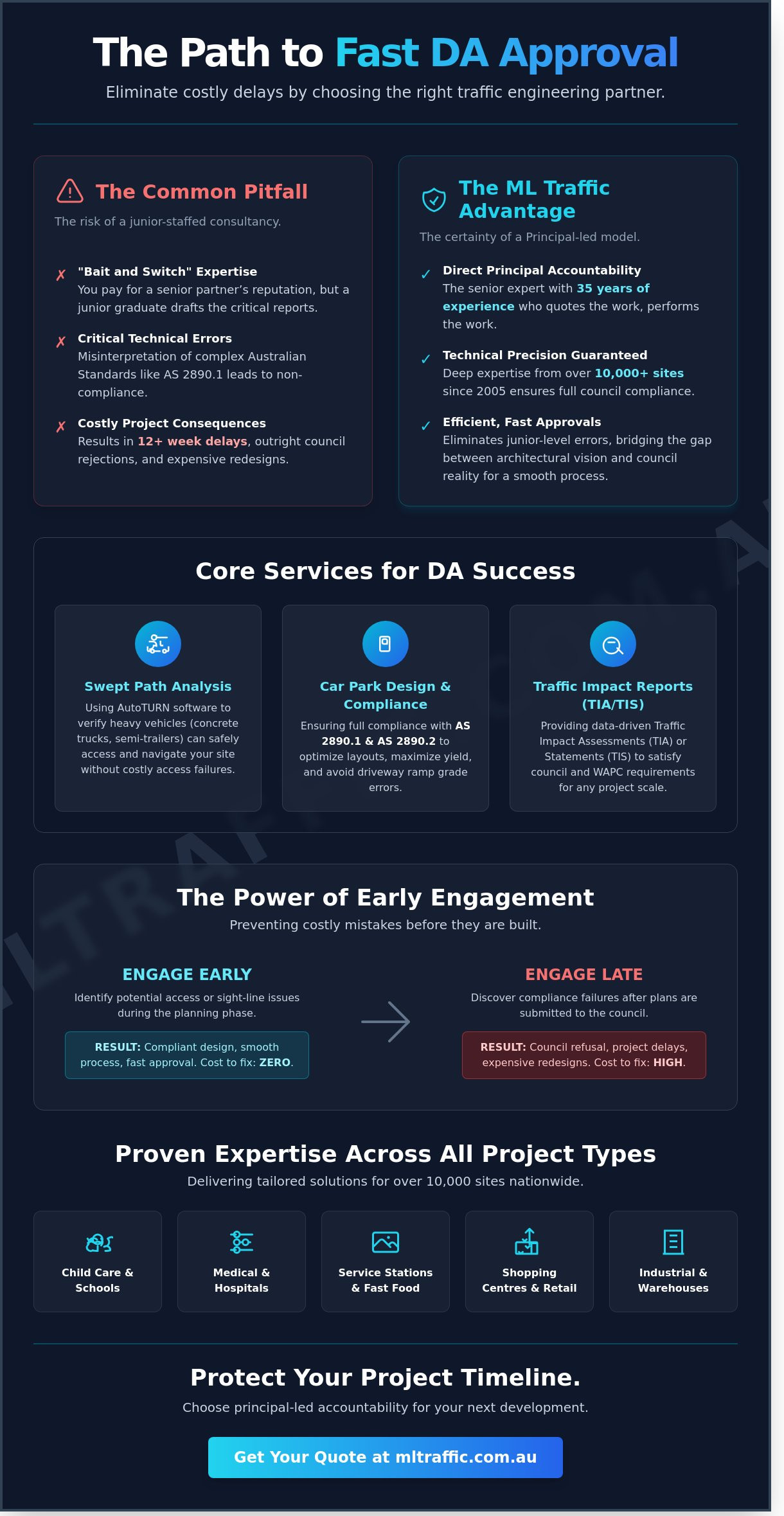
Key Takeaways
- Learn how traffic engineering consultants in Perth bridge the gap between architectural vision and council approval to secure successful Development Applications (DA).
- Identify whether your project requires a Traffic Impact Assessment (TIA) or a Statement (TIS) and how parking demand assessments can justify reducing required onsite spaces.
- Understand the role of AutoTURN software in Swept Path Analysis to ensure heavy vehicles and concrete trucks can navigate your site without access failures.
- Ensure full compliance with Australian Standards AS 2890.1 and AS 2890.2 to optimize car park layouts and avoid costly driveway ramp grade errors.
- Discover the “Principal-led” advantage, ensuring the senior expert who quotes your work is the same professional executing the technical assessments to eliminate junior-level errors.
Table of Contents
-
The Role of Traffic Engineering Consultants in Australian Developments
-
Essential Reports for Successful Development Applications (DA)
-
Technical Accuracy in Swept Path Analysis for Concrete Trucks
-
Why Direct Principal Accountability Matters for Your Project
The Role of Traffic Engineering Consultants in Australian Developments
Traffic engineering serves as the essential technical bridge between an architect’s creative vision and the strict requirements for council approval. Professional Traffic engineering focuses on the safe and efficient movement of people and goods on the road network. For private developers, hiring traffic engineering consultants in Perth is a mandatory step in the Development Application (DA) process. Without a formal assessment, projects often stall due to non-compliance with Australian Standards or local planning schemes.
To better understand how these roles function, watch this helpful video:
Experienced consultants bring a high level of accountability to a project. ML Traffic Engineers has been trading since 2005, providing over 15 years of specialized expertise in the Australian market. This experience is critical because every local council has different expectations for road network impact and site utility. A senior engineer doesn’t just identify problems; they find ways to maximize parking yield and improve vehicle circulation without compromising safety. Our focus remains on providing direct access to principals who perform the technical work themselves.
From Apartments to Warehouses: Versatile Traffic Expertise
The requirements for a traffic assessment change significantly based on the land-use type. A multi-deck apartment complex requires a focus on trip generation and bicycle parking compliance. In contrast, a regional warehouse needs rigorous Vehicle Swept Path Assessments to ensure semi-trailers can enter and exit in a forward gear. Our firm has completed assessments for over 10,000 sites nationwide. This experience includes diverse uses such as:
-
Child care centres and schools
-
Medical centres and hospitals
-
Service stations and fast food outlets
-
Shopping centres and retail strips
-
Industrial subdivisions and warehouses
Each project type demands a specific technical approach to satisfy the Department of Transport or local government authorities. We ensure every assessment meets the necessary criteria for a successful DA submission.
The Value of Early-Stage Engineering Involvement
Waiting until the final design stage to consult an engineer is a costly mistake. Early-stage involvement allows us to identify potential access issues or sight-line obstructions before they’re locked into the architectural plans. Fixing a driveway ramp grade on paper costs nothing, but redesigning a basement after a council refusal is expensive and time-consuming. Preliminary advice can save developers months of back-and-forth negotiations with the council. It creates a smoother path to approval by ensuring the design is compliant from day one. You can learn more about these requirements in our Traffic Engineering: The Definitive Guide. Engaging traffic engineering consultants in Perth early in the process is the most effective way to protect your investment and project timeline.
Essential Reports for Successful Development Applications (DA)
Securing approval from local government authorities like the City of Perth or City of Stirling requires technical evidence that a project won’t compromise road safety or network efficiency. Experienced
**traffic engineering consultants in Perth
**provide this evidence through data-driven reports that satisfy both the Western Australian Planning Commission (WAPC) and local council requirements. These documents bridge the gap between architectural vision and civil reality.
The scope of reporting depends on the scale of the project. Smaller developments usually require a Traffic Impact Statement (TIS), while larger commercial or mixed-use hubs necessitate a full Traffic Impact Assessment (TIA). Beyond these, specific technical studies often become necessary:
-
Sight Distance Assessments: These are non-negotiable for safety. Engineers measure visibility at entry and exit points to ensure they comply with the Australian Standard for car park design (AS 2890).
-
Intersection Analysis: For developments generating significant volume, engineers use SIDRA software to model how the local road network handles increased loads. This determines if existing intersections require upgrades like dedicated turning lanes or signal timing adjustments.
-
Swept Path Analysis: Using specialized software to prove that waste collection vehicles or delivery trucks can physically maneuver through the site without hitting curbs or structures.
Traffic Impact Assessments (TIA) Explained
A TIA is an exhaustive study that examines the existing transport environment and predicts how a new development will alter it. Engineers start by collecting volume data from the last 12 to 24 months to establish a baseline. They then apply trip generation rates specific to the land use, whether it’s a 50-unit apartment block or a 2,000-square-meter warehouse.
The report details how traffic distributes across the local street hierarchy and identifies potential bottlenecks. It also evaluates pedestrian access, cycling facilities, and public transport integration. A Traffic Impact Assessment (TIA) is the primary technical document required by council to evaluate and approve the traffic implications of a proposed development.
Car Parking Demand and Design
Local planning schemes often mandate a fixed number of parking bays that don’t reflect modern transport habits or specific site locations. This frequently creates a gap between rigid council requirements and the actual parking demand for a project. When a developer can’t fit the mandated number of bays, a Car Parking Demand Assessment becomes essential.
These assessments justify parking shortfalls by analyzing peak demand periods, proximity to high-frequency transit, and reciprocal parking opportunities. By providing empirical data,
**traffic engineering consultants in Perth
**can often reduce the required parking provision, saving developers significant construction costs. You can view the full range of
[ML Traffic Services
](https://www.mltraffic.com.au/services/)to see how these specialized reports support varied land uses from childcare centers to industrial estates.
If you’re facing a difficult parking requirement, it’s best to
[consult with an engineer
](https://www.mltraffic.com.au/contact/)
Technical Accuracy in Swept Path Analysis for Concrete Trucks
Swept Path Analysis (SPA) is a technical requirement for any development application involving heavy vehicle movement. It calculates the precise envelope of space a vehicle occupies while performing a turn or maneuver. For construction sites in Western Australia, SPA is the primary tool used to verify that a site layout is functional and safe. Without this data, developers risk costly redesigns or rejection from local government authorities. Experienced traffic engineering consultants in Perth use these assessments to ensure that heavy rigid vehicles can enter and exit a site in a forward gear, which is a standard safety requirement for most councils.
Concrete trucks present unique challenges due to their weight distribution and turning characteristics. A standard 3-axle concrete mixer requires significant clearance for its body swing and wheel paths. If the site design doesn’t account for the "outswing" of the mixer’s rear, the vehicle may strike structural columns, gate posts, or parked cars. We focus on providing precise simulations that reflect the actual dimensions of vehicles specified in Australian Standards (AS 2890.2).
Swept Path Analysis for Concrete Trucks
Concrete truck access is a high-priority check for councils during the construction phase planning. A standard mixer often follows the dimensions of a Medium Rigid Vehicle (MRV) or a Heavy Rigid Vehicle (HRV), depending on its capacity. Design errors often occur when architects use passenger vehicle templates for heavy vehicle crossovers. Common mistakes include:
-
Failing to provide enough width for the vehicle to clear the curb on entry.
-
Ignoring the vertical clearance required for the mixer’s loading hopper.
-
Designing internal roads that don’t allow for the 12.5-meter turning radius often required by larger units.
Our role as traffic engineering consultants in Perth involves identifying these bottlenecks early. We ensure driveways and loading docks comply with AS 2890.2 to prevent trucks from reversing into oncoming traffic on busy arterial roads.
AutoTURN and Digital Maneuverability
Digital simulations are the industry standard for proving a design’s viability. We use AutoTURN software to overlay vehicle paths directly onto architectural site plans. This process allows us to test "worst-case" maneuvers, such as a fully loaded truck navigating a narrow basement ramp or a tight 90-degree turn into a delivery bay. These simulations remove guesswork and provide a visual guarantee to council assessors that the design works in the real world.
Verifying these maneuvers is critical for site safety; it ensures that drivers don’t have to perform multi-point turns in confined spaces. For a more detailed look at these technical requirements, see our Swept Path Analysis Guide. By using digital maneuverability tests, we help clients avoid structural damage to their assets and ensure a smooth approval process with local authorities.
Meeting National Requirements for Car Park Design (AS 2890)
Compliance with Australian Standard AS 2890 is the primary technical hurdle for any development application in Western Australia. Traffic engineering consultants in Perth must ensure that every design element, from the entry crossover to the rear-most parking bay, adheres to these national benchmarks. AS 2890.1 covers off-street car parking for light vehicles, while AS 2890.2 dictates the requirements for commercial vehicle facilities. These standards aren’t suggestions. They are the metric by which local councils and planning authorities measure the safety and functionality of your project.
The role of the engineer involves more than just drawing lines. We provide the formal certification required for council submissions, verifying that the proposed layout works in practice. This involves checking swept paths, sightlines, and vertical clearances. When a design lacks this professional oversight, it often results in costly redesigns during the construction phase or an outright refusal from the council.
AS 2890.1 Compliance Checklist
Engineers evaluate parking layouts based on specific user classes defined by the duration of stay and the required ease of use. A Class 1A parking space for a residential apartment requires different dimensions than a Class 3A space for a high-turnover shopping centre. Minor deviations of even 50mm can lead to DA rejection because they compromise the ability of a B99 vehicle to maneuver safely.
-
Standard parking bay widths: Usually range from 2.4m to 2.7m depending on the specific user class and adjacent obstructions like columns.
-
Aisle widths: A standard 90-degree parking aisle typically requires 5.8m for two-way traffic, though this increases if the bays are narrower.
-
Blind aisle extensions: Must include an additional 1m beyond the last bay to allow a vehicle to turn around without multiple shunts.
-
Queue lengths: Entry points must accommodate a specific number of vehicles to prevent queuing onto public roads like St Georges Terrace or Scarborough Beach Road.
For a deeper technical breakdown of these metrics, refer to this AS 2890.1 Explained guide.
Driveway Ramp Grades and Ground Clearance
Ramp design is a frequent point of failure in development applications. It requires precise calculation of vertical curves to prevent vehicles from bottoming out, or scraping their bumpers. AS 2890.1 specifies a maximum grade of 1 in 4 (25%) for private ramps, but sudden changes in grade are prohibited. Any change exceeding 12.5% requires a transition section at least 2m long to protect the vehicle undercarriage.
Our engineers use 2D profile templates to test the 85th percentile vehicle (B85) against the proposed design. For commercial sites, the requirements are stricter. AS 2890.2 requires different transitions depending on whether a Small Rigid Vehicle (SRV) or Medium Rigid Vehicle (MRV) needs access. We calculate these vertical curves to ensure that service trucks can reach loading bays without damaging the pavement or the vehicle itself. Precision at the design stage prevents operational headaches once the building is occupied.
Ensure your project meets all Western Australian planning requirements by speaking with our experienced traffic engineering consultants in Perth today.
Why Direct Principal Accountability Matters for Your Project
Successful development applications in Western Australia require technical precision and high levels of accountability. ML Traffic Engineers maintains a strict principal-led model. This means the senior engineer who quotes your work is the same professional who performs the site assessment, drafts the report, and signs off on the final submission. We operate on a hands-on philosophy developed through 30 to 40 years of senior engineering experience per principal. It’s a method that ensures your project doesn’t become a training exercise for junior staff. When the person who understands the project scope is the one executing the technical analysis, the risk of data misinterpretation disappears.
The Problem with Large Consultancy Bureaucracy
Project knowledge is frequently lost in large firms when work moves from senior sales teams to junior engineers. This dilution of expertise often leads to errors in technical assessments like a Traffic Impact Statement (TIS) or a Car Parking Demand Assessment. In contrast, traffic engineering consultants in Perth who prioritize direct accountability provide more reliable results for private developers. At ML Traffic, we’ve completed over 10,000 site assessments since our establishment in 2005. Clients receive direct mobile access to the principals, Michael Lee or Benny Chen. This ensures immediate answers to technical queries. You won’t wait days for a response from a project manager who isn’t familiar with your specific site constraints or driveway ramp grades.
Ensuring Results-Oriented Outcomes
Senior expertise translates directly into more persuasive arguments during council negotiations and JDAP hearings. We focus on a fact-based engineering approach that aligns strictly with Australian Standards, such as AS 2890.1 for parking facilities. This technical authority allows us to identify potential issues with sight-line assessments or vehicle swept paths early in the design phase. By addressing these factors proactively, we reduce the likelihood of costly revisions or delays at the local government level. Our reports are designed to be authoritative and compliant, leaving little room for subjective debate by planning officers. If your project requires a complex Traffic Impact Assessment (TIA), you benefit from decades of direct industry knowledge applied to every page of the report. The result is a streamlined approval process built on technical integrity.
For professional advice and direct accountability on your next development, Contact the Principals at ML Traffic.
Secure Your Development Approval with Technical Precision
Successful development applications in Western Australia demand technical accuracy and a deep understanding of national standards. Navigating AS 2890 requirements for car park design and performing precise swept path analysis for heavy vehicles are critical steps for project viability. ML Traffic Engineers has assessed more than 10,000 sites across Australia, delivering the rigorous data required to meet strict council expectations. As experienced traffic engineering consultants in Perth, we provide direct access to our principals, Michael Lee and Benny Chen. Each senior engineer brings between 30 and 40 years of professional experience to your project. This hands-on approach means the consultant who provides your quote is the same expert who performs the technical work. We focus on private clients and their specific development needs, ensuring every Traffic Impact Statement and Sight-Line Assessment is meticulous. Don’t risk delays due to technical errors or junior staff oversights. You can move your project forward with confidence by partnering with specialists who prioritize direct accountability and proven results.
Get a quote from the engineers who will actually do the work
We look forward to helping you achieve a successful outcome for your next development.
Frequently Asked Questions
What is the purpose of a Traffic Impact Assessment (TIA)?
A Traffic Impact Assessment (TIA) evaluates the technical impact a proposed development has on the surrounding road network and transport infrastructure. It determines if the existing roads can accommodate the projected increase in vehicle movements, which often ranges from 10% to 30% for new commercial sites. Our traffic engineering consultants in Perth use these assessments to ensure your project meets Western Australian Planning Commission (WAPC) guidelines. The report identifies necessary infrastructure upgrades to maintain safety and efficiency for all road users.
When is a Swept Path Analysis required for a development?
A Swept Path Analysis is required whenever a development needs to prove that specific vehicles can maneuver safely within the site boundaries. This is a mandatory requirement for 100% of commercial development applications involving loading docks, waste collection, or basement parking. We use specialized CAD software to simulate the turning circles of B85 or B99 vehicles. This process ensures that delivery trucks or cars don’t strike curbs, walls, or structural columns while navigating the property.
Can a traffic engineer help reduce the number of required parking spaces?
Yes, a traffic engineer can justify a parking reduction through a formal Parking Demand Assessment. We analyze the specific land use and proximity to public transport to demonstrate that the statutory requirements exceed the actual demand. If a site is located within 800 metres of a high-frequency bus or train station, local councils often approve a lower number of bays. This assessment helps you maximize the buildable area of your site while remaining compliant with local planning schemes.
What are the most common reasons for a traffic report to be rejected by council?
Traffic reports are most frequently rejected due to the use of outdated traffic count data or non-compliance with AS 2890.1 standards. Many councils in Western Australia will dismiss a report if the sight-line analysis at the driveway exit doesn’t meet specific safety criteria. If the data is more than 24 months old, it’s often considered invalid. Professional traffic engineering consultants in Perth ensure every report uses current data and addresses the specific technical requirements of the relevant local government authority.
How long does it typically take to prepare a Traffic Impact Statement?
Preparation of a Traffic Impact Statement (TIS) generally takes between 5 and 10 business days once we receive your final architectural plans. This timeframe includes site inspections, data collection, and technical analysis of the proposed layout. More complex projects that require intersection modelling or extensive traffic counts might take up to 15 business days. We provide a clear deadline at the start of the project so your development application stays on schedule without unexpected delays.
Do I need a separate assessment for heavy vehicle access like concrete trucks?
You need a specific assessment if your site requires access for any vehicle larger than a standard passenger car. This includes heavy rigid vehicles (HRVs) such as concrete trucks, waste collection units, or delivery vans. We perform dedicated swept path assessments for these vehicles to confirm they can enter and exit the site in a forward gear. This is a critical safety requirement for industrial developments and large-scale residential projects across the Perth metropolitan area.
What is AS 2890 and why is it important for my project?
AS 2890 is the suite of Australian Standards that governs the design and layout of off-street parking facilities. It’s the primary benchmark used by local councils to evaluate the safety and functionality of your development’s parking and access. Part 1 focuses on standard car parking, while Part 2 covers commercial vehicle facilities. Compliance is mandatory for project approval. It ensures that all parking bays, ramps, and aisles are sized correctly to prevent vehicle damage and traffic congestion.
How much does a traffic engineering consultant cost for a DA?
The cost for traffic engineering services varies based on the complexity of the development and the specific reporting requirements of the local council. A basic Traffic Impact Statement for a small residential project involves different technical work than a full TIA for a major shopping centre. We provide fixed-fee quotes based on your specific architectural drawings to ensure there are no hidden costs. The consultant who provides your initial quote will be the one performing the technical analysis on your file.
Which areas do you cover?
We are traffic engineers servicing Alexander Heights, Alfred Cove, Alkimos, Anketell, Applecross, Ardross, Armadale, Ascot, Ashby, Ashendon, Ashfield, Attadale, Atwell, Aubin Grove, Aveley, Balcatta, Baldivis, Balga, Ballajura, Banksia Grove, Bassendean, Bateman, Bayswater, Beaconsfield, Beckenham, Bedford, Beechboro, Beeliar, Beldon, Bellevue, Belmont, Bentley, Bertram, Bibra Lake, Bicton, Booragoon, Brentwood, Brigadoon, Brookdale, Bull Creek, Bullsbrook, Burns Beach, Burswood, Butler, Byford, Canning Vale, Cannington, Carine, Carlisle, Carramar, Casuarina, Caversham, Champion Lakes, Chidlow, Churchlands, City Beach, Claremont, Clarkson, Cloverdale, Cockburn Central, Connolly, Coogee, Coolbellup, Coolbinia, Cottesloe, Craigie, Crawley, Currambine, Dalkeith, Darch, Doubleview, East Perth, Edgewater, Ellenbrook, Floreat, Fremantle, Girrawheen, Greenwood, Guildford, Hamilton Hill, Heathridge, Hillarys, Inglewood, Joondalup, Kallaroo, Kingsley, Leeming, Mandurah, Maylands, Melville, Midland, Mindarie, Morley, Mosman Park, Mount Hawthorn, Mount Lawley, Mullaloo, Nedlands, North Perth, Northbridge, Ocean Reef, Osborne Park, Padbury, Perth, Piara Waters, Rockingham, Scarborough, South Perth, Subiaco, Swanbourne, Thornlie, Tuart Hill, Victoria Park, Wangara, Wanneroo, Warwick, Wembley, West Perth, Willetton, Woodvale, Yokine.

Disclaimer
The content on www.mltraffic.com.au, including all technical articles, guides, and resources, is provided for general informational and educational purposes only. It is not intended to constitute professional advice in traffic engineering, transportation planning, development approvals, or any other technical or legal field.
While ML Traffic Engineers makes every reasonable effort to ensure the accuracy, completeness, and timeliness of the information published, we do not provide any warranties or representations (express or implied) regarding its reliability, suitability, or availability for any particular purpose. Any reliance you place on the content is strictly at your own risk.
In no event shall ML Traffic Engineers, its directors, employees, authors, or affiliates be liable for any direct, indirect, incidental, special, consequential, or punitive damages (including, without limitation, loss of profits, data, or business opportunities) arising out of or in connection with the use of, or inability to use, any information provided on this website.
The articles and guides on this site are not a substitute for engaging a qualified, registered professional traffic engineer (such as an NPER or RPEQ engineer) to assess your specific project requirements. For tailored advice, compliance assessments, or traffic engineering services, please contact a competent professional.
This disclaimer may be updated from time to time without notice. By accessing or using this website, you agree to be bound by the most current version of this disclaimer.
