

We are traffic engineers operating in Perth and surrounding regions.
For any Perth property developer, the words ‘council delay’ can signal the start of costly budget blowouts and immense frustration. More often than not, the source of these delays lies in a non-compliant traffic impact assessment or a poorly optimised parking design that fails to meet the stringent standards of the Western Australian Planning Commission (WAPC).
Securing a swift Development Application approval requires a strategic, proactive approach. Engaging experienced traffic engineering consultants Perth developers trust is the critical first step to ensuring every aspect of your site’s access, parking, and traffic flow is meticulously planned and fully compliant from the outset.
In this article, we detail the key strategies for navigating the DA approval process in 2026. You will discover how expert traffic engineering ensures your application meets all council and WAPC standards, how clever design can optimise your site yield, and why direct communication with the engineer handling your project is essential for avoiding costly, over-engineered solutions and achieving a seamless approval.
Key Takeaways
-
Understand the critical difference between a TIS and a TIA to ensure you only pay for the traffic report your Perth development actually needs.
-
Learn how to successfully navigate the WAPC Transport Impact Assessment Guidelines and specific local council rules to fast-track your approval.
-
Discover how expert traffic engineering consultants perth use Swept Path Analysis to prove your site design meets AS 2890.1 standards, preventing costly redesigns.
-
Find out why a traffic engineer is the essential link between your architectural plans and gaining council approval, translating your vision into a compliant reality.
Table of Contents
-
What Do Traffic Engineering Consultants in Perth Actually Do?
-
Essential Traffic Reports for Your Perth Development Application
-
Optimising Site Design: Swept Path Analysis and AS 2890 Compliance
-
Why ML Traffic Engineers is the Preferred Choice for Perth Projects
What Do Traffic Engineering Consultants in Perth Actually Do?
At its core, a traffic engineering consultant is a specialist engineer who analyzes and reports on how a new development will impact Perth’s transport network. They are the critical bridge between your architectural vision and the complex requirements of local and state government authorities. Whether you are planning a small residential subdivision in a growing outer suburb or a major commercial hub in the Perth CBD, these experts provide the data-driven evidence needed to secure development approval. The work of professional traffic engineering consultants in Perth ensures that vehicle movements, pedestrian safety, and site access are not just functional, but fully compliant with all relevant standards.
To better understand the core principles and data points involved, this video provides a helpful overview:
As Perth continues to densify, the regulatory landscape evolves. Future-focused transport planning and evolving regulations mean that development applications now require more sophisticated data and analysis than in previous years. A simple traffic count is no longer sufficient; councils demand robust modelling and justification for every aspect of a site’s transport impact.
The Intersection of Engineering and Planning
Traffic consultants work hand-in-hand with town planners and architects to justify a development’s proposed intensity. Their expertise in the field of Traffic engineering allows them to translate complex vehicle movements, intersection performance, and parking logic into clear, council-ready technical reports. This evidence is vital for mediation and for presenting a strong case at Joint Development Assessment Panel (JDAP) meetings, where expert testimony can be the deciding factor for project approval.
Core Deliverables for WA Developers
For developers in Western Australia, engaging a traffic consultant results in several essential documents and strategies that directly support a successful Development Application (DA). Key deliverables include:
-
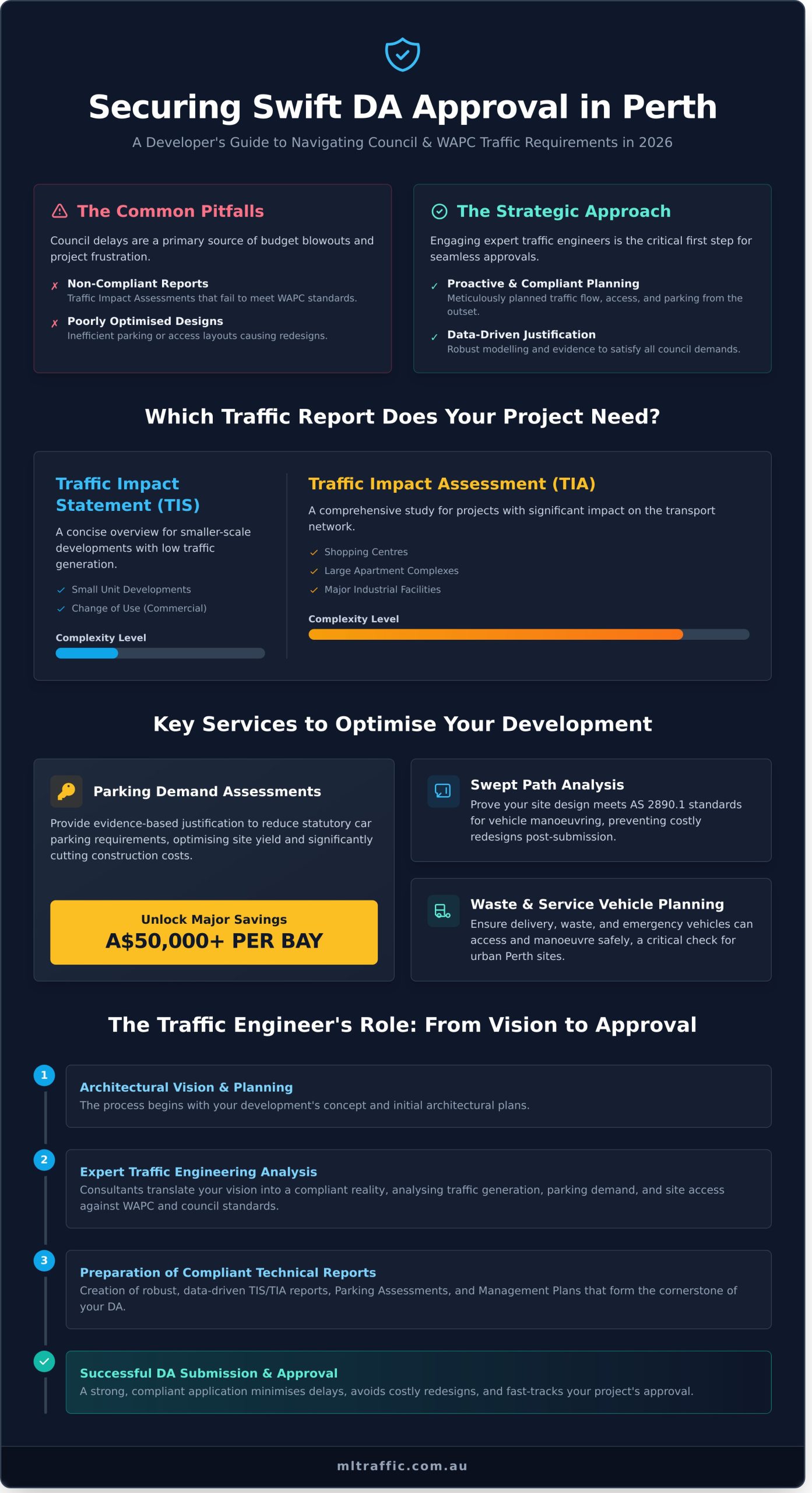
Traffic Impact Assessments (TIA) and Statements (TIS): These reports form the cornerstone of any DA, providing a detailed analysis of the development’s effect on the surrounding road network.
-
Parking Demand Assessments: A crucial tool for optimising your project. By providing evidence-based justification, these assessments can often reduce statutory car parking requirements, saving significant construction costs (A$50,000+ per bay).
-
Waste Management & Service Vehicle Planning: Essential for urban Perth sites, this planning ensures that delivery, waste, and emergency vehicles can access and manoeuvre safely and efficiently without disrupting public roads.
Essential Traffic Reports for Your Perth Development Application
Securing approval for your Development Application (DA) in Perth hinges on providing the correct supporting documentation. A crucial component is the traffic report, which demonstrates to the council that your project’s impact on the local road network and parking supply has been professionally assessed and managed. Engaging experienced traffic engineering consultants in Perth from the outset ensures you submit the right report for your project’s scale, avoiding costly delays and requests for further information.
Depending on the size and nature of your development, your DA will require one or more of the following essential reports:
-
Traffic Impact Statement (TIS): This is typically required for smaller-scale developments with low traffic generation, such as small unit developments or a change of use for a commercial tenancy. It provides a concise overview of traffic and parking impacts.
-
Traffic Impact Assessment (TIA): A TIA is a comprehensive study reserved for high-impact projects like shopping centres, large apartment complexes, or industrial facilities. It involves detailed analysis of traffic generation, network capacity, and intersection performance.
-
Parking Management Plans: When a development cannot meet the standard parking bay ratios, this plan provides a robust strategy to satisfy council requirements. It analyses actual demand and proposes solutions for "shortfall" or "overflow" parking.
-
Construction Traffic Management Plans (CTMP): Essential for projects on busy Perth corridors, a CTMP provides a detailed strategy to ensure the safety of workers, pedestrians, and motorists during the construction phase, minimising disruption to the surrounding network.
When is a Full TIA Required?
A full Traffic Impact Assessment (TIA) is mandated for developments that exceed specific thresholds for traffic generation. These are clearly defined within the official WAPC Transport Impact Assessment Guidelines and are designed to identify significant projects. The assessment meticulously analyses the "Level of Service" (LoS) for surrounding intersections, ensuring they can absorb the additional traffic. Undertaking this assessment early prevents costly redesigns and council objections after your DA has been lodged.
Parking Demand vs. Council Requirements
Local councils often apply standard parking ratios that may not reflect the specific needs of your site. Our role is to navigate the gap between these requirements and the actual parking demand. For transit-oriented developments (TOD) near train stations or high-frequency bus routes, we use survey data and first-principles analysis to present a compelling case for parking reductions, optimising your development’s land use and feasibility. Check out our comprehensive list of services for specific report types.
Navigating WAPC Guidelines and Perth Council Expectations
A successful development application hinges on a deep understanding of Perth’s complex regulatory environment. The requirements set by the Western Australian Planning Commission (WAPC), Main Roads WA, and individual local councils can be intricate and often overlap. Engaging professional traffic engineering consultants perth ensures your submission is robust, compliant, and positioned for approval from the outset.
It is critical to recognise that council expectations vary significantly. A Traffic Impact Assessment for a high-density site in the City of Perth will face intense scrutiny on pedestrian amenity, bicycle facilities, and reduced car parking provisions. In contrast, a development in an outer metropolitan council like the City of Wanneroo or Rockingham may place a greater emphasis on managing peak hour vehicle generation and ensuring seamless integration with the surrounding road network.
Our experience shows that councils frequently reject or delay applications due to common, avoidable errors. Key "deal-breakers" include:
-
Non-compliant sight-lines at vehicle access points.
-
Inadequate swept path analysis for the required design vehicle (e.g., waste collection trucks).
-
Insufficient justification for proposed parking supply or a requested shortfall.
-
Poorly designed pedestrian or cyclist access and end-of-trip facilities.
The WAPC Framework in 2026
WAPC’s current framework prioritises the integration of sustainable transport modes into all new developments. Recent policy updates place stricter controls on driveway crossover locations and require rigorous sight-line assessments to enhance safety. While a "deemed-to-comply" solution offers a straightforward path, a "performance-based" approach often delivers a superior design outcome but requires expert justification to gain council approval.
Dealing with Main Roads WA
If your development fronts a primary distributor or highway, such as Stirling Highway or Kwinana Freeway, it will automatically trigger a referral to Main Roads WA (MRWA). MRWA’s primary concern is the safety and efficiency of their network. We advocate for early, pre-lodgement consultation with MRWA to address their requirements proactively, which is essential for avoiding a "recommendation for refusal" that can derail a project.
Optimising Site Design: Swept Path Analysis and AS 2890 Compliance
On Perth’s increasingly tight urban infill sites, every square metre of your development counts. The secret to maximising your building footprint while guaranteeing functional and safe vehicle access lies in precise Swept Path Analysis. This technical assessment isn’t just a box-ticking exercise; it’s a critical design tool that prevents costly rework and ensures your project gains council approval without delays.
Using industry-standard AutoTURN software, we simulate the precise movements of various vehicles, from passenger cars to service trucks, ensuring they can navigate your site safely and efficiently. This proactive approach identifies and resolves potential access issues at the design stage, long before they become expensive construction problems.
Vehicle Manoeuvring for Urban Infill
A successful design must accommodate the vehicles that will actually use the site. Our analysis focuses on key design vehicles to ensure compliance and functionality. This includes:
-
The B99 Design Vehicle: We ensure standard large cars can comfortably navigate residential basement ramps and parking bays without issue.
-
Waste Truck Access: Most Perth councils mandate a "reverse-in, drive-out" or "drive-in, drive-out" capability for waste collection. We model these manoeuvres to prove compliance and ensure practical, safe servicing for the life of the building.
To see how these principles are applied in practice, view our technical videos demonstrating vehicle swept path assessments.
Driveway and Ramp Grade Standards
A common point of failure in development applications is non-compliant driveway and ramp design. Adherence to Australian Standard AS 2890.1 is non-negotiable. We focus on the critical details that determine feasibility, such as the "break-over" and "scrape" angles at grade transitions. Getting these wrong results in vehicles bottoming out, causing damage and creating a significant liability.
For developers in Perth, these standards directly impact the viability of underground parking. As experienced traffic engineering consultants in Perth, we provide certified designs that meet all council requirements. A certified traffic engineer’s sign-off is essential to de-risk your project and avoid being held personally liable for a non-compliant or unsafe design.
Why ML Traffic Engineers is the Preferred Choice for Perth Projects
When selecting a partner for your development, you need certainty, expertise, and efficiency. ML Traffic Engineers Pty Ltd delivers on all fronts with a simple, effective principle: the senior consultant who quotes your project is the person who completes the work. This model of direct accountability is our core advantage.
With a history of assessing over 10,000 sites nationwide and a deep operational focus on the Perth metropolitan area, our experience is both broad and locally specific. We have provided compliant, practical traffic solutions for every tier of land use, from small-scale childcare centres and medical clinics to multi-level residential towers and large-format industrial warehouses. This proven track record ensures we understand the unique challenges and council requirements of your project.
Expertise You Can Call Directly
In an industry where projects are often passed to junior staff, we guarantee direct access to our principals, Michael Lee and Benny Chen. Our "no-gatekeepers" approach eliminates communication bottlenecks and ensures the person making critical decisions on your traffic report is a seasoned professional. This direct accountability leads to faster, more accurate reports and smoother Development Application (DA) approvals. This commitment to principal-led service has been central to our 15+ year history in the Australian market.
Get Started with Your Perth Traffic Report
Requesting a comprehensive traffic report is a straightforward process. As specialist traffic engineering consultants in Perth, we provide accurate, fixed-fee quotes that cover exactly what your local council requires. To prepare your Traffic Impact Assessment (TIA) or Vehicle Swept Path Analysis, we typically need the following information:
-
Architectural or site plans (PDF or DWG format)
-
Any relevant council correspondence or existing DA conditions
-
A brief description of the proposed development and its intended use
With these details, we can deliver a robust assessment designed to meet the rigorous standards of Perth councils and keep your project moving forward. Ready to proceed with confidence? Contact our Perth experts today for a precise quote and expert guidance.
Secure Your Perth Development Approval with Expert Guidance
Navigating Perth’s development application process in 2026 demands a precise and experienced approach to traffic management. Successfully satisfying WAPC guidelines and local council requirements hinges on robust, technically sound traffic reports and meticulous site design compliance. These elements are not just procedural hurdles; they are critical to the viability and approval of your project.
Engaging the right traffic engineering consultants perth is the single most important decision to ensure a smooth pathway to approval. With a track record of over 10,000 completed projects, ML Traffic Engineers provides direct access to Senior Engineers with more than 30 years of specialised experience in WA council and WAPC compliance. We deliver the authoritative, defensible reports your project needs.
Don’t let traffic compliance issues create costly delays or jeopardise your investment. Take the next step with confidence. Get a Professional Quote for Your Perth Traffic Report today and leverage our proven expertise to move your project forward.
Frequently Asked Questions
How much does a traffic engineering consultant cost in Perth?
The cost for traffic engineering consultants in Perth is based on project complexity. A standard Traffic Impact Statement for a small development may start from A$2,000, while a comprehensive Traffic Impact Assessment (TIA) for a major project will be more. Key factors include the site’s scale, land use, and specific council requirements. We provide a fixed-fee quote before work begins, ensuring complete cost transparency for our clients.
When do I need a Traffic Impact Assessment (TIA) for my Perth DA?
A full Traffic Impact Assessment (TIA) is typically needed for a Perth Development Application (DA) when your project generates significant traffic. This is often triggered by Western Australian Planning Commission (WAPC) guidelines, such as for developments creating over 100 vehicle trips in a peak hour. Projects like shopping centres, large residential complexes, or schools almost always require a TIA, whereas smaller developments may only need a Traffic Impact Statement (TIS).
Do Perth councils accept swept path analysis from non-engineers?
No, Perth councils require that swept path analysis plans be prepared and certified by a qualified traffic engineer. This is to ensure the assessment accurately uses the correct vehicle templates and complies with Australian Standards (AS 2890.1). Submitting a non-certified analysis creates a significant risk of rejection and will cause delays to your development application, as the council cannot verify its technical accuracy and compliance.
How long does it take to get a traffic report for a development application?
The timeframe depends on the report’s scope. A straightforward Traffic Impact Statement (TIS) or Car Parking Demand Assessment is typically completed within one to two weeks. A more detailed Traffic Impact Assessment (TIA), which may require on-site traffic counts and extensive data analysis, usually takes three to four weeks. We always provide a clear project timeline with our fee proposal to help you meet your submission deadlines.
What is the difference between a Traffic Impact Statement and a full TIA?
A Traffic Impact Statement (TIS) is a concise report suitable for smaller-scale developments with a low traffic impact, like a small cafe or a few townhouses. It provides a basic overview for council assessment. In contrast, a full Traffic Impact Assessment (TIA) is an in-depth study for larger projects with significant traffic implications, such as a supermarket or large office building. A TIA involves detailed traffic modelling and analysis of the surrounding road network.
Can a traffic engineer help reduce the number of parking spots required for my site?
Yes, absolutely. A traffic engineer can prepare a Car Parking Demand Assessment to justify a reduction in the statutory parking requirements. By analysing factors like your specific land use, proximity to public transport, and opportunities for shared parking, we can present a robust, evidence-based case to the council. This can demonstrate that the standard rate is excessive for your site, potentially saving significant construction costs and improving site yield.
Are Australian Standards (AS 2890) legally binding for Perth developments?
While not legislation themselves, Australian Standards like AS 2890.1 (for off-street parking) are referenced within local government planning schemes and the National Construction Code. This makes compliance a mandatory, de-facto requirement for gaining development approval in Perth. Any car park or access design that fails to meet these standards will be rejected by the assessing authority, making expert engineering input essential for approval.
What happens if Main Roads WA objects to my development access?
If Main Roads WA raises an objection, your traffic consultant acts as your professional advocate. We engage directly with their engineers to understand the specific concerns, which often relate to road safety or traffic efficiency on their network. Our role is to then negotiate a resolution by providing revised designs, further technical analysis, or mitigation strategies. As experienced traffic engineering consultants in Perth, we are skilled at navigating these discussions to achieve a positive outcome.
Which suburbs do you service?
We operate in Alexander Heights, Alfred Cove, Alkimos, Anketell, Applecross, Ardross, Armadale, Ascot, Ashby, Ashendon, Ashfield, Attadale, Atwell, Aubin Grove, Aveley, Balcatta, Baldivis, Balga, Ballajura, Banksia Grove, Bassendean, Bateman, Bayswater, Beaconsfield, Beckenham, Bedford, Beechboro, Beeliar, Beldon, Bellevue, Belmont, Bentley, Bertram, Bibra Lake, Bicton, Booragoon, Brentwood, Brigadoon, Brookdale, Bull Creek, Bullsbrook, Burns Beach, Burswood, Butler, Byford, Canning Vale, Cannington, Carine, Carlisle, Carramar, Casuarina, Caversham, Champion Lakes, Chidlow, Churchlands, City Beach, Claremont, Clarkson, Cloverdale, Cockburn Central, Connolly, Coogee, Coolbellup, Coolbinia, Cottesloe, Craigie, Crawley, Currambine, Dalkeith, Darch, Doubleview, East Perth, Edgewater, Ellenbrook, Floreat, Fremantle, Girrawheen, Greenwood, Guildford, Hamilton Hill, Heathridge, Hillarys, Inglewood, Joondalup, Kallaroo, Kingsley, Leeming, Mandurah, Maylands, Melville, Midland, Mindarie, Morley, Mosman Park, Mount Hawthorn, Mount Lawley, Mullaloo, Nedlands, North Perth, Northbridge, Ocean Reef, Osborne Park, Padbury, Perth, Piara Waters, Rockingham, Scarborough, South Perth, Subiaco, Swanbourne, Thornlie, Tuart Hill, Victoria Park, Wangara, Wanneroo, Warwick, Wembley, West Perth, Willetton, Woodvale, Yokine.
