

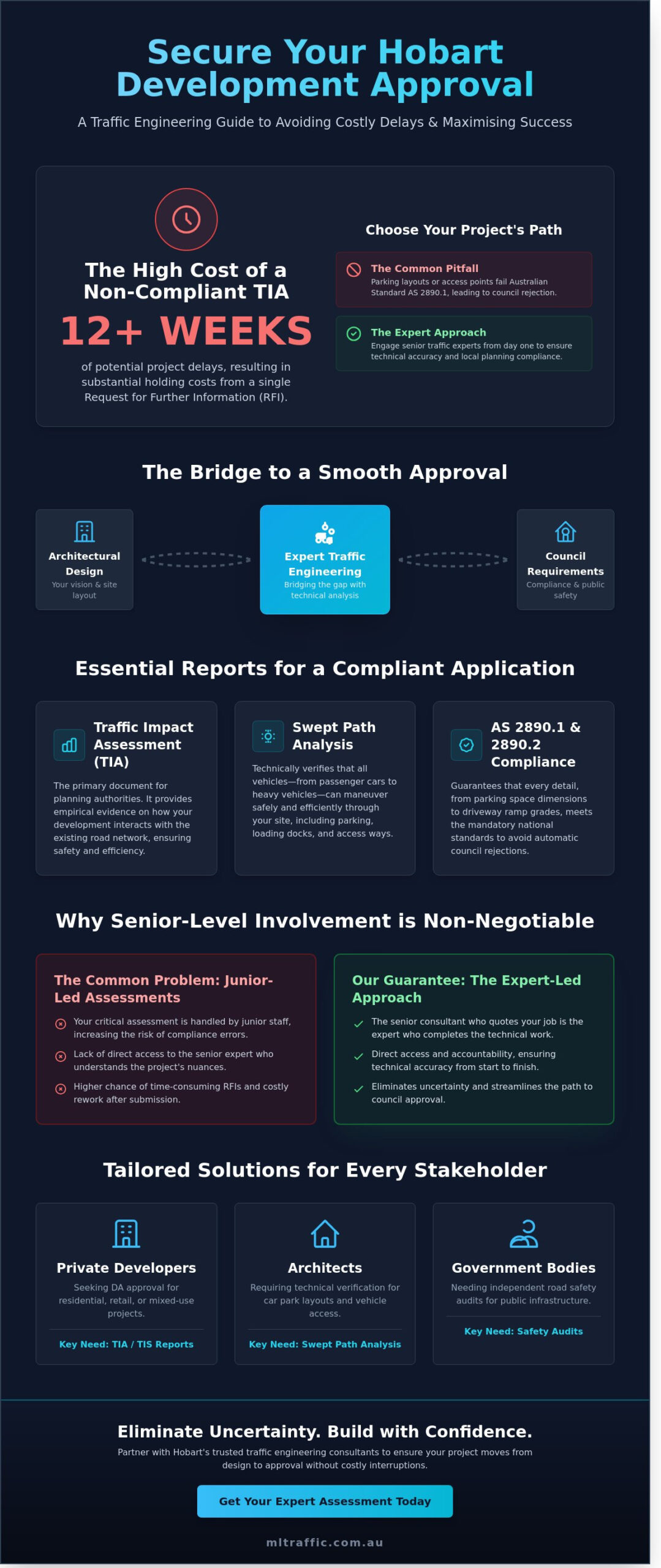
A non-compliant Traffic Impact Assessment (TIA) can delay a Hobart development by 12 weeks or more, resulting in substantial holding costs. You understand that navigating council requirements is often the most technical hurdle in the development process. When parking layouts or access points fail to meet Australian Standard AS 2890.1, the resulting Request for Further Information (RFI) can stall your project indefinitely. Engaging expert traffic engineering consultants in Hobart ensures your application is built on a foundation of technical accuracy and local planning knowledge from day one.
It’s frustrating when junior staff at large firms handle your critical assessments, only for you to discover compliance errors later. This guide provides the engineering insights needed to secure timely council approvals and implement cost-effective access designs. We’ll examine the specific requirements of a Traffic Impact Statement (TIS) and show you how direct access to senior experts eliminates the uncertainty of the approval process.
Key Takeaways
- Understand how professional consultants bridge the gap between architectural design and council requirements to streamline your development application.
- Identify the critical technical reports your project needs, including Traffic Impact Assessments and Swept Path Analysis, to demonstrate road network safety.
- Learn how traffic engineering consultants in Hobart ensure full compliance with Australian Standards AS 2890.1 and AS 2890.2 to avoid costly council rejections.
- Discover why senior-level involvement is vital for project success and why the consultant who quotes your job must be the one to complete the technical assessment.
- Gain a clear roadmap for integrating engineering insights into your site layout through effective collaboration with architects and town planners.
What is the Role of Traffic Engineering Consultants in Modern Development?
Traffic engineering consultants specialize in the safe and efficient movement of people and goods on the road network. They provide the technical bridge between architectural design and local council planning requirements. For any developer, engaging traffic engineering consultants in Hobart is a prerequisite for securing planning permits for high-density, commercial, or industrial land-use types. It’s a technical discipline that ensures a project doesn’t just look good on paper but functions safely in the real world.
The discipline involves more than just drawing lines for parking spaces. To understand the core principles, you can research What is Traffic Engineering? as it relates to transportation systems. Professional consultants ensure that every driveway, intersection, and loading dock complies with Australian Standards such as AS 2890.1. This expertise prevents bottlenecks and safety hazards before the first brick is laid. Early integration of these experts into your project team reduces the risk of council refusal during the development application phase.
To better understand the distinction between these engineering roles, watch this helpful video:
The Difference Between Traffic Engineering and Transport Planning
Transport planning involves broad-scale infrastructure strategy and regional policy. Traffic engineering focuses on the technical design and road geometry of specific sites. Consultants use empirical data and software like SIDRA to predict how a new development will affect local traffic volumes. This level of traffic engineering is essential in urban densification, where a 15% increase in local density can lead to significant congestion without proper mitigation. We use specific data to assess sight-line requirements and driveway ramp grades to ensure compliance.
Who Needs a Traffic Consultant?
The need for professional traffic advice spans across the entire development sector. At ML Traffic Engineers, we focus on providing direct results for various stakeholders:
- Private Developers: Those seeking DA approval for residential, retail, or mixed-use projects require a Traffic Impact Statement (TIS) or Traffic Impact Assessment (TIA).
- Architects: Technical verification is required for car park layouts and vehicle swept path assessments to ensure vehicles can maneuver safely within the site.
- Government Bodies: Agencies require independent road safety audits or corridor studies for public infrastructure projects to manage risk.
Integrating traffic planning early in the project lifecycle provides long-term value. It’s common for a 10,000sqm industrial site to face months of delays because a heavy vehicle cannot safely turn into the property. Identifying these constraints during the initial design phase saves thousands in rework fees. When you hire traffic engineering consultants in Hobart, the consultant who provides the quote should be the one doing the work. This hands-on approach ensures technical accountability from the first site visit to the final council submission.
Essential Traffic Reports Required for Development Applications
Securing a planning permit for a new development requires a suite of technical reports to satisfy local council requirements. Experienced traffic engineering consultants in Hobart identify which specific documents are necessary based on the project scale and land use. These reports provide the empirical evidence needed to prove that a project is safe, functional, and compliant with Australian Standards like AS 2890.1.
The Anatomy of a Traffic Impact Assessment (TIA)
A TIA is the primary document analyzed by planning authorities. It evaluates how a proposed development interacts with the existing road network. This involves modeling trip generation and distribution based on empirical data from sources like the RTA Guide to Traffic Generating Developments. Reference to the Transport Impact Assessment Guidelines provides a framework for how these assessments are structured across different Australian jurisdictions. Detailed evaluation of traffic impact assessments for council submission ensures that all potential congestion or safety issues are mitigated before construction begins.
Why Swept Path Analysis is Non-Negotiable
Swept path analysis is a mandatory requirement for site access design. It verifies that larger vehicles, such as 12.5-meter heavy rigid vehicles (HRVs) used for waste collection or emergency services, can safely maneuver within the site. We use AutoTURN software to produce compliant diagrams that meet rigorous council review standards. Developers can read more about swept path analysis for site access to understand how these simulations prevent costly design errors and physical site constraints.
Car Parking Demand Assessments
When a project doesn’t meet the minimum parking rates specified in the local planning scheme, a Car Parking Demand Assessment becomes essential. These reports justify lower provisions by analyzing actual land-use needs, peak demand times, and the availability of public transport. This data-driven approach prevents projects from being rejected due to perceived parking shortfalls. Traffic engineering consultants in Hobart often use local census data and parking surveys to support these justifications.
Traffic Guidance Schemes (TGS)
A Traffic Guidance Scheme, formerly known as a Traffic Control Plan (TCP), manages safety during the construction phase. It outlines how workers, motorists, and pedestrians are protected while heavy machinery operates. A TGS is a live document that must be implemented by qualified personnel to ensure worksite compliance. This level of technical detail is why developers rely on professional traffic engineering services to manage their development applications from start to finish.
Most councils require these reports to be signed off by a registered professional engineer. Providing these documents early in the application process reduces the likelihood of a Request for Further Information (RFI), which can delay projects by several months.
Ensuring Compliance with Australian Standards (AS 2890.1)
Compliance with Australian Standards represents the baseline for any successful development application. For projects in Tasmania, local councils rely on traffic engineering consultants in Hobart to verify that designs meet the rigorous requirements of AS 2890.1 (Off-street car parking) and AS 2890.2 (Commercial vehicle facilities). Failure to adhere to these benchmarks often results in immediate RFI (Request for Further Information) letters or project refusal. We ensure every design element aligns with these technical mandates before submission.
Common design failures include inadequate aisle widths, poorly positioned structural columns, and non-compliant blind aisles. AS 2890.1 dictates that a blind aisle shouldn’t extend more than six spaces without a designated turnaround area. If an architect misses this detail, the car park becomes non-functional for standard vehicles. We focus on identifying these technical gaps early. Our role involves certifying every geometric detail to ensure the site operates safely while maximizing the available footprint. Balancing maximum yield with safety requirements is a technical challenge that requires deep experience with Hobart’s specific planning schemes.
Car Park Design and Certification
Functional parking requires more than just drawing rectangles on a plan. AS 2890.1 specifies different bay widths based on user class. A retail site requires wider bays of 2.6 meters, while a long-stay residential garage can utilize 2.4 meters. We analyze column placement to ensure they don’t obstruct vehicle doors, which is a frequent point of failure in basement designs. Pedestrian access routes must be integrated without creating conflict points. For disabled parking, we apply AS 2890.6 standards, ensuring specific headroom clearances of 2.2 meters. Driveway ramp grades are another critical factor. We certify that transitions don’t exceed 1 in 8 (12.5%) to prevent vehicle scraping, while maintaining a maximum grade of 1 in 4 (25%) for short private ramps.
Sight Distance and Safety Assessments
Safety at the property boundary is a primary concern for council assessors. We evaluate sightlines according to Figure 3.2 of AS 2890.1. This requires a 2.0-meter by 2.5-meter clear visibility triangle at the exit point. Obstructions like high fences, signage, or landscaping can create blind spots that endanger pedestrians and cyclists. When site constraints make these standards difficult to meet, traffic engineering consultants in Hobart must develop mitigation strategies. This might include installing convex mirrors, warning lights, or adjusting the gate setback. We use swept path analysis software to simulate vehicle movements, ensuring that even the largest B99 vehicles can enter and exit in a single forward motion. This technical rigor protects the developer from future liability and ensures the project meets the safety expectations of the Hobart City Council.
How to Evaluate and Choose the Right Traffic Consultant
Selecting traffic engineering consultants in Hobart requires more than a simple fee comparison. Developers must vet the technical capability and the specific personnel assigned to the project. A report is only as strong as the data and the engineer’s ability to defend it before the council or planning tribunals. It’s vital to ensure the expert you hire understands the local planning schemes and the nuances of the Department of State Growth requirements.
Experience Matters: 10,000+ Sites and Counting
Broad experience across diverse land-use types is critical for a successful application. A consultant who only handles residential subdivisions may struggle with the complexities of a 100-place childcare centre or a high-turnover industrial warehouse. ML Traffic Engineers has been trading since 2005 and has completed assessments for over 10,000 sites across Australia. This portfolio includes apartments, bars, medical centres, places of worship, and shopping centres. You can learn more about ML Traffic Engineers and our hands-on approach to complex planning permits. Working with consultants who have over 15 years of specific traffic expertise ensures that potential issues, like inadequate car parking or poor sight lines, are identified before the report reaches the council.
Technical proficiency with industry-standard software is non-negotiable. Ensure your chosen firm uses:
- SIDRA Intersection: For detailed capacity, delay, and queue length analysis at critical junctions.
- AutoTURN: For Vehicle Swept Path Assessments to verify that waste vehicles and delivery trucks can navigate the site.
- AS 2890 Compliance: To ensure every parking space and driveway ramp grade meets Australian Standards.
Accountability and the Principal-Led Model
Many large firms use senior staff to win the contract, then delegate the technical work to junior engineers. This often leads to errors in Sight-Line Assessments or driveway ramp grades that cause delays during the RFI (Request for Further Information) stage. We don’t believe in that model. Our firm operates on a principal-led approach where the traffic consultant who provides the quote, does the work.
Direct access to principals like Michael Lee and Benny Chen, who each have between 30 and 40 years of experience, ensures total accountability. This “no-gatekeepers” approach means you aren’t stuck talking to an administrative assistant when you have an urgent project query. If a council officer has a technical question regarding a Traffic Impact Statement (TIS), you need an immediate, expert response. This direct communication leads to more robust reports, fewer RFIs, and faster approvals for your development. When the principal is the one performing the Vehicle Swept Path Assessment, the risk of technical oversight disappears.
If you need a reliable and expert assessment for your next development, contact our senior traffic engineering consultants in Hobart today to discuss your project requirements.
The Path to Approval: Integrating Traffic Engineering into Your Project
Securing development approval requires a logical, data-driven approach to transport planning. Our traffic engineering consultants in Hobart facilitate this by integrating technical analysis into your project from the initial feasibility stage. We don’t just write reports; we provide a roadmap to compliance. The process follows a structured sequence to ensure no detail is overlooked by council assessors.
The journey begins with a site visit and data collection. We analyze existing road conditions, traffic volumes, and safety records. Following this, we work closely with your architects and town planners. This collaboration is vital. By reviewing site layouts early, we identify potential issues with parking configurations or vehicle access before they are hard-coded into your plans. We ensure every design element aligns with AS 2890.1 and local planning schemes.
Once the Traffic Impact Assessment (TIA) is submitted, the council may issue a Request for Information (RFI). This is a standard part of the process. We manage these queries directly. Our team provides the necessary technical justifications, revised swept path analyses, or sight-line certifications to satisfy the authorities. Since 2005, we’ve completed over 10,000 projects, giving us the experience to anticipate council concerns and address them proactively.
- Initial Assessment: Review of site constraints and local traffic patterns.
- Design Integration: Refining driveway grades and internal circulation with the design team.
- Final Submission: Delivery of a professional report signed by experienced principals.
- Post-Submission Support: Expert responses to RFI documents and council meetings.
Our Range of Traffic Engineering Services
We offer traffic engineering services designed for the private development sector. Our expertise covers a broad spectrum of land uses, from high-density apartments and childcare centers to industrial warehouses and medical clinics. We specialize in technical assessments including driveway ramp grade transitions and detailed intersection analysis. For complex sites with restricted access, our traffic engineering consultants in Hobart develop customized solutions that maintain safety while maximizing the functional use of the land.
Getting Started with Your Traffic Assessment
To begin your assessment, we require a current set of architectural site plans and a clear description of the proposed land use. This allows us to provide an accurate, fixed-fee quote. Most reports are finalized within 10 to 14 business days after we receive all necessary site data. At ML Traffic Engineers, the consultant who provides your quote is the person who performs the work. This ensures accountability and direct access to senior expertise. Contact ML Traffic Engineers today to discuss your project requirements with our principals, Michael Lee or Benny Chen. We bring between 30 and 40 years of individual experience to every Hobart development project.
Secure Your Project Approval with Senior Traffic Expertise
Successfully navigating a development application requires more than a basic site plan. It demands technical precision through detailed Traffic Impact Statements and rigorous compliance with Australian Standards like AS 2890.1. By integrating professional assessments during the design phase, you prevent expensive late-stage revisions. When searching for traffic engineering consultants in Hobart, prioritize firms that offer direct accountability. Since 2005, ML Traffic Engineers has assessed over 10,000 sites nationwide, providing the data-driven reports councils require. We maintain a strict policy where the senior consultant who quotes your project is the one who completes the technical work. You won’t find junior staff handling your critical assessments. With over 15 years of specific industry experience, we’ve refined our process to support private developers across every land-use type. Our team focuses on delivering authoritative, fact-based reports that withstand council scrutiny. We look forward to helping you move your project from the drawing board to the construction phase.
Request a Traffic Assessment Quote from our Senior Engineers
Frequently Asked Questions
What is the difference between a Traffic Impact Statement and a Traffic Impact Assessment?
A Traffic Impact Statement (TIS) is a concise report for small developments that generate fewer than 10 vehicle trips during peak hours. A Traffic Impact Assessment (TIA) is a comprehensive study required for larger projects with significant network implications. TIA reports include detailed intersection modeling and analyze the long term impact on the surrounding road hierarchy over a 10 year horizon.
How much does a traffic engineering report cost for a standard DA?
Costs for a traffic engineering report depend on the project’s complexity and the specific requirements of the local planning authority. Fees are determined by factors like the need for SIDRA modeling or 24 hour traffic counts. We provide fixed fee quotes after reviewing your architectural plans to ensure the consultant who quotes the work is the one who performs the assessment.
When is a swept path analysis required by council?
Council requires a swept path analysis when a design involves tight maneuvers or access for heavy vehicles like waste collection trucks. Australian Standard AS 2890.1 mandates specific clearances for B85 and B99 vehicles. Most applications for multi unit developments must demonstrate that a 6.4 meter Small Rigid Vehicle can enter and exit the site in a forward direction without hitting curbs.
Do I need a traffic engineer for a small residential subdivision?
You need a traffic engineer for a residential subdivision if the project creates three or more lots or shares a single access point. Traffic engineering consultants in Hobart assess sight distance against the Hobart Interim Planning Scheme 2015 to ensure safety. Small subdivisions often require a formal sight line assessment if the property fronts a road with a speed limit of 50km/h or higher.
What are the common reasons councils reject parking designs?
Councils reject parking designs primarily for non compliance with AS 2890.1 dimensions or inadequate maneuvering space. Approximately 30 percent of rejections occur because of blind aisles that lack the required 1 meter extension or parking bays that are too narrow for the user class. Incorrect driveway gradients that exceed the 1:4 limit for private residential access are also frequent grounds for refusal.
Can a traffic engineer help if my project doesn’t meet the minimum parking requirements?
A traffic engineer can justify a parking shortfall by preparing a Car Parking Demand Assessment to prove the actual demand is lower than statutory rates. Traffic engineering consultants in Hobart use empirical data from similar developments and local transport surveys to support the reduction. We often leverage the 200 meter proximity rule to high frequency transit corridors to argue for fewer onsite car spaces.
How long does it typically take to complete a traffic impact report?
Completing a standard traffic impact report typically takes between 10 and 15 business days once we receive your final architectural drawings. Complex projects that require external agency consultation or manual traffic volume counts can take up to 20 business days. Our principals manage every project directly to maintain these timelines and ensure your development application stays on track for submission.
Is a Traffic Guidance Scheme the same as a Traffic Management Plan?
A Traffic Guidance Scheme (TGS) is a technical diagram showing the exact placement of signs and devices, while a Traffic Management Plan (TMP) is a strategic document. The TMP covers the broader project scope, including risk assessments and public transport impacts. You’ll need a TGS for the physical setup on the road, but the TMP is the primary document required for council approval.
Disclaimer
The content on www.mltraffic.com.au, including all technical articles, guides, and resources, is provided for general informational and educational purposes only. It is not intended to constitute professional advice in traffic engineering, transportation planning, development approvals, or any other technical or legal field.
While ML Traffic Engineers makes every reasonable effort to ensure the accuracy, completeness, and timeliness of the information published, we do not provide any warranties or representations (express or implied) regarding its reliability, suitability, or availability for any particular purpose. Any reliance you place on the content is strictly at your own risk.
In no event shall ML Traffic Engineers, its directors, employees, authors, or affiliates be liable for any direct, indirect, incidental, special, consequential, or punitive damages (including, without limitation, loss of profits, data, or business opportunities) arising out of or in connection with the use of, or inability to use, any information provided on this website.
The articles and guides on this site are not a substitute for engaging a qualified, registered professional traffic engineer (such as an NPER or RPEQ engineer) to assess your specific project requirements. For tailored advice, compliance assessments, or traffic engineering services, please contact a competent professional.
This disclaimer may be updated from time to time without notice. By accessing or using this website, you agree to be bound by the most current version of this disclaimer.
