

Your site yield is dictated by vehicle movements, not just land square-meterage. Many developers realize too late that a council’s density requirements or mandated road upgrades can gut their profit margins. Conducting rigorous traffic engineering due diligence for land acquisition is a financial risk-mitigation tool that ensures you don’t buy a site where the required density is physically or legally impossible to achieve.
You likely share the common fear of discovering that service vehicles can’t maneuver on-site or that the council will demand an expensive intersection upgrade. This technical framework provides the confidence you need to make an informed decision. By following this checklist, you’ll identify critical constraints before the cooling-off period expires, protecting your capital from unforeseen infrastructure costs and ensuring compliance with the latest standards like the ITE Trip Generation Manual, 12th Edition.
This guide examines how to use tools like SIDRA INTERSECTION 11 and vehicle swept path analysis to verify site feasibility, alongside accurate parking demand assessments and driveway ramp grade evaluations performed by senior technical experts.
Key Takeaways
- Validate site accessibility by identifying the correct design vehicle and ensuring compliance with the “Forward In, Forward Out” rule required by councils.
- Protect profit margins by accurately calculating parking rates and assessing the impact of unbundled parking on total site feasibility.
- Execute traffic engineering due diligence for land acquisition to identify critical intersections that could trigger costly, council-mandated infrastructure upgrades.
- Secure a Preliminary Traffic Advice Letter during the cooling-off period to provide a technical “Go/No-Go” framework for your proposed site density.
- Ensure technical accountability by maintaining direct access to senior principals who perform the hands-on assessment and modeling work.
Table of Contents
-
The Strategic Role of Traffic Engineering in Land Acquisition
-
Site Access and Swept Path Analysis: The Technical Deal-Validator
-
Executing Due Diligence: Engaging a Traffic Engineering Expert
The Strategic Role of Traffic Engineering in Land Acquisition
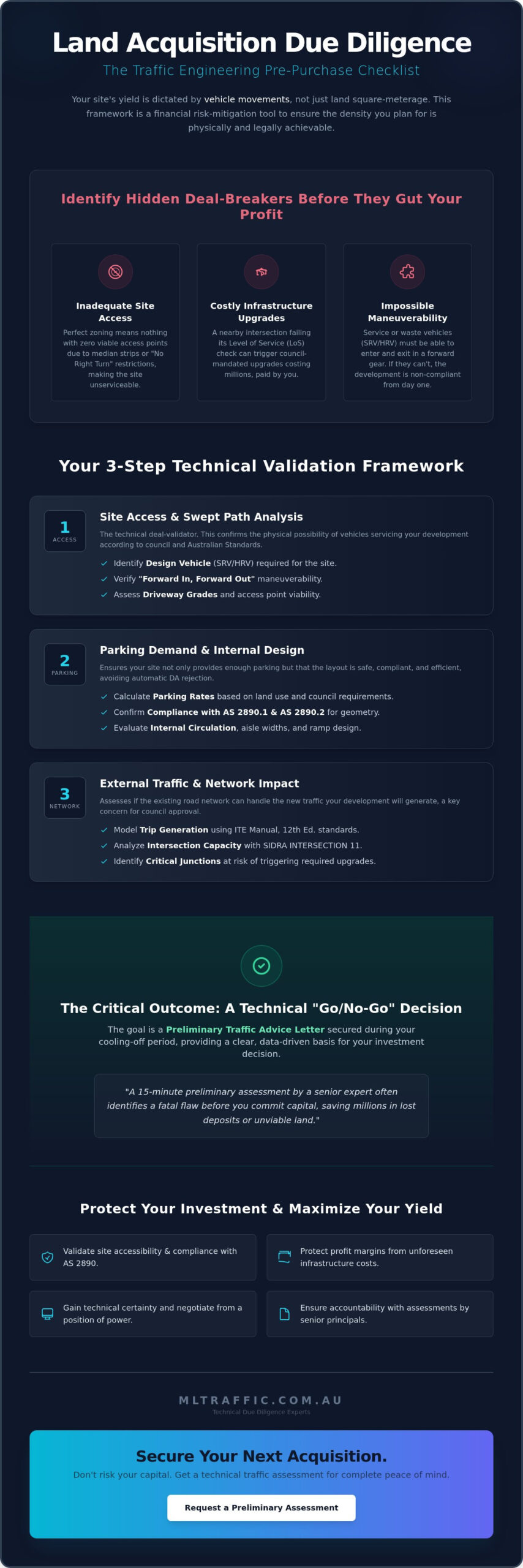
Traffic engineering due diligence for land acquisition is the technical validation of a site’s physical accessibility and parking viability. It’s a proactive risk-mitigation strategy. It moves beyond simple zoning checks to ensure the site can legally and physically accommodate the intended density. This process applies core traffic engineering principles to identify constraints that a standard property report will miss. For modern developers, this isn’t just a compliance step. It is a fundamental method of yield protection.
A 15-minute preliminary assessment by a senior expert often identifies a fatal flaw before you commit capital. This brief review can save millions in lost deposits or the purchase of unviable land. If the road network cannot support the trip generation of your proposed density, your yield will be cut regardless of what the zoning allows. You must verify that the site’s potential matches the reality of the surrounding infrastructure.
To better understand the critical questions involved in site selection, watch this helpful video:
Council Local Environmental Plans (LEP) dictate the theoretical use of the land. However, they don’t account for real-time network capacity or specific site access limitations. If the surrounding infrastructure is already at a poor Level of Service (LoS), the council may refuse the application. They may also mandate expensive intersection upgrades as a condition of consent. These requirements often emerge late in the DA process, destroying the project’s feasibility after the purchase is finalized.
Why Traffic Constraints are "Hidden" Deal-Breakers
A site might have perfect zoning but zero viable access points. Existing median strips or "No Right Turn" restrictions can drastically reduce site value by limiting entry and exit options. These physical barriers are often permanent. Additionally, a new acquisition often triggers the need for a detailed Intersection Analysis. If the analysis shows the development will push a nearby junction beyond its capacity, the developer is usually held responsible for the cost of the fix. Executing thorough traffic engineering due diligence for land acquisition allows you to negotiate from a position of technical certainty.
Regulatory Compliance and Australian Standards (AS 2890)
Compliance with AS 2890.1 for off-street car parking and AS 2890.2 for commercial vehicle facilities is mandatory. Failing these standards during the due diligence phase leads to automatic DA rejection. It’s not just about having enough spaces; it’s about the geometry of the ramps and the width of the aisles. We ensure all assessments align with the latest 2025 and 2026 amendments to these standards. Our technical services include detailed driveway ramp grade assessments and car park design to ensure your layout meets every regulatory requirement from day one. Meticulous attention to these details prevents costly redesigns and protects your profit margins.
Site Access and Swept Path Analysis: The Technical Deal-Validator
Site access is often the primary technical constraint that determines if a development is viable. During the pre-purchase phase, developers must identify the largest design vehicle required for the site. This is typically a Heavy Rigid Vehicle (HRV) for commercial sites or a Small Rigid Vehicle (SRV) for smaller residential builds. Failing to account for these movements can lead to a "No-Go" decision. A comprehensive land acquisition due diligence checklist should always include a review of these vehicle requirements to prevent buying land that cannot be serviced.
Councils strictly enforce the "Forward In, Forward Out" rule. Vehicles must be able to enter and exit the site in a forward direction to maintain road safety. This requirement often necessitates large internal turning circles or heavy vehicle loading docks within the site boundary. If the site is too narrow to accommodate these movements, the council will likely reject the DA. Executing traffic engineering due diligence for land acquisition is essential for verifying these access points. We use Vehicle Swept Path Analysis to model these movements precisely before you commit to the purchase.
Driveway locations are not flexible. They must be positioned away from existing intersections and street furniture. We evaluate sight distance requirements to ensure drivers can see oncoming traffic clearly. If a site has poor sightlines due to neighboring buildings or topography, you may be forced to set back your building line. This reduces your buildable area and directly impacts your project’s total yield. Our senior principals personally conduct each Sight Distance Assessment to ensure technical accuracy.
Swept Path Analysis Checklist for Acquisition
-
Does the site permit a 12.5m Heavy Rigid Vehicle to turn without hitting property boundaries?
-
Are there existing street trees, power poles, or service pits obstructing the ideal driveway location?
-
Can the largest anticipated vehicle maneuver without encroaching on oncoming traffic lanes during entry or exit?
Driveway and Ramp Grade Feasibility
Basement access requires careful calculation of maximum ramp grades. We assess these grades during traffic engineering due diligence for land acquisition to ensure compliance with Australian Standards. High-gradient ramps require specific "transition zones" to prevent vehicle scraping. These zones take up significant space. If the driveway is too steep, it can reduce the available footprint for ground-floor retail or lobby areas. Identifying these issues early allows for more accurate profit margin estimations. Our senior experts provide a Driveway Ramp Grade Assessment to confirm your architectural plans are physically achievable.
Car Parking Demand and Internal Circulation Checklist
Parking provision is a primary determinant of a project’s financial viability. During traffic engineering due diligence for land acquisition, we calculate minimum parking rates based on the specific Council Development Control Plan (DCP) for the subject land. Statutory requirements often demand a high number of spaces that can lead to excessive basement depths, significantly increasing construction costs. Modern developers now use a Car Parking Demand Assessment to justify parking shortfalls where the proposed use generates less demand than the DCP predicts.
A critical checklist item is assessing the impact of "unbundled parking" trends on site feasibility. This involves separating the cost of a parking space from the purchase price of the property. This trend can reduce the total number of spaces required on-site, potentially saving an entire basement level. However, this must be balanced against market expectations and lender requirements. We evaluate the car park layout for efficiency, focusing on column placement, aisle widths, and the elimination of dead-ends. Poorly placed columns or narrow aisles don’t just frustrate users; they often lead to a non-compliant layout that fails council scrutiny.
Parking Yield vs. Council Requirements
We compare statutory requirements against actual market demand for specific land uses. A major red flag in basement layouts is the presence of "blind aisles" or dead-ends without a dedicated turn-around area. These features frequently cause DA delays. Additionally, developers must account for bicycle parking and end-of-trip facility requirements. These are no longer optional extras. In many urban local environmental plans, bicycle parking can consume up to 10% of the available basement area, directly impacting the remaining parking yield and the site’s overall value.
Internal Safety and Circulation Standards
Safety compliance is non-negotiable. We check for pedestrian sight triangles at property boundaries to ensure exiting drivers can see pedestrians on the footpath. This is a common point of failure in traffic engineering due diligence for land acquisition. Other safety considerations include:
-
Verifying the viability of two-way versus one-way internal circulation systems to optimize traffic flow.
-
Ensuring headroom clearances meet AS 2890 standards, especially for accessible parking spaces and van access.
-
Checking that all parking modules, including disabled and visitor spaces, are located for maximum safety and ease of use.
Accurate Car Park Design ensures that every square meter of the basement contributes to the project’s bottom line while meeting all regulatory safety standards. Our senior principals personally review these layouts to ensure they are physically achievable before you finalize the site purchase.
External Traffic Impact and Network Capacity Assessment
Permissible development yield is not solely determined by land square-meterage. It’s often limited by the finite capacity of the surrounding road network. Traffic engineering due diligence for land acquisition must evaluate whether the existing infrastructure can absorb the additional peak-hour load. If a network is already at capacity, even a small development can trigger a requirement for major upgrades. We follow a structured five-step process to assess this risk before the cooling-off period expires.
First, we identify the "Critical Intersection" likely to be affected by the development. This is usually the primary site access point or the nearest major junction. Second, we assess the current Level of Service (LoS) through preliminary traffic counts. Third, we estimate trip generation rates for the proposed land use. We utilize the ITE Trip Generation Manual, 12th Edition, which incorporates post-pandemic travel data to ensure accuracy. Fourth, we determine the "Degree of Saturation" (DoS) using SIDRA INTERSECTION 11. If the DoS exceeds 0.9 for signalized intersections, the council may reject the application. Finally, we evaluate the potential for mandatory frontage road widening or new signalization requirements.
The Financial Risk of External Road Upgrades
External road upgrades represent a significant financial risk. A mandated intersection upgrade can easily exceed $500,000, which often kills the feasibility of small-scale projects. Councils frequently identify pre-existing network failures and attempt to pin the rectification costs on the new developer. A detailed Traffic Impact Assessment is essential in these negotiations. It provides the technical evidence needed to dispute unfair cost attributions and protects your project’s profit margins. If you’re currently evaluating a site, you should request a preliminary Intersection Analysis to identify these "hidden" infrastructure costs immediately.
Public Transport and Active Transport Connectivity
High connectivity to public transport and active transport networks is a technical asset. We assess the site’s proximity to transit hubs and its overall "Walk Score" during the due diligence phase. High connectivity can be used as a primary argument to justify reduced parking rates, which directly lowers basement construction costs. However, developers must also identify required upgrades to footpaths or cycleways adjacent to the site. These requirements are increasingly common in modern urban Local Environmental Plans (LEP). Identifying these obligations early ensures they are factored into your initial feasibility modeling.
Executing Due Diligence: Engaging a Traffic Engineering Expert
Executing traffic engineering due diligence for land acquisition culminates in the delivery of a Preliminary Traffic Advice Letter. This document translates complex technical modeling into a clear risk assessment for the development team. A Professional Traffic Engineer acts as a critical intermediary, ensuring that the proposed density aligns with the physical and regulatory constraints of the site. This phase bridges the gap between the initial feasibility study and the formal Traffic Impact Assessment required for a future development application.
Our senior principals oversee this process to ensure technical accountability. Unlike larger firms that delegate due diligence to junior staff, we ensure that the expert who initiates the site assessment is the one who performs the technical modeling. This direct oversight is vital when evaluating high-stakes acquisitions where a single access error can compromise the entire project’s viability. By formalizing these findings during the cooling-off period, you move from architectural assumptions to technical certainty.
The Preliminary Traffic Advice Letter
A Preliminary Traffic Advice Letter provides a concise technical summary designed for rapid decision-making. It includes several key components:
-
Access Feasibility: Confirmation that the site can accommodate the required design vehicle without encroaching on property boundaries or oncoming traffic.
-
Parking Yield Validation: A comparison of the proposed parking layout against the statutory requirements of the Council Development Control Plan.
-
Infrastructure Red Flags: Identification of potential external road upgrades or intersection signalization requirements that could impact project costs.
-
Compliance Assessment: A high-level review of the project’s adherence to AS 2890 standards.
Developers use this letter as leverage during price negotiations. If our assessment identifies significant infrastructure obligations that weren’t disclosed, the technical evidence allows you to adjust your offer before the contract becomes unconditional. This document also serves as the foundation for your eventual DA submission, saving time and reducing the risk of redesigns.
Why ML Traffic Engineers Australia for Your Acquisition?
With over 15 years of experience in Australian planning environments, we understand the specific requirements of local councils and state road authorities. Our "Personnel Continuity Promise" ensures that you have a single point of contact from the initial site visit through to the final report delivery. We don’t use gatekeepers; you have direct access to the senior experts performing the work.
Our technical capabilities cover every aspect of traffic engineering due diligence for land acquisition. We utilize industry-standard software to perform Vehicle Swept Path Analysis and Intersection Analysis, providing the technical certainty needed to protect your development yield. Contact ML Traffic Engineers Australia for a rapid site assessment to ensure your next acquisition is technically and financially sound.
Securing Site Feasibility Through Technical Validation
Site yield is fundamentally tied to the physical reality of vehicle movements and surrounding infrastructure capacity. Relying on zoning alone is a high-risk strategy that often leads to costly council-mandated upgrades or significantly reduced density. Rigorous traffic engineering due diligence for land acquisition identifies these hidden deal-breakers before you commit capital or let a cooling-off period expire. By validating swept paths, parking requirements, and network saturation early, you ensure that your development remains both compliant and profitable.
ML Traffic Engineers Australia provides the technical certainty required for complex property deals across the country. We leverage over 15 years of consultancy experience and specialized expertise in AS 2890 compliance to protect your profit margins. Our personnel continuity promise means you maintain direct contact with senior principals who perform the technical work themselves. This hands-on approach ensures that your feasibility assessments are accurate, reliable, and ready for council scrutiny.
Proactive technical assessment ensures your project moves from acquisition to approval with complete confidence.
Frequently Asked Questions
What is the most common traffic-related reason for a development application rejection?
The most common reason for rejection is non-compliance with the "Forward In, Forward Out" rule for service vehicles. If the site layout doesn’t allow the design vehicle to enter and exit in a forward direction, councils view it as a safety hazard. This often results from trying to maximize yield without leaving enough space for a compliant turning circle. We identify these geometric failures during traffic engineering due diligence for land acquisition to prevent unviable site purchases.
How long does a traffic engineering due diligence assessment typically take?
A high-level preliminary traffic assessment typically takes two to five business days. Complex sites requiring intersection modeling or detailed parking demand assessments may take longer. Developers should engage an expert as soon as the cooling-off period begins. This timeline ensures you receive a technical advice letter with enough time to negotiate terms or withdraw from the deal if fatal traffic constraints are identified.
Can I use a preliminary traffic report to negotiate a lower land purchase price?
You can use a technical advice letter to negotiate a lower purchase price if significant constraints are found. If our assessment identifies a mandatory intersection upgrade costing several hundred thousand dollars, this provides empirical evidence for a price reduction. Identifying these infrastructure obligations during traffic engineering due diligence for land acquisition protects your capital by ensuring the land price reflects the true cost of development.
What is a "Swept Path Analysis" and why is it required for land acquisition?
Swept Path Analysis is a computer-simulated model that tracks the path of a vehicle’s body and wheels during a turn. It’s required to prove that the largest anticipated vehicle, such as a heavy rigid truck, can physically maneuver within the site boundaries. Without this analysis, you risk purchasing a site where waste collection or delivery vehicles cannot access the building, leading to immediate DA refusal.
Do I need a traffic engineer if the site already has an existing driveway?
An existing driveway doesn’t guarantee compliance for a new development. Your proposed land use likely changes the design vehicle or increases the trip generation rates beyond the original driveway’s capacity. We assess whether the existing access point meets current sight distance standards and AS 2890 requirements. Often, existing driveways are too narrow or poorly positioned for the increased traffic volume of a modern commercial or residential project.
How do Council parking requirements differ between residential and commercial land uses?
Residential parking rates are typically calculated based on the number of bedrooms per dwelling. Commercial requirements are usually determined by the Gross Floor Area (GFA) or the maximum number of staff and patrons. Some councils also apply parking maximums in high-density areas to encourage public transport use. We analyze the specific DCP to ensure your car park design meets these varying statutory requirements without wasting valuable floor space.
What happens if the local road network is already at capacity before I build?
If the local road network is at capacity, the council may require you to fund specific infrastructure upgrades as a condition of consent. This could include signalizing a nearby intersection or widening the frontage road. Our role is to model the Degree of Saturation using SIDRA software. If the impact is deemed significant, we help negotiate agreements to ensure the costs are proportionate to your project’s scale.
Does the AS 2890 standard apply to all Australian states and territories?
AS 2890 is the national standard for off-street parking and applies across all Australian states and territories. While local councils may have specific DCP variations, the geometric requirements for ramps, aisles, and parking spaces must adhere to this standard. Failing to meet these national safety and design benchmarks will lead to a rejection of your architectural plans during the council’s technical review phase.
Which areas do you cover?
We are traffic engineers servicing Melbourne, Sydney, Brisbane, Gold Coast, Hobart, Perth, Adelaide, Darwin, Canberra and surrounding areas.

Disclaimer
The content on www.mltraffic.com.au, including all technical articles, guides, and resources, is provided for general informational and educational purposes only. It is not intended to constitute professional advice in traffic engineering, transportation planning, development approvals, or any other technical or legal field.
While ML Traffic Engineers makes every reasonable effort to ensure the accuracy, completeness, and timeliness of the information published, we do not provide any warranties or representations (express or implied) regarding its reliability, suitability, or availability for any particular purpose. Any reliance you place on the content is strictly at your own risk.
In no event shall ML Traffic Engineers, its directors, employees, authors, or affiliates be liable for any direct, indirect, incidental, special, consequential, or punitive damages (including, without limitation, loss of profits, data, or business opportunities) arising out of or in connection with the use of, or inability to use, any information provided on this website.
The articles and guides on this site are not a substitute for engaging a qualified, registered professional traffic engineer (such as an NPER or RPEQ engineer) to assess your specific project requirements. For tailored advice, compliance assessments, or traffic engineering services, please contact a competent professional.
This disclaimer may be updated from time to time without notice. By accessing or using this website, you agree to be bound by the most current version of this disclaimer.
