

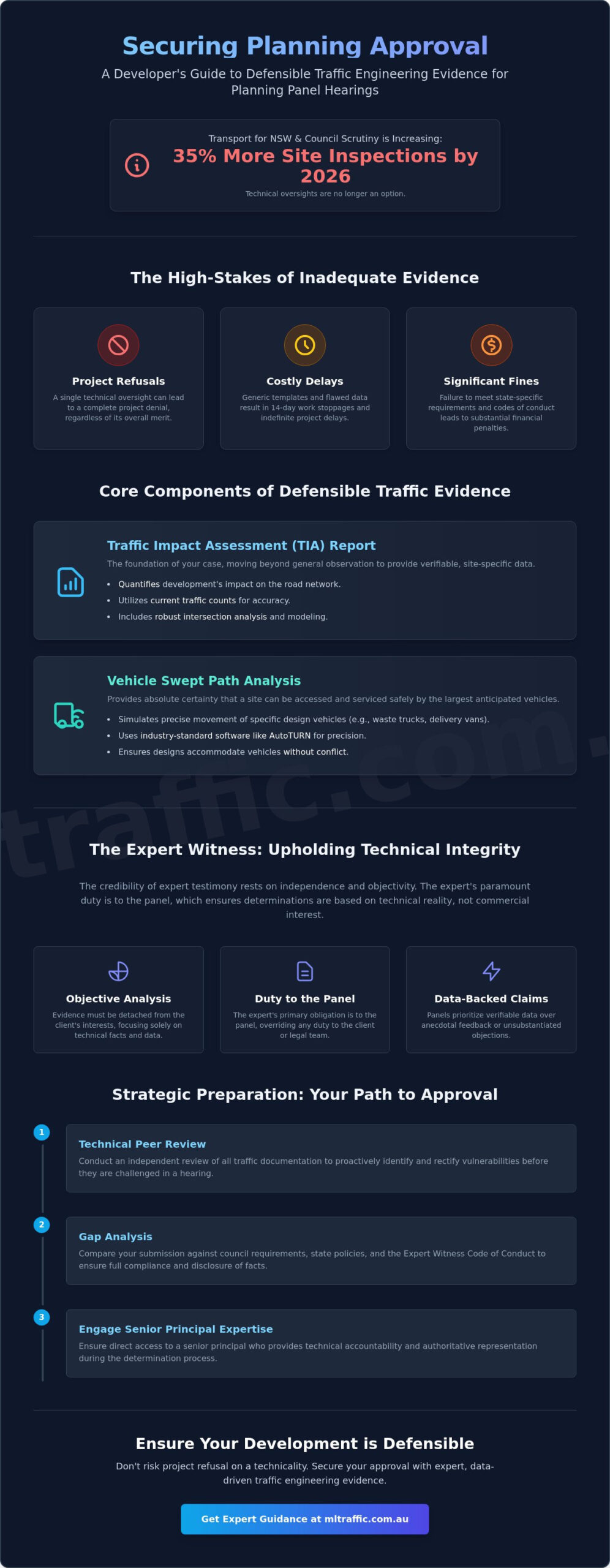
A project refusal at a planning panel often stems from a single technical oversight rather than the project’s overall merit. With Transport for NSW and local councils increasing site inspections by 35% in 2026, the margin for error has disappeared. Securing a successful determination now depends entirely on the technical integrity and independent credibility of your traffic engineering evidence for planning panel hearings. You know that managing state-specific requirements and the expert witness code of conduct is a high-stakes environment where generic templates lead to 14-day work stoppages and significant fines.
This guide provides a comprehensive reference for developers and legal teams to prepare, present, and defend traffic evidence that withstands rigorous cross-examination. You’ll learn how to leverage site-specific assessments, such as a Traffic Impact Assessment (TIA) Report and Vehicle Swept Path Analysis, to satisfy modern digital permitting systems. We will examine the transition to the latest AS 1742.3 standards and detail the exact documentation required to ensure your development application remains defensible and positioned for approval.
Key Takeaways
- Understand how Australian planning panels utilize expert testimony to resolve complex council and community objections.
- Learn the technical requirements for defensible traffic engineering evidence for planning panel hearings, including the integration of TIA reports and Vehicle Swept Path Analysis.
- Navigate the Expert Witness Code of Conduct to ensure full disclosure of facts and assumptions, maintaining the legal credibility of your expert report.
- Identify and rectify vulnerabilities in your traffic documentation through strategic technical peer reviews and gap analysis prior to the hearing.
- Discover how direct access to senior principals ensures technical accountability and authoritative representation during the determination process.
The Critical Role of Traffic Engineering Evidence in Planning Panel Hearings
Traffic engineering evidence for planning panel hearings serves as the technical bridge between a proposed development and the regulatory requirements of the Australian planning framework. This evidence isn’t merely a summary of a project’s merits. It’s a formal submission that applies the principles of traffic engineering to address specific concerns raised by councils or community submitters. While a standard Traffic Impact Assessment (TIA) Report assesses general site suitability, evidence prepared for a hearing must be robust enough to withstand legal scrutiny and professional cross-examination.
To better understand the scope of these technical assessments, watch this overview of transport planning and engineering:
Panels rely on expert testimony because they require objective, data-driven answers to resolve conflicts. Without authoritative traffic engineering evidence for planning panel hearings, developers risk costly project refusals or indefinite delays caused by unsubstantiated traffic objections. Professional evidence provides the panel with the technical certainty required to approve a development; it confirms that safety and efficiency standards are met through rigorous analysis.
When is Expert Traffic Evidence Required?
Common triggers for requiring expert representation include high-volume traffic generation, significant parking shortfalls, or complex site access issues. Contentious developments, such as high-density residential towers or major commercial hubs, often attract intense community scrutiny. In these cases, senior engineering representation is mandatory to address technical challenges. Whether the hearing is at a local level or involves State-significant planning panels, the depth of the evidence must match the project’s scale and the complexity of the objections.
The Objective Nature of Traffic Testimony
The credibility of an expert witness rests on their independence. Evidence must remain detached from the client’s commercial interests to be considered valid by the panel. Panels consistently prioritize data-backed claims, such as intersection analysis or vehicle swept path analysis, over anecdotal community feedback. The expert witness has a paramount duty to the panel which overrides any obligation to the client or legal team. This objectivity ensures that the final determination is based on technical reality rather than speculation or emotion.
Essential Components of Technical Traffic Evidence for Australian Panels
Technical integrity is the primary metric by which panels judge submissions. Comprehensive traffic engineering evidence for planning panel hearings must move beyond generic observations to provide verifiable, site-specific data. The foundation of this evidence is a detailed Traffic Impact Assessment (TIA) Report. This document must quantify the development’s impact on the surrounding road network using current traffic counts and robust intersection analysis. It’s not enough to state that a project works; the evidence must demonstrate it through technical modeling.
Accurate Vehicle Swept Path Analysis is equally critical. We use industry-standard software like AutoTURN to simulate the movement of specific vehicles. This ensures that the design accommodates the largest anticipated vehicles without conflict. This level of precision mirrors the rigorous standards seen in international jurisdictions, such as the SFMTA Engineering Public Hearings, where technical rigor determines the outcome of public infrastructure and private development disputes.
Swept Path and Access Certification
Panels require absolute certainty that a site can be serviced safely. Our evidence includes Swept Path Analysis services to prove maneuverability for waste collection vehicles and emergency services. We also provide Sight Distance Assessments at property boundaries and intersections to ensure compliance with Austroads and local council standards. Proving safe vehicle maneuverability is a non-negotiable component of traffic engineering evidence for planning panel hearings, as it directly impacts public safety and operational efficiency.
Parking Demand and Supply Analysis
A common point of contention is the deviation from statutory parking rates. We justify parking variations through Car Parking Demand Assessments based on empirical data and historical precedents from similar land uses. This includes referencing AS 2890.1 compliance for off-street parking and AS 2890.2 for commercial facilities. Panels now place significant weight on “Green Travel Plans” and sustainable transport initiatives. We integrate these into our formal evidence to support parking reductions where appropriate. If your project faces parking objections, contacting our senior engineers early can help identify the specific data needed to secure an approval.
The Obligations and Role of the Traffic Engineering Expert Witness
The expert witness plays a strictly defined role in the determination process. Their primary duty is to the panel, not the developer. This is a critical distinction for anyone presenting traffic engineering evidence for planning panel hearings. Every report must include a signed declaration acknowledging the relevant code of conduct. In Victoria, experts must adhere to VCAT Practice Note 2. In New South Wales, the Land and Environment Court (LEC) Expert Witness Code of Conduct sets the standard for local planning panels. These codes mandate that the expert’s opinion must be independent and unbiased.
Full disclosure is a legal requirement. An expert must state all facts and assumptions used to reach their conclusions. If a technical trade-off exists, such as reduced sight distance to preserve a significant tree, the expert must explain the safety implications objectively. Senior principal involvement is essential here. Experienced engineers provide the technical weight needed for high-stakes testimony. This ensures that the evidence remains defensible under intense questioning. Effective traffic engineering evidence for planning panel hearings relies on the witness’s ability to simplify complex data for non-technical panel members.
Independence and Professional Integrity
“Hired gun” witnesses often fail because they prioritize the client’s commercial goals over technical reality. Panels quickly identify and dismiss biased testimony. At ML Traffic Engineers Australia, we ensure senior principals perform the technical work from the start. This accountable approach guarantees continuity. The same expert who analyzes the data is the one who defends it at the hearing. Maintaining this professional integrity is the only way to build long-term credibility with planning authorities.
The Joint Expert Meeting (JEM) Process
Before a formal hearing, panels often mandate a Joint Expert Meeting. This process requires experts from opposing sides to meet without their legal teams. They identify areas of agreement and dispute, resulting in a Joint Statement of Professional Opinions. This document streamlines the hearing by focusing the panel’s attention on unresolved technical conflicts. Effective participation in a JEM requires a deep understanding of the Intersection Analysis and data sets involved. It’s a strategic opportunity to resolve technical disputes before they reach the public forum.
Strategic Preparation: Reviewing Traffic Evidence Before the Hearing
Strategic preparation determines whether a development application survives the scrutiny of a panel. You must identify vulnerabilities in your traffic engineering evidence for planning panel hearings well before the formal session begins. A common failure point is the reliance on outdated data or incorrect parking ratios. Reports using traffic counts from 2023, for instance, often fail to account for the 35% increase in site inspections and changing road conditions observed in 2026. Our process involves a meticulous audit of all data sets to ensure they meet current regulatory standards and reflect physical site realities.
Legal teams must manage the strict lodgement timeline. Expert reports are typically due 10 to 15 business days prior to the hearing. Failure to meet these deadlines often results in the evidence being disregarded or the hearing being adjourned at the developer’s expense. Beyond administrative compliance, preparation involves anticipating cross-examination. We analyze objector concerns regarding:
- Intersection saturation levels and queuing lengths.
- Sight distance obstructions at new access points.
- Heavy vehicle noise, vibration, and maneuvering constraints.
- Driveway ramp grades and pedestrian safety interfaces.
- Car park design efficiency and compliance with AS 2890.1.
Peer Review and Second Opinions
Fresh eyes are critical for complex development applications. A technical peer review identifies non-compliance in Swept Path Analysis or driveway design before the panel identifies them. We align evidence with current Council planning schemes to ensure the project meets specific local requirements. This proactive approach allows for technical corrections that strengthen the overall case. Identifying a technical error in a Car Parking Demand Assessment before lodgement can save months in delays. If you need an independent assessment of your existing reports, contact our senior principals for a technical review.
Presenting Evidence at the Hearing
The formal presentation usually follows a structured format. Experts provide a summary statement highlighting key conclusions from the technical reports. This is not a summary of the project but a summary of the technical findings related to traffic engineering evidence for planning panel hearings. This is followed by questioning from the panel, legal counsel, and occasionally the public. We use visual aids, including intersection modelling and detailed diagrams, to simplify complex traffic flows. Clear, data-backed responses during cross-examination are essential for maintaining professional credibility. The expert must remain composed while defending the technical integrity of their findings under pressure.
Securing Planning Approval with ML Traffic Engineers’ Expert Evidence
ML Traffic Engineers Australia provides authoritative traffic engineering evidence for planning panel hearings based on over 15 years of specialist consultancy experience. We focus on delivering technical results that withstand the highest levels of regulatory scrutiny across all Australian states. Our firm maintains a national capability; we support projects through detailed Traffic Impact Assessment (TIA) Reports, Vehicle Swept Path Analysis, and comprehensive Car Park Design. Meticulous adherence to Australian Standards, including the AS 2890 series, builds the necessary trust with planning panels and road authorities.
Our leadership team remains involved in every stage of the project. You get direct access to senior principals who perform the technical work themselves. This ensures the expert defending the evidence at the hearing is the same individual who conducted the initial site assessments and modeling. This personnel continuity promise eliminates the risks associated with larger, impersonal firms where junior staff often handle the underlying data. We don’t use gatekeepers. You deal directly with the specialists responsible for your project’s success.
Why Developers Trust ML Traffic Engineers Australia
Developers and legal teams rely on our proven track record across a vast range of project environments. We maintain a commitment to defensible engineering logic and absolute technical accuracy. Our experience covers diverse land-use categories:
- High-density residential developments and mixed-use towers.
- Major commercial hubs and retail shopping centers.
- Industrial estates and logistics distribution warehouses.
- Childcare centers, medical clinics, and educational facilities.
- Specialized tourism and recreational infrastructure projects.
Learn more about ML Traffic Engineers Australia and our senior leadership to understand how our expertise supports your specific planning goals.
Get Started with Your Hearing Preparation
Early engagement is the most effective way to secure a planning approval. Engaging an expert traffic engineer during the initial DA process allows us to identify and resolve potential traffic objections before they escalate. We provide a preliminary assessment of your project’s traffic engineering evidence for planning panel hearings to ensure your documentation is robust and code-compliant. This proactive strategy prevents the delays and significant fines often issued for non-compliant traffic layouts or inadequate parking assessments. Contact our senior principals today for expert witness services and ensure your development is positioned for a successful determination.
Position Your Development for Planning Success
Success at a planning panel requires more than just submitting data; it demands a meticulous approach to technical documentation and a deep understanding of the regulatory landscape. High-quality traffic engineering evidence for planning panel hearings must be built on site-specific analysis, including robust Traffic Impact Assessments and precise Vehicle Swept Path Analysis. Ensuring your evidence complies with the latest 2026 standards and the Expert Witness Code of Conduct is the only way to maintain credibility under cross-examination. It’s essential to recognize that a panel’s trust is won through technical accuracy and independent professional integrity.
ML Traffic Engineers brings over 15 years of specialist consultancy experience to every project. Our national capability ensures that your development is supported by defensible engineering logic across all Australian jurisdictions. We guarantee direct principal involvement, providing you with accountable leadership and technical continuity from the initial report to the final hearing. Don’t leave your project’s outcome to chance by relying on generic documentation. Secure expert traffic evidence for your next planning hearing to ensure your project remains on track for approval. We look forward to supporting your team in achieving a successful determination.
Frequently Asked Questions
What is the difference between a traffic report and expert witness evidence?
A standard traffic report is a technical document used for a development application; expert witness evidence is a formal submission specifically prepared for a tribunal or panel. Evidence must include a signed declaration of independence and comply with strict court codes. It’s designed to withstand cross-examination and focuses on resolving contested technical issues rather than general site assessment.
How much does it cost to engage a traffic engineer for a planning panel hearing?
Fees for expert witness services depend on the complexity of the development and the required level of senior principal involvement. Total costs typically include site inspections, technical modeling, report preparation, and daily rates for hearing attendance. Developers should check with their consultancy for a project-specific fee proposal that accounts for the anticipated length of the hearing and any required joint meetings.
Can a planning panel refuse a development despite positive traffic evidence?
Yes; panels can refuse applications if non-traffic factors like urban design or heritage impact outweigh the technical merits of the transport plan. While positive traffic engineering evidence for planning panel hearings confirms that safety and capacity standards are met, the panel considers the project’s overall planning merit. Technical evidence ensures that traffic concerns don’t become the primary grounds for project refusal.
What is the Expert Witness Code of Conduct in Australian planning tribunals?
The code is a legal framework that mandates an expert’s primary duty is to the panel or tribunal rather than the party paying their fees. It requires absolute impartiality, independence, and the full disclosure of all facts and technical assumptions. Experts must acknowledge this code in their written evidence; failure to do so can result in the testimony being struck out or ignored by the panel.
How long does it take to prepare traffic evidence for a hearing?
Preparation usually requires 4 to 6 weeks to ensure all data sets are current and defensible. This timeline accounts for new traffic counts, detailed intersection modeling, and the drafting of the formal evidence statement. You must also factor in the mandatory lodgement period; most panels require the final expert report to be filed 10 to 15 business days before the hearing commences.
Do I need a traffic engineer if the Council has already approved the plans?
You need an expert engineer if a third party appeals the Council’s decision to a tribunal. Community objectors often challenge technical aspects like parking shortfalls or driveway safety during the appeal process. An expert witness defends the approved plans by providing authoritative traffic engineering evidence for planning panel hearings, ensuring the Council’s technical support is backed by independent testimony.
What happens if two traffic experts disagree at a panel hearing?
The panel members will evaluate the technical rigor, data sources, and modeling assumptions used by each expert. They weigh the evidence based on its alignment with Australian Standards and the logic of the engineering conclusions. Experts are often required to justify their specific data points under cross-examination to help the panel determine which testimony is more reliable for the final determination.
Is a Joint Expert Meeting (JEM) mandatory for all planning panels?
JEMs are not mandatory for every case but are frequently directed by the panel for complex or highly contested developments. This process requires experts from both sides to meet and identify areas of agreement. The resulting Joint Statement streamlines the hearing by focusing only on the unresolved technical disputes, which significantly reduces the time and cost associated with the formal proceedings.

Disclaimer
The content on www.mltraffic.com.au, including all technical articles, guides, and resources, is provided for general informational and educational purposes only. It is not intended to constitute professional advice in traffic engineering, transportation planning, development approvals, or any other technical or legal field.
While ML Traffic Engineers makes every reasonable effort to ensure the accuracy, completeness, and timeliness of the information published, we do not provide any warranties or representations (express or implied) regarding its reliability, suitability, or availability for any particular purpose. Any reliance you place on the content is strictly at your own risk.
In no event shall ML Traffic Engineers, its directors, employees, authors, or affiliates be liable for any direct, indirect, incidental, special, consequential, or punitive damages (including, without limitation, loss of profits, data, or business opportunities) arising out of or in connection with the use of, or inability to use, any information provided on this website.
The articles and guides on this site are not a substitute for engaging a qualified, registered professional traffic engineer (such as an NPER or RPEQ engineer) to assess your specific project requirements. For tailored advice, compliance assessments, or traffic engineering services, please contact a competent professional.
This disclaimer may be updated from time to time without notice. By accessing or using this website, you agree to be bound by the most current version of this disclaimer.
