

The lowest quote on your desk is often the most expensive mistake you’ll make this year. When you request a traffic engineering fee proposal, you aren’t just buying a report; you’re hiring a shield against council RFIs and costly redesigns. Many developers find themselves trapped by vague scopes that omit critical requirements like AS 2890 compliance or Vehicle Swept Path Assessments, only to be hit with variations later. At ML Traffic Engineers Australia, we recognize the frustration caused by technical jargon and the persistent fear of council rejection due to inadequate reporting.
This guide ensures you get a fixed-price proposal that covers every technical necessity for your development application. You’ll learn how to identify a comprehensive scope that includes everything from Sight-Line Assessments to council liaison. We also examine April 2026 industry shifts, where a 3% growth in transportation construction and persistent labor shortages mean you need a consultant who is both qualified and hands-on. You will learn how to secure a proposal where the professional who quotes the work is the one actually performing it, giving you total confidence in your council submission.
Key Takeaways
- Define the difference between a basic quote and a professional traffic engineering fee proposal to prevent unexpected project variations.
- Identify critical technical requirements for your application, including Traffic Impact Assessments (TIA) and specialized Vehicle Swept Path Analysis.
- Compare fixed-price versus hourly fee structures to determine which model best protects your development budget.
- Ensure your submission meets Australian Standards and council requirements through precise scope accuracy and expert liaison.
- Benefit from direct accountability with a service model where the senior engineer providing the quote is the one performing the assessment.
Table of Contents
What is a Traffic Engineering Fee Proposal?
A traffic engineering fee proposal is a formal document that defines the specific scope of works required for a development project’s planning approval. It’s not a simple price estimate. Instead, it functions as a professional services agreement that outlines the technical assessments needed to satisfy local government requirements. To understand the broader context of these services, you should review the core principles of traffic engineering, which focus on the safe and efficient movement of people and goods across the road network.
In the Australian development landscape, a simple quote lacks the detail necessary for complex applications. A professional traffic engineering fee proposal establishes consultant accountability and sets clear project timelines. It ensures that the engineer understands the specific constraints of your site, from driveway ramp grades to council-specific parking rates. Without this formal agreement, developers often face "hidden" costs when councils request additional data that wasn’t included in the initial price.
To better understand how these professional fees are calculated and estimated for construction projects, watch this helpful video:
The Purpose of the Proposal in the DA Process
The proposal identifies the exact reports your local council demands for a Development Application (DA). It defines the critical interface between your private site and the public road network. A primary goal is ensuring the project brief aligns with Traffic Impact Assessment requirements. By documenting these needs upfront, the proposal minimizes the risk of receiving a Request for Information (RFI) from the council, which can stall a project for months.
Who Prepares the Proposal?
Qualified, experienced traffic consultants must prepare these documents to ensure technical accuracy. Senior-level involvement at the quoting stage is critical. If a junior staff member who doesn’t understand the site’s nuances prepares the quote, the scope will likely be inadequate. A robust traffic engineering fee proposal acts as a roadmap for the entire engineering phase. You can view our full range of traffic engineering services to see the technical expertise required to build a compliant proposal. At ML Traffic Engineers Australia, we maintain a strict policy: the consultant who provides the quote is the one who does the work. This ensures the person signing off on the costs has a deep-seated understanding of the project’s technical demands.
Key Components of a Robust Traffic Fee Proposal
A generic quote is a liability for your development application. A robust traffic engineering fee proposal must be granular; it shouldn’t just list "Traffic Report" as a single line item. Instead, it should break down the technical deliverables that protect your project from council scrutiny. Planners look for specific evidence of compliance, and your proposal needs to reflect the exact technical work required to provide that evidence. If a quote lacks detail on intersection analysis or car park certification, you’re likely looking at future variations and delays.
Traffic Impact Assessment (TIA) Scope
The Traffic Impact Assessment (TIA) or Statement (TIS) is the core of your submission. This component analyzes trip generation based on your specific land use and assesses the resulting impact on the surrounding road network. A professional proposal includes intersection analysis and sight distance assessments to ensure your project doesn’t compromise local safety. These reports must comply with state-specific transport guidelines and national standards to be accepted by the council. Without this level of detail, your application is vulnerable to immediate rejection during the initial assessment phase.
Parking and Access Compliance (AS 2890)
Council planners focus heavily on parking layouts and driveway safety. Your proposal must include certification of car park layouts against Australian Standards (AS 2890.1). This technical work involves assessing driveway ramp grades and ensuring pedestrian safety through proper sight-line assessments. Every land-use type, from warehouses to medical centres, has unique parking demand requirements. A seasoned expert will evaluate these specific needs against local council codes to ensure your design isn’t just functional, but fully compliant.
Vehicle Maneuvering and Swept Paths
Most urban developments have tight spatial constraints. You must demonstrate that the B99 design vehicle can enter and exit the site safely without crossing into oncoming traffic. This is where Swept Path Analysis using specialized software like AutoTURN is essential. It’s also a requirement for waste collection and service vehicle access. Including Swept Path Analysis in your initial proposal is non-negotiable for most urban developments; it proves your site can handle the physical reality of vehicle movements.
Your proposal should also provide for council liaison and responses to Information Requests (RFIs). This ensures your consultant stays accountable until the project gains approval. If you need a clear, fixed-price breakdown for your site, contact our senior engineers to discuss your specific project requirements. We ensure the person who provides the quote is the one who performs the technical work.
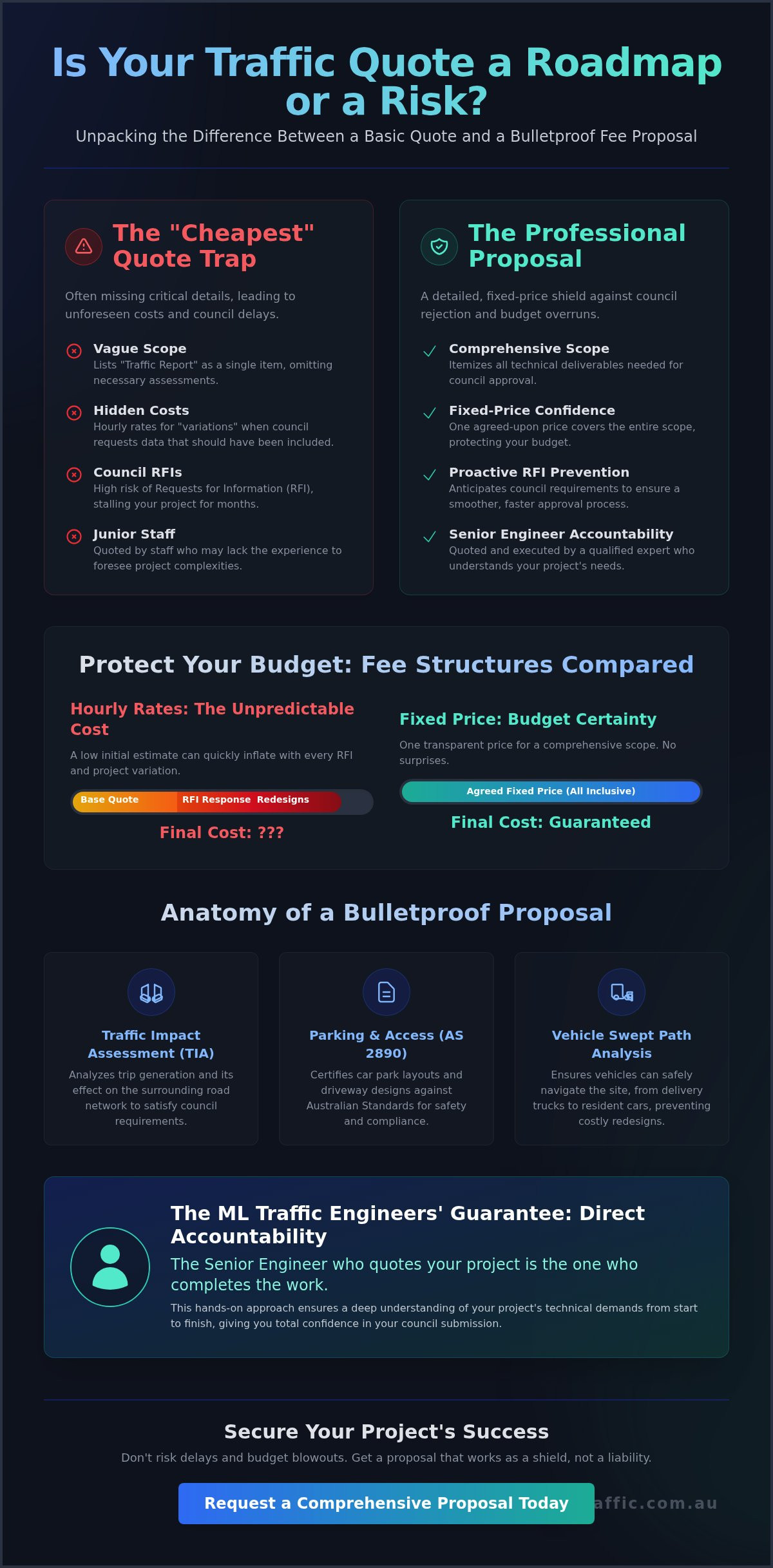
Evaluating Fee Structures: Fixed Price vs. Hourly Rates
Choosing between a fixed-price and an hourly rate structure is a critical decision in project procurement. For most development applications, a fixed-price traffic engineering fee proposal offers the most security. It provides a clear ceiling for your project budget and ensures the consultant is committed to the defined scope. Hourly rates, while sometimes necessary for open-ended litigation or complex public works, present a significant risk. Costs can spiral quickly as technical challenges arise, leaving developers with unexpected invoices during the most sensitive phases of a project.
Understanding what "out of scope" means is vital before signing any agreement. In traffic engineering, this usually refers to major architectural redesigns or additional reports requested by the council that fall outside the initial brief. The cheapest quote often leads to the most expensive delays. If a consultant low-balls a proposal by excluding RFI responses or basic compliance checks, you will pay for it later through project stagnation or high variation fees.
The Danger of the "Box-Ticking" Quote
Inadequate reporting is the primary trigger for council Requests for Further Information (RFI). A "box-ticking" quote might look attractive on paper, but it rarely survives the scrutiny of a council traffic engineer. When a report is rejected due to poor data or missing assessments, the cost of the delay far outweighs the initial savings of a professional report. A robust proposal must include a realistic time allowance for responding to council queries. This proactive approach ensures your application maintains momentum rather than getting stuck in a cycle of revisions.
Transparency in Deliverables
Developers must verify that a proposal covers all necessary Traffic Engineering services. This includes checking for RPEQ or equivalent senior certification, which is often a mandatory requirement for council acceptance. Many large firms use senior staff to win the work, only to pass the technical execution to junior graduates with limited site experience. This creates an "accountability gap" that leads to technical errors and missed constraints.
Our firm operates differently. The "ML Traffic Signature" is our promise that the traffic consultant who provides the quote is the same person who performs the work. This hands-on approach eliminates the risk of miscommunication between the quoting phase and the engineering phase. It ensures that the person accountable for the project’s success is deeply familiar with every technical nuance of your site. You can learn more about our experienced team and our direct approach to consultancy.
Why Scope Accuracy is Vital for Council Approval
An accurate traffic engineering fee proposal serves as the technical backbone of your Statement of Environmental Effects (SEE). It ensures every traffic-related claim in your DA is supported by empirical data and engineering logic. When the scope is precise, it pre-empts council concerns regarding site access, safety, and parking capacity. National experience is particularly valuable here. A consultant who understands the specific nuances of different jurisdictions can navigate varying council requirements across Australia, ensuring your project meets local expectations without costly rework.
Precision in scoping is critical because council assessment teams are under significant pressure. They don’t have the time to help you fix an incomplete application. If your initial scope misses a required sight-line assessment or a specific parking demand study, your project will likely be pushed to the back of the queue. This leads to months of avoidable delays that could have been prevented by a comprehensive initial brief.
Mitigating Risk through Professional Scoping
Professional scoping identifies potential access issues before they become DA blockers. This includes ensuring your proposal covers AS 2890.1 compliance for car parks. A traffic engineer who understands local council nuances nationwide can spot these risks during the initial site review. At ML Traffic Engineers Australia, we look for constraints that junior staff might overlook, such as:
-
Proximity of site access to busy intersections.
-
Clearance heights for basement waste collection.
-
Pedestrian safety at high-volume driveway interfaces.
-
Compliance with updated disability access standards.
The Role of Senior Staff in Scoping
Junior-led scoping often misses critical site constraints because it relies on templates rather than experience. At ML Traffic Engineers Australia, our principals have between 30 and 40 years of experience each. This depth of knowledge ensures that your traffic engineering fee proposal is accurate from day one. You won’t deal with gatekeepers or account managers who don’t understand the technicalities of your site. We provide direct access to our senior engineers, ensuring the person who assesses your site’s needs is the same person who will defend the report to the council. This accountability is the most effective way to mitigate project risk and ensure a smooth approval process.
To secure a document that protects your project from technical scrutiny, request a professional traffic engineering fee proposal directly from our senior consulting team.
Requesting Your Proposal from ML Traffic Engineers
Obtaining an accurate traffic engineering fee proposal requires a transparent exchange of project data. We don’t provide "ballpark" estimates because they lead to budget blowouts and technical gaps. Instead, we analyze your specific site constraints and council requirements to deliver a fixed-price agreement. This ensures that the scope we define today is the scope that gets your development through the council assessment process without unexpected variations.
Our firm prioritizes direct communication and technical accountability. We’ve assessed over 10,000 sites across Australia since 2005, ranging from small-scale residential subdivisions to complex industrial warehouses. This volume of experience allows us to identify potential traffic issues during the quoting phase, rather than discovering them halfway through your DA process. You’ll receive a detailed breakdown of costs and deliverables, giving you a clear roadmap for your planning approval.
What We Need From You
To ensure your proposal is comprehensive, we require specific documentation. The more detail you provide at this stage, the more accurate our assessment will be. Please prepare the following items for our review:
-
Current site plans and architectural drawings showing access points and parking layouts.
-
A clear description of the proposed land use, including floor areas or unit counts.
-
Any formal correspondence from the local council, such as pre-DA minutes or a Request for Information (RFI).
-
Specific concerns raised by your town planner or architect regarding driveway grades or sight lines.
Once we have this information, we typically generate a formal proposal within 24 to 48 hours. This quick turnaround ensures your project timeline stays on track while providing the technical depth required for a successful submission.
The ML Traffic Advantage
The most significant risk in the consultancy market is the "accountability gap." Many large firms send a senior engineer to win the work, only to have a junior graduate perform the actual technical assessment. We eliminate this risk entirely. At ML Traffic Engineers, the traffic consultant who provides the quote is the one who does the work. You get direct access to our principals, Michael Lee and Benny Chen, both of whom possess between 30 and 40 years of experience in the field.
We don’t use gatekeepers or account managers. When you call us, you speak directly to the engineer responsible for your project. This hands-on approach is why we’ve successfully navigated thousands of DAs through local councils nationwide. Our Traffic Consultant Services are built on a foundation of reliability and deep-seated expertise. We understand the bureaucratic requirements of traffic engineering inside and out, ensuring your proposal is compliant with all relevant Australian Standards from day one.
If you’re ready to secure a fixed-price agreement for your next project, contact us today. We provide professional, authoritative traffic engineering solutions that get results.
Secure Your Project’s Path to Council Approval
A robust traffic engineering fee proposal is your best defense against council RFIs and project stagnation. By focusing on a fixed-price structure and a comprehensive technical scope, you protect your development budget and timeline. We’ve assessed over 10,000 sites nationally and bring 15+ years of professional experience to every project. This expertise ensures your car park designs and swept path assessments meet every regulatory requirement from the outset.
Our hands-on approach guarantees direct access to senior principals throughout the engineering process. You won’t deal with junior staff or gatekeepers who lack site-specific knowledge. We provide the technical certainty needed to navigate the bureaucratic requirements of local government across all Australian jurisdictions. Request a Professional Traffic Engineering Fee Proposal today to secure an authoritative partner for your next development application. Your project deserves the reliability and accountability of seasoned experts who do the work they quote.
Frequently Asked Questions
How long does it take to receive a traffic engineering fee proposal?
You will typically receive a professional traffic engineering fee proposal within 24 to 48 hours of submitting your project documentation. We recognize that development timelines are tight; therefore, we prioritize rapid assessment of your site plans. Our senior engineers review the provided drawings to ensure the scope is accurate from the first draft. This prevents the delays associated with back and forth clarifications that often occur with less experienced firms.
What information do I need to provide for a traffic quote?
To generate a precise quote, you must provide the current architectural site plans and a detailed description of the proposed land use. If you have received correspondence from the local council, such as pre-DA minutes or a formal Request for Information (RFI), these documents are essential. We also require information regarding the scale of the development, such as the number of units or total gross floor area, to calculate trip generation accurately.
Does the fee proposal include responding to council RFIs?
A robust traffic engineering fee proposal should explicitly include a provision for responding to council Requests for Information (RFIs). At ML Traffic Engineers, we include council liaison within our fixed-price scope to ensure accountability through to the approval stage. This prevents unexpected costs when planners request technical clarifications. We recommend verifying that any quote you receive includes time for these critical post-submission negotiations to avoid project stagnation.
Why do traffic engineering fees vary so much between firms?
Fee variations typically reflect the depth of the technical scope and the experience level of the staff performing the work. Lower quotes often exclude essential items like Vehicle Swept Path Assessments or RFI responses, leading to expensive variations later. Additionally, firms that use junior staff for technical execution often offer lower initial prices. We provide direct access to principals with 30 to 40 years of experience, ensuring the technical report is defensible and accurate.
What is the difference between a TIA and a TIS in a proposal?
A Traffic Impact Assessment (TIA) is a comprehensive report required for large-scale developments that significantly impact the road network. Conversely, a Traffic Impact Statement (TIS) is a more concise document for smaller projects with localized effects. The traffic engineering fee proposal will specify which report your council requires based on the development’s scale. Both documents must demonstrate compliance with AS 2890 and local planning codes to ensure a successful application.
Are site visits included in a standard traffic fee proposal?
Site visits are standard inclusions when physical assessments like Sight-Line Assessments or intersection observations are required. We conduct site inspections to verify that architectural plans align with the physical reality of the road environment. This is critical for identifying potential safety hazards or access constraints that aren’t visible on a 2D drawing. If a proposal excludes site inspections, it may lead to technical errors that trigger council rejection during the assessment phase.
Can a traffic engineer help reduce the required number of parking spaces?
We can often justify a reduction in parking spaces through a formal Car Parking Demand Assessment. By analyzing empirical data and similar land-use types, we demonstrate to the council that the actual parking needs are lower than the generic rates in the planning code. This process requires a senior engineer to present a data-driven argument. We have successfully utilized this approach across many of the 10,000 sites we’ve assessed nationally since 2005.
Is the fee proposal legally binding for the duration of the project?
The fee proposal becomes a legally binding professional services agreement once signed by both parties. It fixes the price for the specific scope of work defined in the document. If the project’s scale or architectural design changes significantly, a variation may be required to cover the new work. However, for a stable project design, our fixed-price commitment ensures your engineering costs remain predictable from the initial quote through to the final council submission.
Which areas do you cover?
We are traffic engineers servicing Melbourne, Sydney, Brisbane, Gold Coast, Hobart, Perth, Adelaide, Darwin, Canberra and surrounding areas.

Disclaimer
The content on www.mltraffic.com.au, including all technical articles, guides, and resources, is provided for general informational and educational purposes only. It is not intended to constitute professional advice in traffic engineering, transportation planning, development approvals, or any other technical or legal field.
While ML Traffic Engineers makes every reasonable effort to ensure the accuracy, completeness, and timeliness of the information published, we do not provide any warranties or representations (express or implied) regarding its reliability, suitability, or availability for any particular purpose. Any reliance you place on the content is strictly at your own risk.
In no event shall ML Traffic Engineers, its directors, employees, authors, or affiliates be liable for any direct, indirect, incidental, special, consequential, or punitive damages (including, without limitation, loss of profits, data, or business opportunities) arising out of or in connection with the use of, or inability to use, any information provided on this website.
The articles and guides on this site are not a substitute for engaging a qualified, registered professional traffic engineer (such as an NPER or RPEQ engineer) to assess your specific project requirements. For tailored advice, compliance assessments, or traffic engineering services, please contact a competent professional.
This disclaimer may be updated from time to time without notice. By accessing or using this website, you agree to be bound by the most current version of this disclaimer.
