

A low-cost fee proposal is often the most expensive document in a developer’s file. While the Australian government’s 2024-25 budget allocated over $120 billion for transport infrastructure, individual developers still face significant project delays due to poorly scoped consultancy agreements. You’ve likely experienced the frustration of a Request for Information (RFI) letter from council that demands technical data your consultant missed. To prevent these unforeseen variations and mid-project extra charges, you need a rigorous traffic engineering fee proposal checklist that holds your consultant accountable from day one.
It’s reasonable to expect a fixed-price proposal with zero surprises, but technical jargon often obscures the actual scope. You need absolute confidence that your project meets Australian Standards (AS 2890) without the gatekeeper bureaucracy of larger firms. This guide ensures your traffic engineering quote covers every technical requirement, from Vehicle Swept Path Analysis to Driveway Ramp Grade Assessments, to avoid costly delays. We’ll break down the essential components of a professional scope so you can secure council approval and ensure the engineer who quotes your project is the one actually performing the work.
Key Takeaways
- Understand why a fee proposal functions as a technical contract that preempts Council RFIs by defining a precise scope of works.
- Use our traffic engineering fee proposal checklist to verify that essential deliverables like Vehicle Swept Path Analysis and Car Parking Demand Assessments are explicitly included.
- Identify the financial advantages of fixed-price proposals over hourly estimates to maintain budget certainty throughout the development application process.
- Discover the benefits of the principal-led model, where the senior engineer who provides the quote is the same expert who performs the technical work.
Table of Contents
-
Why a Traffic Engineering Fee Proposal is Your Project’s First Line of Defence
-
Core Technical Requirements: The ‘Must-Haves’ in Every Proposal
-
The ML Traffic Engineers Australia Difference: Accountability in Scoping
Why a Traffic Engineering Fee Proposal is Your Project’s First Line of Defence
A fee proposal isn’t just a pricing document; it’s a technical commitment that defines the boundaries of your project’s success. In the 2026 development environment, where council scrutiny on parking demand and traffic flow has intensified, a vague proposal is a significant liability. Traffic engineering involves complex assessments that must be accurately scoped to support your Statement of Environmental Effects. If your consultant misses a single required intersection analysis or fails to account for updated local planning instruments, your DA timeline stalls immediately.
Using a comprehensive traffic engineering fee proposal checklist ensures that every technical hurdle is identified before you sign a contract. This proactive approach transforms the proposal into a risk-mitigation tool. It’s the difference between a project that moves through council and one that gets buried under a stack of Request for Information (RFI) letters. When you receive a proposal, you aren’t just buying a report; you’re securing a methodology for approval that must stand up to rigorous bureaucratic testing.
To better understand the complexities involved in professional scoping, watch this helpful video:
The quality of your initial proposal directly impacts the overall success of your development application. A well-scoped document provides the traffic data necessary for other consultants, such as town planners and architects, to finalise their designs. Without this technical foundation, your entire project team is working on assumptions that council will likely challenge during the assessment phase.
The True Cost of a ‘Box-Ticking’ Quote
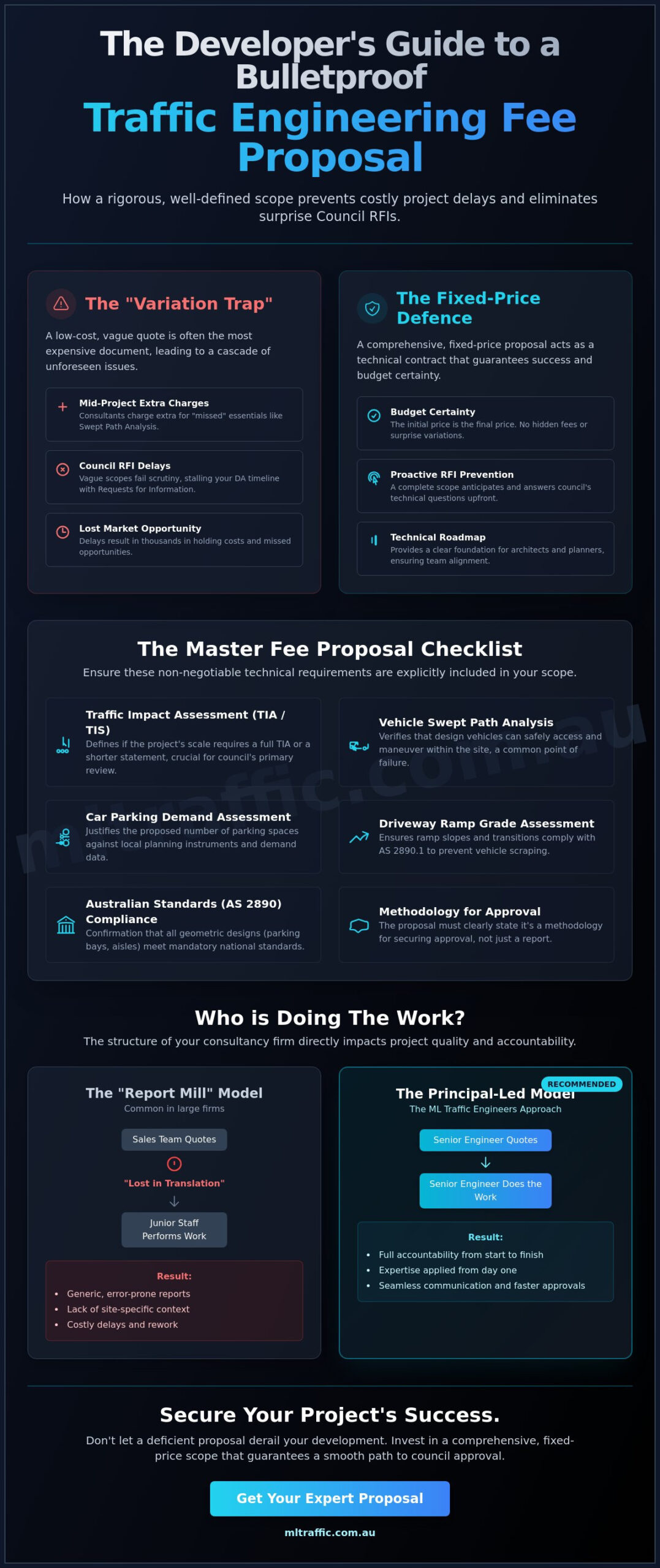
Cheap quotes often hide the "Variation Trap." When a consultant provides a bare-bones scope, they frequently charge "extra" for basic requirements like Vehicle Swept Path Analysis or driveway ramp grade assessments later in the project. With the Australian construction sector facing a massive $450 billion project pipeline, project delays caused by technical omissions can cost developers thousands in holding costs and lost market opportunities. A robust proposal is a technical roadmap that anticipates council objections before they are raised, ensuring the initial price remains the final price.
Proposal vs. Quote: Understanding the Difference
A quote is simply a price for a report; a proposal is a methodology for securing approval. "Report mills" often use junior staff to churn out generic documents that fail under council scrutiny because they lack site-specific context. Professional traffic engineering services require senior engineer involvement at the quoting stage. This ensures that the person assessing your site’s constraints actually understands the local traffic environment. At ML Traffic Engineers Australia, the consultant who provides the quote is the one who does the work, eliminating the "lost in translation" errors that occur in larger firms.
Core Technical Requirements: The ‘Must-Haves’ in Every Proposal
Every Australian traffic report must adhere to a strict set of technical foundations to survive the council assessment process. If these components aren’t explicitly detailed in your initial agreement, you’re likely looking at a deficient scope. A comprehensive traffic engineering fee proposal checklist ensures that your consultant isn’t just providing a generic letter, but a data-backed technical document that satisfies statutory requirements. These "must-haves" form the evidence base for your development application and are non-negotiable for project approval.
Traffic Impact Assessment (TIA) Scope
The scale of your development dictates whether you need a full Traffic Impact Assessment (TIA) or a shorter Traffic Impact Statement (TIS). A full TIA is mandatory for larger developments that significantly alter local traffic flow. Your proposal should explicitly include trip generation and distribution models based on current RTA or RMS Guide benchmarks. It’s vital to verify that the scope covers both existing baseline conditions and projected post-development traffic. Without a detailed intersection analysis using SIDRA software for high-impact sites, your proposal is incomplete and prone to council rejection.
Parking, Access, and AS 2890 Compliance
Compliance with Australian Standards is the backbone of any traffic report. Your proposal must cite AS 2890.1:2004 for off-street car parking and AS 2890.2:2018 for commercial vehicle facilities. A common omission is the Driveway Ramp Grade Assessment. If this isn’t performed early, you risk expensive architectural redesigns when council identifies that your ramp is too steep or lacks the required transitions. Additionally, ensure the scope includes a Car Parking Demand Assessment. This assessment uses empirical data to justify parking rates that might differ from standard council DCP requirements, potentially saving you significant construction costs on basement levels.
Vehicle Manoeuvring and Swept Path Analysis
Council engineers now consider Swept Path Analysis a mandatory requirement for most urban sites. These AutoTURN software diagrams prove that your site can accommodate the "worst-case" vehicle, such as a 12.5-metre Heavy Rigid Vehicle (HRV) for waste collection or a B-99 vehicle for residential parking. Vague proposals often omit these diagrams or only account for standard cars. Ensure your traffic engineering fee proposal checklist confirms that the consultant will test all critical turn movements, including entry, exit, and internal loading bay manoeuvres. When reviewing your next project, ensure these professional traffic engineering assessments are itemised to avoid the "lost in translation" errors common with junior-led firms.
Comparing Fee Structures: Fixed Price vs. Hourly Rates
Choosing the right fee structure is just as critical as the technical scope itself. In the Australian development sector, most projects benefit from a fixed-price model. This provides budget certainty for developers who must manage tight margins and financing requirements. An "Estimate Only" quote often lacks a hard ceiling; it leaves you vulnerable to cost blowouts if the consultant encounters minor complications. When you use a traffic engineering fee proposal checklist, you can quickly identify whether a quote offers true price protection or merely a starting point for future invoices.
Hourly rates are rarely the best choice for a standard development application. However, they are beneficial in specific scenarios, such as prolonged Land and Environment Court cases where the timeline is dictated by legal proceedings rather than technical work. For 95% of DA submissions, a fixed-price proposal is the gold standard because it aligns the consultant’s efficiency with your project goals. It forces the engineer to be precise in their scoping from the outset, ensuring they understand the site constraints before the work begins.
The Fixed-Price Advantage for DA Submissions
A fixed-price proposal should be an all-encompassing technical bundle. This model ensures that essential traffic engineering services, such as the TIA and Swept Path Analysis, are delivered for a set fee. A professional proposal includes at least one round of response to council RFIs within the initial price. This prevents the "nickel and diming" that occurs when consultants charge extra for every minor clarification council requests. Developers should look for quotes that clearly define the number of revisions and the specific technical assessments included in the "lump sum" total.
Exclusions and Variations: Red Flags to Watch For
Hidden exclusions in the fine print are the primary cause of project cost variations. Many "low-cost" reports omit essential activities like site visits, attendance at council meetings, or direct liaison with planning officers. If "Council Liaison" isn’t listed as a specific line item, you’ll likely receive a variation invoice the first time your consultant picks up the phone to talk to a council engineer. You should reject any proposal that doesn’t explicitly list its exclusions in a clear, unambiguous format. A professional traffic engineering fee proposal checklist must include a review of these administrative gaps to ensure the quoted price is the final price. Look for a "no-surprises" guarantee where the principal who quotes the work remains accountable for the entire project lifecycle, avoiding the "lost in translation" errors typical of junior-led report mills.
The Master Traffic Engineering Fee Proposal Checklist
Reviewing a consultancy quote requires more than a glance at the bottom line. You must treat the document as a technical audit tool. A deficient scope is the primary reason for project delays and unexpected variations. By using a traffic engineering fee proposal checklist, you can verify that the consultant has accounted for every regulatory hurdle before you commit your budget. This systematic approach ensures your development application remains on track and within its financial boundaries.
Section 1: Administrative and Professional Credibility
Professional credibility is the foundation of a reliable report. First, confirm the consultant holds Professional Indemnity (PI) insurance specifically for traffic engineering. In states like Queensland, check that the engineer is a Registered Professional Engineer of Queensland (RPEQ). As of January 1, 2026, the full-year registration fee for an RPEQ is $264.10; this registration is a legal requirement for providing professional engineering services. You should also verify the firm’s experience with your specific land-use type. A consultant who has worked on 10,000 sites across residential, commercial, and industrial sectors brings a level of seasoned expertise that junior-led firms cannot match. Ensure the proposal identifies the senior engineer by name to guarantee accountability.
Section 2: Technical Scope and Compliance
The technical section of your traffic engineering fee proposal checklist must be granular. Generic assumptions lead to Council RFIs. Ensure the following items are explicitly listed:
-
Sight-Line Assessments: These are vital for safety and council compliance at all entry and exit points.
-
Swept Path Analysis: The scope must specify the vehicle types being tested, such as Heavy Rigid Vehicles (HRV) for waste or delivery.
-
DCP Comparison: The consultant must compare your design against local council Development Control Plan (DCP) requirements and Australian Standards (AS 2890).
-
Site-Specific Data: Verify if the proposal includes actual site visits rather than relying solely on desktop surveys.
Section 3: Post-Submission Support
The work doesn’t end when the report is filed. Council often provides comments or requests for further information that require a technical response. Your proposal should cover the initial round of council comments within the fixed price. It’s also important to check for provisions regarding attendance at pre-DA or post-submission meetings with council planners. Without these inclusions, you’ll face additional hourly charges that can quickly erode your project’s profitability. For a transparent and technically sound agreement, you should contact ML Traffic for a scoped proposal that eliminates these administrative gaps.
The ML Traffic Engineers Australia Difference: Accountability in Scoping
Accountability is the missing link in most consultancy agreements. In many large engineering firms, a business development manager or a senior partner provides the initial quote, but the actual technical work is handed off to a junior staff member. This separation of sales and execution creates "lost in translation" errors where the final report fails to address the specific promises made during the scoping phase. At ML Traffic Engineers Australia, we eliminate this risk through a principal-led model. The traffic consultant who provides the quote is the same expert who performs the work. This direct line of accountability ensures that your traffic engineering fee proposal checklist is a technical guarantee rather than a sales pitch.
Our hands-on approach has been the foundation of our business since we began trading in 2005. By removing the gatekeepers and bureaucracy common in impersonal firms, we provide developers with direct access to senior expertise. This model significantly reduces RFI rates because the person assessing your site constraints already understands the bureaucratic requirements of your local council. We have successfully applied this meticulous scoping process across over 10,000 sites, ensuring that technical integrity always takes precedence over the lowest possible price.
Direct Access to Senior Expertise
Senior involvement is not just a luxury; it’s a risk-mitigation strategy. Michael Lee and Benny Chen bring between 30 and 40 years of experience each to every project they handle. This deep-seated expertise allows them to identify potential "show-stoppers" in a project before the first draft is even written. For example, a comprehensive initial scope recently saved a high-density residential developer from a major basement redesign. By anticipating council’s concerns regarding parking rates and including a data-driven Car Parking Demand Assessment from day one, we secured approval without the need for expensive structural changes. You can learn more about our senior-led methodology by visiting our page about ML Traffic Engineers Australia.
Requesting Your Custom Proposal Today
To provide an accurate, fixed-price quote that remains RFI-proof, we require specific project data. When you submit your request, please include your current site plans, a detailed description of the proposed land-use, and any preliminary council correspondence. We typically provide a professional fee proposal within 24 to 48 hours. This proposal will be a complete technical roadmap, not just an invoice. It will itemise every required assessment, from Vehicle Swept Path Analysis to AS 2890 compliance checks. Choosing a consultant based on technical integrity ensures your project stays on schedule. To secure a transparent and comprehensive agreement, you should request your custom traffic engineering fee proposal checklist today and experience the difference that principal-led accountability makes to your DA success.
Secure Your Project Success with Precise Scoping
A robust fee proposal acts as your primary insurance against Council RFIs. It ensures technical requirements like AS 2890 compliance and Vehicle Swept Path Analysis aren’t left to chance. By applying a systematic traffic engineering fee proposal checklist, you eliminate the variation trap and maintain budget certainty through fixed-price agreements. This clarity allows your entire development team to move forward with confidence.
Our principal-led model ensures the senior engineer who quotes your work is the one who performs the assessment. We bring 15 years of specialist experience and a track record of 10,000 successful site assessments across Australia to your project. You won’t deal with gatekeepers; you’ll have direct access to the experts responsible for your approval.
Don’t let poor scoping delay your development. Request a Fixed-Price Traffic Engineering Proposal from Our Senior Engineers. Getting the technical scope right at the start is the most effective way to fast-track your council approval and keep your project moving.
Frequently Asked Questions
What is the average cost of a traffic engineering fee proposal in Australia?
Fees are determined by market forces and individual consultants because there is no standardized government regulated fee schedule in Australia. The total cost depends on the technical complexity of the project and the specific reports required for your development application. A fixed-price proposal is the standard recommendation to ensure budget certainty throughout the council approval process.
Why do some traffic engineering quotes vary so much in price?
Price discrepancies usually occur because of differences in the technical scope and the seniority of the staff assigned to the project. Low-cost quotes often omit essential items like Vehicle Swept Path Analysis or site-specific data collection. These omissions lead to expensive variations later. A comprehensive traffic engineering fee proposal checklist helps you identify these gaps before you sign a contract.
Should my fee proposal include a site visit?
A site visit is a mandatory component for any reliable traffic assessment. Desktop surveys cannot accurately capture sight distance constraints or existing driveway ramp grades. Proposals that exclude physical site inspections often result in deficient reports that fail to meet Australian Standards (AS 2890). You should verify that on-site verification is a listed line item in your consultant’s scope.
Does a fee proposal cover Land and Environment Court representation?
Standard fee proposals for development applications typically exclude expert witness services and court appearances. These services are generally provided under a separate agreement or on an hourly rate basis due to unpredictable legal timelines. If your project is likely to be contested, ensure your consultant has the senior qualifications, such as RPEQ status, required to provide evidence in court.
How long is a traffic engineering fee proposal valid for?
Most proposals remain valid for 30 to 60 days from the date of issue. This timeframe accounts for fluctuations in staff availability and changes to professional registration costs. For example, as of January 1, 2026, the full-year registration fee for a practicing RPEQ is $264.10. Always confirm the validity period on your traffic engineering fee proposal checklist to avoid price adjustments.
What happens if the council requests changes not covered in the original scope?
Technical requests from council that fall outside the agreed scope are handled as variations. If the consent authority demands a new Intersection Analysis or a Car Parking Demand Assessment that wasn’t in the initial proposal, the consultant will issue an additional fee. You can minimize this risk by ensuring the initial scope is based on a thorough review of the local Development Control Plan.
Can a traffic engineer guarantee council approval in their proposal?
No professional consultant can guarantee council approval because the final decision lies with the consent authority. The engineer’s responsibility is to provide a compliant, data-backed report that meets all statutory requirements. A robust proposal focuses on technical integrity and adherence to Australian Standards to give your project the highest possible chance of a fast-tracked approval.
Is Swept Path Analysis always required in an initial fee proposal?
Swept Path Analysis is now a standard requirement for almost all urban development applications. Council engineers use these diagrams to verify that waste vehicles and delivery trucks can safely enter and exit the site. Excluding this analysis from your initial quote is a major red flag. It almost always results in a Request for Information (RFI) that stalls your project timeline.
Which areas do you cover?
We are traffic engineers servicing Melbourne, Sydney, Brisbane, Gold Coast, Hobart, Perth, Adelaide, Darwin, Canberra and surrounding areas.

Disclaimer
The content on www.mltraffic.com.au, including all technical articles, guides, and resources, is provided for general informational and educational purposes only. It is not intended to constitute professional advice in traffic engineering, transportation planning, development approvals, or any other technical or legal field.
While ML Traffic Engineers makes every reasonable effort to ensure the accuracy, completeness, and timeliness of the information published, we do not provide any warranties or representations (express or implied) regarding its reliability, suitability, or availability for any particular purpose. Any reliance you place on the content is strictly at your own risk.
In no event shall ML Traffic Engineers, its directors, employees, authors, or affiliates be liable for any direct, indirect, incidental, special, consequential, or punitive damages (including, without limitation, loss of profits, data, or business opportunities) arising out of or in connection with the use of, or inability to use, any information provided on this website.
The articles and guides on this site are not a substitute for engaging a qualified, registered professional traffic engineer (such as an NPER or RPEQ engineer) to assess your specific project requirements. For tailored advice, compliance assessments, or traffic engineering services, please contact a competent professional.
This disclaimer may be updated from time to time without notice. By accessing or using this website, you agree to be bound by the most current version of this disclaimer.
