

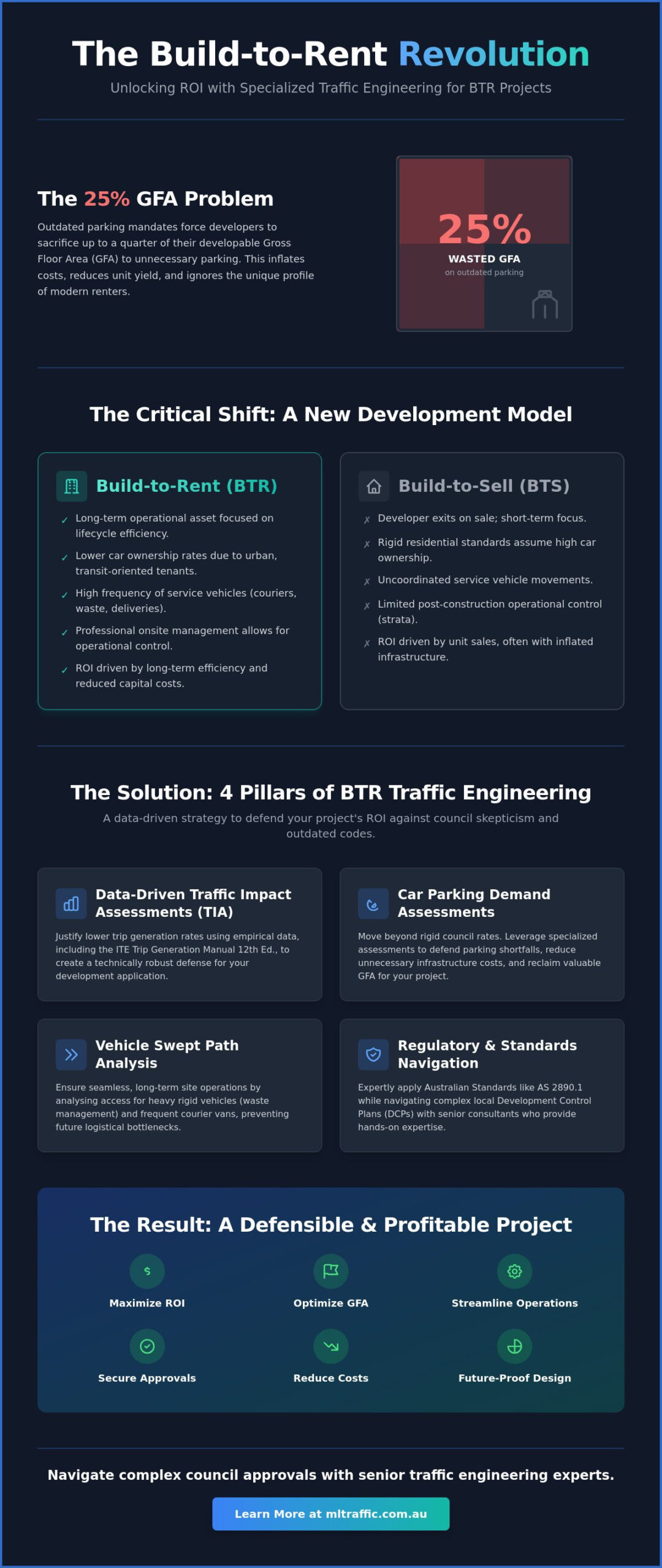
Why are you letting outdated parking mandates consume up to 25% of your developable Gross Floor Area? Specialized traffic engineering for build-to-rent projects is no longer just about meeting codes; it’s about defending your ROI against council skepticism. You likely recognize that BTR is an operational asset, yet authorities often apply rigid residential standards that ignore the unique trip generation rates of modern renters. With 1.2 million new renter households created since 2023, the demand is clear, but infrastructure requirements remain a significant bottleneck for developers.
You’ll discover how to leverage the latest data, including the ITE Trip Generation Manual 12th Edition released in August 2025, to secure approvals with reduced parking ratios and streamlined logistics. We’ll examine how precise car parking demand assessments and vehicle swept path analysis transform complex delivery and waste management into seamless operational advantages. This article provides the technical roadmap to navigate council requirements and optimize your project’s long-term efficiency.
Key Takeaways
- Identify the critical differences between BTR and traditional residential developments, focusing on long-term operational logistics rather than simple “Build-to-Sell” metrics.
- Utilise specialised traffic engineering for build-to-rent projects to justify lower trip generation rates through data-backed Traffic Impact Assessment (TIA) reports.
- Optimise your project’s Gross Floor Area by leveraging Car Parking Demand Assessments to defend parking shortfalls and reduce unnecessary infrastructure costs.
- Ensure seamless site operations by conducting Vehicle Swept Path Analysis for heavy rigid vehicles and frequent courier deliveries essential to BTR management.
- Navigate complex council approvals more effectively by working directly with senior consultants who provide hands-on expertise for every development application.
Table of Contents
-
What is Traffic Engineering for Build-to-Rent (BTR) Projects?
-
Navigating Traffic Impact Assessments (TIA) for BTR Developments
-
Managing Delivery and Service Vehicle Requirements in BTR Projects
-
Securing Council Approval with ML Traffic Engineers Australia
What is Traffic Engineering for Build-to-Rent (BTR) Projects?
Traffic engineering for build-to-rent projects is a data-driven approach to transport planning designed for long-term rental assets. Unlike traditional residential developments, these projects prioritize the functional lifecycle of the building. What is Traffic Engineering in this specific context? It’s the technical science of optimizing vehicle, pedestrian, and cyclist movement to ensure long-term operational efficiency. It moves beyond basic compliance to address how a high-density community interacts with the surrounding road network over decades. By focusing on the unique needs of renters, this discipline helps developers maximize their project’s feasibility.
Developers must view BTR through a different lens than Build-to-Sell (BTS) residential projects. In a BTS model, the developer typically exits once the units are sold; in BTR, the developer or operator remains responsible for daily site management. This shift necessitates a focus on seamless mobility rather than just providing the maximum number of parking spaces. High-quality traffic engineering directly impacts a project’s ROI. It reduces unnecessary infrastructure costs, such as oversized parking basements that consume developable Gross Floor Area (GFA) and increase construction timelines. Using modern data, such as the ITE Trip Generation Manual 12th Edition released in August 2025, allows for more accurate forecasting of these operational needs.
To better understand this concept, watch this helpful video:
BTR vs. Traditional Residential: The Traffic Profile Shift
BTR developments typically exhibit lower car ownership rates. Tenants often prioritize central locations with high Walk Scores and proximity to public transit. Since 2023, 1.2 million new renter households have entered the market, many of whom opt for shared transport or micro-mobility over private vehicle ownership. While resident vehicle trips might decrease, service vehicle movements increase significantly. You’ll see a higher frequency of "white van" courier movements and grocery deliveries. Professional onsite management allows for coordinated loading dock schedules. This coordination optimizes parking turnover and prevents driveway congestion, a level of control rarely seen in standard strata-titled buildings.
Key Regulatory Frameworks and Australian Standards
Adherence to AS 2890.1 is mandatory for compliant car park design. This standard dictates the geometry of ramps, aisle widths, and parking modules. Beyond national standards, developers must navigate state-specific planning policies and local council Development Control Plans (DCPs). These local codes often lag behind current market trends. This gap requires a robust Traffic Impact Assessment to justify departures from standard parking rates. Early-stage traffic advice is critical for site feasibility. It identifies potential access issues and sight-line constraints before they become expensive design flaws during the formal DA process.
Navigating Traffic Impact Assessments (TIA) for BTR Developments
A successful Traffic Impact Assessment (TIA) for BTR isn’t a generic compliance document. It must account for the specific operational profile of a rental-only community. Key components include peak hour trip generation, parking demand, and site access geometry. Unlike standard apartments, BTR projects require a focus on high-frequency service vehicle movements. Authorities often default to conservative residential trip rates. To counter this, developers need a TIA that uses empirical data to demonstrate that BTR tenants generate fewer car trips than owner-occupiers. This technical defense is a core part of effective traffic engineering for build-to-rent projects.
Justifying Trip Generation Rates
BTR trip rates are calculated by applying state-specific guidelines, such as the NSW Transport for NSW Guide to Traffic Generating Developments, while adjusting for site-specific demographic data. We use census data and surveys from established BTR sites to prove that car ownership is significantly lower in these developments. Central locations and high-density living naturally discourage private vehicle use. A ‘Green Travel Plan’ (GTP) is also an essential mitigation tool. It formalizes commitments to shared mobility, bicycle storage, and transit subsidies. This proactive approach reduces the perceived traffic burden on the local council. For a broader perspective on methodology, refer to the Caltrans Transportation Impact Study Guide; it emphasizes modern metrics like Vehicle Miles Traveled (VMT) over simple car counts.
Intersection and Network Capacity
Density is often the primary concern for local planning authorities. We perform detailed intersection analysis to determine if the existing road infrastructure can support the proposed BTR project. This involves SIDRA modeling to assess Degree of Saturation (DoS) and Average Delay. Identifying necessary road upgrades early prevents project delays and budget blowouts. ML Traffic Engineers Australia leverages over 15 years of proprietary data from more than 10,000 sites to support these assessments. We provide the technical evidence needed to show that high-density BTR can coexist with local traffic networks without compromising safety or performance. Effective traffic engineering for build-to-rent projects ensures that site access is both compliant and functional.
Integrating active transport into the TIA is no longer optional. Councils now require detailed plans for walking and cycling connectivity. This includes assessing sight distances at driveway exits and ensuring that internal car park design accommodates e-bikes and cargo bikes. By demonstrating a holistic approach to mobility, you streamline the approval process. If you need a robust assessment to support your DA, you can explore our full range of traffic engineering services.
Optimising Car Parking Demand and Access Design
High-density BTR developments often face rigid council parking minimums that don’t align with actual tenant behavior. Achieving a balance between commercial viability and regulatory compliance requires a sophisticated approach to traffic engineering for build-to-rent projects. We utilize Car Parking Demand Assessments to provide empirical evidence that supports lower parking ratios. This process often involves unbundling parking costs from residential leases. This strategy has proven to reduce demand by up to 20% in urban centers where residents prioritize transit access over vehicle ownership. Every square meter reclaimed from unnecessary parking is a square meter added to your developable Gross Floor Area.
Modern BTR design must incorporate shared mobility solutions to remain competitive and compliant. This includes car share pods, dedicated EV charging stations, and optimized visitor parking layouts. These features aren’t just amenities; they’re technical justifications used in a Traffic Impact Assessment to support parking shortfalls. All designs must adhere strictly to AS 2890.1 for residential parking and AS 2890.2 for service areas. Service areas in BTR are significantly more active than in standard apartments. Ensuring that waste collection and move-in vehicles don’t block resident access is vital. We use Vehicle Swept Path Analysis to verify these movements during the design phase.
Reduced Parking Ratios: The BTR Advantage
BTR operators have a unique commercial advantage because they manage parking as a separate operational stream. Unbundling parking from rent ensures that only those who need a space pay for it. This transparency naturally suppresses demand. In transport-oriented developments (TODs), we leverage "Maximum Parking" policies to argue against excessive provision. Our evidence-based reports use data from over 10,000 sites to overcome council skepticism. For instance, sites within 400 meters of a high-frequency rail station often see car ownership rates drop by 15% compared to regional averages. This data allows us to defend parking shortfalls that would otherwise stall a development application.
Functional Car Park Design and Ramps
A functional car park requires meticulous attention to geometry. We perform a Driveway Ramp Grade Assessment to ensure clearances meet AS 2890.1 requirements. This prevents vehicle scraping and ensures safety for low-clearance vehicles entering the basement. Efficient internal circulation is vital to minimize resident frustration and prevent bottlenecks at peak times. This detailed design work is a core component of a comprehensive Traffic Engineering strategy. By integrating these technical assessments early, you ensure the site remains operational and profitable. Linking parking design to the broader traffic strategy ensures that the building functions as a high-performance asset for its entire lifecycle.
Managing Delivery and Service Vehicle Requirements in BTR Projects
BTR developments function as high-intensity operational hubs. Unlike standard apartments where residents move in and stay for years, BTR assets experience constant tenant churn. With national occupancy rates at 91.9% as of May 2026, the volume of move-in and move-out events is substantial. This necessitates a specialized approach to traffic engineering for build-to-rent projects. You can’t rely on a single, undersized loading bay. You need dedicated space for couriers and heavy rigid vehicles (HRVs) to operate simultaneously without blocking resident access. Standard residential designs often fail here because they underestimate the daily delivery load from e-commerce and grocery services.
We conduct Swept Path Analysis using AutoTURN software to verify site access. This technical assessment ensures that an 8.8m medium rigid vehicle or a 12.5m heavy rigid vehicle can maneuver within the site boundaries. Common design errors often involve insufficient clearance heights or tight turning circles that prevent garbage trucks from entering basements. These mistakes lead to council refusals or costly retrofits. ML Traffic Engineers Australia uses data from over 10,000 sites to prevent these issues during the early design phase. Efficient traffic engineering for build-to-rent projects prioritizes these "back-of-house" logistics to ensure long-term asset performance.
The Loading Dock: The Engine Room of BTR
A functional loading dock handles simultaneous parcel deliveries and resident moves. If you don’t size these areas correctly, couriers will park on the street or block driveway access. We ensure that turning circles and ramp grades accommodate the specific wheelbase of modern delivery fleets. This prevents lift congestion and keeps the building’s internal logistics running smoothly. Professional management requires a dock that functions under peak load, especially during weekend move-in windows. Designing for simultaneous use is the difference between a seamless tenant experience and operational chaos.
Waste Management and Collection Access
Local councils generally mandate that waste vehicles enter and exit in a forward direction. This requires precise geometric planning for heavy vehicle turnarounds within the site. We coordinate with waste consultants to ensure collection points are safe and accessible. Managing the interface between pedestrians and heavy vehicles in shared zones is a critical safety requirement. We perform a Sight Distance Assessment to ensure exiting service vehicles have clear visibility of oncoming traffic and pedestrians. If you’re designing a high-density project, contact ML Traffic Engineers Australia for a loading dock and waste access review.
Securing Council Approval with ML Traffic Engineers Australia
Navigating the final stages of a Development Application (DA) requires more than just standard technical reports; it requires authoritative advocacy at the negotiation table. ML Traffic Engineers Australia operates on a direct-to-principal consultancy model. This ensures that your project is never handed off to junior staff after the initial engagement. Michael Lee and Benny Chen bring between 30 and 40 years’ experience each to every assessment. This level of seniority is a decisive factor when defending complex traffic engineering for build-to-rent projects during council meetings or planning panels. We’ve been trading since 2005 and have successfully assessed over 10,000 sites, providing us with a deep understanding of local government expectations nationwide.
Accountability is central to our project delivery. A core signature of our firm is that the traffic consultant who provides the quote, does the work. This eliminates the communication gaps often found in larger, bureaucratic firms where the lead engineer is disconnected from the technical analysis. By maintaining this hands-on approach, we ensure that every Vehicle Swept Path Analysis and Car Parking Demand Assessment is technically sound and defensible under cross-examination. We don’t just provide a document; we provide a result-oriented strategy designed to minimize infrastructure costs while maximizing the likelihood of a favorable council recommendation.
Streamlining the Request for Information (RFI) process is critical for maintaining project momentum. Proactive traffic advice during the design phase identifies potential access or safety issues before the council flags them. This foresight reduces the number of post-submission amendments and keeps the assessment timeline on track. Our reports are meticulously formatted to meet Australian Standards and state-specific planning policies. We focus on providing council engineers with clear, declarative evidence that justifies departures from standard residential codes. By using the specific operational data inherent to the BTR model, we build a technical case that prioritizes long-term asset performance over rigid, car-centric mandates.
Our Proven Process for BTR Projects
-
Initial site feasibility: We perform transport due diligence to identify access constraints and potential parking shortfalls before the design is finalized.
-
Preparation of reports: Our team produces comprehensive TIA and Parking Demand reports tailored to the unique trip generation rates of rental-only communities.
-
Post-submission support: We act as your technical advocate, negotiating directly with council engineers to resolve technical queries and streamline the approval path.
Contact Our Senior Engineers Today
ML Traffic Engineers Australia provides national coverage for BTR developments across the country. You get direct access to Michael Lee and Benny Chen for expert project guidance. This hands-on approach is why developers trust us with their most challenging high-density applications. We operate with a no-nonsense, fact-based methodology that builds confidence with planning authorities. If you’re ready to move your development forward with technical certainty, contact us for a project-specific quote today.
Maximise Your Development ROI with Strategic Traffic Planning
Successful BTR developments depend on shifting from traditional car-centric models to operationally focused mobility. You’ve seen how specialized traffic engineering for build-to-rent projects allows for reduced parking ratios and optimized loading dock designs that protect your Gross Floor Area. Using empirical data from over 10,000 sites assessed across Australia, developers can challenge outdated council mandates and secure approvals faster. This data-driven approach ensures your project remains a high-performing asset for its entire operational lifecycle.
ML Traffic Engineers brings over 15 years of industry-leading experience to your development application. You’ll have direct access to senior principals Michael Lee and Benny Chen on every project. We ensure the technical work matches the quote, providing the accountability needed for complex high-density projects. This hands-on expertise is the key to navigating council skepticism and streamlining the RFI process. Take the next step in securing your project’s feasibility and long-term efficiency.
Get an Expert Traffic Engineering Quote for Your BTR Project
We look forward to helping you achieve a successful outcome for your next development.
Frequently Asked Questions
What is the typical parking ratio for a Build-to-Rent project in Australia?
Typical parking ratios for BTR in metropolitan areas range from 0.25 to 0.5 spaces per dwelling, depending on proximity to transit. This represents a 50% reduction compared to standard suburban residential codes. We use site-specific Car Parking Demand Assessments to justify these lower rates to planning authorities. The final ratio depends heavily on the local Development Control Plan (DCP) and the availability of shared mobility options like car-share pods.
How do councils view BTR traffic generation compared to traditional apartments?
Councils often view BTR as having a lower traffic impact than Build-to-Sell apartments due to centralized management and younger tenant demographics. However, they require rigorous proof. Specialized traffic engineering for build-to-rent projects provides this proof by demonstrating that rental-only models discourage car ownership. We use survey data from established projects to show that BTR residents utilize public transport at rates 20% higher than traditional apartment owners.
Why is Swept Path Analysis critical for BTR loading docks?
Swept Path Analysis is essential to ensure that heavy rigid vehicles can maneuver into loading docks without multiple-point turns. BTR projects experience high-frequency courier activity, often exceeding 30 deliveries per day for a 200-unit building. We use AutoTURN software to verify that an 8.8m or 12.5m vehicle can enter and exit in a forward direction. This prevents sidewalk blockages and maintains safety in high-pedestrian zones.
Can a Green Travel Plan help reduce parking requirements for my BTR project?
A Green Travel Plan is a primary tool for securing parking shortfalls. It outlines commitments to provide e-bike charging, car-share memberships, and real-time transit information in lobbies. By formalizing these non-car incentives, developers can often negotiate a 15% to 25% reduction in mandatory parking minimums. Councils accept these plans as part of a comprehensive Traffic Impact Assessment when they’re backed by enforceable operational management strategies.
What are the common traffic engineering mistakes in high-density residential design?
Common mistakes include designing driveway ramp grades that exceed AS 2890.1 limits and providing insufficient vertical clearance for waste trucks. Many designs fail to account for the 3.5m to 4.5m height required for modern collection vehicles. Additionally, ignoring the need for dedicated move-in bays leads to lift congestion. These errors often result in council RFIs that delay project timelines by several months during the development application phase.
How does unbundling parking work in a BTR traffic assessment?
Unbundling parking involves leasing parking spaces separately from the residential unit. In a BTR traffic assessment, this is used as a demand-management strategy. When tenants pay a separate fee for a space, car ownership rates typically drop by 10% to 15%. We include this operational model in our reports to justify lower parking provision. It transforms parking from a static requirement into a flexible, managed asset for the operator.
What information do I need to provide for a BTR Traffic Impact Assessment?
You must provide a detailed site plan, the proposed unit mix, and an operational management plan. The traffic consultant requires these to calculate peak hour trip generation and parking demand. We also need details on the proposed waste collection method and the largest vehicle expected on site. This information forms the basis of traffic engineering for build-to-rent projects that complies with state planning policies and local council requirements.
Do BTR projects require different waste management traffic planning?
BTR projects require more intensive waste management planning due to higher tenant turnover and delivery volumes. Traffic planning must account for larger collection vehicles and the frequency of pickups. Most councils mandate that garbage trucks don’t reverse on public roads. This requires internal turnaround areas designed with precise Swept Path Analysis to ensure heavy vehicles can maneuver safely within the site boundaries without impacting resident parking or pedestrian safety.
Which areas do you cover?
We are traffic engineers servicing Melbourne, Sydney, Brisbane, Gold Coast, Hobart, Perth, Adelaide, Darwin, Canberra and surrounding areas.

Disclaimer
The content on www.mltraffic.com.au, including all technical articles, guides, and resources, is provided for general informational and educational purposes only. It is not intended to constitute professional advice in traffic engineering, transportation planning, development approvals, or any other technical or legal field.
While ML Traffic Engineers makes every reasonable effort to ensure the accuracy, completeness, and timeliness of the information published, we do not provide any warranties or representations (express or implied) regarding its reliability, suitability, or availability for any particular purpose. Any reliance you place on the content is strictly at your own risk.
In no event shall ML Traffic Engineers, its directors, employees, authors, or affiliates be liable for any direct, indirect, incidental, special, consequential, or punitive damages (including, without limitation, loss of profits, data, or business opportunities) arising out of or in connection with the use of, or inability to use, any information provided on this website.
The articles and guides on this site are not a substitute for engaging a qualified, registered professional traffic engineer (such as an NPER or RPEQ engineer) to assess your specific project requirements. For tailored advice, compliance assessments, or traffic engineering services, please contact a competent professional.
This disclaimer may be updated from time to time without notice. By accessing or using this website, you agree to be bound by the most current version of this disclaimer.
