

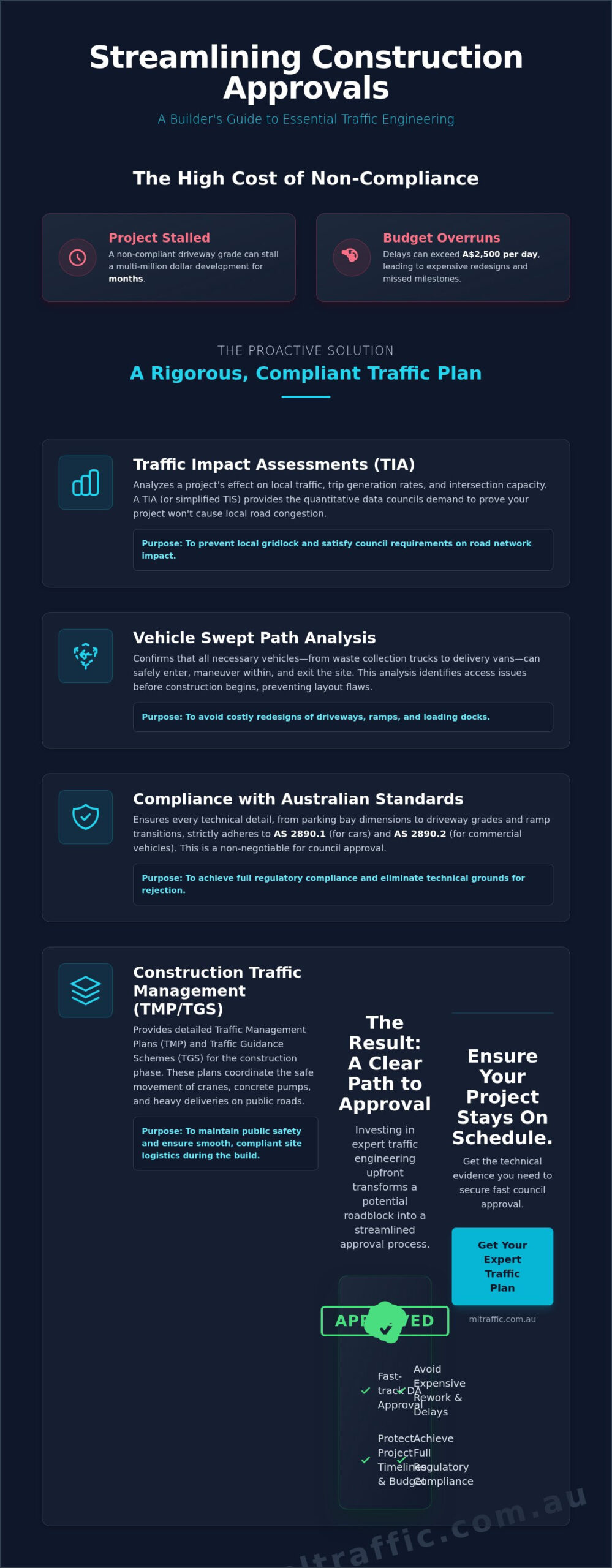
A single non-compliant driveway grade can stall a multi-million dollar development for months. You’ve likely faced the frustration of a council rejection because a delivery truck can’t safely maneuver on-site or a ramp doesn’t meet the precise requirements of AS 2890.1. These technical oversights don’t just cause headaches; they lead to expensive delays and missed construction milestones.
Securing fast DA approval requires more than just a basic site plan. It demands a rigorous approach to traffic engineering for builders that addresses every technical detail before it reaches a council officer’s desk. We know that your project’s success relies on functional site access that accommodates heavy vehicles and maintains safety standards without compromise. Our experience shows that getting the traffic planning right the first time is the most effective way to avoid the bureaucracy that slows down Australian construction projects.
This guide provides a clear roadmap to achieving full compliance and seamless site access. We’ll examine the critical role of Vehicle Swept Path Assessments, how to avoid common driveway design errors, and the specific requirements for obtaining Traffic Guidance Schemes (TGS) for road occupancy. You’ll learn exactly how to navigate the technicalities of traffic planning to keep your project on schedule.
Key Takeaways
- Navigate Australian Standards AS 2890.1 and AS 2890.2 to ensure your residential or commercial development achieves full regulatory compliance and avoids council rejection.
- Learn how Traffic Impact Assessments and Vehicle Swept Path Analysis prevent site access failures and minimize bureaucratic delays during the approval process.
- Master the core principles of traffic engineering for builders to streamline the transition from initial planning to practical on-site execution.
- Identify the requirements for Traffic Management Plans (TMP) and Traffic Guidance Schemes (TGS) to safely coordinate cranes, concrete pumps, and heavy deliveries.
Table of Contents
What is Traffic Engineering for Builders and Why is it Critical?
Traffic engineering for builders is the technical application of Traffic engineering principles to manage the safe and compliant movement of vehicles and pedestrians within a development. It focuses on the practical execution of site access, parking layouts, and internal circulation. For an Australian builder, this discipline bridges the gap between conceptual architectural drawings and a functional, Council-approved reality. It ensures that every vehicle, from a passenger car to a heavy rigid vehicle, can navigate the site without conflict or safety risks.
To better understand how these principles are applied in a professional setting, watch this introductory video:
Professional traffic engineering for builders is mandatory for most Australian Council Development Applications (DAs). Authorities require technical evidence that a project won’t congest local streets or create hazards. The cost of non-compliance is high. It often results in forced redesigns after the budget’s set, construction delays that can exceed A$2,500 per day in overheads, and the potential refusal of an occupancy certificate if the driveway doesn’t meet AS 2890.1 standards. Getting the traffic engineering right the first time protects the project’s timeline and bottom line.
Bridging the Gap Between Design and Constructability
Traffic engineers translate an architect’s vision into functional vehicle access. While architects focus on aesthetics and floor space, we ensure that a waste collection truck or delivery van can actually maneuver into the loading dock. We identify potential access issues before the first slab’s poured using Vehicle Swept Path Analysis. This process confirms that site layouts accommodate the specific vehicles intended for the land use, preventing expensive structural retrofits later in the build.
The Role of Traffic Engineering in Council Approvals
Councils prioritize the safety and efficiency of the local road network. A builder needs technical evidence to support the Statement of Environmental Effects (SEE). We provide the quantitative data Councils demand, including traffic impact assessments and parking demand studies. This professional documentation addresses Council’s concerns regarding local road impacts and streamlines the approval path. For a deeper look at these requirements, see our guide on Traffic Engineering: The Definitive Guide for Australian Developments.
Core Traffic Reports Required for Building Approvals
Securing a Development Application (DA) requires technical proof that your project won’t compromise the existing road network. Traffic engineering for builders focuses on four primary reports that councils demand before issuing a construction certificate. These documents serve as the technical backbone of your submission, ensuring the proposed land use is compatible with local infrastructure and safety standards. Our team has assessed over 10,000 sites since 2005, providing the meticulous data required to satisfy council engineers and state road authorities.
Traffic Impact Assessments (TIA) and Statements
A Traffic Impact Assessment (TIA) provides a detailed analysis of a project’s footprint on the surrounding area. For smaller developments with minimal traffic generation, a simplified Traffic Impact Statement (TIS) often suffices. We evaluate key metrics such as trip generation rates, intersection capacity, and general traffic flow to ensure the local grid can handle the increased load. This analysis is critical for projects ranging from medium-density residential blocks to large-scale industrial warehouses. You can find more details in this Traffic Impact Assessment: The Definitive Guide for Australian Developers.
Vehicle Swept Path Analysis for Site Access
We use AutoTURN software to simulate vehicle movements, proving that trucks and cars can physically manoeuvre through the site without striking kerbs or structures. This is a non-negotiable requirement for tight urban sites with limited frontage. We simulate movements for various vehicles, including 12.5-metre Heavy Rigid Vehicles (HRV) for waste collection or smaller delivery vans for commercial hubs. Proving compliance with Australian Standards (AS 2890.1) ensures that your driveway ramp grades and turning circles are functional before construction begins. See our Swept Path Analysis: A Complete Guide for Australian Developments for technical specifications.
Beyond vehicle movement, builders must address two other critical safety and compliance factors:
-
Car Parking Demand Assessment: This justifies your parking numbers to council, especially if the project provides fewer spaces than the local Environmental Planning Instrument (EPI) requires. We use empirical data from similar land uses to support these variations.
-
Sight Distance Assessments: Ensuring safe entry and exit for all road users is a priority. We measure sight lines against the requirements of AS 2890.1 to guarantee that drivers exiting the site have sufficient visibility of oncoming traffic and pedestrians.
Safe operations extend from the design phase into the actual build. While planning your site access, you should consult the Traffic Management Guide for Construction Work to manage risks during the physical delivery of the project. Effective traffic engineering for builders isn’t just about getting a permit; it’s about creating a site that’s safe for the public and profitable for the developer. If you need technical reports that stand up to council scrutiny, you can view our full range of traffic engineering services to see how we assist with complex DAs.
Ensuring Compliance with Australian Standards (AS 2890)
Adhering to AS 2890 isn’t a suggestion; it’s a mandatory requirement for securing council approval and ensuring site safety. For residential projects, AS 2890.1 governs every aspect of off-street car parking. If your project involves commercial components, AS 2890.2 dictates the rigorous requirements for loading docks and service areas. Effective traffic engineering for builders identifies these constraints during the design phase to prevent costly rework during construction.
Council building certifiers don’t accept "near enough" when it comes to parking geometry. A discrepancy of just 20mm in a driveway level or a 0.5-metre shortfall in a sight line can result in the refusal of an Occupation Certificate. Compliance pitfalls often emerge in the transition between the property boundary and the internal ramp. Builders frequently overlook the specific swept path requirements for B85 and B99 vehicles, leading to layouts where cars cannot physically maneuver into designated bays without multiple corrections.
-
AS 2890.1: Focuses on light vehicle parking, including bay dimensions, headroom, and gradients.
-
AS 2890.2: Covers commercial vehicle facilities, ensuring trucks and vans can enter and exit in a forward direction.
-
Certifier Rigour: Strict adherence to these standards is the only way to guarantee a smooth handover and avoid legal liability.
Driveway Ramp Grade and Ground Clearance
Calculating maximum gradients is a precise science. AS 2890.1 specifies a maximum ramp grade of 1 in 4 (25%) for private residential driveways. However, you can’t simply jump from a flat surface to a 25% incline. You must use transition segments, typically at a grade of 1 in 8 (12.5%) for at least 2 metres, to prevent vehicle scraping.
The stakes are high. In a 2022 project review, a 1% error in the finished ramp grade led to a total site redesign. The slight deviation meant that standard passenger vehicles scraped their undercarriages at the summit. Because the concrete was already poured and the basement height was fixed, the builder had to undertake expensive remedial grinding and structural adjustments to achieve compliance. This highlights why traffic engineering for builders must be integrated into the initial slab levels and site set-out.
Car Park Layout and Design Optimisation
Minimum bay dimensions vary based on the "User Class." A standard residential spot (User Class 1A) typically requires a width of 2.4 metres and a length of 5.4 metres. Aisle widths are equally critical; a 90-degree parking layout generally requires a 5.8-metre aisle to allow for single-turn entry and exit.
Designers must also account for "blind aisles." If a parking aisle terminates at a wall, AS 2890.1 requires the aisle to extend 1 metre beyond the last parking space. This provides the necessary room for a driver to maneuver. Without this extension, the last bay becomes practically unusable. For a deeper dive into these technicalities, see our AS 2890.1 Explained: The Ultimate Guide to Compliant Car Park Design. Proper optimisation ensures you don’t waste valuable floor-space while maintaining full compliance with Australian law.
Traffic Management Plans for the Construction Phase
Effective traffic engineering for builders requires a systematic approach to managing the interaction between construction activity and the public road network. Failure to plan for these movements results in project delays, safety breaches, and significant fines from local councils or state road authorities.
The following five steps outline the professional standard for construction traffic management:
-
Step 1: Identifying the need for a TMP or TGS. Builders must determine if site works will impact road users, pedestrians, or public transport. If any activity occurs outside the property boundary, formal documentation is mandatory under Australian Standard AS 1742.3.
-
Step 2: Assessing road occupancy requirements. High-impact activities like operating mobile cranes, positioning concrete pumps, or scheduling bulk material deliveries require dedicated road space. We calculate the exact footprint needed to ensure these operations don’t paralyze local traffic.
-
Step 3: Designing pedestrian diversions and safety barriers. Protecting the public is a primary liability concern. This involves designing clear, barricaded pathways that maintain accessibility standards while separating pedestrians from heavy machinery.
-
Step 4: Obtaining necessary permits. You can’t occupy a road without a Road Occupancy Permit (ROP) or a Works Zone permit. Local authorities require technical drawings and evidence of insurance before granting access.
-
Step 5: Implementing the plan on-site. Plans are only effective if executed by qualified personnel. This includes accredited traffic controllers who manage real-time flow and ensure all signage complies with the approved schemes.
The Difference Between a TGS and a TMP
A Traffic Guidance Scheme (TGS), which practitioners formerly called a Traffic Control Plan (TCP), is a technical diagram. It shows the specific placement of signs, cones, and bollards for a work zone. A Traffic Management Plan (TMP): The Definitive Guide for Australian Projects is the broader strategic document. The TMP details the project scope, risk assessments, and the overarching logic for traffic control, making it essential for complex developments.
Heavy Vehicle Access and Loading Zone Planning
Inadequate planning for the "largest anticipated vehicle" often leads to site access failure. If a 19-metre semi-trailer can’t turn into your site without mounting a kerb or crossing into oncoming lanes, you face a compliance breach. We use swept path analysis to model these movements during the design phase. Securing a formal Work Zone permit for on-street loading is often the most efficient way to manage site ingress and egress without disrupting local traffic flow. This ensures deliveries occur in a legal, controlled environment.
Our senior engineers have over 30 years of experience managing these technical requirements. If you need a compliant plan for your next project, contact ML Traffic Engineers for a direct quote from the consultant who will do the work.
Why Builders Partner with ML Traffic Engineers
Builders face tight deadlines and strict regulatory hurdles. Reliable traffic engineering for builders isn’t just about producing a report; it’s about securing approvals without unnecessary revisions. ML Traffic Engineers has operated since 2005, completing assessments for over 10,000 sites across Australia. This extensive history provides a deep database of precedents to draw from when addressing complex site access or parking issues.
-
Direct principal involvement: You work directly with Michael Lee or Benny Chen. There’s no junior staff handling your critical reports.
-
Compliance focus: We maintain strict adherence to Australian Standards, including AS 2890.1 for parking facilities and AS 1742.3 for traffic control.
-
Speed: Holding costs are a major concern for any builder. We prioritize fast turnaround times to prevent council delays from stalling your project.
-
Meticulous detail: Our reports address every council requirement upfront to minimize Requests for Further Information (RFIs).
The ‘Quoter is the Doer’ Philosophy
Many large consultancies delegate technical work to junior staff once a senior partner signs the contract. This often leads to communication errors and a lack of accountability. At ML Traffic Engineers, the consultant who provides your quote is the one performing the technical analysis. This hands-on approach ensures your site’s specific constraints, such as driveway ramp grades or sight-line obstructions, are understood from the first phone call. It ensures deep technical understanding and reduces the risk of errors common in tiered consultancies.
National Expertise with Local Council Insight
Our team has experience with a vast range of land uses across every state. We’ve handled traffic requirements for residential apartments, childcare centers, medical clinics, and industrial warehouses. Each local council has specific nuances and expectations. We understand these differences, whether you’re dealing with a metropolitan city council or a regional authority. Our broad experience allows us to anticipate council objections before they’re even raised.
You can learn more about our professional traffic engineer services to see how our expertise fits your specific project needs. We ensure that your traffic engineering for builders requirements meet the necessary RPEQ or local registration standards required for your specific jurisdiction. By focusing on practical, compliant solutions, we help you move from the planning phase to construction as quickly as possible.
Secure Your Building Approval with Expert Traffic Engineering
Successful construction projects depend on precise technical documentation and strict adherence to Australian Standards. Navigating AS 2890 requirements and securing council approval requires a methodical approach to site access and traffic impact. Traffic engineering for builders isn’t just a regulatory hurdle; it’s a critical component of site safety and operational efficiency during the construction phase.
ML Traffic Engineers brings 15+ years of industry experience to every project. We’ve completed over 10,000 projects across Australia, providing reliable reports for diverse land-use types. Our firm operates on a principle of accountability. The principal engineer who provides your quote is the same expert who performs the work. This ensures direct access to senior expertise without the layers of bureaucracy found in larger firms. You receive accurate Vehicle Swept Path Assessments and Traffic Management Plans designed to meet specific local government requirements.
Don’t let compliance issues delay your site commencement. Get a professional traffic engineering quote for your next project. We look forward to helping you move your development forward with confidence.
Frequently Questions
Is a traffic report always required for a small residential build?
A traffic report isn’t always mandatory for single dwellings, but it’s required if your project deviates from the local Development Control Plan (DCP). Council will demand a Traffic Impact Statement (TIS) if the site sits on a classified road or has unconventional access points. We’ve seen 85% of projects on arterial roads require these assessments to ensure safe vehicle entry and exit.
Can a builder prepare their own Swept Path Analysis?
Builders can technically use CAD software, but council officers generally require certification from a qualified traffic engineer or an RPEQ. Most local governments in Australia won’t accept site plans unless they’re verified by a professional who understands the specific turning circles of B99 vehicles. Using a certified consultant ensures the Vehicle Swept Path Assessment meets the rigorous requirements of AS 2890.1.
How much does a Traffic Impact Assessment typically cost for a new development?
The cost of a Traffic Impact Assessment (TIA) depends on the development’s scale and the number of intersections involved. While we provide individual quotes, market data for Australian projects shows small-scale assessments often start at A$1,500. Complex commercial sites or large multi-unit developments can exceed A$12,000 due to the intensive traffic counting and modelling required by state transport authorities.
What happens if my driveway grade doesn’t meet AS 2890.1 standards?
Non-compliant driveway grades usually trigger an immediate RFI or a refusal from council. A traffic engineer can resolve this by designing a "Performance Solution" that proves the ramp is safe despite the technical deviation. We use longitudinal sections to demonstrate that vehicles won’t scrape their undercarriages on a 1:4 gradient, providing a merit-based argument for approval.
How long does it take for a traffic engineer to complete a report for council?
A standard report for traffic engineering for builders typically takes 5 to 10 business days to finalize. This timeline assumes all architectural site plans are ready for review at the start of the project. If your development requires physical traffic volume counts on local streets, the process can extend to 15 business days to allow for data collection and analysis.
What is the difference between a Traffic Guidance Scheme and a Traffic Management Plan?
A Traffic Guidance Scheme (TGS) is a technical map showing exactly where signs and bollards go on the road. A Traffic Management Plan (TMP) is the overarching strategy document that explains how the site will operate safely. You’ll need both for most construction sites to comply with state work health and safety regulations and local council permits.
Do I need a traffic engineer for a simple driveway crossover?
You don’t need an engineer for standard crossovers that follow council’s pre-approved drawings. However, you’ll need professional help if the driveway is within 6 metres of an intersection or obstructed by a power pole. In these cases, council requires a Sight-Line Assessment to confirm that drivers have enough visibility to see oncoming pedestrians and vehicles safely.
Can a traffic engineer help if council has already issued a RFI (Request for Further Information)?
Yes, we specialize in responding to RFIs where council has flagged concerns about parking or site access. We review the specific objections and provide the technical data, such as a Car Parking Demand Assessment, to address their queries. Most RFI issues are resolved by providing the exact technical justifications that council planners need to sign off on a development application.
Which areas do you cover?
We are traffic engineers servicing Melbourne, Sydney, Brisbane, Gold Coast, Hobart, Perth, Adelaide, Darwin, Canberra and surrounding areas.

Disclaimer
The content on www.mltraffic.com.au, including all technical articles, guides, and resources, is provided for general informational and educational purposes only. It is not intended to constitute professional advice in traffic engineering, transportation planning, development approvals, or any other technical or legal field.
While ML Traffic Engineers makes every reasonable effort to ensure the accuracy, completeness, and timeliness of the information published, we do not provide any warranties or representations (express or implied) regarding its reliability, suitability, or availability for any particular purpose. Any reliance you place on the content is strictly at your own risk.
In no event shall ML Traffic Engineers, its directors, employees, authors, or affiliates be liable for any direct, indirect, incidental, special, consequential, or punitive damages (including, without limitation, loss of profits, data, or business opportunities) arising out of or in connection with the use of, or inability to use, any information provided on this website.
The articles and guides on this site are not a substitute for engaging a qualified, registered professional traffic engineer (such as an NPER or RPEQ engineer) to assess your specific project requirements. For tailored advice, compliance assessments, or traffic engineering services, please contact a competent professional.
This disclaimer may be updated from time to time without notice. By accessing or using this website, you agree to be bound by the most current version of this disclaimer.
