

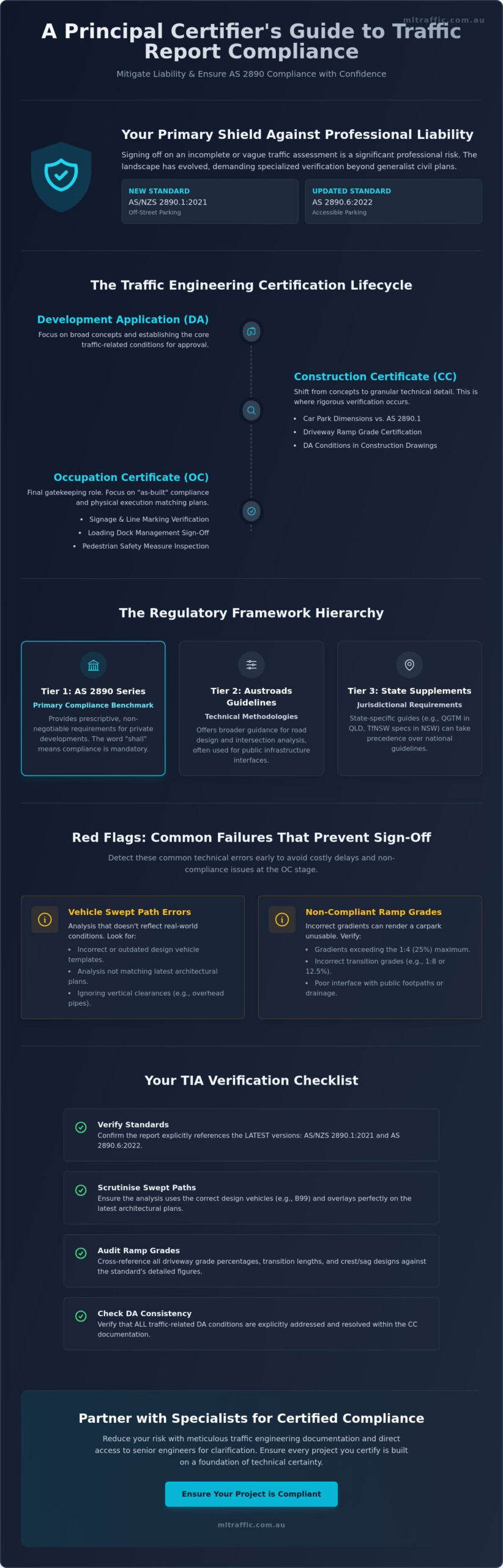
A traffic report is not a formality; it’s your primary shield against professional liability. For a Principal Certifier, signing off on a Construction Certificate based on an incomplete or vague assessment is a significant risk you can’t afford to take. We understand that the complexity of modern traffic engineering for certifiers has increased with the introduction of AS/NZS 2890.1:2021 and the updated AS 2890.6:2022 for accessible parking. You need more than just a generalist’s opinion. You need technical certainty that every driveway ramp grade and vehicle swept path complies with the latest national standards and state-specific supplements.
This article provides a technical roadmap to help you evaluate traffic documentation with professional confidence. You’ll learn exactly what to look for in a Traffic Impact Assessment (TIA) and how to verify that the provided designs mitigate your professional exposure. We will break down the mandatory requirements for Car Parking Demand Assessments and Intersection Analysis. This guide ensures a streamlined path to issuing your CC and OC approvals while maintaining strict adherence to the current Australian Standards and Austroads frameworks.
Key Takeaways
- Understand the mandatory role of specialized traffic engineering for certifiers in verifying development compliance beyond the scope of general civil plans.
- Identify the specific sections of AS 2890 and Austroads guidelines that are critical for signing off on Construction and Occupation Certificates.
- Learn to detect common technical errors in Vehicle Swept Path Analysis and Driveway Ramp Grade Assessments that lead to non-compliance.
- Implement a systematic checklist to verify the accuracy of Traffic Impact Assessment (TIA) reports against the latest architectural revisions.
- Discover how professional traffic documentation and direct access to senior engineering expertise can mitigate professional liability for Principal Certifiers.
Table of Contents
-
The Role of Traffic Engineering in the Certification Lifecycle
-
Partnering with ML Traffic Engineers for Certified Compliance
The Role of Traffic Engineering in the Certification Lifecycle
Traffic engineering for certifiers serves as the technical bridge between a conceptual Development Application (DA) and a safe, functional built environment. It’s a mandatory compliance verification process. Certifiers must ensure that every aspect of vehicle and pedestrian movement adheres to the strict requirements of Australian Standards. While a generalist civil engineer might provide basic site layouts, they often lack the specialized software and deep regulatory knowledge required to verify complex maneuvers or gradient transitions. Relying on non-specialist plans introduces significant liability risks during the certification lifecycle.
Traffic engineering is a specialized discipline focused on the safe and efficient movement of people and goods. For a Principal Certifier, this expertise is essential to confirm that a design doesn’t just look good on paper but functions correctly in the real world. A failure to address traffic safety at the design stage leads to costly retrofits or professional negligence claims if an accident occurs on a non-compliant site.
The following video provides a concise overview of the technical responsibilities inherent in this field:
Traffic Requirements for the Construction Certificate (CC)
The transition from DA approval to a Construction Certificate requires a shift from broad concepts to granular technical detail. Certifiers must verify that the construction drawings accurately reflect all traffic-related DA conditions. This stage involves more than a cursory glance at parking counts. It requires a rigorous review of detailed car park dimensions against AS/NZS 2890.1:2021 and certification of driveway grades. You must ensure that all DA traffic conditions have been translated into the final construction drawings to prevent mid-build compliance failures.
Compliance Verification for the Occupation Certificate (OC)
Issuing an Occupation Certificate is the final gatekeeping role for a certifier. At this stage, the focus shifts to "as-built" compliance. It’s not enough for the plans to be correct; the physical execution must match the approved traffic engineering specifications. Certifiers often require a final sign-off from a qualified traffic consultant to mitigate risk. This inspection process covers the verification of signage, line marking, and physical safety barriers. You’ll also need final sign-off on loading dock management and pedestrian safety measures before the site becomes operational.
Critical Australian Standards Every Certifier Must Enforce
The regulatory framework for traffic design in Australia is governed by a strict hierarchy of documents. At the foundation lies the AS 2890 series, which provides the prescriptive requirements for off-street parking and commercial facilities. While Austroads guidelines offer broader technical methodologies for intersection analysis and road design, AS 2890 is the primary compliance benchmark for private developments. Effective traffic engineering for certifiers requires a clear distinction between mandatory requirements and advisory recommendations. When a design uses the word "shall," compliance is non-negotiable. If a report proposes a "performance-based" solution to bypass a prescriptive standard, you must ensure the justification is backed by rigorous technical data.
State-specific supplements also play a critical role in the certification process. For instance, the Queensland Guide to Traffic Management (QGTM) takes precedence over national Austroads guides in that jurisdiction. In New South Wales, Transport for NSW (TfNSW) specifications, such as the TS 03401 (G10) updated in January 2026, dictate temporary management requirements. You can verify specific compliance needs through a professional Traffic Impact Assessment (TIA) Report to ensure your project meets both national and local mandates.
AS 2890.1:2021 Off-Street Car Parking
This standard was updated in 2021 to accommodate the increasing size of the Australian vehicle fleet. Certifiers must verify that parking bay dimensions align with the B85 and B99 vehicle classes specified in the code. A common point of failure is the blind aisle extension; the standard requires a minimum 2-meter extension beyond the last parking space to allow for multi-point turns. Additionally, you must scrutinize driveway ramp grades. The maximum allowable grade is 1:4 (25%), but this is only permissible with mandatory 1:8 transitions at the top and bottom to prevent vehicle scraping. For accessible parking, AS 2890.6:2022 provides the latest mandatory requirements for bay design and shared zones.
AS 2890.2:2018 Commercial Vehicle Facilities
Commercial developments rely on AS 2890.2:2018 to govern loading dock design and service vehicle access. You must confirm that the design accounts for the specific vehicle classifications intended for the site, ranging from Small Rigid Vehicles (SRV) to Articulated Vehicles (AV). A critical task in traffic engineering for certifiers is reviewing Vehicle Swept Path Analysis. These diagrams shouldn’t just show the wheel path; they must illustrate the body overhang to ensure the vehicle doesn’t strike columns or walls. Loading areas must also demonstrate clear separation between heavy vehicle movements and pedestrian paths to mitigate high-risk conflict points.
Common Technical Failures That Prevent Certificate Sign-Off
Identifying technical errors before they are cast in concrete is the primary responsibility of a Principal Certifier. Many development plans fail because they rely on generalized civil drawings rather than specialized traffic engineering. These failures frequently involve non-compliant sight distances at property boundaries or the use of incorrect vehicle classes during the design phase. If a report assumes a B85 vehicle class where a B99 is required by the local Development Control Plan (DCP), the entire parking layout is technically flawed. Professional traffic engineering for certifiers ensures these discrepancies are caught during the Construction Certificate (CC) phase to prevent professional liability and expensive post-construction remediation.
Non-compliant sight distances are a recurring issue in rejected Occupation Certificate (OC) applications. AS 2890.1:2021 requires clear sight triangles to ensure drivers can see pedestrians and other vehicles before exiting a property. High boundary walls, landscaping, or utility boxes often obstruct these triangles. A formal Sight Distance Assessment provides the technical verification you need to confirm that the as-built environment matches the safety requirements of the Australian Standards.
The Driveway Ramp Trap
Driveway ramp grades are a common source of certification failure. While a maximum grade of 1:4 is often cited, architectural drawings frequently omit the mandatory 1:8 or 1:12 transitions required at the top and bottom of the ramp. Without these transitions, vehicles with standard ground clearance will "bottom out" or scrape their chassis. Certifiers must look for a detailed Driveway Ramp Grade Assessment that includes a longitudinal section. This section must prove that the 1:20 transition requirements specified in AS 2890.1:2021 have been integrated into the construction drawings to avoid vehicle damage and site non-compliance.
Swept Path Analysis Errors
A Vehicle Swept Path Analysis is only valid if the correct design vehicle and clearance parameters are applied. Common errors include:
-
Incorrect Vehicle Selection: Using a standard passenger car template for a loading dock designed for Medium Rigid Vehicles (MRV).
-
Illegal Maneuvers: Diagrams that show vehicles mounting curbs or crossing into oncoming traffic lanes to complete a turn.
-
Insufficient Clearance: Failing to maintain the mandatory 300mm clearance from fixed objects like structural columns or fire hydrants in the AutoTURN simulation.
-
Multi-point Turns: Relying on complex "3-point turns" in residential driveways where the council or Australian Standards require single-motion entry and exit.
Verifying these technical details is essential for any project involving traffic engineering for certifiers. You must confirm that the swept path diagrams account for the actual vehicle fleet expected to use the site, including waste collection and emergency service vehicles.
A Certifier’s Checklist for Evaluating Traffic Reports
Evaluating a traffic report requires more than a cursory glance at the executive summary. As a Principal Certifier, your signature confirms that the development adheres to the law. If you approve a non-compliant design, you inherit the professional liability for any subsequent failures. Effective traffic engineering for certifiers provides a systematic framework to audit these documents before issuing a Construction Certificate (CC) or Occupation Certificate (OC).
-
Verify Specialist Qualifications: Ensure the consultant has demonstrated experience in civil engineering and urban planning. In Queensland, any professional engineering service must be carried out or supervised by a Registered Professional Engineer of Queensland (RPEQ) under the Professional Engineers Act 2002.
-
Cross-check Revision Alignment: Confirm the report date against the latest architectural revision. A minor change in column placement or door swing can invalidate a Vehicle Swept Path Analysis.
-
Audit DA Condition Compliance: Review the Development Application conditions line-by-line. The report must explicitly address every traffic-related requirement imposed by the consent authority without exception.
-
Assess Operational Realism: Check swept path diagrams for realistic maneuvers. Diagrams showing vehicles mounting curbs or requiring five-point turns in a residential driveway aren’t compliant with AS 2890.1:2021.
-
Confirm Standards Citation: Ensure the report cites the correct versions of the law, including AS/NZS 2890.1:2021 and the updated AS 2890.6:2022 for accessible parking facilities.
What Makes a Traffic Report "Certifier-Ready"?
A certifier-ready report uses declarative language. It states that a design "complies" with specific clauses of AS 2890 rather than using vague qualifiers. Diagrams must be high-resolution with legible dimensions and scales that allow for independent verification. If the project utilizes a performance-based solution, the report must include a comprehensive summary explaining how the alternative design meets the safety objectives of the Australian Standards. It’s about providing technical certainty, not just a document for the file.
Red Flags in Traffic Documentation
Be wary of generic reports that lack site-specific verification. When evaluating traffic engineering for certifiers, you’ll find that missing references to specific AS 2890 sub-clauses often indicate a lack of technical depth. Another critical red flag is an over-reliance on "management plans" to solve physical design flaws. A loading dock that’s physically too small cannot be fixed with a management plan; it requires a redesign to meet AS 2890.2:2018 requirements. For a definitive review of your project’s compliance, contact our senior engineering team for a technical consultation.
Partnering with ML Traffic Engineers for Certified Compliance
ML Traffic Engineers Australia provides a dependable partnership for Principal Certifiers seeking technical certainty. With over 15 years of national experience, we understand the bureaucratic and technical requirements of the certification lifecycle. Our approach to traffic engineering for certifiers is built on accountability. You deal directly with senior principals who perform the technical work and stand behind every certification. This eliminates the risks associated with larger, impersonal firms where junior staff often handle complex compliance assessments.
Our comprehensive service suite covers every requirement from initial site assessment to final sign-off. We provide specialized documentation including:
-
Traffic Impact Assessment (TIA) Reports
-
Vehicle Swept Path Analysis
-
Car Parking Demand Assessments
-
Traffic Guidance Schemes (TGS)
-
Driveway Ramp Grade Assessments
-
Intersection Analysis
-
Sight Distance Assessments
-
Car Park Design
Why Certifiers Trust Our Documentation
Every technical report undergoes a rigorous internal peer-review process before it reaches your desk. We design our reporting to be clear and concise, specifically mapping to certifier workflows and the requirements of AS 2890 and Austroads. Our national expertise ensures that our documentation meets the specific supplements of each jurisdiction, whether you’re working under TfNSW specifications in New South Wales or the QGTM in Queensland. This meticulous attention to detail ensures we get it right the first time, preventing costly delays in the Construction Certificate (CC) phase.
Streamlining Your Approval Process
Efficiency is a core metric of our service. We offer fast turnaround times for urgent CC and OC certifications without compromising on technical accuracy. Our senior engineers provide expert advice on resolving complex site access disputes or interpreting performance-based solutions. We maintain personnel continuity; the expert who starts your project is the one who finishes it. This hands-on philosophy distinguishes our consultancy as a reliable resource for risk management. Contact our senior engineers today to discuss your project requirements or to request a technical review of your current traffic documentation.
Secure Your Certification Process with Professional Compliance
The integrity of your certification process depends on the technical accuracy of the traffic documentation you approve. It’s your responsibility to ensure every site movement adheres to national mandates. By strictly enforcing the latest updates to AS 2890 and utilizing a systematic audit checklist, you mitigate your professional risk. Specialized traffic engineering for certifiers replaces generic civil plans with precise, data-driven assessments. These reports account for the actual vehicle fleet and operational realities of the site to prevent post-construction failures.
ML Traffic Engineers Australia brings 15+ years of national experience to every project. We provide direct access to principal engineers who specialize in AS 2890 compliance and rigorous technical reporting. Our documentation is designed to withstand scrutiny and streamline your path to issuing final certificates. We ensure that every swept path and ramp grade is verified against current Australian Standards before you sign off.
Get Expert Traffic Engineering Support for Your Next Certification. We look forward to providing the technical certainty your projects require.
Frequently Asked Questions
What is the difference between a Traffic Statement and a full Traffic Impact Assessment (TIA)?
A Traffic Statement is a simplified document used for low impact developments with minimal traffic generation. In contrast; a full Traffic Impact Assessment (TIA) is a comprehensive technical report required for larger developments. A TIA includes detailed intersection analysis; parking demand assessments; and traffic modeling to ensure the surrounding road network maintains its level of service.
Does every Construction Certificate require a formal traffic sign-off?
A formal traffic sign-off is required if the Development Application (DA) includes specific conditions regarding traffic or parking. Certifiers should request specialized traffic engineering for certifiers whenever a project involves complex vehicle maneuvers; steep driveway transitions; or high volume car parks. This verification ensures the construction drawings align with the approved DA and relevant Australian Standards.
How does AS 2890.1 apply to residential driveway designs?
AS 2890.1:2021 dictates the technical requirements for domestic off street parking; including maximum driveway grades and mandatory transitions. It specifies that the maximum grade for a domestic driveway is 1:4. Certifiers must verify that these designs include the required 1:8 or 1:12 transitions to prevent vehicle scraping and ensure safe property access.
Can a certifier approve a driveway that doesn’t strictly meet AS 2890 grades?
Certifiers can only approve non prescriptive driveway grades if the engineer provides a robust performance based solution. This solution must demonstrate that the alternative design meets the safety and functional objectives of the Australian Standards. You shouldn’t accept a non compliant grade without a formal technical justification and a detailed longitudinal section proving vehicle clearance.
What is Swept Path Analysis and why is it critical for CC approval?
Vehicle Swept Path Analysis is a computer simulation that tracks the path of a design vehicle to ensure it can maneuver safely through a site. It’s critical for CC approval because it proves that vehicles can enter; exit; and circulate within the development without striking structural elements or mounting curbs. This analysis must use the correct design vehicle class specified by the local council.
What are the most common traffic-related reasons for an Occupation Certificate delay?
Occupation Certificate delays frequently stem from as built discrepancies where the physical construction differs from the approved traffic plans. Common issues include non compliant sight distances due to boundary walls; missing regulatory signage; or incorrect line marking in the car park. A final inspection and Sight Distance Assessment help verify that the site is safe for public use before sign off.
How do I verify if a traffic engineer is suitably qualified to provide certification?
Verification of qualifications depends on the jurisdiction of the project. In Queensland; it’s a legal requirement under the Professional Engineers Act 2002 that any professional engineering service be carried out by a Registered Professional Engineer of Queensland (RPEQ). Certifiers should also verify that the consultant has specific experience in traffic engineering for certifiers and is familiar with the latest AS 2890 revisions.
Is a Traffic Management Plan (TMP) required for every building site?
A Traffic Management Plan (TMP) or a Traffic Guidance Scheme (TGS) is mandatory whenever construction work impacts the public road reserve or pedestrian footpaths. These documents ensure that vehicle and pedestrian movements around the work site are managed according to the Austroads Guide to Temporary Traffic Management. Certifiers must confirm these plans are in place before site disturbing activities begin.
Which areas do you cover?
We are traffic engineers servicing Melbourne, Sydney, Brisbane, Gold Coast, Hobart, Perth, Adelaide, Darwin, Canberra and surrounding areas.

Disclaimer
The content on www.mltraffic.com.au, including all technical articles, guides, and resources, is provided for general informational and educational purposes only. It is not intended to constitute professional advice in traffic engineering, transportation planning, development approvals, or any other technical or legal field.
While ML Traffic Engineers makes every reasonable effort to ensure the accuracy, completeness, and timeliness of the information published, we do not provide any warranties or representations (express or implied) regarding its reliability, suitability, or availability for any particular purpose. Any reliance you place on the content is strictly at your own risk.
In no event shall ML Traffic Engineers, its directors, employees, authors, or affiliates be liable for any direct, indirect, incidental, special, consequential, or punitive damages (including, without limitation, loss of profits, data, or business opportunities) arising out of or in connection with the use of, or inability to use, any information provided on this website.
The articles and guides on this site are not a substitute for engaging a qualified, registered professional traffic engineer (such as an NPER or RPEQ engineer) to assess your specific project requirements. For tailored advice, compliance assessments, or traffic engineering services, please contact a competent professional.
This disclaimer may be updated from time to time without notice. By accessing or using this website, you agree to be bound by the most current version of this disclaimer.
