

The most technically brilliant development design is effectively worthless if it cannot survive a council’s scrutiny regarding road safety and parking capacity. A single objection regarding traffic congestion or a perceived parking shortfall can invalidate months of architectural planning and lead to immediate refusal. When the stakes are this high, traffic engineering for contentious development applications moves beyond simple compliance; it becomes a strategic tool for project survival.
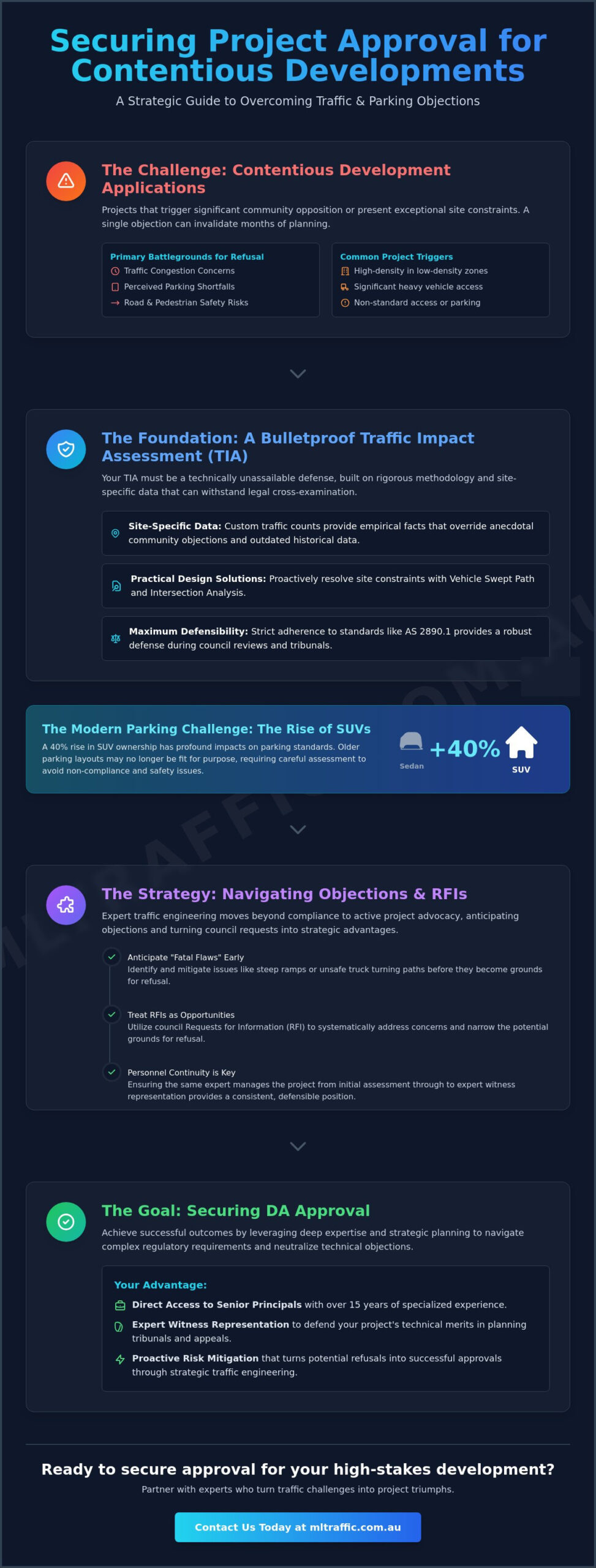
We understand the frustration of receiving repeated Requests for Information (RFI) or facing organized community resistance based on anecdotal traffic concerns. You need more than just a standard report to move forward. This guide details how expert traffic engineering and defensible data can overcome council objections and secure approvals for your most challenging projects. We’ll examine the requirements for a bulletproof Traffic Impact Assessment (TIA) that stands up to legal scrutiny, the impact of the 40% rise in SUV ownership on parking standards, and how expert representation during planning tribunals can neutralize technical objections.
Key Takeaways
- Construct a defensible Traffic Impact Assessment (TIA) using site-specific data and rigorous methodology to withstand technical scrutiny from local authorities.
- Utilize Council Requests for Information (RFI) as strategic opportunities to address community concerns and systematically narrow the potential grounds for application refusal.
- Ensure successful outcomes in traffic engineering for contentious development applications by maintaining personnel continuity from the initial assessment through to expert witness representation.
- Implement practical design solutions, including Vehicle Swept Path Analysis and Intersection Analysis, to proactively resolve site constraints and road safety objections.
- Gain direct access to senior principals with over 15 years of experience to navigate complex regulatory requirements and secure approvals for high-stakes developments.
Understanding Contentious Development Applications in Traffic Engineering
Contentious development applications (DAs) are projects that trigger significant community opposition or present exceptional site constraints. In the context of Traffic engineering, these applications require a higher level of technical rigor than standard submissions. While a routine application might rely on generic data, traffic engineering for contentious development applications demands site-specific evidence and strategic positioning to withstand public and council scrutiny.
Traffic and parking are the primary battlegrounds for planning refusals across Australia. Local residents often fear increased road congestion, safety risks for pedestrians, or the loss of on-street parking availability. These concerns are frequently used by councils as technical grounds for refusal, even if the proposed development meets basic zoning requirements. Without a robust technical defense, these objections can lead to costly delays or project termination.
To better understand the complexities and critiques of modern traffic assessments, watch this helpful video:
Strategic traffic engineering differs from standard compliance because it anticipates objections before they are lodged. It involves identifying “fatal flaws” in the site design early in the process. For example, if a driveway ramp grade is too steep or a vehicle swept path analysis shows a truck cannot safely exit in a forward direction, the project may be doomed from the start. Early engagement allows for redesigns that mitigate these risks before they become public knowledge or council records.
Common Triggers for Contentious Traffic Reviews
Certain project characteristics almost always result in increased scrutiny from authorities and the public. These include high-density residential developments in established low-density neighborhoods, where local street capacity is a concern. Commercial or industrial sites with significant heavy vehicle (truck) requirements also face high hurdles. Finally, any projects involving significant parking shortfalls or non-standard access points will require a highly specialized Car Parking Demand Assessment to justify the deviation from standard requirements.
The Strategic Role of the Traffic Consultant
A traffic consultant’s role on a contentious project goes beyond drafting a report. It involves active project advocacy and risk mitigation. This includes liaising with road authorities and councils to find “in-principle” common ground before the final submission. Crucially, all designs must strictly adhere to AS 2890.1. Ensuring parking layouts and access points are fully compliant with national standards provides the maximum level of defensibility during a council review or a subsequent planning tribunal appeal.
Developing a Bulletproof Traffic Impact Assessment (TIA)
A bulletproof Traffic Impact Assessment (TIA) is the cornerstone of any successful project. In the context of traffic engineering for contentious development applications, a TIA must move beyond basic checklists to provide a technically unassailable defense of the proposal. This requires a rigid adherence to established methodologies and the use of site-specific data that can withstand cross-examination in a legal or tribunal setting. A report that relies on generic assumptions is a liability that councils will quickly exploit to justify a refusal.
Custom traffic counts are essential for contentious cases. Historical data often fails to account for recent local shifts in traffic patterns or the specific peak-hour characteristics of a unique neighborhood. By performing manual or automated counts at critical intersections, we provide empirical facts that override anecdotal community objections. This high-resolution data ensures that the baseline for all subsequent modelling is accurate and defensible.
We utilize SIDRA intersection modelling to provide clear evidence of existing and future network capacity. This software allows us to calculate the Degree of Saturation (DoS) and Level of Service (LoS) for affected junctions. By demonstrating that an intersection will continue to operate within acceptable limits, we provide the technical assurance planning officers require. This rigorous approach aligns with the regulatory frameworks outlined in the CDOT Access Permit Guide, which highlights the necessity of thorough traffic engineering for contentious development applications to satisfy safety and operational standards. We also include a cumulative impact analysis to pre-empt concerns about other nearby developments currently in the planning pipeline.
Advanced Modelling and Swept Path Analysis
Proving that a site can safely accommodate its required vehicle types is critical. Our Swept Path Analysis uses AutoTURN software to simulate the exact movements of waste collection, delivery, and emergency vehicles. We visualize these movements in 2D or 3D to satisfy skeptical planning officers and demonstrate compliance with driveway ramp grade requirements. This technical visualization removes the ambiguity that often leads to RFIs and project delays.
Parking Demand vs. Council Requirements
Rigid council parking rates don’t always reflect the reality of modern developments. We conduct empirical parking demand assessments to justify variations where the standard rates would impose unnecessary infrastructure costs. Our analysis considers peak-hour demand profiles and existing public transport accessibility. Every design we produce strictly adheres to AS 2890.1:2004 and AS 2890.2:2018 standards to ensure full regulatory compliance. For those facing complex parking objections, reviewing our specialized traffic engineering services can provide the technical path forward to secure your DA approval.
Navigating Council Objections and Requests for Information (RFI)
A Request for Information (RFI) from Council is often viewed as a hurdle, but it’s actually a strategic opportunity to narrow the grounds for a potential refusal. In the specialized field of traffic engineering for contentious development applications, the RFI response serves as a formal technical defense. We use these responses to systematically address and neutralize specific concerns raised by planning officers or community groups. By providing precise data and refined modelling, we limit the scope of their objections and build a stronger case for approval.
Community objections frequently center on “rat-running” and perceived risks to local street safety. Residents often fear that new developments will flood quiet streets with shortcut-seeking vehicles. We address these fears with empirical evidence. This might involve additional intersection analysis or speed surveys to prove that the projected traffic volumes won’t compromise local amenity. We don’t just dismiss community concerns; we provide the data that makes those concerns technically irrelevant to the planning decision.
Technical rebuttal strategies are essential when a Council officer’s assessment relies on outdated standards or overly conservative assumptions. If their traffic model predicts a failure that our site-specific SIDRA analysis does not, we challenge their baseline data. We also incorporate a Traffic Guidance Scheme (TGS) early in the process. This addresses construction-phase concerns regarding site access and heavy vehicle movements before they can be used as a reason to delay or refuse the application.
Mitigating Impact Through Design Refinement
Successful outcomes often require adjusting site access and egress to improve sight distances and overall safety. We implement traffic calming measures directly within the development footprint to manage vehicle speeds effectively. It’s vital to ensure traffic engineering principles inform the master plan from the earliest stages. Collaborating with architects allows us to design compliant driveway ramp grades and internal circulation paths that prevent technical RFIs from being issued in the first place.
Negotiating with Road Authorities
Contentious projects often involve referrals to state-level transport departments like TfNSW, VicRoads, or TMR. Securing concurrence from these bodies requires evidence-based safety audits and rigorous intersection analysis. Our senior principals personally handle these high-stakes negotiations. Direct representation in council meetings ensures that the technical merits of the project are communicated clearly and authoritatively. This senior-level involvement is critical for resolving complex transport issues that might otherwise stall a project for months or result in an unfavorable decision.
Expert Witness Services: Defending Your Project in Appeals
When a development application is refused by Council, the technical battle moves to a legal forum. In Australia, this typically involves planning tribunals such as the Victorian Civil and Administrative Tribunal (VCAT), the New South Wales Civil and Administrative Tribunal (NCAT), or the Land and Environment Court. At this stage, traffic engineering for contentious development applications transitions from report preparation to expert testimony. The quality of the technical evidence provided during these proceedings often determines the final outcome of the project.
Personnel continuity is a critical factor in successful appeals. We ensure that the senior principal who initiates the project and performs the technical work is the same expert who defends it in court. This “no-gatekeepers” approach prevents the information gaps that often occur in larger firms where junior staff write reports and senior staff testify. A seasoned expert with deep-seated knowledge of every SIDRA model and vehicle swept path analysis in the file is far more effective during cross-examination.
The appeals process frequently involves preparing Joint Expert Reports (JER) and participating in conciliation conferences. These are high-stakes technical meetings where traffic engineers from both sides attempt to resolve disagreements. Professional credibility and multi-decade experience are essential here; a senior engineer with a proven track record of reliability can often negotiate “in-principle” agreements that narrow the issues before a full hearing begins.
The Weight of Evidence in Planning Appeals
Tribunals prioritize empirical traffic data over anecdotal community objections. While residents may claim a street is “dangerous” or “congested,” a tribunal will rely on rigorous counts and adherence to Austroads Guides and the AS 2890 series of standards. An expert witness’s primary duty is to provide independent and impartial assistance to the court or tribunal, overriding any obligation to the party who engaged them. By maintaining this professional objectivity and grounding every statement in verifiable data, we provide the tribunal with the confidence needed to overturn a council’s refusal.
De-Risking Through Senior Involvement
Direct access to senior principals ensures that your legal representation is supported by robust technical expertise. During cross-examination, an expert must defend complex traffic matters, such as intersection analysis or driveway ramp grade assessments, under intense scrutiny. Seasoned experts have the composure and technical depth to handle these challenges without faltering. Professional traffic engineering has repeatedly overturned DA refusals by identifying flaws in a council’s own data or demonstrating that proposed mitigation measures meet all regulatory safety standards. If you are facing a refusal and require expert representation, contact our senior principals directly to discuss your appeal strategy.
Securing DA Approval with ML Traffic Engineers Australia
ML Traffic Engineers Australia provides a results-oriented methodology designed specifically to secure planning approvals. We don’t just produce reports; we deliver strategic technical defenses. With over 15 years of experience in the Australian market, we understand the bureaucratic requirements that often stall high-stakes projects. Our expertise in traffic engineering for contentious development applications ensures that every technical hurdle is identified and addressed before it can lead to a refusal.
Our “No-Gatekeepers” approach distinguishes us from larger, more impersonal firms. You have direct access to the senior principals responsible for your project. This ensures total accountability and technical continuity. The expert who performs your Vehicle Swept Path Analysis or Intersection Analysis is the same professional who will represent your interests in council meetings or planning tribunals. This streamlined communication model eliminates information loss and provides the reliability needed for complex developments.
Our National Expertise in Traffic and Transport Planning
We maintain a comprehensive project portfolio across diverse sectors. Our team has successfully managed transport challenges for various project environments, including:
- High-density residential apartment complexes and subdivisions.
- Large-scale commercial retail and office developments.
- Industrial facilities requiring heavy vehicle access and loading assessments.
- Mixed-use projects with complex parking and shared access requirements.
- Childcare centers, medical clinics, and educational institutions.
Our work is grounded in a meticulous adherence to national regulatory standards and local government requirements. We provide fact-based engineering solutions that withstand the highest levels of scrutiny. This commitment to technical excellence ensures that our TIA reports and Car Parking Demand Assessments provide a solid foundation for project approval.
Get Started on Your Development Application
Engaging a traffic engineer during the preliminary site assessment phase is the most effective way to de-risk your project. Early-stage consultancy allows us to identify potential technical issues in driveway ramp grades, sight distances, or parking layouts. Resolving these issues before submitting your DA prevents costly RFIs and reduces the risk of community-led objections. It’s a proactive strategy that saves time and capital.
We provide a clear path forward for developers facing difficult site constraints or significant local opposition. Our senior leadership remains involved in every assessment to ensure technical accuracy and strategic alignment. Contact ML Traffic Engineers Australia today to discuss your contentious DA and secure the expert representation your project requires. Expert engineering turns complex site constraints into approved developments.
Secure Your Development Approval with Technical Precision
Successful project outcomes depend on the transition from standard documentation to strategic technical defense. We’ve detailed how robust SIDRA modelling and site-specific data neutralize community resistance and satisfy rigorous council requirements. Addressing RFIs proactively and ensuring personnel continuity during tribunal appeals are the final steps in mitigating refusal risks. Effective traffic engineering for contentious development applications requires this level of meticulous detail to withstand intense legal and regulatory scrutiny.
ML Traffic Engineers Australia brings over 15 years of industry experience and national coverage across all Australian jurisdictions to your development. We ensure direct principal involvement on all reports to maintain total accountability and technical excellence. Don’t leave your high-stakes application to chance or allow anecdotal objections to stall your progress. Discuss your project with a Senior Traffic Engineer to ensure your technical evidence is unassailable. Expert engineering turns complex site constraints into approved developments.
Frequently Asked Questions
What makes a development application “contentious” from a traffic perspective?
A development application is considered contentious when it triggers significant community opposition or presents complex site constraints. Common triggers include high-density residential projects in low-density zones, significant parking shortfalls, or sites requiring heavy vehicle access. These projects require specialized traffic engineering for contentious development applications to provide a defensible technical response to council and resident objections.
How can a traffic engineer help if the community objects to my project?
Traffic engineers provide empirical data to neutralize anecdotal community concerns regarding congestion or safety. We use site-specific traffic counts and rigorous modelling to prove that a development’s impact remains within acceptable limits. This technical evidence is far more persuasive to planning authorities than the subjective fears often raised during public consultation periods.
Is a Traffic Impact Assessment (TIA) always required for a DA in Australia?
A Traffic Impact Assessment (TIA) Report is required for any development that exceeds specific council thresholds. Most Australian local authorities mandate a transport plan for projects creating three or more residential lots. Larger commercial or industrial developments always require a formal TIA to assess the long-term impact on the surrounding road network.
What is the difference between a Traffic Management Plan and a Traffic Impact Assessment?
A Traffic Impact Assessment (TIA) evaluates the permanent, long-term effects of a development on traffic flow and parking. In contrast, a Traffic Management Plan, often submitted as a Traffic Guidance Scheme (TGS), focuses on the temporary construction phase. Contentious projects often require both to address long-term operational concerns and short-term construction safety risks.
Can a traffic engineer act as an expert witness in a planning appeal?
Yes, senior traffic engineers frequently provide expert witness services in tribunals such as VCAT, NCAT, or the Land and Environment Court. We prepare Joint Expert Reports and defend the technical merits of a project under cross-examination. Our primary duty is to provide independent and impartial assistance to the tribunal to help them reach a decision.
How long does it take to prepare a traffic report for a contentious application?
Preparation times depend on the project’s complexity and the required data collection. While a standard report might take two weeks, traffic engineering for contentious development applications often requires four to six weeks. This timeline allows for manual traffic counts, SIDRA intersection modelling, and detailed vehicle swept path analysis to ensure the report is bulletproof.
What technical software is used for traffic modelling in Australia?
SIDRA INTERSECTION is the industry standard for analyzing intersection capacity and performance in Australia. We also use AutoTURN software for Vehicle Swept Path Analysis to ensure all driveway ramps and loading areas are compliant. These tools provide the empirical evidence necessary to satisfy council engineers and planning officers.
How do I know if my site has enough parking to meet council standards?
Site parking must be assessed against local planning schemes and national standards like AS 2890.1:2004. If your site doesn’t meet the minimum number of spaces, a Car Parking Demand Assessment can provide the technical justification for a variation. This assessment uses empirical data to demonstrate that the actual parking demand will be lower than the council’s generic requirement.

Disclaimer
The content on www.mltraffic.com.au, including all technical articles, guides, and resources, is provided for general informational and educational purposes only. It is not intended to constitute professional advice in traffic engineering, transportation planning, development approvals, or any other technical or legal field.
While ML Traffic Engineers makes every reasonable effort to ensure the accuracy, completeness, and timeliness of the information published, we do not provide any warranties or representations (express or implied) regarding its reliability, suitability, or availability for any particular purpose. Any reliance you place on the content is strictly at your own risk.
In no event shall ML Traffic Engineers, its directors, employees, authors, or affiliates be liable for any direct, indirect, incidental, special, consequential, or punitive damages (including, without limitation, loss of profits, data, or business opportunities) arising out of or in connection with the use of, or inability to use, any information provided on this website.
The articles and guides on this site are not a substitute for engaging a qualified, registered professional traffic engineer (such as an NPER or RPEQ engineer) to assess your specific project requirements. For tailored advice, compliance assessments, or traffic engineering services, please contact a competent professional.
This disclaimer may be updated from time to time without notice. By accessing or using this website, you agree to be bound by the most current version of this disclaimer.
