

A poorly designed heavy vehicle interface doesn’t just cause operational delays; it can render a multi-million dollar freight development commercially unviable before the first B-double even arrives. Achieving successful traffic engineering for intermodal facilities requires more than a basic understanding of road rules. It demands a meticulous application of AS 2890.2:2018 and the latest 2026 Austroads Guide updates to ensure every vehicle movement is accounted for. When site layouts fail to accommodate the precise swept paths of high-productivity vehicles, the result is often a rejected Development Application and costly retrofitting.
You likely understand that securing council approval for a high-intensity freight hub is increasingly difficult as regulatory scrutiny intensifies. This guide provides the technical roadmap you need to master these complexities, ensuring your facility operates at peak efficiency while meeting every compliance hurdle. We will examine the critical role of Traffic Impact Assessments, the necessity of professional vehicle swept path analysis using AutoTURN, and how to align your site design with the January 2026 updates to traffic management standards.
Key Takeaways
- Understand why traffic engineering for intermodal facilities requires more rigorous assessment than standard industrial projects to manage complex road and rail interfaces.
- Utilise Vehicle Swept Path Analysis and AutoTURN software to ensure B-double and A-double manoeuvrability within tight site constraints.
- Master the requirements of AS 2890.2:2018 to ensure off-street commercial vehicle facilities meet current Australian regulatory standards.
- Identify the essential components of a robust Traffic Impact Assessment, including SIDRA intersection analysis and heavy vehicle trip generation modelling.
- Streamline the planning approval process by leveraging senior-led technical reporting that addresses council concerns before they cause delays.
The Role of Traffic Engineering in Australian Intermodal Facility Development
Effective traffic engineering for intermodal facilities is a highly specialised discipline that governs the movement of goods between different transport modes. Unlike standard industrial developments, an intermodal site acts as a critical node where road, rail, and often sea transport converge. This requires a sophisticated understanding of intermodal freight transport logistics to manage the complex interfaces between heavy vehicles, locomotives, and terminal infrastructure. A failure to account for these interactions during the design phase often leads to operational bottlenecks that diminish the facility’s commercial value.
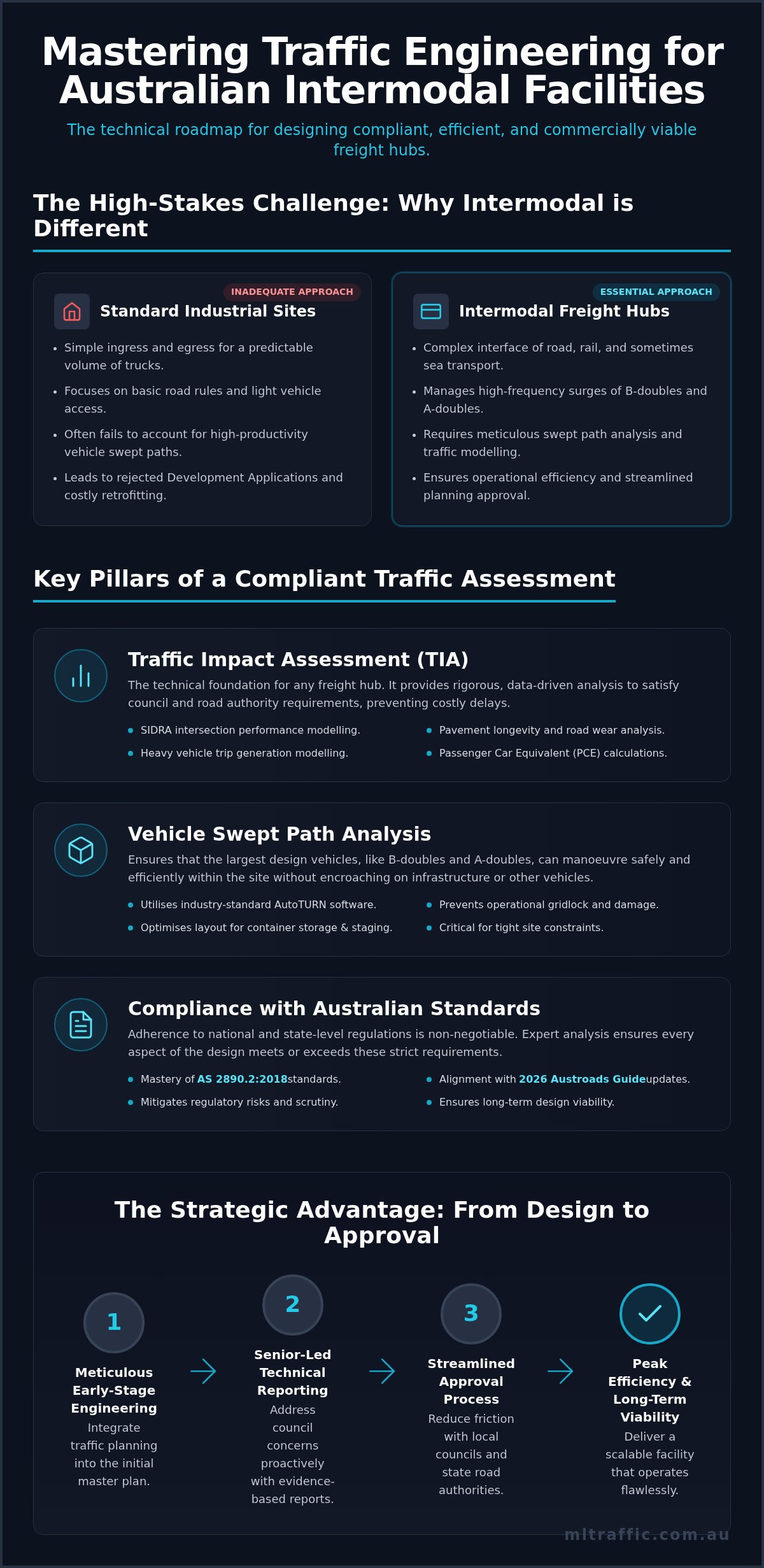
Standard industrial sites typically focus on simple ingress and egress for a predictable volume of trucks. Freight hubs require more rigorous traffic assessments because they must handle high-frequency movements of high-productivity vehicles, such as B-doubles and A-doubles. The commercial impact of efficient flow is direct. Faster turnaround times reduce operational overheads and increase the throughput capacity of the terminal. Meticulous early-stage engineering prevents the need for costly site redesigns during the Development Application (DA) process, ensuring the project remains on schedule and within budget.
Navigating the Complexity of Multi-Modal Logistics
Managing an intermodal terminal involves balancing the high-volume throughput of heavy freight with the safety of light vehicles and site personnel. Freight schedules often dictate arrival patterns, creating significant peak-hour surges that can overwhelm poorly designed access points. Integrating professional traffic engineering into the initial master planning phase is essential. It allows for the segregation of vehicle types and the implementation of efficient staging areas. This prevents heavy vehicle congestion from spilling onto the public road network and disrupting local traffic flow.
The Strategic Advantage of Professional Traffic Consultancy
Engaging a specialist consultancy reduces friction with local councils and state road authorities by providing evidence-based design solutions. Professional traffic engineering for intermodal facilities ensures that land use is optimised to maximise container storage and vehicle staging. This level of technical oversight guarantees that the facility can scale as freight demand increases over time. Our approach involves senior principals performing the technical work directly, which ensures that every report is meticulous and compliant. By addressing Australian Standards from the outset, developers secure a streamlined approval process and a site layout that supports long-term operational excellence.
Critical Components of a Traffic Impact Assessment for Freight Hubs
A comprehensive Traffic Impact Assessment (TIA) is the technical foundation of traffic engineering for intermodal facilities. It must go beyond basic traffic counts to include rigorous intersection performance modelling using SIDRA software. This analysis assesses how the existing road network handles the increased load of heavy vehicle movements and staff shift changes. We also examine pavement longevity, as the repetitive axle loads of high-productivity vehicles can significantly accelerate road wear on local thoroughfares. Developing a Guide to Traffic Impact Assessment compliant report ensures that mitigation strategies for identified bottlenecks are technically sound and ready for council review. Mitigation often involves proposing physical infrastructure upgrades, such as signalisation or roundabout modifications, to manage freight surges safely.
Data-Driven Trip Generation and Distribution
Accurate trip generation for intermodal sites requires calculating the Passenger Car Equivalent (PCE) for semi-trailers, B-doubles, and A-doubles. A single heavy vehicle does not equate to one car in terms of road capacity or intersection delay; it occupies more space and has slower acceleration profiles. We model traffic distribution across primary freight corridors to predict exactly where congestion will occur during peak periods. Accurate trip generation data directly dictates the required lane configurations, signal timings, and storage lengths at site access points to prevent heavy vehicle queuing on public thoroughfares. Our specialised TIA reports provide the granular data needed for these complex calculations, ensuring the site remains operational under maximum load.
Intersection and Access Point Analysis
Heavy vehicles require significantly longer sight distances and larger turning radii than standard passenger cars to navigate safely. Access point design must include dedicated acceleration and deceleration lanes to allow trucks to merge with high-speed traffic without causing braking waves. We ensure all designs meet the stringent requirements of Austroads and local authority supplements, focusing on the safe interface between the private site and the public network. Integrating these Traffic Impact Assessments into the broader Statement of Environmental Effects is a critical step for project approval. This documentation provides clear evidence to all stakeholders that the facility will not compromise local road safety or overall network efficiency.
Vehicle Swept Path Analysis and Heavy Vehicle Access Design
Meticulous traffic engineering for intermodal facilities relies on the precise simulation of heavy vehicle movements to prevent site-wide gridlock. We use industry-standard AutoTURN software to model the swept paths of high-productivity vehicles, ensuring every turn and reverse movement is technically feasible. Designing for the “worst-case scenario” vehicle, typically a 26m B-double or an A-double, guarantees the facility remains flexible as logistics requirements evolve. Minimising reversing manoeuvres is a priority. Reducing these movements directly lowers the risk of on-site accidents and enhances operational speed. Effective planning often draws on principles found in research such as Intermodal Passenger Facility Planning and Decision-Making for Seamless Travel, which emphasises the necessity of infrastructure integration and seamless movement between modes.
Designing Compliant Loading Docks and Staging Areas
It’s essential that site layouts provide sufficient clearance heights and ramp grades that accommodate heavy freight loads without risk of vehicle grounding or overhead strikes. Adequate vehicle queuing space is vital. Trucks must be able to stage on-site without backing up onto the public road network. We apply swept path analysis to verify that driveway widths and gate set-backs are fit for purpose. This technical verification prevents operational friction and ensures the facility meets the heavy vehicle access requirements set by local planning authorities. Our assessments specifically check that the internal road geometry allows for continuous forward motion, assessing the transition from public roads to private loading docks to ensure no part of the vehicle encroaches on opposing traffic lanes.
Heavy Vehicle Manoeuvring Standards
Adherence to standard turning templates for 19m semi-trailers and 25m or 26m B-doubles is non-negotiable for DA approval. Specialised freight vehicles, such as car carriers or fuel tankers, often possess unique articulation points and overhangs that require custom swept path simulations. Our analysis covers these edge cases to ensure the site is universally accessible for all approved vehicle classes. We use these simulations to determine the exact placement of bollards, signage, and light poles to prevent property damage. Detailed swept path analysis diagrams serve as essential evidence for council DA submissions, demonstrating that the proposed layout is safe and functional. By providing these high-fidelity visualisations, we eliminate ambiguity during the planning review process and build confidence with regulatory stakeholders.
Ensuring Compliance with Australian Standards (AS 2890.2)
Adherence to Australian Standard AS 2890.2:2018 is mandatory for any off-street commercial vehicle facility. This standard provides the technical framework for designing access and parking for heavy vehicles. In the context of traffic engineering for intermodal facilities, compliance ensures that the site safely accommodates high-frequency freight movements without operational failure. Senior traffic engineers certify that every design element meets these national regulatory benchmarks to facilitate a smooth planning approval process. The standard specifies rigorous physical requirements for:
- Driveway gradients and ramp transitions to prevent heavy vehicle grounding
- Minimum driveway widths for specific service vehicle classifications
- Head-room clearances, typically requiring a minimum of 4.5 metres for heavy vehicles
- Sight distance requirements at the property boundary to ensure safe entry into the public road network
Failure to meet these specific metrics often leads to immediate rejection by local councils or state road authorities, as non-compliant designs pose a significant risk to public safety and infrastructure longevity.
Key Technical Requirements of AS 2890.2
AS 2890.2:2018 classifies service vehicles into categories based on their dimensions and turning capabilities. These include Small Rigid Vehicles (SRV), Medium Rigid Vehicles (MRV), and Heavy Rigid Vehicles (HRV), up to Articulated Vehicles (AV). Each classification has unique design requirements for loading bay dimensions and swept path clearances. For mixed-use sites, it’s vital to understand how these commercial requirements interact with AS 2890.1, which governs light vehicle parking. Managing the interface between heavy freight movements and staff parking areas is essential for maintaining site safety. We ensure that heavy vehicle parking bays are correctly dimensioned to allow for safe door opening and pedestrian access within the terminal.
Mitigating Non-Compliance Risks
Minor design oversights often result in council issuing a Request for Information (RFI) letter, which can delay a project by several months. Common errors include insufficient vertical clearance for refrigerated trailers or inadequate driveway widths for simultaneous two-way heavy vehicle movement. A meticulous traffic engineer identifies these compliance gaps early in the design phase. We focus on the technical details that juniors might miss, such as the specific transition grades required to prevent trailers from scraping on steep driveways. Professional certification acts as a guarantee to planning authorities that the facility is fit for purpose. Our senior principals personally review every project to ensure total adherence to AS 2890.2:2018 before submission. This hands-on approach eliminates the risk of costly post-submission redesigns and ensures the site layout is operationally sound from day one.
Secure your DA approval by speaking directly with our senior experts for a compliant Traffic Impact Assessment report.
Securing Planning Approval with Expert Traffic Consultancy
Moving from a technical site design to a council-ready submission requires more than just data; it requires a report that anticipates and answers every regulatory concern. Professional traffic engineering for intermodal facilities must culminate in a robust Traffic Impact Assessment that defends the project during public exhibition and council meetings. A high-quality report acts as a technical shield, providing fact-based evidence to counter objections regarding heavy vehicle safety or local congestion. By delivering authoritative engineering documentation, developers can transform complex technical data into a persuasive narrative of compliance. This strategic approach provides a clear return on investment by reducing the time a project spends in the planning phase, allowing operational activities to commence sooner and avoiding the costs of delayed approvals.
The seniority of the engineer performing the analysis is often the deciding factor in a positive DA outcome. While larger firms frequently delegate technical tasks to junior staff, intermodal projects are too complex for a template-led approach. A senior principal brings a nuanced understanding of how state road authorities and local councils interpret standards like AS 2890.2. This experience allows for the identification of subtle site constraints that a junior staffer might overlook, preventing the issuance of a Request for Information (RFI) that can stall a development for months. Meticulous reporting builds institutional trust, ensuring that your facility is viewed as a well-planned logistical asset rather than a community burden.
The ML Traffic Advantage for Intermodal Projects
Clients at ML Traffic Engineers receive direct access to senior principals who possess over 15 years of specialist experience in the Australian market. We maintain a “no-nonsense” approach to solving complex vehicle access challenges, prioritising technical accuracy over unnecessary bureaucracy. Our reports are reliable and fact-based, designed specifically to build council confidence through demonstrated expertise in Swept Path Analysis and intersection modelling. We provide a personnel continuity promise, meaning the expert who initiates your relationship is the same professional performing the technical work. This accountability ensures that the specific operational requirements of your freight hub are never lost in translation between staff levels.
Next Steps for Your Intermodal Facility
Engaging a traffic engineer during the site feasibility stage is essential for long-term project success. A preliminary assessment can reveal if a site can support your intended throughput before you commit to final design plans. Preparing for a pre-DA meeting with a comprehensive traffic statement allows you to address authority concerns early, often resulting in more favourable conditions of consent. If you are currently planning a freight or logistics hub, contact our team for a tailored traffic engineering assessment. We provide the technical evidence and senior-level accountability required to secure your planning approval and optimise your site’s operational efficiency.
Optimising Your Intermodal Facility for Long-Term Success
Successful logistics developments rely on the seamless integration of heavy vehicle movements and regulatory compliance. Mastering traffic engineering for intermodal facilities ensures that your site remains operationally efficient while meeting the stringent requirements of AS 2890.2:2018. Meticulous swept path analysis and rigorous Traffic Impact Assessments provide the technical evidence required to secure council approval and prevent costly site redesigns. By addressing these complexities during the early design stages, you eliminate the operational bottlenecks that can diminish the commercial value of a freight hub.
ML Traffic Engineers provides over 15 years of specialist experience in Australian traffic planning to help you achieve these outcomes. We guarantee direct senior principal involvement in every project, ensuring that technical work is performed by seasoned experts rather than junior staff. This commitment to accountability and deep knowledge of heavy vehicle manoeuvrability ensures your facility is safe, compliant, and ready for high-volume freight operations. Contact ML Traffic Engineers today for a professional traffic assessment of your intermodal facility to streamline your planning approval process and secure a functional site layout. We are ready to help you deliver a high-yield, compliant freight asset.
Frequently Asked Questions
What is the difference between a Traffic Impact Assessment and a Traffic Management Plan?
A Traffic Impact Assessment (TIA) is a strategic document required for planning approval that evaluates the long-term effects of a development on the road network. In contrast, a Traffic Management Plan (TMP) or Traffic Guidance Scheme (TGS) provides operational instructions for managing traffic during construction or specific events. While the TIA focuses on capacity and safety for the life of the project, the TGS details the physical controls like signage and barriers needed for temporary works.
When does an intermodal facility require a Vehicle Swept Path Analysis?
A Vehicle Swept Path Analysis is mandatory whenever a facility needs to accommodate heavy vehicles such as semi-trailers or B-doubles. This technical simulation proves to council that large vehicles can enter, exit, and circulate within the site without encroaching on footpaths or opposing traffic lanes. It’s a fundamental part of traffic engineering for intermodal facilities, ensuring that loading docks and driveway set-backs are fit for purpose before construction begins.
What are the main requirements of AS 2890.2 for heavy vehicle access?
AS 2890.2:2018 dictates the physical design of off-street commercial vehicle facilities. Key requirements include a minimum vertical clearance of 4.5 metres for heavy vehicles and specific driveway widths based on the vehicle’s classification. It also mandates maximum ramp grades to prevent trailers from grounding. Compliance with these standards is non-negotiable for securing planning approval, as they ensure that the site layout safely supports the weight and dimensions of standard Australian freight vehicles.
How does a traffic engineer calculate trip generation for a logistics hub?
Engineers calculate trip generation by applying Passenger Car Equivalents (PCE) to predicted freight volumes. This process accounts for the fact that one heavy vehicle has a greater impact on intersection delay than a single car. We analyse the facility’s floor area, container throughput, and staff shift patterns to model peak-hour surges. This data-driven approach ensures that the surrounding road network can handle the specific load profile of the logistics hub without failing.
Can an intermodal facility be approved if it doesn’t meet standard turning circles?
Securing approval for a site that fails to meet standard turning circles is exceptionally difficult and often requires a redesigned layout. Planning authorities rely on Australian Standards to ensure public safety and infrastructure protection. If standard templates aren’t met, you must provide a rigorous performance-based assessment using AutoTURN software. This evidence must demonstrate that the proposed movements don’t pose a risk to other road users or result in property damage within the facility.
What role does a traffic engineer play in the DA approval process?
A traffic engineer acts as the technical lead for all transport-related components of a Development Application. We prepare the TIA reports and swept path diagrams that provide the evidence council needs to grant consent. Beyond technical modelling, we communicate with state road authorities to resolve potential objections. Expert traffic engineering for intermodal facilities streamlines the approval process by addressing compliance gaps and safety concerns before the project reaches the public exhibition stage.
How long does it typically take to prepare a TIA for a freight facility?
The timeframe for preparing a TIA depends on the project’s scale and the complexity of the required intersection modelling. Most assessments for freight facilities require several weeks to complete. This period allows for accurate traffic counts, SIDRA analysis, and internal site circulation reviews. Engaging a senior principal early in the process ensures that the technical work is performed meticulously, which ultimately prevents delays during the council’s formal review and RFI period.
Do I need a separate assessment for staff parking at an intermodal site?
Staff parking is typically assessed as a dedicated component within the overall Traffic Impact Assessment. While heavy vehicle areas must follow AS 2890.2, the light vehicle parking for employees must adhere to AS 2890.1. A professional assessment ensures that the interface between these two vehicle classes is safe and efficient. We calculate parking demand based on staff numbers and shift overlaps to ensure the site provides sufficient on-site capacity for all users.

Disclaimer
The content on www.mltraffic.com.au, including all technical articles, guides, and resources, is provided for general informational and educational purposes only. It is not intended to constitute professional advice in traffic engineering, transportation planning, development approvals, or any other technical or legal field.
While ML Traffic Engineers makes every reasonable effort to ensure the accuracy, completeness, and timeliness of the information published, we do not provide any warranties or representations (express or implied) regarding its reliability, suitability, or availability for any particular purpose. Any reliance you place on the content is strictly at your own risk.
In no event shall ML Traffic Engineers, its directors, employees, authors, or affiliates be liable for any direct, indirect, incidental, special, consequential, or punitive damages (including, without limitation, loss of profits, data, or business opportunities) arising out of or in connection with the use of, or inability to use, any information provided on this website.
The articles and guides on this site are not a substitute for engaging a qualified, registered professional traffic engineer (such as an NPER or RPEQ engineer) to assess your specific project requirements. For tailored advice, compliance assessments, or traffic engineering services, please contact a competent professional.
This disclaimer may be updated from time to time without notice. By accessing or using this website, you agree to be bound by the most current version of this disclaimer.
