
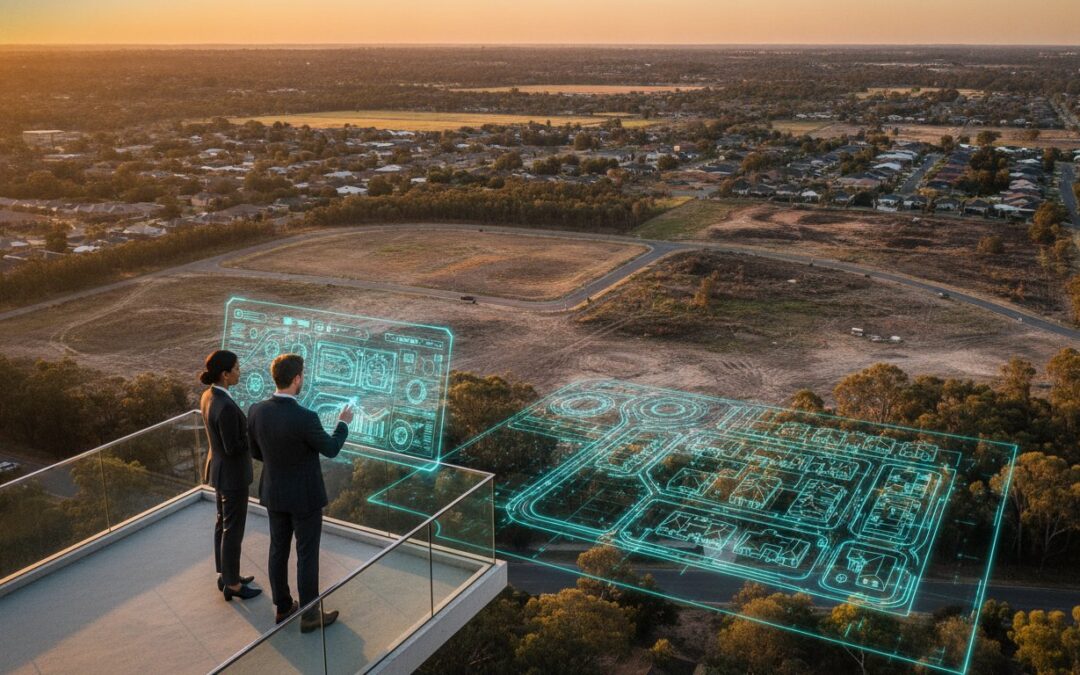
What if the primary barrier to increasing Australia’s housing supply isn’t land availability, but the capacity of the local road network? Many developers find their Planning Proposals stalled because local authorities fear that new residential or commercial density will trigger unmanageable traffic congestion. Integrating specialized traffic engineering for land rezoning applications early in the process is the only way to address these concerns with technical certainty. With state governments setting ambitious new housing targets across AU, the pressure to densify is high, but so is the regulatory scrutiny on existing infrastructure limits.
You likely understand the frustration of complex negotiations with state road authorities who demand absolute proof of transport feasibility before a site is even considered for rezoning. This guide provides a clear roadmap to navigate those requirements. We’ll show you how to use rigorous data and sophisticated modeling to prove your project fits within the existing network. You’ll learn how a precise Traffic Impact Assessment and parking demand analysis can minimize the risk of costly rejections. By the end of this article, you’ll have the strategic knowledge needed to secure successful rezoning through expert technical evidence.
Key Takeaways
- Understand why transport capacity is the primary constraint for land use changes and how to prove infrastructure feasibility to authorities.
- Learn how specialized traffic engineering for land rezoning applications ensures compliance with Australian Standards AS 2890.1 and AS 2890.2.
- Identify the essential technical reports, such as Traffic Impact Assessments and SIDRA modeling, required for planning proposal approvals.
- Follow a structured four-step methodology to identify network constraints early and avoid costly late-stage redesigns.
- Reduce the risk of “Request for Information” (RFI) delays by involving senior experts in negotiations with state road authorities.
The Strategic Role of Traffic Engineering in Land Rezoning
Land rezoning, often referred to as a Planning Proposal, is the foundational step in the land development lifecycle. It establishes the legal framework for what can be built on a specific site. Increasing density or changing land use from industrial to residential is not just a planning exercise. It’s an infrastructure challenge. Traffic engineering serves as the critical bridge between a developer’s vision and the reality of the existing road network. Without proven transport feasibility, authorities will reject a proposal regardless of its architectural merit.
Transport capacity is frequently the primary constraint for land use changes. Authorities prioritize the preservation of the existing network’s performance over new development. This requires a shift from site-specific design to a broader strategic assessment. Professional traffic engineering for land rezoning applications identifies these bottlenecks before they become project-ending obstacles. By quantifying the impact on regional intersections and public transport corridors, developers can prove that their proposed changes are sustainable.
To better understand how land use and property zoning work together, watch this helpful video:
Rezoning vs. Development Applications (DA)
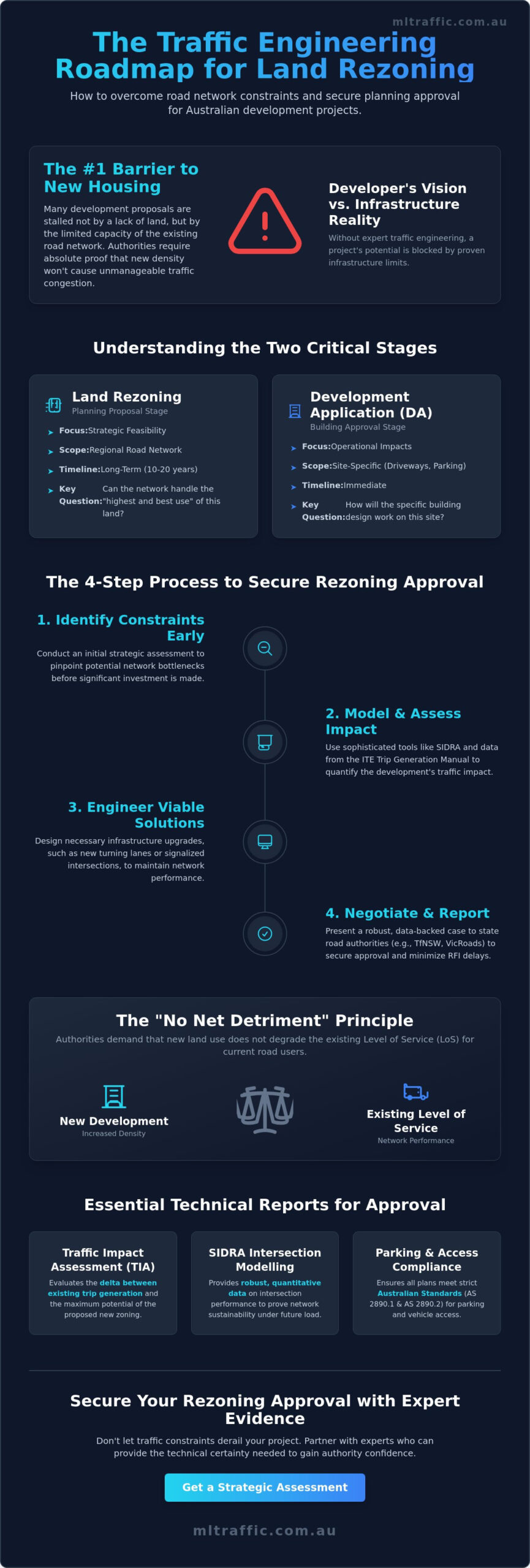
There is a distinct difference between rezoning and a Development Application (DA). A DA focuses on operational impacts, such as specific driveway locations and internal car park layouts. Rezoning focuses on strategic feasibility. It asks whether the regional road network can handle the “highest and best use” of the land over the next 10 to 20 years. Strategic traffic assessments analyze long-term network planning rather than just immediate intersection performance. This ensures that the proposed rezoning aligns with future government infrastructure projects and population growth targets.
The “No Net Detriment” Principle
Authorities typically operate under the “no net detriment” principle. This means new land use shouldn’t degrade the existing level of service (LoS) for current road users. Proving this requires meticulous data collection and modeling. Key considerations include:
- Identifying required infrastructure upgrades, such as new turning lanes or signalized intersections, well before the DA stage.
- Determining the capacity for increased density through robust Intersection Analysis.
- Balancing private vehicle trips with sustainable transport options like pedestrian links and cycling networks.
Addressing these factors early prevents the “infrastructure bottleneck” rejection that stalls many projects. It provides a clear data-backed argument that the development is a benefit to the community rather than a burden on public resources. This technical assurance is what secures the confidence of council planners and state road authorities.
Essential Traffic Reports for Rezoning Applications
Securing approval for a land use change in Australia requires more than a conceptual site plan. Authorities demand data-backed proof that the local infrastructure can absorb the resulting increase in vehicle movements. This is where specialized traffic engineering for land rezoning applications becomes indispensable. Technical documentation must address both the immediate site access and the broader long-term network stresses. Without these specific reports, a proposal is likely to face significant delays or outright rejection from planning authorities like Transport for NSW (TfNSW) or VicRoads.
Traffic Impact Assessment (TIA) for Strategic Use
A strategic TIA differs significantly from a standard development application report. It evaluates the delta between existing trip generation and the maximum potential of the proposed new zoning. We utilize the 12th Edition of the ITE Trip Generation Manual, released in August 2025, to ensure all forecasts reflect current post-pandemic travel behaviors. This report must also account for the cumulative impacts of nearby future developments. It’s not just about your site; it’s about how your project interacts with all other planned growth in the precinct. Reviewing a comprehensive Traffic Impact Assessment guide helps developers understand the specific data sets required. Many jurisdictions follow rigorous state-based guidelines that mandate detailed mitigation plans if the development causes a drop in the established level of service.
Intersection and Network Modeling
Intersection Analysis is the technical core of rezoning work. We use SIDRA modeling to simulate how local junctions will perform under peak loads 10 to 20 years into the future. This modeling identifies the “tipping point” where the existing road geometry fails to meet safety or capacity standards. If a proposal pushes an intersection toward a failing Level of Service, we identify the necessary infrastructure upgrades. These might include new signal phases, roundabouts, or dedicated turning lanes. Proposing these solutions during the rezoning phase demonstrates that the project is feasible and that the developer has accounted for necessary infrastructure contributions.
Parking Demand Assessments are also critical, particularly for non-standard land uses where statutory rates don’t accurately reflect actual needs. We provide empirical evidence to justify parking variations, especially for sites with high public transport accessibility. This multimodal review includes pedestrian and cycling connectivity, ensuring the proposal aligns with modern active transport requirements. If you need a technical review of your site’s capacity, the experts at ML Traffic Engineers Australia offer a full range of traffic engineering services to identify which reports are required for your specific application.
Navigating Authority Requirements and Compliance
Coordination between Local Councils and State Road Authorities is a primary hurdle in the rezoning process. While the Council manages local zoning, state agencies oversee the arterial roads that support the broader network. Successful traffic engineering for land rezoning applications requires bridging the gap between these two entities. Each authority has distinct performance criteria and safety standards that must be reconciled early in the planning proposal phase. Meticulous traffic engineering for land rezoning applications ensures that these diverse requirements are met through a single, cohesive technical strategy. Failure to align these expectations leads to conflicting requirements that can stall a project for years.
Infrastructure planning is no longer just about car throughput. Modern standards emphasize a multimodal approach. Integrating ITE’s Multimodal Transportation Impact Analysis Recommended Practice ensures that pedestrian, cycling, and public transport accessibility are given equal weight to vehicle capacity. This comprehensive view is essential for meeting the sustainability targets set by regional planning authorities. Authorities often evaluate rezoning through several lenses:
- Consistency with the Regional Transport Plan and future growth corridors.
- Compliance with state-specific Traffic Impact Assessment guidelines.
- The adequacy of proposed public transport and active transport infrastructure.
- Financial commitments through Voluntary Planning Agreements (VPAs) or infrastructure contributions.
Australian Standards and Design Compliance
Technical compliance with national standards is non-negotiable. We ensure all proposed access points and internal layouts adhere to AS 2890.1 for off-street car parking safety. This prevents fundamental design errors that could lead to rezoning rejection. For industrial or mixed-use rezonings, we prioritize AS 2890.2 to future-proof loading areas for heavy vehicles. Early integration of Vehicle Swept Path Analysis provides visual proof that the site can accommodate the intended vehicle types without compromising the safety of the public road network.
State Road Authority Consultation
Navigating the referral process for state-controlled roads is a complex task. State authorities often demand more rigorous modeling than local councils, focusing on regional network integrity. This often involves negotiating VPAs to fund necessary road works or intersection upgrades. The Traffic Engineer acts as a vital liaison during these high-stakes discussions. Our senior principals handle these negotiations directly, ensuring technical arguments are presented clearly to agency decision-makers. This direct access to leadership minimizes the risk of bureaucratic delays and ensures that infrastructure contributions remain proportionate to the development’s impact.
The 4-Step Traffic Engineering Process for Rezoning
Successful rezoning outcomes are the result of a methodical technical workflow. We don’t guess at infrastructure capacity. We prove it through a rigorous four-stage sequence. This structured approach to traffic engineering for land rezoning applications ensures that every technical vulnerability is identified and mitigated before the proposal reaches the public exhibition stage. By following a standardized process, we provide the technical certainty that authorities require to approve land use changes.
Scoping and Data Baseline
The process begins with initial scoping. We conduct physical site visits to identify immediate transport opportunities and constraints. This includes analyzing existing sight distances and current access point geometry. We establish a data baseline by collecting fresh traffic counts and analyzing historical network performance. Identifying the specific peak hour challenges for the local area is critical. This baseline serves as the yardstick for measuring all future growth. We look at existing queue lengths, saturation levels, and public transport frequency. Without accurate starting data, any subsequent modeling is flawed and likely to be challenged by council engineers during the assessment phase.
Scenario Testing and Mitigation
Once the baseline is established, we move to impact modeling. This stage involves testing “Base Case” scenarios against “Proposed Case” scenarios. We use sophisticated software to simulate how the network performs with the added density. This is often an iterative design process. If the traffic results indicate a failure in level of service, we work with the project team to adjust density or propose specific infrastructure upgrades. This data-driven feedback loop is essential for drafting the transport section of the Statement of Environmental Effects (SEE). We focus on providing practical mitigation measures that are both technically sound and commercially viable for the developer.
The final stage is reporting and liaison. We compile all findings into a comprehensive Traffic Impact Assessment (TIA) Report. Our senior principals remain directly involved during this phase to address authority feedback and negotiate technical requirements. This hands-on approach ensures that the person who performed the technical work is the one defending the results to the authorities. It eliminates the risk of communication gaps that often occur in larger firms. This continuity is a core part of our traffic engineering for land rezoning applications, ensuring accountability from the initial count to the final approval. If you’re preparing a planning proposal, contact our senior traffic engineers to discuss your project’s specific requirements.
Why Expert Traffic Engineering Secures Rezoning Approval
Expert traffic engineering for land rezoning applications is the difference between a project that proceeds and one that stalls in bureaucratic gridlock. It’s not just about technical precision; it’s about the ability to defend that data in high-stakes negotiations with government agencies. Authorities don’t just look for data. They look for technical assurance that the infrastructure can support the proposed land use change without compromising safety or efficiency. Securing this confidence requires a combination of meticulous modeling and seasoned consultancy experience that understands the specific requirements of Australian planning systems.
Direct Access to Senior Principals
In many large firms, junior staff perform the SIDRA modeling and data analysis while senior partners only appear for the initial pitch. ML Traffic Engineers Australia operates differently. The expert who initiates the project is the one performing the technical work. This personnel continuity promise ensures that when council engineers ask technical questions, the response comes from the person who actually built the model. Accountability is direct. There are no gatekeepers between you and the senior leadership of ML Traffic Engineers Australia. This “no-gatekeepers” approach allows for faster decision-making and more effective negotiations during complex planning proposal meetings.
Having a senior engineer lead these discussions is critical when navigating the referral process for state-controlled roads. We understand the specific technical thresholds that trigger a “Request for Information” (RFI) and address them in the initial submission. This proactive strategy reduces the risk of costly delays that can set a project back by several months. Our focus is entirely on conveying expertise and competence through a no-nonsense, fact-based approach that builds trust with regulatory bodies. We provide a direct line to our experts to ensure your project remains on schedule.
Comprehensive Expertise Across All Land Uses
Rezoning often involves complex mixed-use environments that require a deep understanding of diverse traffic behaviors. The team at ML Traffic Engineers Australia brings over 15 years of professional consultancy experience across residential, commercial, industrial, and specialized land-use categories. We use advanced software like AutoTURN to perform precise Swept Path Analysis. This provides visual proof that even the most constrained sites can accommodate heavy vehicles or emergency services without compromising the integrity of the public road network.
Our results-oriented methodology ensures that every technical report, from a Car Parking Demand Assessment to an Intersection Analysis, adheres to national regulatory standards. We don’t just provide reports; we provide a clear roadmap for rezoning approval. If you’re ready to prove the transport feasibility of your project, Contact ML Traffic Engineers Australia for a strategic fee proposal. Our senior principals are ready to provide the dependable, meticulous expertise required to secure your land use change.
Secure Your Rezoning with Technical Certainty
Successful land use changes require more than just architectural vision. They demand rigorous technical evidence that the existing road network can support increased density. By implementing a structured four-step process and adhering to Australian Standards, developers can proactively address infrastructure constraints before they lead to project-ending rejections. Expert traffic engineering for land rezoning applications provides the data-backed assurance that local councils and state road authorities require to grant approval.
ML Traffic brings over 15 years of Australian consultancy experience to every project. We provide direct access to senior principals who manage your technical work and lead negotiations with authorities. Our mastery of industry-standard tools like SIDRA and AutoTURN ensures your application is built on a foundation of precision and compliance. Don’t risk costly delays or “Request for Information” (RFI) setbacks by relying on junior staff or incomplete data.
Request a Traffic Engineering Proposal for Your Rezoning Project to ensure your planning proposal meets every regulatory requirement. We look forward to helping you achieve a successful rezoning outcome.
Frequently Asked Questions
Why do I need a traffic engineer for a rezoning application?
A traffic engineer is required to prove that the proposed land use change is sustainable within the existing and future transport network. Authorities won’t approve a Planning Proposal without a data-backed assessment showing that the infrastructure can accommodate the increased trip generation. We provide the technical certainty needed to mitigate concerns regarding road safety and network capacity through professional analysis.
What is the difference between a Traffic Impact Assessment and a Transport Plan?
A Traffic Impact Assessment (TIA) focuses on the specific vehicle movements and infrastructure capacity related to a site’s development. A Transport Plan is broader, often addressing multimodal integration, public transport accessibility, and long-term regional connectivity. For land rezoning, the TIA serves as the technical proof of feasibility, while the Transport Plan aligns the project with regional planning objectives.
Will the council reject my rezoning if the local roads are already congested?
Congestion doesn’t guarantee rejection, but it necessitates a more rigorous infrastructure mitigation strategy. We identify specific upgrades, such as intersection signalization or additional turning lanes, to ensure the project meets the “no net detriment” principle. Proving that the development can contribute to broader network improvements often turns a potential rejection into a conditional approval supported by technical data.
How long does it take to prepare a traffic report for rezoning?
Preparation typically takes between three to six weeks depending on the complexity of the required data collection and modeling. This timeline includes conducting site visits, performing peak-hour traffic counts, and executing SIDRA intersection analysis. Complex projects involving state road authority referrals may require additional time for preliminary consultations to ensure the report meets all regulatory expectations from the outset.
Do I need a SIDRA analysis for a small rezoning project?
Most authorities require SIDRA analysis regardless of project size if the rezoning impacts a key intersection. Even small-scale traffic engineering for land rezoning applications must demonstrate that the cumulative impact of the change won’t push a junction beyond its capacity. We use SIDRA to provide the granular data that council engineers use to verify your project’s feasibility during their assessment.
Can a traffic engineer help negotiate with state road authorities?
Expert traffic engineers act as the primary technical liaison between developers and state road authorities during the referral process. We present the data-driven arguments needed to negotiate Voluntary Planning Agreements (VPAs) and infrastructure contributions. Having a senior principal lead these discussions ensures that technical requirements remain proportionate to the development’s actual impact, reducing the risk of unreasonable or excessive agency demands.
What happens if my rezoning requires road upgrades?
If upgrades are required, they are typically formalized through a Voluntary Planning Agreement or a condition of the rezoning approval. We identify the most cost-effective engineering solutions, such as roundabout modifications or lane reconfigurations, to satisfy authority requirements. Identifying these costs early in the planning process allows for accurate project budgeting and prevents unexpected financial burdens during the later development stages.
Does the same traffic report work for the DA phase later on?
The strategic report used for rezoning provides the foundation, but a more detailed operational TIA is usually required for the Development Application (DA). While the rezoning report proves network capacity, the DA-level report focuses on site-specific details like driveway grades, swept paths, and internal car park design. However, the data collected during the traffic engineering for land rezoning applications phase significantly streamlines the subsequent DA reporting process.

Disclaimer
The content on www.mltraffic.com.au, including all technical articles, guides, and resources, is provided for general informational and educational purposes only. It is not intended to constitute professional advice in traffic engineering, transportation planning, development approvals, or any other technical or legal field.
While ML Traffic Engineers makes every reasonable effort to ensure the accuracy, completeness, and timeliness of the information published, we do not provide any warranties or representations (express or implied) regarding its reliability, suitability, or availability for any particular purpose. Any reliance you place on the content is strictly at your own risk.
In no event shall ML Traffic Engineers, its directors, employees, authors, or affiliates be liable for any direct, indirect, incidental, special, consequential, or punitive damages (including, without limitation, loss of profits, data, or business opportunities) arising out of or in connection with the use of, or inability to use, any information provided on this website.
The articles and guides on this site are not a substitute for engaging a qualified, registered professional traffic engineer (such as an NPER or RPEQ engineer) to assess your specific project requirements. For tailored advice, compliance assessments, or traffic engineering services, please contact a competent professional.
This disclaimer may be updated from time to time without notice. By accessing or using this website, you agree to be bound by the most current version of this disclaimer.
