
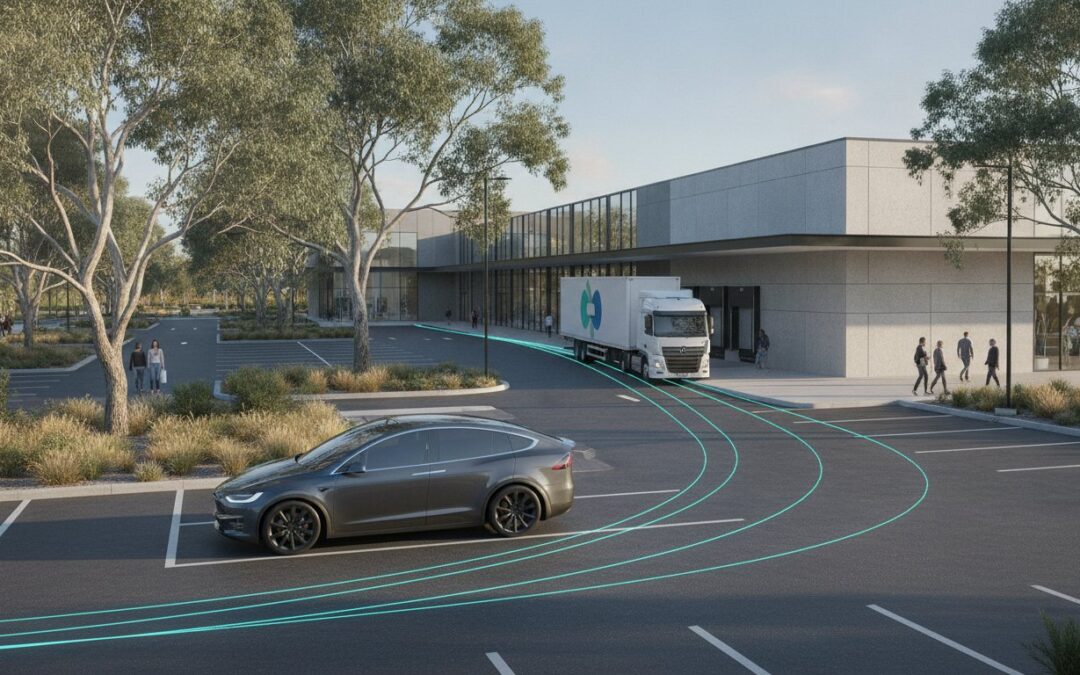
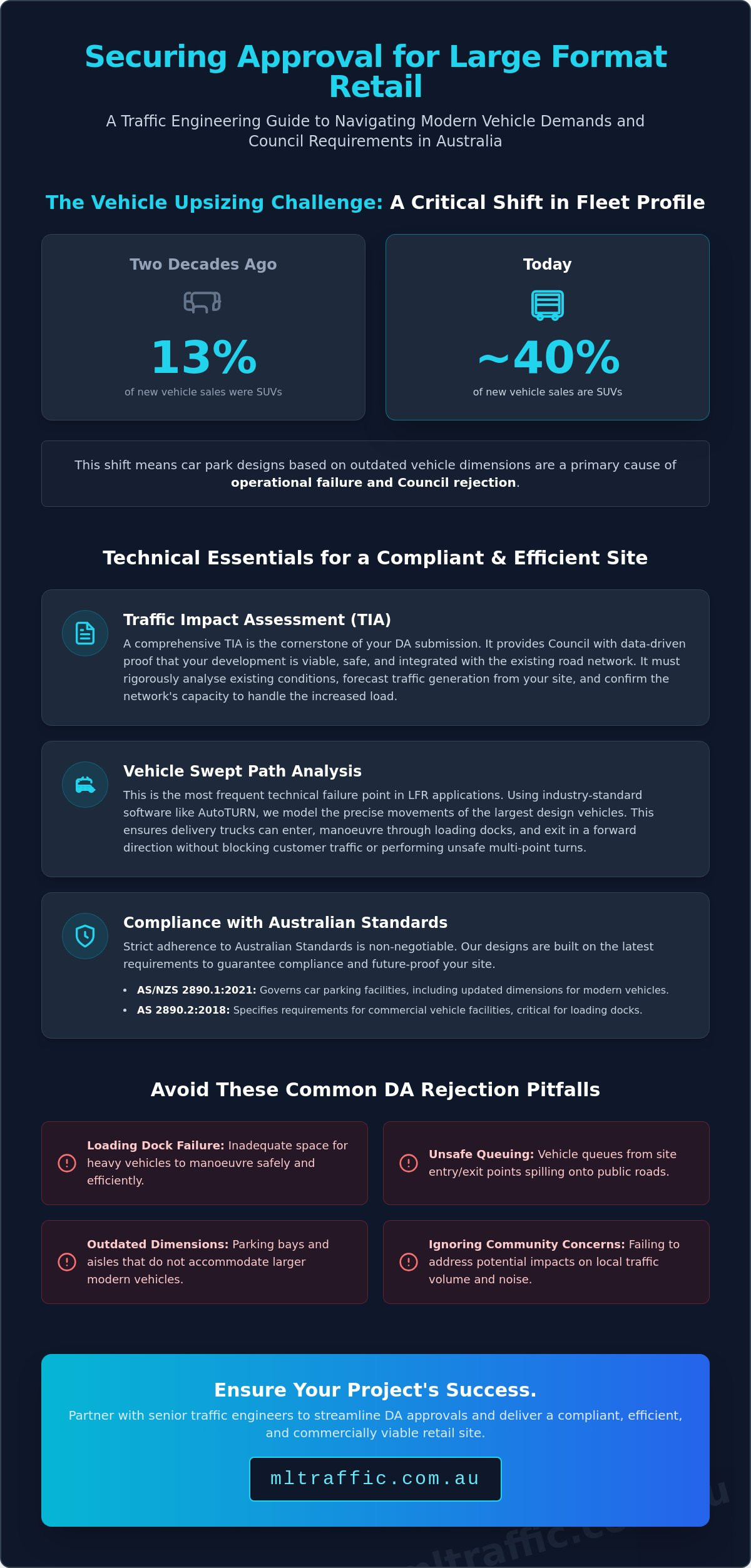
SUVs now account for approximately 40% of all new vehicle sales in Australia, a massive leap from just 13% two decades ago. This shift in the national fleet makes specialised traffic engineering for large format retail more critical than ever. If your site design relies on outdated dimensions or fails to account for these larger vehicle profiles, you risk immediate rejection from Council. Securing a compliant, efficient site layout requires a rigorous application of the latest standards, including AS/NZS 2890.1:2021 for car parking and AS 2890.2:2018 for commercial vehicle facilities.
You likely recognise that a single bottleneck at the loading dock or a non-compliant driveway ramp can stall a multi-million dollar development for months. We will show you how expert traffic engineering ensures your large format retail project meets every regulatory requirement while streamlining the DA approval process. This guide covers the impact of vehicle upsizing on car park design, the necessity of precise vehicle swept path analysis, and how direct communication with a senior engineer eliminates operational friction before the first stone is turned.
Key Takeaways
- Understand why large format retail sites require distinct traffic profiles and how a comprehensive Traffic Impact Assessment (TIA) addresses these specific operational demands.
- Learn how specialised traffic engineering for large format retail ensures strict adherence to AS 2890.1 and AS 2890.2, specifically regarding adjusted bay widths for larger modern vehicles.
- Discover the importance of utilising AutoTURN for vehicle swept path analysis to prevent operational friction at loading docks and customer entry points.
- Identify common pitfalls that lead to Council rejection and how to proactively navigate community concerns regarding noise and traffic volume.
- Recognise the value of direct access to senior engineers who manage your project from initial consultation through to technical completion to ensure accountability.
The Critical Role of Traffic Engineering for Large Format Retail (LFR)
Large Format Retail (LFR) represents a unique land-use category in Australian transport planning. Unlike traditional shopping centres that rely on high pedestrian density and public transport hubs, LFR developments are defined by high vehicle-to-floor-area ratios and a reliance on private vehicle access. Traffic engineering for these sites must account for the 21.6 million square metres of floor space this sector occupies across the nation. From a transport perspective, LFR is characterised by low-frequency, high-value trips where customers often require direct vehicle access for the collection of bulky goods.
Poorly designed car parks and site access points directly impact customer retention and commercial viability. If a driver encounters significant queuing on a public road or finds internal aisles too narrow for a modern SUV, they’re unlikely to return. Effective traffic engineering for large format retail balances these high-volume passenger vehicle flows with the heavy vehicle logistics required for constant stock replenishment. This dual-purpose infrastructure must remain functional during peak weekend surges without compromising site safety or regulatory compliance.
To better understand the technical foundations of this discipline, watch this instructional video:
Unique Traffic Generation in LFR Environments
LFR sites generate distinct traffic profiles that differ significantly from residential or mixed-use developments. While a standard retail centre might see steady weekday foot traffic, LFR precincts often experience extreme weekend surges and peak hour turnover. Accurate trip generation data is vital for Council submissions to prove the local road network can handle these concentrated volumes. Our traffic engineering services utilise specific data sets to analyse these patterns, ensuring your site design reflects actual consumer behaviour rather than generic estimates. With SUVs now making up 40% of new vehicle sales, the demand for wider aisles and larger parking bays is no longer optional; it’s a technical requirement for site efficiency.
Operational Efficiency and Site Safety
Safety in a large-scale retail car park depends on minimising pedestrian-vehicle conflict points. This is achieved through strategic placement of trolley bays, clear line marking, and dedicated pedestrian crossings that don’t impede vehicle flow. We focus on ensuring smooth entry and exit points to prevent dangerous queuing on public roads, a common reason for DA rejection. The primary goal of LFR traffic engineering is the seamless integration of customer access and freight logistics.
Technical Essentials: TIA and Swept Path Analysis for Retail Sites
Traffic engineering for large format retail requires a data-driven approach to justify site access and parking provisions. A Traffic Impact Assessment (TIA) Report is the primary technical document reviewed by Council. It must detail existing road conditions, proposed traffic generation, and the capacity of the surrounding network to absorb the new load. We rely on established frameworks such as Queensland’s Guide to Traffic Impact Assessment to ensure our reports meet the rigorous expectations of statutory authorities. Without this level of technical detail, projects often face significant delays during the DA determination phase.
Loading dock access is the most frequent failure point in LFR Development Applications. If a heavy vehicle cannot enter, manoeuvre, and exit the site in a forward direction without multiple-point turns that block customer traffic, Council will likely reject the proposal. Utilising AutoTURN software allows us to perform precise simulations of vehicle movements. This software identifies potential pinch points in the design before construction begins. Integrating intersection analysis into the TIA further supports site access points by proving that turn treatments and signal timings can accommodate both passenger cars and freight logistics.
Vehicle Swept Path Assessment for Heavy Goods Vehicles
Designing for Articulated Vehicles (AV) and B-doubles is a mandatory requirement for most LFR developments. These sites rely on heavy vehicle deliveries that demand specific turning radii and vertical clearances. Compliance with AS 2890.2 for commercial vehicle facilities is non-negotiable. A detailed swept path analysis verifies that delivery vehicles won’t mount kerbs or strike structural columns. If your site plan hasn’t been vetted for these heavy vehicle requirements, reviewing our specialised assessment services early in the design phase can prevent costly structural redesigns later.
Traffic Impact Statements vs. Full Assessments
Not every retail project requires a full TIA. For minor retail modifications or small-scale tenancies, a simpler Traffic Impact Statement may suffice. The distinction depends on the scale of the development and the anticipated increase in trip generation. Key data points include comparing the existing road capacity against the proposed development load. For deeper technical context on how these simulations are conducted, refer to our Swept Path Analysis guide. Whether a statement or a full assessment is required, the data must be defensible and based on current Australian traffic volumes.
Compliance with Australian Standards: AS 2890.1 and AS 2890.2
Adherence to national regulatory frameworks is the foundation of any successful development application. AS 2890 compliance is a non-negotiable prerequisite for DA approval in every Australian jurisdiction. For developers, this means site plans must strictly follow the dimensions and geometries specified in the AS 2890 series to ensure safety and functionality. In the context of traffic engineering for large format retail, these standards dictate everything from the curvature of a driveway to the specific width of a parking bay. Failure to meet these technical benchmarks often results in immediate requests for information (RFIs) or outright refusal from local government authorities.
The mandatory requirements for off-street car parking under AS 2890.1 were updated in 2021 to better reflect the modern Australian vehicle fleet. LFR sites require specific design parameters such as wider bay widths and increased aisle clearances to accommodate larger SUVs and 4WDs. We also incorporate dedicated trolley bays into the initial Car Park Design to prevent customers from leaving trolleys in trafficable areas. These elements must be integrated seamlessly to maintain flow while maximising the available gross floor area.
Commercial vehicle access is governed by AS 2890.2. This standard specifies the design requirements for loading areas and service vehicle docks. For LFR developments, this typically involves designing for Heavy Rigid Vehicles (HRV) or Articulated Vehicles (AV). We ensure that all loading areas allow these vehicles to enter and exit the site in a forward direction. We also conduct a Driveway Ramp Grade Assessment to ensure that transitions between different levels do not cause vehicle scraping or bottoming out, which is a common technical oversight in complex retail sites.
Car Park Design and Demand Assessment
Determining the optimal number of parking spaces is a critical commercial decision. We perform a Car Parking Demand Assessment to avoid the costs of over-supply while ensuring the site doesn’t suffer from under-supply during peak periods. Our designs include mandated accessible parking spaces and clear pedestrian paths of travel that comply with AS 2890.6:2022. We provide full certification of car park designs to meet Council requirements and ensure your project remains compliant from the first draft.
Driveway and Access Point Certification
Safety at the site boundary is paramount. We conduct a Sight Distance Assessment to verify that motorists exiting the site have a clear view of oncoming traffic and pedestrians. This involves technical measurements of SISD (Stopping Intersight Distance) and ASD (Approach Sight Distance). Compliance with driveway grade standards ensures that all vehicle types, from low-clearance passenger cars to heavy freight trucks, can navigate access points without incident.
Navigating the DA Approval Process for Retail Developments
Securing a Development Application (DA) for a large format retail site is rarely a straightforward process. Local Councils frequently scrutinise traffic reports for inconsistencies in trip generation data or inadequate parking supply. Traffic engineering for large format retail must proactively address these concerns before they become grounds for rejection. Common failure points include insufficient sight distances at egress points or loading dock designs that force heavy vehicles to reverse onto public roads. These technical errors can stall a project for months, increasing holding costs and delaying commercial returns.
Community objections regarding increased traffic volume and noise are standard hurdles for LFR projects. We mitigate these through robust data modelling and clear technical communication. When a Council issues a Request for Information (RFI), the traffic engineer must provide a precise response that satisfies planning officers without compromising the commercial viability of the site. This requires close coordination with town planners and architects to ensure the traffic strategy aligns with the broader site layout and building footprint. Defending the technical integrity of the TIA during this phase is essential for maintaining project momentum.
Strategic Traffic Management Plans (TMP)
A successful DA often requires a comprehensive Traffic Management Plan for the construction phase. This document details how pedestrian safety will be managed while site works are underway. For existing centres undergoing expansion, the TMP ensures minimal disruption to current retail operations and customer access. Managing the interaction between construction machinery and the public is a high-priority safety requirement for every Australian jurisdiction.
Expert Witness and Representation
Technical findings often require defense at Council meetings or regional planning panels. We provide professional representation, using data-driven evidence to support our TIA findings. This often involves preparing a Statement of Environmental Effects (SEE) that specifically addresses traffic and parking impacts. Having a senior expert present technical arguments ensures that bureaucrats and community members receive factual, standard-compliant information. If you are currently preparing a submission or have received an RFI, you can contact our senior engineers to discuss your site strategy and technical requirements.
ML Traffic Engineers Australia: Senior Engineering Expertise for Your Retail Project
ML Traffic Engineers Australia provides specialised technical consultancy for complex retail developments across the country. Our expertise in traffic engineering for large format retail is backed by over 15 years of industry experience in transport planning and infrastructure design. We operate with a core philosophy of direct accountability. This means every client has direct access to senior principals throughout the project lifecycle. We don’t utilise gatekeepers or administrative layers that distance you from the technical experts managing your Development Application.
Our firm maintains a national capability with a specific focus on compliant, efficient retail design. We understand the high stakes involved in LFR projects, where technical errors in a traffic engineering report can lead to costly delays. A recurring signature of our service is the personnel continuity promise; the senior engineer who initiates your project is the same expert who performs the technical modelling and signs off on the final report. This hands-on approach distinguishes our consultancy from larger, more impersonal firms.
Why Senior-Level Oversight Matters
Many large engineering firms fall into the “junior engineer trap” where senior staff secure the contract but delegate the actual technical work to inexperienced graduates. This often leads to oversights in complex Vehicle Swept Path Analysis or TIA reports that fail to withstand Council scrutiny. At ML Traffic Engineers Australia, we ensure meticulous attention to detail by keeping senior leadership involved in every calculation. This direct involvement guarantees project timelines are met and technical accuracy is maintained, providing you with a defensible submission for planning panels.
Get Started with ML Traffic Engineers Australia
Requesting a fee proposal for your LFR development is a straightforward process. To begin your site assessment, our team typically requires a current site plan, details on the proposed retail yield, and any preliminary Council feedback. We use this information to scope the required assessments, from car parking demand to intersection analysis. Contact our senior team today via our contact page to discuss your project requirements and secure the technical expertise necessary for DA success.
Secure Your Retail Development Approval with Expert Engineering
Successful retail developments hinge on technical precision and a proactive approach to regulatory compliance. We have explored how adhering to the latest Australian Standards and utilising advanced modelling tools can eliminate the operational bottlenecks that often lead to project delays. Professional traffic engineering for large format retail is the most effective way to protect your commercial investment and ensure long-term site functionality without compromising on customer access or freight logistics.
ML Traffic Engineers Australia provides national coverage across all Australian States with over 15 years of specialist experience in transport planning. We guarantee Senior Principal involvement in every report to maintain direct accountability and technical integrity. Our personnel continuity promise ensures the same expert manages your project from the initial consultation through to final certification. You can Request a Traffic Engineering Quote for Your Retail Project to secure a compliant, efficient site strategy. We look forward to helping you achieve a streamlined DA approval process.
Frequently Asked Questions
When do I need a Traffic Impact Assessment for a retail development?
A Traffic Impact Assessment (TIA) Report is required for any new retail development or major alteration that significantly increases trip generation or alters site access. Local Councils typically mandate a TIA when the gross floor area exceeds specific thresholds defined in their planning schemes. If your project impacts the safety or capacity of the surrounding road network, a formal assessment is a mandatory component of your Development Application.
How much parking does a large format retail store actually require?
Parking requirements are determined by local planning codes and a site-specific Car Parking Demand Assessment. While generic rates exist, large format retail often requires a custom approach due to the bulky nature of goods and the high percentage of customers arriving in large SUVs. We use empirical data to justify parking provisions that avoid both under-supply and the unnecessary costs of over-supply.
What is the difference between AS 2890.1 and AS 2890.2?
AS 2890.1 governs off-street parking facilities for light vehicles, focusing on customer car park dimensions and aisle clearances. AS 2890.2 specifies the requirements for commercial vehicle facilities, including loading docks and service areas. For any project involving traffic engineering for large format retail, compliance with both standards is essential to ensure customer safety and freight efficiency.
Can you help if Council has already rejected my initial traffic report?
Yes, we frequently assist developers after a Council rejection or a complex Request for Information (RFI). Our senior engineers review the existing report to identify technical gaps, such as non-compliant swept paths or inaccurate trip generation data. We then provide a senior-led, defensible response that addresses Council’s specific concerns to move the DA toward approval.
How long does it take to prepare a Swept Path Analysis for a loading dock?
A standard Vehicle Swept Path Analysis for a retail loading dock typically takes 3 to 5 business days once we receive your current site plans. Complex sites that require simulations for multiple vehicle types, such as B-doubles and Heavy Rigid Vehicles, may require additional time. This assessment is critical for verifying that delivery vehicles can enter and exit the site in a forward direction.
Do you provide traffic engineering services for retail sites across all of Australia?
Yes, we provide traffic engineering for large format retail across every Australian state and territory. Our senior principals have a deep understanding of the varying planning requirements and transport guidelines used by different local government authorities nationwide. This national capability ensures your retail design remains compliant regardless of the project location.
What software do you use for vehicle turning path assessments?
We utilise AutoTURN software for all vehicle turning path assessments and manoeuvrability testing. This industry-standard tool allows our senior engineers to create precise simulations of vehicle movements based on Australian Standard design vehicles. Using AutoTURN ensures that your site layout can safely accommodate the specific trucks and passenger vehicles expected to use the facility.
Is a Traffic Management Plan required during the construction of a retail site?
A Traffic Management Plan (TMP) or Traffic Guidance Scheme (TGS) is almost always a condition of consent for the construction phase of a retail development. These documents are necessary to manage the interaction between construction traffic and the public. They are especially vital for site expansions where existing retail operations must continue safely while construction work is performed.

Disclaimer
The content on www.mltraffic.com.au, including all technical articles, guides, and resources, is provided for general informational and educational purposes only. It is not intended to constitute professional advice in traffic engineering, transportation planning, development approvals, or any other technical or legal field. While ML Traffic Engineers makes every reasonable effort to ensure the accuracy, completeness, and timeliness of the information published, we do not provide any warranties or representations (express or implied) regarding its reliability, suitability, or availability for any particular purpose. Any reliance you place on the content is strictly at your own risk. In no event shall ML Traffic Engineers, its directors, employees, authors, or affiliates be liable for any direct, indirect, incidental, special, consequential, or punitive damages (including, without limitation, loss of profits, data, or business opportunities) arising out of or in connection with the use of, or inability to use, any information provided on this website. The articles and guides on this site are not a substitute for engaging a qualified, registered professional traffic engineer (such as an NPER or RPEQ engineer) to assess your specific project requirements. For tailored advice, compliance assessments, or traffic engineering services, please contact a competent professional. This disclaimer may be updated from time to time without notice. By accessing or using this website, you agree to be bound by the most current version of this disclaimer.
