
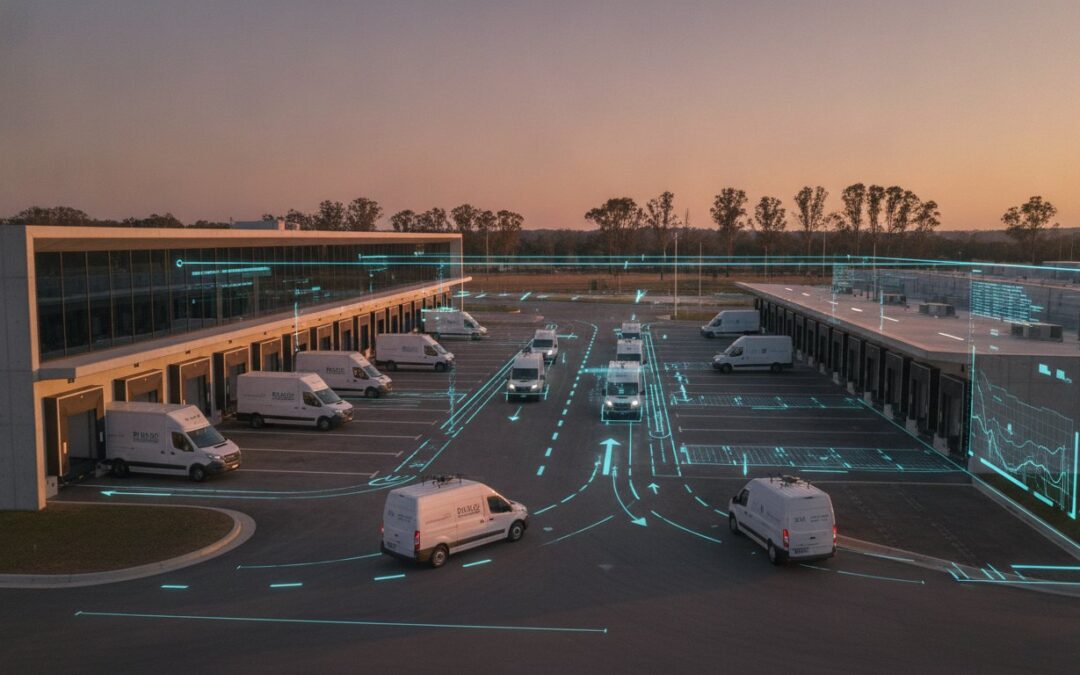
With the Australian last-mile delivery market projected to reach AUD 8.99 billion by 2035, your proposed facility isn’t just a warehouse. It’s a high-frequency traffic machine that councils often view with extreme skepticism. Securing a Development Application (DA) approval requires more than a simple site plan. It demands specialized traffic engineering for last-mile delivery hubs to prove that your high-turnover operations won’t paralyze local road networks or violate safety protocols.
It’s a common frustration for developers to face council rejection due to perceived traffic impacts or to discover that a loading dock layout fails to meet the strict requirements of Australian Standards. These technical oversights don’t just delay your project; they create long-term operational inefficiencies that eat into your margins. You need a design that works on paper and in practice while strictly adhering to AS 2890.2:2018.
This guide provides the technical roadmap you need to navigate these complexities, from mastering compliance to optimizing vehicle turnaround times. We’ll examine how to leverage precise logistics assessments, Vehicle Swept Path Analysis, and Traffic Impact Assessment (TIA) reports to satisfy regulatory bodies. Learn how to secure your approval and ensure your facility operates at peak efficiency from the moment the first van arrives.
Key Takeaways
- Distinguish high-frequency turnover from traditional warehousing to address council skepticism regarding traffic intensity.
- Ensure strict adherence to AS 2890.2:2018 using specialized traffic engineering for last-mile delivery hubs to secure DA approval.
- Utilize Vehicle Swept Path Analysis to confirm heavy vehicle access and optimize loading dock efficiency for high-volume sites.
- Apply site-specific logistics assessments to forecast trip generation more accurately than standard RMS/RTA guide rates.
- Implement Operational Traffic Management Plans (OTMP) to flatten peak traffic profiles and minimize the risk of RFI delays.
The Evolution of Last-Mile Delivery Hubs in Australian Planning
The traditional Australian warehouse model focused on long-term storage and infrequent heavy vehicle movements. Modern logistics has shifted this paradigm. Developers now prioritize high-frequency turnover facilities that facilitate Last-mile delivery. These hubs act as sorting engines rather than storage containers. This evolution presents unique challenges for urban planning and infrastructure capacity. The shift from heavy rigid vehicles to high-volume light commercial van fleets has fundamentally changed the spatial requirements of industrial sites.
Councils now view these developments with increased skepticism. The primary concern lies in the intensity of traffic. A traditional warehouse might generate a handful of semi-trailer movements daily. A last-mile hub generates hundreds of light commercial vehicle trips. This volume places immense pressure on local intersections and residential interfaces. Professional traffic engineering for last-mile delivery hubs is now a prerequisite for navigating these planning hurdles and securing site approval.
To better understand this concept, watch this helpful video:
The High-Turnover Challenge
Last-mile hubs operate on a distinct temporal rhythm. They experience intense peak-hour surges that differ from standard industrial sites. Most fleets follow a morning dispatch and evening return cycle. This concentrates vehicle movements exactly when the local road network is at its most constrained. Traditional traffic generation ratios often fail to account for this intensity. These older guides typically link traffic to gross floor area. In a delivery hub, floor area is a poor predictor of trip generation. The on-demand nature of modern e-commerce requires constant fleet movement. This makes site-specific data and rigorous traffic engineering for last-mile delivery hubs essential for a credible submission.
Regulatory Scrutiny and Hub Zoning
Zoning remains a significant hurdle for developers. These hubs often occupy land zoned for light industrial use, yet their operational profile mimics heavy transport depots. Councils frequently cite noise, congestion, and pedestrian safety as reasons for refusal. This is particularly common when sites interface with residential zones. A generic site plan is no longer sufficient to overcome these objections. Developers must provide a comprehensive Traffic Impact Assessment to justify site conversion. This assessment must address several critical factors:
- Integration with existing local road network capacity.
- Management of high-volume van ingress and egress.
- Noise mitigation for 24/7 or early morning operations.
- Separation of commercial vehicles and pedestrian traffic.
Failure to provide this level of technical detail often leads to costly Requests for Information or outright project rejection. Expert assessments bridge the gap between your operational goals and the council’s regulatory requirements.
Technical Compliance: AS 2890.2 and Swept Path Analysis
The foundation of any successful delivery hub design is strict adherence to AS 2890.2:2018. This national standard governs the design of off-street commercial vehicle facilities and is the benchmark used by council engineers to assess DA suitability. Unlike standard industrial sites, last-mile hubs require a multi-class vehicle approach. You must ensure the site accommodates everything from high-roof delivery vans to Heavy Rigid Vehicles (HRV). Effective traffic engineering for last-mile delivery hubs avoids the “one-size-fits-all” trap by designing for specific fleet profiles rather than generic vehicle categories.
A critical distinction in logistics design is the difference between the “Design Vehicle” and the “Check Vehicle.” The Design Vehicle is the standard unit that must navigate the site with fluid, continuous movement. The Check Vehicle is typically larger and represents the maximum vehicle size that can physically fit, albeit with more complex maneuvering. For a delivery hub, a Large Rigid Vehicle (LRV) might serve as the check vehicle for infrequent heavy restocking, while the light commercial van remains the design vehicle for high-frequency operations. When establishing these design frameworks, we often reference international best practices, such as the Transportation Analysis under CEQA, which provides a rigorous methodology for assessing how these specific vehicle movements interact with broader urban infrastructure.
Swept Path Analysis for Tight Urban Sites
In congested urban environments, every square metre of hardstand must be justified. We use AutoTURN software to perform detailed simulations of vehicle movements. This process is essential for verifying Vehicle Swept Path & Access compliance. It’s not enough to show that a van can enter the site; the analysis must prove it can dock and exit in a forward direction without obstructing other bays. Optimising loading dock approach angles through precise traffic engineering for last-mile delivery hubs can significantly reduce turnaround times. If a driver needs a four-point turn to dock, your operational efficiency and safety margins both suffer.
Loading Dock Geometry and Clearance
Vertical and horizontal clearances are frequent points of failure in DA submissions. High-roof delivery vans often exceed 2.5 metres in height, yet many older industrial sites feature bulkheads or service pipes that sit much lower. Grade requirements for ramps are equally vital. A ramp that is too steep will cause vehicles to “ground” or “bottom out,” leading to property damage and site downtime. You must also calculate the required number of loading bays based on peak throughput data. If your morning dispatch involves 50 vans departing within a tight 90-minute window, your bay count and internal queuing area must be designed to absorb that specific surge without spilling onto the public road network.
With such high-frequency fleet operations, protecting the interior of delivery vehicles becomes a vital part of maintaining asset value and driver safety. For those looking to upgrade their vans with durable insulation and flooring, learn more about Tru-Fit Carpets by Vision Auto.
To ensure your site layout meets these technical requirements, consider a professional Vehicle Swept Path Analysis before finalising your architectural drawings.
The Logistics Assessment: Forecasting Demand and Managing Impact
A comprehensive logistics assessment serves as the technical evidence required to validate a site’s operational capacity. It’s the bridge between a business model and a physical site plan. Unlike academic freight models, a developer needs a practical, site-specific report that addresses the unique constraints of the local environment. This assessment must detail the entire lifecycle of goods within the facility, from the arrival of line-haul heavy vehicles to the rapid dispatch of light commercial van fleets. Without this data, councils will likely assume the worst-case scenario regarding local traffic congestion.
Forecasting trip generation is the most scrutinized component of this assessment. Relying solely on standard RTA or RMS guide rates is a common error in DA submissions for modern facilities. These historical rates often undercount the intensity of high-turnover micro-fulfilment centres. Effective traffic engineering for last-mile delivery hubs involves analyzing the specific delivery routes, the number of couriers, and the frequency of inventory replenishment. This granular approach provides a realistic movement profile that can withstand rigorous council review.
Dock efficiency depends heavily on “dwell time,” which refers to the duration a vehicle occupies a loading bay. In last-mile operations, dwell times are typically shorter than in traditional warehousing but occur with much higher frequency. The transition between line-haul arrival and last-mile dispatch must be managed to avoid operational overlap. If replenishment trucks arrive during a peak dispatch window, the demand for bays can exceed supply. Professional traffic engineering for last-mile delivery hubs identifies these bottlenecks early in the design phase to prevent site gridlock.
Trip Generation and Road Network Capacity
Determining the actual number of movements for a micro-fulfilment centre requires a bottom-up calculation based on projected parcel volumes and fleet capacity. We then perform an intersection analysis to determine if the proposed hub will degrade the Level of Service (LoS) at nearby junctions. Proving that the local network can absorb the additional load is a fundamental part of Traffic Engineering. If the analysis shows a significant drop in LoS, developers may need to propose intersection upgrades or adjust their operational hours to secure site viability.
On-Site Traffic Management
Safety and speed are the two primary goals of on-site management. This requires total physical separation between delivery vehicles, staff parking, and pedestrian zones. We conduct a detailed queuing analysis to ensure that even during peak surges, delivery vans don’t spill onto public roads. Implementing one-way flow systems is often the most effective strategy for maintaining maximum safety. This reduces the need for complex reversing manoeuvres, which are the leading cause of site accidents and loading delays. A well-designed flow system ensures that every vehicle enters and exits the site in a forward direction, meeting the strict requirements of most Australian councils.
Mitigation Strategies for Council Approval
Securing DA approval for high-turnover sites requires moving beyond passive design. You must propose active mitigation strategies that address a council’s specific concerns regarding congestion and safety. Expert traffic engineering for last-mile delivery hubs provides the technical framework for these solutions. Physical design fixes, such as widening driveways or increasing sight distances, are often necessary but insufficient on their own. You need a combination of infrastructure and operational controls to satisfy regulatory scrutiny and prove site viability.
The Operational Traffic Management Plan (OTMP)
An OTMP serves as a formal agreement between the developer and the council. It codifies how the site will function day-to-day. This document defines driver protocols for arrival and departure, specifically designed to minimize noise in residential interfaces. It also enforces “Left In / Left Out” movements to maintain road safety on busy arterial corridors. A robust Traffic Management Plan acts as a legal contract, providing council with the assurance that operational impacts will remain within predicted limits.
Scheduling strategies are equally vital for flattening the peak traffic profile. By utilizing dock management systems, developers can prove they have the capability to stagger arrivals. This prevents the morning dispatch surge from overwhelming local intersections. Proving this level of site efficiency through detailed traffic engineering for last-mile delivery hubs often makes the difference between an approval and a protracted RFI process. It demonstrates that the facility is a managed environment rather than a source of random traffic chaos.
Safety and Sight Distance Assessments
High-frequency courier environments present unique safety risks that standard industrial assessments may overlook. We conduct specialized analysis to ensure exiting vans have adequate visibility of pedestrians and cyclists on the frontage. This is particularly critical in urban consolidation zones where foot traffic is high. We implement physical controls including:
- Convex mirrors at blind corners to eliminate vehicle-pedestrian conflict.
- Clear line marking and high-visibility signage to direct internal flow.
- Strategic placement of speed humps to enforce a 10km/h site limit.
- Widened driveway aprons to accommodate simultaneous ingress and egress without delay.
If you need to satisfy council requirements and secure your DA, contact our senior principals for a professional Operational Traffic Management Plan today.
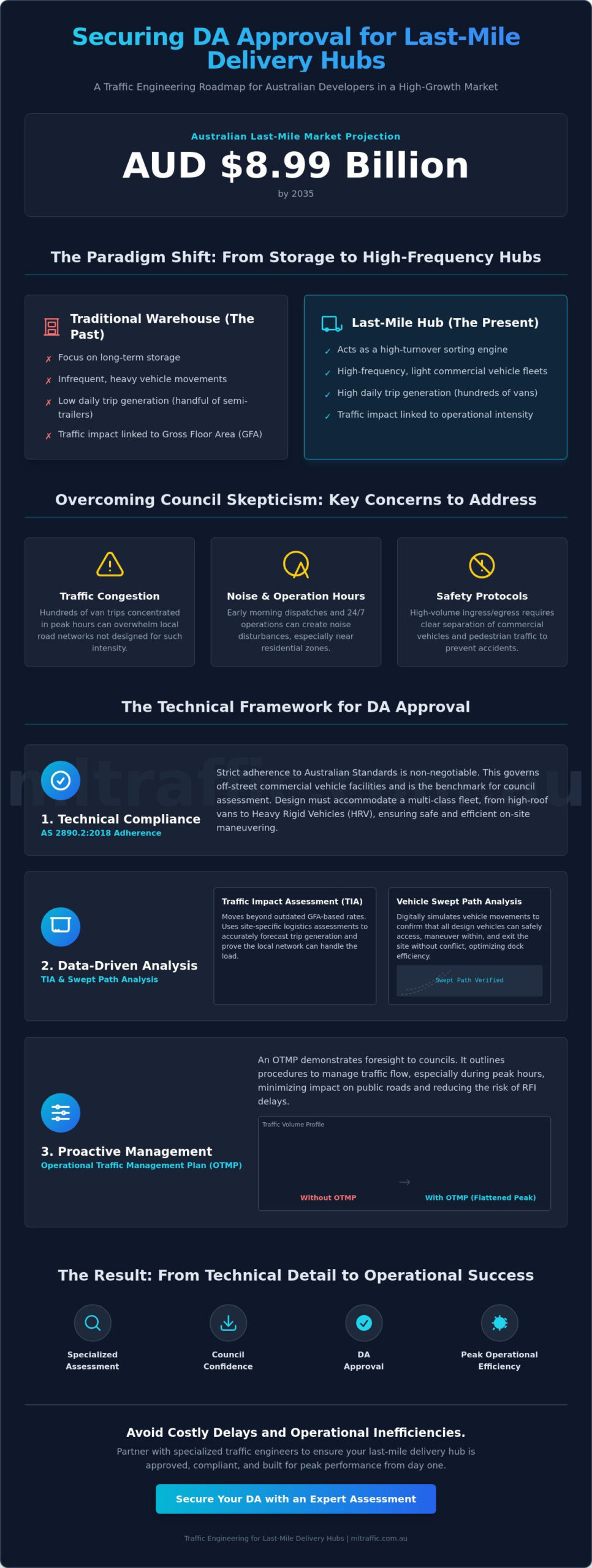
Securing Your DA: Why Professional Traffic Engineering is Essential
Securing a Development Application (DA) for high-turnover logistics sites is a rigorous technical process. A generic or “DIY” approach to traffic planning is a significant liability. Councils see through templated reports that fail to account for the specific operational intensity of modern delivery networks. These generic submissions lead to immediate skepticism from planning officers and result in extensive project delays. Professional traffic engineering for last-mile delivery hubs provides the technical depth required to bridge the gap between your commercial objectives and a council’s regulatory requirements. It ensures that every movement on your site plan is backed by data-driven evidence provided by ML Traffic Engineers Australia.
Navigating the Council RFI Process
Councils frequently issue Requests for Information (RFIs) when a submission lacks site-specific data or relies on outdated traffic generation models. Common traffic-related RFIs focus on the impact of peak-hour surges on local intersection capacity and the adequacy of on-site queuing areas. We preempt these queries by providing precise technical justifications for every design choice. This is particularly important when proposing departures from standard parking rates or loading bay requirements. Utilizing Professional Traffic Engineer Services from ML Traffic Engineers Australia ensures your submission is defensible and compliant from the outset. We provide the specific evidence needed to prove that your hub won’t degrade the local road network’s Level of Service.
Direct Access to Expertise
At ML Traffic Engineers Australia, we prioritize direct accountability and senior leadership. The expert who performs your technical assessment is the same principal who defends the report at council meetings or planning panels. This continuity is essential. It prevents the communication breakdowns that often occur with larger, more impersonal firms where junior staff handle the technical work. Having a seasoned expert provide immediate, authoritative answers to a council’s technical questions can save months of back-and-forth correspondence. Our senior-led approach ensures that your traffic engineering for last-mile delivery hubs is meticulous, results-oriented, and tailored to your specific site constraints.
The journey from initial site feasibility to final council certification requires a dependable partner. We manage the technical complexities of intersection analysis, swept path verification, and operational management plans. This comprehensive service allows you to focus on the commercial success of your development while we navigate the bureaucratic requirements. If you’re preparing a DA for a logistics facility, contact ML Traffic Engineers Australia to discuss your hub assessment requirements and secure a professional pathway to approval.
Secure Your Logistics Facility Approval
Developing high-turnover delivery hubs requires a shift from traditional warehousing models to precise, data-driven logistics design. Success depends on your ability to prove that high-frequency vehicle movements won’t compromise the local road network or safety standards. You must ensure every site plan strictly adheres to AS 2890.2:2018 and is validated by detailed Vehicle Swept Path Analysis. These technical benchmarks are the primary focus of council planning officers and the most common source of project delays when ignored.
Effective traffic engineering for last-mile delivery hubs bridges the gap between your operational goals and regulatory approval. With over 15 years of Australian experience, ML Traffic Engineers Australia specializes in navigating these technical requirements. We provide direct access to senior principals on every project, ensuring your logistics assessment is performed and defended by seasoned experts. We understand the bureaucratic hurdles of the DA process and provide the meticulous documentation needed to avoid costly Requests for Information.
Ensure your next project is backed by technical expertise and a commitment to results. Get a Professional Traffic Assessment for Your Delivery Hub today. We look forward to helping you optimize your site’s efficiency and secure a successful approval.
Frequently Asked Questions
What is a logistics assessment for a last-mile delivery hub?
A logistics assessment is a technical document that quantifies vehicle movements and operational capacity for a specific site. It details the process of receiving goods via line-haul vehicles and the subsequent sorting and dispatch of light commercial van fleets. This report serves as evidence for councils that the site can handle high-frequency turnover without compromising the local road network’s safety or efficiency.
Does my delivery hub need to comply with AS 2890.2?
Yes, all commercial delivery hubs in Australia must strictly comply with AS 2890.2:2018. This standard dictates the design requirements for off-street commercial vehicle facilities, including loading bay dimensions, height clearances, and ramp grades. Failure to demonstrate compliance in your DA submission will lead to immediate rejection or a protracted Request for Information (RFI) process from council engineers during the assessment phase.
How does trip generation differ between a hub and a standard warehouse?
Delivery hubs generate significantly higher trip volumes than standard warehouses of the same floor area. While a traditional warehouse focuses on long-term storage and infrequent heavy vehicle movements, a hub operates as a high-frequency transit point. This results in intense peak-hour surges, typically during morning dispatch and evening return cycles, requiring specialized traffic engineering for last-mile delivery hubs to model accurately.
What is the role of a traffic engineer in a last-mile DA?
A traffic engineer provides the technical justification required to secure DA approval. This involves preparing Traffic Impact Assessment (TIA) reports, performing Swept Path Analysis, and developing Operational Traffic Management Plans. The engineer acts as a technical advocate, defending the site design and operational protocols during council meetings or planning panels to ensure all traffic concerns are professionally addressed with data-driven evidence.
Can I use a standard driveway for a delivery hub site?
Standard residential or light commercial driveways are generally inadequate for delivery hubs. High-frequency sites require widened driveway aprons to allow simultaneous ingress and egress without causing queuing on public roads. Detailed traffic engineering for last-mile delivery hubs ensures that driveway geometry accommodates the specific turning circles of your fleet while maintaining safe sight distances for pedestrians and other road users.
How do I manage pedestrian safety at a high-frequency delivery site?
Pedestrian safety is managed through total physical separation and enhanced visibility measures. We implement dedicated pedestrian walkways that don’t cross vehicle paths, along with convex mirrors at blind corners and high-visibility line marking. Site speed limits are strictly enforced using physical controls like speed humps to minimize risks in environments where courier vans are frequently maneuvering in tight spaces.
What happens if the council objects to my delivery hub traffic volume?
If a council objects to projected traffic volumes, you must provide robust technical mitigation strategies. This often involves submitting a detailed Intersection Analysis to prove the local network can absorb the load or an Operational Traffic Management Plan (OTMP) to stagger vehicle arrivals. Professional engineers use site-specific data to challenge generic council assumptions and negotiate viable operational conditions for the developer.
How much parking is required for a last-mile delivery facility?
Parking requirements are determined by a combination of council DCP rates and a site-specific Car Parking Demand Assessment. You must provide adequate space for staff, visitors, and the delivery fleet itself without causing overflow. We analyze shift patterns and fleet turnover to justify parking rates that may depart from standard warehouse requirements, ensuring the site remains functional during peak operations.

Disclaimer
The content on www.mltraffic.com.au, including all technical articles, guides, and resources, is provided for general informational and educational purposes only. It is not intended to constitute professional advice in traffic engineering, transportation planning, development approvals, or any other technical or legal field.
While ML Traffic Engineers makes every reasonable effort to ensure the accuracy, completeness, and timeliness of the information published, we do not provide any warranties or representations (express or implied) regarding its reliability, suitability, or availability for any particular purpose. Any reliance you place on the content is strictly at your own risk.
In no event shall ML Traffic Engineers, its directors, employees, authors, or affiliates be liable for any direct, indirect, incidental, special, consequential, or punitive damages (including, without limitation, loss of profits, data, or business opportunities) arising out of or in connection with the use of, or inability to use, any information provided on this website.
The articles and guides on this site are not a substitute for engaging a qualified, registered professional traffic engineer (such as an NPER or RPEQ engineer) to assess your specific project requirements. For tailored advice, compliance assessments, or traffic engineering services, please contact a competent professional.
This disclaimer may be updated from time to time without notice. By accessing or using this website, you agree to be bound by the most current version of this disclaimer.
