

A masterplanned community’s success is often decided before the first brick is laid, specifically at the moment your Traffic Impact Assessment lands on a council officer’s desk. Inadequate traffic engineering for masterplanned communities is a primary driver of DA delays, often resulting from non-compliance with AS 2890 standards or inaccurate parking demand assessments that waste valuable land. You understand that a project’s viability hinges on a seamless approval process and a design that balances vehicle access with resident safety.
This article explores how expert traffic engineering ensures your masterplanned project achieves council approval while creating a safe, efficient, and liveable environment. We’ll outline the strategies used to optimise internal road networks, perform precise vehicle swept path analysis, and navigate the technicalities of Australian regulatory requirements. You’ll discover how direct access to senior principals who perform the technical work can eliminate the bottlenecks typical of larger, impersonal firms and keep your development on schedule. This approach ensures your development remains compliant, functional, and ready for construction without the risk of expensive redesigns.
Key Takeaways
- Understand why traffic engineering serves as the essential connective tissue for large-scale developments, ensuring movement is treated as a liveability asset rather than a logistical hurdle.
- Identify the technical requirements for AS 2890 compliance and learn how expert traffic engineering for masterplanned communities facilitates a smoother DA approval process.
- Discover how to integrate active transport networks and multi-modal connectivity to meet modern Council requirements for sustainable and safe community design.
- Master the five-step Council approval process and identify common triggers for Requests for Further Information (RFI) to streamline your development application.
- Recognise the importance of direct senior principal involvement in technical reporting to ensure accountability and professional continuity from inception to project completion.
The Strategic Importance of Traffic Engineering in Masterplanned Communities
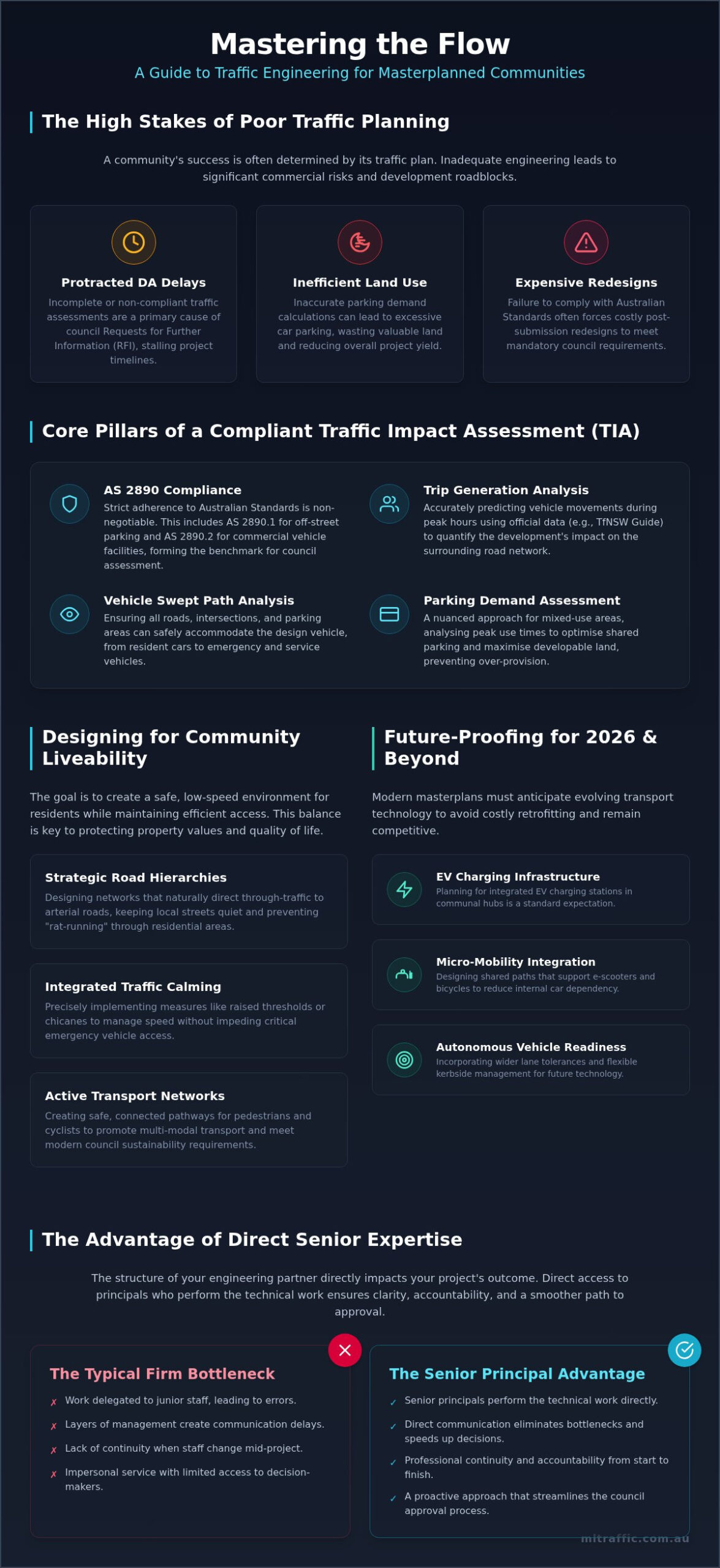
Effective traffic engineering for masterplanned communities begins long before the first road is gazetted. A traffic engineer’s role in the early-stage design phase is to establish a viable framework that supports both current density and future growth. When transport planning is treated as an afterthought, developers face significant commercial risks. These include protracted DA delays, inefficient land use that reduces yield, and expensive redesigns required to meet Council standards. Professional Traffic engineering acts as the connective tissue of a large-scale development, linking residential precincts to commercial hubs and the broader external network.
Successful masterplans balance high-volume vehicle access with the “quiet street” environment that residents expect. Achieving this requires a meticulous approach to road hierarchies and intersection design. Poorly planned networks often result in “rat-running”, where external traffic uses residential streets to bypass main roads, compromising safety and property values. Our specialised technical services ensure that your project’s internal movement system is both functional and compliant with Australian Standards.
Infrastructure Capacity vs. Community Liveability
Assessing the impact on the existing external road network is a mandatory requirement for any masterplanned DA. This involves calculating peak-hour trip generation and determining if existing intersections can absorb the additional load. Internally, we design road hierarchies that naturally direct through-traffic toward arterial routes while keeping residential cul-de-sacs low-speed and safe. Incorporating traffic calming measures, such as raised thresholds or chicanes, must be done precisely to ensure emergency vehicle access is never hindered. This technical balance ensures the community remains liveable without creating logistical bottlenecks.
Future-Proofing Your Development for 2026 and Beyond
Modern developments must accommodate evolving transport technology to remain competitive. Planning for Electric Vehicle (EV) charging infrastructure in communal hubs is now a standard expectation for 2026 projects. We also account for micro-mobility trends by integrating shared paths that support e-scooters and bicycles, reducing internal car dependency. Current masterplan designs must incorporate wider lane tolerances and flexible kerbside management to accommodate the eventual deployment of autonomous vehicle technology. These considerations prevent the need for disruptive infrastructure retrofitting in the future.
Core Technical Requirements for Masterplanned DA Approvals
Securing DA approval for large-scale estates requires a rigorous Traffic Impact Assessment (TIA). This document serves as your technical roadmap, justifying the proposed density and infrastructure to Council. Traffic engineering for masterplanned communities must strictly adhere to Australian Standards, specifically AS 2890.1 for off-street car parking and AS 2890.2 for commercial vehicle facilities. These standards are not merely guidelines; they are the benchmarks Councils use to assess safety and functionality. The Planning Function of Traffic Engineering ensures that transport is integrated into the site’s DNA from the outset, preventing the commercial risk of underutilised land or inadequate access.
Calculating parking demand for mixed-use community centres requires a nuanced approach. We assess the peak-use times of various amenities, such as childcare centres and local retail, to determine if shared parking arrangements can reduce the overall footprint. This meticulous assessment ensures you aren’t wasting developable land on excessive car parking spaces. If you are currently in the design phase, reviewing our technical reporting services can help ensure your project meets all regulatory benchmarks.
Traffic Impact Assessment (TIA) Components
TIAs rely on accurate trip generation rates to predict how many vehicle movements your project will create. We use data from the TfNSW Guide to Traffic Generating Developments to model these impacts. Our senior engineers perform detailed intersection analysis using specialised software to model peak-hour delays and queue lengths. This technical data determines the necessity of internal road upgrades, such as the implementation of roundabouts or signalised entry points, to maintain a high level of service for the surrounding network.
Swept Path Analysis and Vehicle Access
Vehicle Swept Path Analysis is a non-negotiable requirement for large-scale estate design. We utilise AutoTURN 2026 to verify that heavy rigid vehicles, including garbage trucks and emergency services, can navigate internal road hierarchies safely. This is critical when designing loading docks for community shopping centres or narrow residential streets. We also perform Driveway Ramp Grade Assessments and Sight Distance Assessments to ensure every lot complies with AS 2890.1. This level of detail prevents expensive redesigns during the construction phase and ensures the safety of all residents and visitors.
Designing for Multi-Modal Connectivity and Active Transport
Modern Australian Councils increasingly prioritise active transport to mitigate the congestion impacts of large-scale residential developments. This shift requires that traffic engineering for masterplanned communities treats pedestrian and cycle networks as primary infrastructure rather than secondary considerations. Integrating these networks into a cohesive traffic guidance scheme ensures that residents have viable alternatives to private vehicle use. Effective wayfinding and signage play a critical role here; they reduce driver confusion and prevent unnecessary vehicle idling within the estate. By providing clear, logical routes for all users, we minimise the risk of internal bottlenecks and enhance the overall safety of the road network.
Designing for public transport is another essential technical requirement. This involves assessing bus route feasibility, ensuring appropriate turn radii for heavy rigid vehicles, and strategically locating stops to maximise catchment areas. In larger estates, transit hubs or ‘Park and Ride’ facilities can significantly reduce the internal traffic load by consolidating vehicle movements at the community’s edge. Our approach involves detailed Vehicle Swept Path Analysis to ensure buses can navigate intersections without encroaching on opposing lanes or damaging kerbside infrastructure.
Pedestrian-First Design Principles
The “10-minute neighbourhood” concept is a cornerstone of current masterplan design. It aims to provide essential services within a short walk of every residence. Achieving this requires designing safe crossing points and ensuring that high-speed vehicle lanes are physically separated from primary school walking routes. We focus on the seamless transition between private driveways and public footpaths. This involves calculating precise driveway ramp grades and ensuring sight distances meet Australian Standards; these measures prevent hazards where vehicles exit residential lots across pedestrian thoroughfares. Traffic engineering for masterplanned communities must account for these interactions to secure Council approval for high-density precincts.
Cycling Infrastructure and End-of-Trip Facilities
Dedicated cycleways must connect residential zones directly to community hubs and schools to be effective. We ensure all cycling infrastructure complies with AS 2890.3, which governs bicycle parking and storage requirements. High-quality end-of-trip facilities, such as secure lockers and racks at retail centres, encourage long-term adoption of cycling. By promoting sustainable transport options, developers can often justify a reduction in total car parking demand assessments. This optimisation saves land and construction costs while meeting the environmental performance targets often mandated by state planning authorities.
Navigating the Council Approval Process for Large Estates
Securing approval for a masterplanned project involves a structured regulatory pathway. Expert traffic engineering for masterplanned communities ensures that every technical submission aligns with Council expectations from the outset. The standard approval process typically follows five key stages: initial site due diligence, a formal pre-DA consultation with Council engineers, the preparation of technical reporting, the formal DA submission during public exhibition, and the final response to any Requests for Further Information (RFI). Skipping the pre-DA phase often leads to expensive delays as Council may have specific local requirements that override national standards.
Common reasons for an RFI include inadequate sight distance assessments at major entry points or the use of outdated trip generation data. Council officers also scrutinise how proposed developments handle community objections regarding increased traffic volume. We address these concerns by providing empirical data, such as SIDRA intersection modelling, to prove that the surrounding network can maintain an acceptable Level of Service (LOS). This evidence-based approach is essential for de-risking the project during the public exhibition phase.
Overcoming Common Planning Hurdles
A significant challenge in large-scale estates is addressing the ‘cumulative impact’. Councils often require developers to account for the traffic generated by other nearby projects that are currently in the planning pipeline. This involves negotiating infrastructure contributions for external road upgrades, such as new traffic signals or lane widenages. It’s also vital to ensure absolute consistency between your Traffic Impact Assessment and the Statement of Environmental Effects (SEE). Any discrepancy between these documents can trigger a refusal or a lengthy RFI process. If you require assistance with these complex submissions, contact our senior engineers to discuss your project requirements.
The Value of Expert Representation
Direct involvement from a senior principal is a core requirement for successful negotiations with planning panels. Non-technical panels need technical data translated into clear, actionable insights regarding safety and community benefit. At ML Traffic Engineers Australia, the same expert who performs the technical work represents your project at Council meetings. This “no-gatekeepers” approach ensures that technical questions are answered immediately, reducing the risk of planning bottlenecks. You can learn about our specialised services for developers to see how we streamline the path to approval for national masterplanned projects. Traffic engineering for masterplanned communities requires this level of direct accountability to succeed in complex regulatory environments.
Partnering with ML Traffic Engineers Australia for Your Next Project
ML Traffic Engineers Australia provides a comprehensive consultancy service for developers across the country. With over 15 years of industry experience, we understand that traffic engineering for masterplanned communities requires more than just technical data; it requires a strategic approach to DA approvals. Our firm delivers a full suite of essential reports, including Traffic Impact Assessments (TIA), Vehicle Swept Path Analysis using AutoTURN 2026, Car Parking Demand Assessments, and Waste Management Plans. We ensure every design is meticulously checked against Australian Standards AS 2890.1, AS 2890.2, and AS 2890.3 to prevent regulatory delays and ensure the long-term viability of your estate.
Our technical expertise extends to every phase of the development lifecycle. We assist with initial site due diligence, intersection analysis, and the design of complex internal road hierarchies. By identifying potential traffic bottlenecks early, we help developers optimise their land use and avoid the commercial risk of underutilised space. Our reports are designed to be authoritative and defensible, providing the empirical evidence Council officers require to grant approval for high-density masterplanned projects.
A National Approach with Local Expertise
Handling a large-scale project requires navigating the specific requirements of different state-based road authorities. Whether your project is in New South Wales, Queensland, or Victoria, our team applies local expertise to national standards. We’ve successfully delivered projects across residential, commercial, and mixed-use land categories, ensuring that infrastructure contributions and external road upgrades are negotiated fairly. You can contact our senior engineers for a project consultation to discuss the specific parameters of your development and how we can streamline your approval pathway.
The ML Traffic Engineers Australia Difference: No Gatekeepers
The ML Traffic Engineers Australia difference lies in our commitment to professional continuity and direct accountability. We don’t use junior staff or administrative intermediaries as gatekeepers for technical work. The same senior principal who takes your initial call is the one who performs the complex modelling and signs off on your TIA. This ensures a level of technical precision that larger, more impersonal firms often struggle to replicate. Every Swept Path Analysis and Parking Assessment undergoes a rigorous review process to ensure absolute accuracy and compliance with current regulations. You can read more about our commitment to engineering excellence and our 15-year history of supporting the Australian development industry through expert traffic engineering for masterplanned communities.
Securing the Future of Your Masterplanned Development
Successful large-scale residential projects depend on technical precision and a deep understanding of complex regulatory frameworks. Professional traffic engineering for masterplanned communities ensures that movement systems are treated as assets that enhance liveability rather than logistical hurdles. By integrating AS 2890 compliance and multi-modal connectivity into the early design phase, developers can avoid expensive redesigns and protracted Council delays. This strategic approach transforms a standard traffic report into a powerful roadmap for DA approval.
ML Traffic Engineers Australia brings over 15 years of experience in Australian transport planning to every project we undertake. Our “no-gatekeepers” approach means you’ll have direct access to senior principals who perform the technical work on your TIAs and Swept Path Assessments. This direct accountability is the cornerstone of a successful submission and a functional community for future residents. We specialise in navigating the specific requirements of road authorities to ensure your project doesn’t face avoidable bottlenecks during the planning phase.
Your project deserves the reliability and meticulous attention to detail that only seasoned experts can provide. We look forward to helping you build a safer and more efficient community.
Frequently Asked Questions
When should a traffic engineer be engaged for a masterplanned community?
A traffic engineer should be engaged during the site due diligence or concept design phase. Early involvement allows us to identify access constraints and determine the required road hierarchy before the site layout is finalised. This prevents expensive redesigns later in the DA process. Our senior principals provide technical guidance from inception to ensure your masterplan is both functional and compliant with local authority requirements.
What is a Traffic Impact Assessment (TIA) and why is it required for my DA?
A Traffic Impact Assessment (TIA) is a comprehensive technical report that evaluates how your development will affect the surrounding road network. Councils require this document to ensure the existing infrastructure can absorb the additional vehicle movements without compromising safety or Level of Service. Expert traffic engineering for masterplanned communities uses TIAs to justify the proposed density and provide empirical evidence that the internal network operates efficiently.
How does Swept Path Analysis affect the layout of my residential estate?
Swept Path Analysis uses specialised software like AutoTURN 2026 to model the physical space required for vehicle movements. This analysis dictates the minimum widths of internal roads and the geometry of intersections to accommodate garbage trucks and emergency vehicles. It directly influences the placement of kerbs, roundabouts, and parking bays. Without this verification, your estate layout may fail to meet mandatory safety and serviceability standards.
Can a traffic engineer help reduce the required number of parking spaces?
We can often reduce the required number of parking spaces by performing a Car Parking Demand Assessment. This involves using empirical data and site-specific analysis to prove that actual demand is lower than the generic rates specified in Council’s Development Control Plan (DCP). By justifying shared parking arrangements or highlighting proximity to public transport, we help developers maximise land use and reduce unnecessary construction costs.
What Australian Standards are most critical for masterplanned communities?
The most critical standards are the AS 2890 series, specifically AS 2890.1 for off-street car parking and AS 2890.2 for commercial vehicle facilities. AS 2890.3 is also essential for bicycle parking compliance. These standards govern everything from driveway ramp grades to the dimensions of parking bays. Adherence to these Australian Standards is a primary metric used by Council officers when assessing traffic engineering for masterplanned communities.
How do traffic engineers account for future growth in a masterplan?
Traffic engineers account for future growth by applying annual traffic growth rates to existing background traffic data. We typically model a 10-year horizon from the date of completion to ensure the infrastructure remains functional as the community matures. This modelling includes projected trips from other nearby developments in the planning pipeline. This foresight prevents the local network from becoming over-saturated shortly after the project is finished.
What is the difference between a Traffic Management Plan and a TIA?
A TIA is a planning document that assesses the long-term impact of a new development on the road network. In contrast, a Traffic Management Plan (TMP) or Traffic Guidance Scheme (TGS) is an operational document focused on safety during construction or specific events. While the TIA influences the permanent design of the estate, the TGS outlines the temporary measures needed to manage vehicle and pedestrian flow during the building phase.
Do you provide traffic engineering services for regional Australian projects?
We provide traffic engineering services for regional and metropolitan projects across all Australian states and territories. Our 15 years of experience include a diverse range of project environments, from high-density urban precincts to regional residential estates. We navigate the specific requirements of both local Councils and state-based road authorities, ensuring that regional developments receive the same level of senior principal involvement as our metro projects.

Disclaimer
The content on www.mltraffic.com.au, including all technical articles, guides, and resources, is provided for general informational and educational purposes only. It is not intended to constitute professional advice in traffic engineering, transportation planning, development approvals, or any other technical or legal field.
While ML Traffic Engineers makes every reasonable effort to ensure the accuracy, completeness, and timeliness of the information published, we do not provide any warranties or representations (express or implied) regarding its reliability, suitability, or availability for any particular purpose. Any reliance you place on the content is strictly at your own risk.
In no event shall ML Traffic Engineers, its directors, employees, authors, or affiliates be liable for any direct, indirect, incidental, special, consequential, or punitive damages (including, without limitation, loss of profits, data, or business opportunities) arising out of or in connection with the use of, or inability to use, any information provided on this website.
The articles and guides on this site are not a substitute for engaging a qualified, registered professional traffic engineer (such as an NPER or RPEQ engineer) to assess your specific project requirements. For tailored advice, compliance assessments, or traffic engineering services, please contact a competent professional.
This disclaimer may be updated from time to time without notice. By accessing or using this website, you agree to be bound by the most current version of this disclaimer.
