
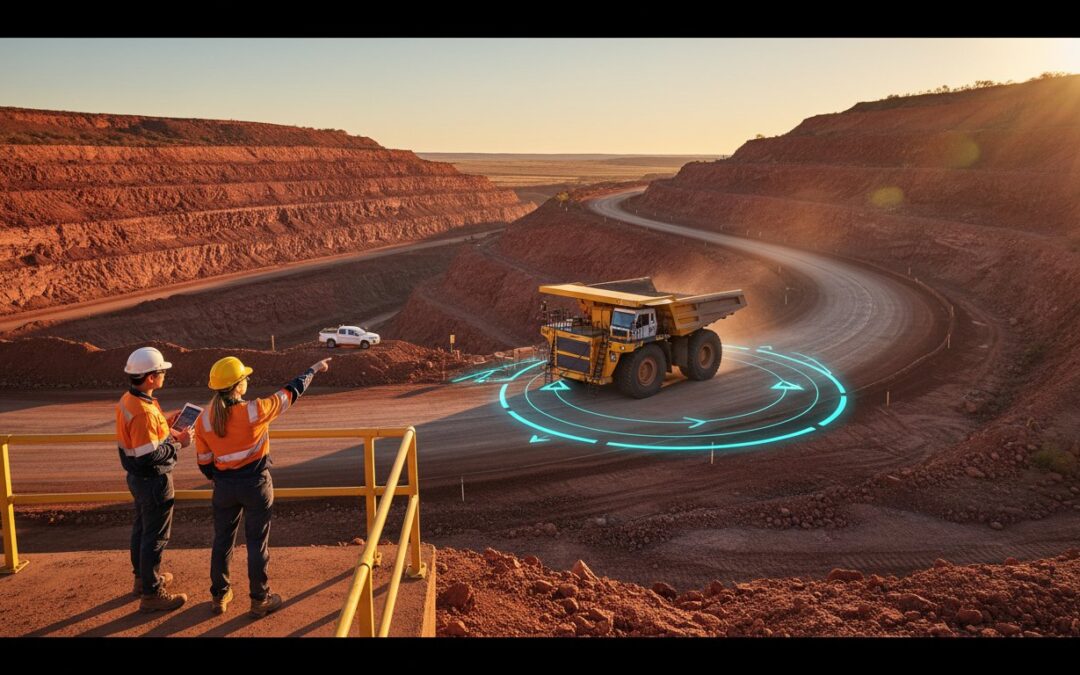
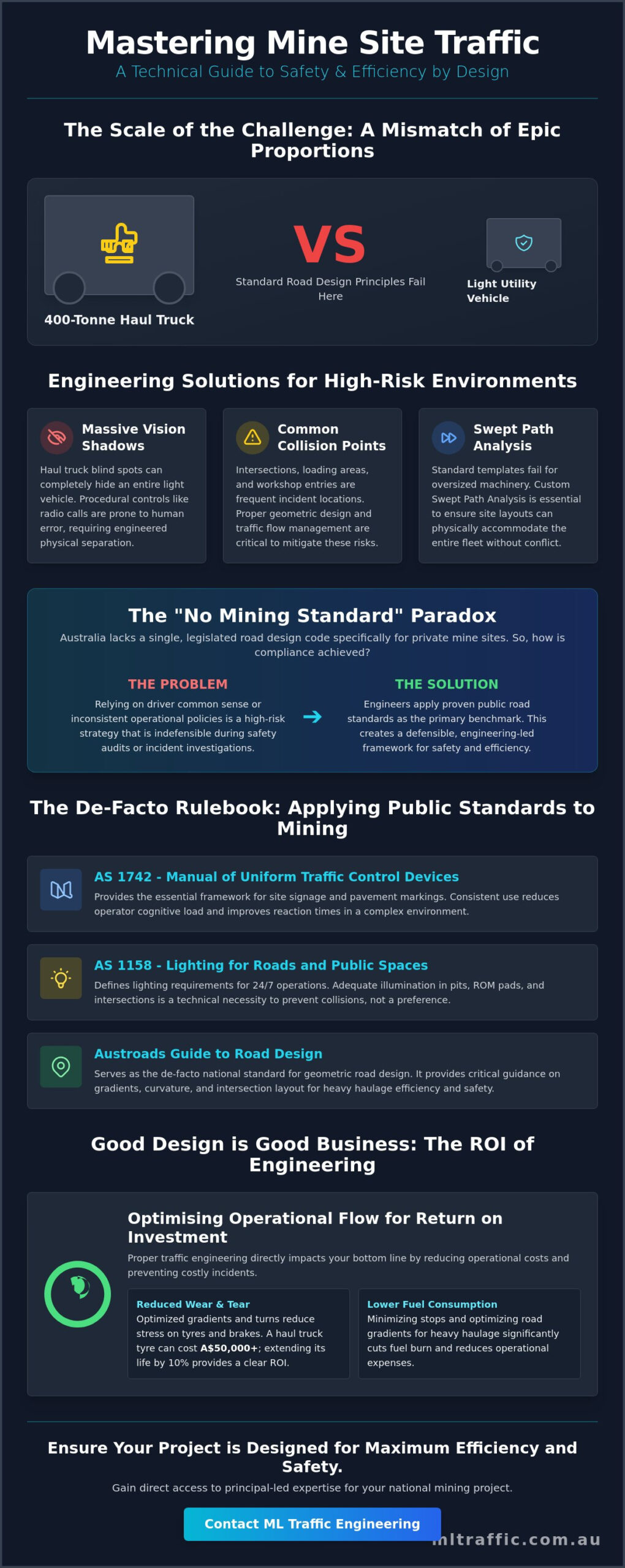
The standard road design principles used for suburban streets fail the moment a 400-tonne haul truck shares a corridor with a light utility vehicle. You know that managing these high-risk interactions is a constant challenge, particularly when legislation lacks specific road standards for private mine sites. Effective traffic engineering for mining sites requires a technical approach that accounts for the complexity of oversized plant equipment and the necessity of rigorous safety protocols.
We understand that a single collision or an inefficient haul route can lead to significant operational delays and safety breaches. This guide provides the technical framework to master the Australian Standards and technical requirements needed to design safe, efficient, and compliant traffic systems. We’ll detail how to apply AS 2890 and Austroads guidelines, conduct precise vehicle swept path assessments, and optimize your layout to pass safety audits while maintaining peak productivity.
Key Takeaways
- Understand the critical safety requirements for managing high-risk interactions between 400-tonne haul trucks and light utility vehicles in complex mining environments.
- Learn how to navigate the Australian Standards paradox by applying AS 1742 and other public benchmarks to achieve site-wide regulatory compliance.
- Discover why specialized traffic engineering for mining sites requires custom Swept Path Analysis software rather than standard templates to accommodate oversized machinery.
- Master the essential components of a robust Traffic Management Plan (TMP), including site-specific risk assessments and the establishment of clear road hierarchies.
- Gain direct access to principal-led expertise from Michael Lee or Benny Chen to ensure your national mining project is designed for maximum efficiency and safety.
The Critical Role of Traffic Engineering in Mine Site Safety and Efficiency
Traffic engineering for mining sites is the rigorous application of scientific and engineering principles to ensure the safe and efficient movement of personnel and materials. It’s a specialized field that goes beyond simple road rules. It focuses on the complex dynamics of a working environment where 400-tonne haul trucks share space with light utility vehicles. Relying on operational policy or driver common sense is a high-risk strategy. Engineering-led solutions are required to manage these environments. Poorly designed road networks lead to operational bottlenecks, increased fuel consumption, and higher maintenance costs.
To better understand the broader scope of mining engineering and how it integrates with site logistics, watch this helpful video:
Professional assessment ensures that site layouts accommodate the physical limitations of the fleet. Without technical oversight, mines often experience congestion that halts production. Our approach involves detailed analysis of vehicle swept paths and site-specific constraints. This level of planning is essential for compliance with Australian safety regulations and for maintaining a productive site. It’s about moving goods from point A to point B with the lowest possible risk and the highest possible speed. Effective traffic engineering for mining sites turns a chaotic environment into a streamlined industrial circuit.
Mitigating High-Risk Vehicle Interactions
The most common collision points on a mine site include intersections, loading areas, and workshop entries. Operators of Heavy Equipment in Mining often deal with massive vision shadows. These are blind spots where an entire light vehicle becomes invisible to the truck driver. While procedural controls like radio calls are common, they’re prone to human error. Physical separation, such as dedicated haul roads or windrows, provides a superior level of safety. Engineering these separations into the site plan from the start is more cost-effective than retrofitting controls after an incident occurs.
Optimising Operational Flow for ROI
Geometric design plays a direct role in reducing vehicle wear and tear. Sharp turns and steep gradients increase the stress on tyres and brakes, leading to premature failure. A tyre for a large haul truck can cost over A$50,000; extending its life by even 10% provides a clear return on investment. Road gradients must be optimized for heavy haulage efficiency to minimize fuel burn. Intelligent intersection priority planning also plays a part. By reducing the number of times a heavy vehicle must come to a complete stop, site managers can significantly lower cycle times and operational expenses. You can find more details on our technical traffic engineering services for complex sites here.
Navigating Australian Standards and De-Facto Mining Road Guidelines
The “No Mining Standard” paradox exists because Australia lacks a single, legislated code dedicated solely to private mine road construction. This gap forces engineers to rely on public road standards as the primary benchmark for safety and compliance. Applying these established frameworks ensures that traffic engineering for mining sites remains defensible during safety audits or incident investigations. Without a specific mining code, the industry defaults to proven civil engineering principles to manage risk.
AS 1742 (Manual of uniform traffic control devices) provides the essential framework for site signage and pavement markings. Consistent use of these symbols reduces cognitive load for operators. For 24/7 operational environments, AS 1158 defines the requirements for lighting. Adequate illumination in pit areas, ROM pads, and intersections is essential to prevent collisions between light vehicles and heavy plant. Visibility isn’t just a safety preference; it’s a technical requirement for high-risk zones.
Austroads Guides, specifically the Guide to Road Design, serve as the de-facto national standard for mine infrastructure. These documents provide the technical basis for road geometry, sight distances, and pavement thickness. Integrating general workplace traffic management guidelines from Safe Work Australia further strengthens the site safety profile. This integration addresses the fundamental need to separate pedestrians from mobile plant through engineered controls.
Applying AS 2890.2 for Heavy Vehicle Facilities
Compliance for mining workshops and loading areas depends heavily on AS 2890.2. This standard outlines the requirements for commercial vehicle parking, access, and maneuvering. Designing workshop bays requires precise Vehicle Swept Path Assessments to ensure B-Double or custom haulage configurations can move without striking infrastructure. While AS 2890.1 covers light vehicles, the heavy vehicle standard is the priority for industrial zones. We verify all designs against these rigid compliance checks to prevent operational bottlenecks and costly retrofits.
State-Specific Mining Regulations and National Consistency
State regulators, such as Western Australia’s DEMIRS or the NSW Resources Regulator, expect high-level traffic management plans. They often look for highway-standard designs on private haul roads. This consistency is vital for driver familiarity. When a contractor moves from a public highway onto a mine site, the road environment should feel predictable. Standardized intersection layouts and clear lane markings reduce the risk of human error. Our team provides professional traffic assessments that align these private roads with national safety expectations, ensuring your site remains compliant and efficient.
Geometric Design and Swept Path Analysis for Heavy Haulage
Swept Path Analysis (SPA) is a technical simulation that predicts the physical envelope a vehicle occupies as it moves through a turn. For traffic engineering for mining sites, this analysis is a mandatory safety requirement rather than a suggestion. Standard turning templates found in Australian Standards often fail to accommodate the scale of customized mining plant and oversized machinery. A Caterpillar 789 haul truck, for instance, requires a turning radius and overhead clearance that standard road design software defaults cannot accurately model without expert calibration.
Effective geometric design separates the “Design Vehicle” from the “Check Vehicle.” The Design Vehicle is the primary fleet unit, such as a 797F haul truck, which requires optimized pathing for high-speed efficiency and reduced tyre wear. The Check Vehicle is the largest possible unit that might access the site, such as a multi-axle low-loader carrying a shovel. While the Design Vehicle needs generous margins to maintain operational speed, the Check Vehicle pathing focuses on absolute clearance at low speeds to prevent infrastructure damage. It’s a balance between daily productivity and occasional access requirements.
AutoTURN Modelling for Mining Plant
ML Traffic utilizes AutoTURN software to create high-fidelity simulations for specific mining fleet models. This precision allows us to verify access for unique vehicle configurations that aren’t found in standard libraries. You can learn more about these technical requirements in our Swept Path Analysis Guide. Our engineers calculate precise clearances for articulated haulers and heavy low-loaders in confined areas, such as maintenance workshops and wash bays, where a 200mm miscalculation can result in costly structural collisions. We don’t guess the dimensions; we model them based on manufacturer specifications.
Intersection Design and Sight Line Assessment
Safe Intersection Sight Distance (SISD) is the most critical metric for high-speed haul road intersections. Because heavy haulage units have significantly longer braking distances than light vehicles, the visibility requirements are much higher than standard road applications. We assess vertical curves and gradients to ensure that a light vehicle driver has sufficient time to react to an emerging haul truck. Utilizing a “Swept Path Analysis: A Developer’s Guide” methodology ensures that every intersection design passes rigorous safety audits and RPEQ certifications. We prioritize unobstructed sight lines by managing roadside vegetation and spoil heap placement, keeping traffic engineering for mining sites compliant with national safety benchmarks. This meticulous approach reduces the risk of high-energy collisions in shared traffic environments.
Developing Comprehensive Traffic Management Plans (TMP) for Mining Operations
Effective traffic engineering for mining sites requires a structured approach to risk mitigation. A Traffic Management Plan (TMP) serves as the primary control document to manage vehicle and pedestrian interactions. Our approach follows five critical steps to ensure site safety and regulatory compliance.
- Step 1: Conduct a comprehensive site traffic risk assessment. Identify every point where heavy plant machinery, light vehicles, and pedestrians might interact. We evaluate sight-line obstructions, blind corners, and high-volume intersections.
- Step 2: Define road hierarchy and vehicle priority rules. Establish clear protocols where haul trucks always have the right of way. Differentiate between primary haul roads, secondary access tracks, and light vehicle lanes to minimize conflict points.
- Step 3: Map out pedestrian-free zones and light vehicle restricted areas. Use physical barriers, safety bunds, and exclusion zones to separate personnel from heavy machinery. Segregation is the most effective engineering control in a mine environment.
- Step 4: Integrate Traffic Guidance Schemes (TGS) for temporary works. Mining environments change rapidly. Use TGS for short-term maintenance, road realignments, or pit expansions to maintain safety during transitions.
- Step 5: Establish a regular audit and review schedule. A TMP isn’t a static document. Conduct formal audits every 12 months or immediately following a significant site change to ensure all controls remain effective.
The Difference Between a TMP and a TGS
A TMP is a strategic document that outlines the overarching safety objectives and traffic flow logic for the entire site. In contrast, a TGS is a tactical layout showing the specific placement of signs, bollards, and delineators for a particular work area. For more information, see our Traffic Management Plan (TMP) Guide. Mining sites often require specific Traffic Control Plans when road realignments are necessary for new pit developments or infrastructure upgrades.
Human Factors: Fatigue and Communication
Road design directly impacts driver fatigue. We design road alignments to avoid excessive monotony, which can lead to highway hypnosis on long haul routes. Standardized signage and strict radio communication protocols are essential. Light vehicle drivers must confirm contact with heavy plant operators before entering active haulage zones. Managing the transition between public roads and private mine site environments is also vital; drivers must adjust their behavior to site-specific rules immediately upon entry. Our engineers ensure all signage complies with AS 1742.3 to maintain clarity and reduce cognitive load on operators.
If you need expert assistance with traffic engineering for mining sites, contact our senior consultants today to discuss your project requirements.
Professional Traffic Engineering Services for National Mining Projects
ML Traffic Engineers provides specialist traffic engineering for mining sites across all Australian states and territories. Since our establishment in 2005, our firm has successfully completed technical assessments for over 10,000 sites. We focus on delivering high-level accuracy for industrial developments, resource projects, and complex mining infrastructure. Our team brings over 30 years of individual experience to every project. This ensures that your development application meets all regulatory hurdles without unnecessary delays.
Our firm operates on a principal-led model. This means clients have direct access to Michael Lee or Benny Chen throughout the project lifecycle. We don’t delegate work to junior staff or hide behind administrative layers. In the context of large-scale mining tenders, accountability is paramount. We stand by our core promise: the traffic consultant who provides the quote is the same professional who does the work. This ensures the technical nuances of your site are understood from the initial consultation to the final submission.
Our Comprehensive Traffic and Parking Services
We offer a full suite of ML Traffic Services tailored to the specific needs of the mining sector. Our expertise covers everything from Traffic Impact Assessments (TIA) for new site approvals to detailed internal road layouts. We ensure every design complies with Australian Standards, including AS 2890.1 for parking facilities and relevant state transport regulations. Our technical capabilities include:
- Traffic Impact Statements (TIS) and Assessments (TIA)
- Vehicle Swept Path Analysis for heavy haulage, B-doubles, and specialized mining equipment
- Sight-line assessments for high-speed haul road intersections
- Car park demand and layout design for workforce camps
- RPEQ certification for projects requiring registered professional engineering oversight
Get Started with a Professional Traffic Assessment
Involving a traffic engineer during the early site planning phase prevents costly redesigns and compliance delays. Whether you’re in the feasibility stage or responding to a formal development application request, we provide clear, fact-based advice. To discuss your specific project requirements or request a detailed fee proposal, Contact ML Traffic Engineers directly. Our principals will review your site plan and provide a direct quote. We understand the high-stakes environment of mining operations and deliver reports that meet the rigorous standards of both local councils and state planning authorities. Professional traffic engineering for mining sites requires a meticulous approach to safety and logistics, and we’re equipped to handle projects of any scale nationwide.
Securing Your Site Through Technical Precision
Effective traffic engineering for mining sites transforms complex haulage routes into safe, streamlined corridors. Achieving compliance with AS 2890 and Austroads Standards isn’t just a regulatory hurdle; it’s a critical step in mitigating heavy vehicle risks and preventing costly operational downtime. Precise geometric designs and swept path analyses ensure that every articulated vehicle moves efficiently without compromising site infrastructure or personnel safety.
ML Traffic Engineers brings over 15 years of industry experience to every project. We don’t delegate your safety to juniors. Senior staff are involved in every assessment to ensure your Traffic Management Plan (TMP) meets rigorous Australian requirements. We’ve completed over 10,000 site assessments across various land-use types, giving us the technical depth needed for high-stakes mining environments. The consultant who provides your quote is the expert who does the work.
Contact ML Traffic Engineers for a professional mining site traffic assessment to ensure your operations remain compliant and productive. We look forward to helping you build a safer, more efficient mining environment.
Frequently Asked Questions
What is the primary Australian Standard for mine site road design?
AS 1742 and AS 2890.2 are the primary benchmarks for traffic engineering for mining sites in Australia. AS 1742 governs the use of traffic control devices, while AS 2890.2 provides the technical specifications for heavy vehicle facilities. Adhering to these standards ensures the site meets the safety requirements of state regulators like the NSW Resources Regulator. It’s essential for maintaining legal compliance and operational safety across all haulage routes.
Do I need a Traffic Impact Assessment for a mine site expansion?
You’ll need a Traffic Impact Assessment (TIA) whenever a mine expansion increases vehicle movements or changes site access points. Planning authorities require these assessments to determine if the existing road network can handle the additional load. A TIA identifies specific upgrades needed for intersections and public road interfaces. This process ensures your project complies with the Environmental Planning and Assessment Act 1979 and local council requirements.
How does Swept Path Analysis help in designing mine workshops?
Swept Path Analysis uses computer modeling to map the spatial requirements of specific vehicles as they turn. In a workshop environment, this ensures that large-scale machinery like loaders and haul trucks can navigate safely around fixed structures. We use this data to calculate the exact clearances for doorways and service bays. This prevents infrastructure damage and ensures that maintenance flows don’t experience bottlenecks due to inadequate spatial planning.
What is the difference between a TMP and a TGS on a mine site?
A Traffic Management Plan (TMP) is a high-level strategic document, whereas a Traffic Guidance Scheme (TGS) is a detailed tactical diagram. The TMP establishes the broad safety framework and risk management protocols for the entire mining operation. A TGS, formerly known as a Traffic Control Plan (TCP), provides the specific layout of signs and devices for a particular task. Both are necessary to meet the requirements of AS 1742.3.
Can public road signage (AS 1742) be used on private mine roads?
You can and should use AS 1742 signage on private mine roads to ensure consistency and safety. Using the same symbols and colors found on public roads helps drivers react faster to warnings and instructions. It’s a best-practice approach that simplifies site induction and reduces the risk of operator confusion. Standardized signage also provides a clear framework for compliance during safety audits and regulatory inspections by state authorities.
Why is sight distance more critical for haul trucks than passenger cars?
Sight distance is more critical for haul trucks because their stopping distances are significantly longer than passenger cars due to their massive weight. A fully loaded truck traveling at 40 km/h can’t stop instantly. Traffic engineering for mining sites must provide enough visibility for operators to recognize hazards and brake safely. We calculate these distances based on the specific braking capabilities of the fleet and the gradient of the haul roads.
How often should a mine site traffic management plan be audited?
A mine site traffic management plan should be audited annually to maintain compliance with safety regulations. You must also conduct a review if there’s a significant change in site layout or after a traffic-related incident. Regular audits verify that the current controls are effective and that the workforce is following the established protocols. This proactive approach ensures your site remains aligned with the latest safety standards and operational requirements.

Disclaimer
The content on www.mltraffic.com.au, including all technical articles, guides, and resources, is provided for general informational and educational purposes only. It is not intended to constitute professional advice in traffic engineering, transportation planning, development approvals, or any other technical or legal field.
While ML Traffic Engineers makes every reasonable effort to ensure the accuracy, completeness, and timeliness of the information published, we do not provide any warranties or representations (express or implied) regarding its reliability, suitability, or availability for any particular purpose. Any reliance you place on the content is strictly at your own risk.
In no event shall ML Traffic Engineers, its directors, employees, authors, or affiliates be liable for any direct, indirect, incidental, special, consequential, or punitive damages (including, without limitation, loss of profits, data, or business opportunities) arising out of or in connection with the use of, or inability to use, any information provided on this website.
The articles and guides on this site are not a substitute for engaging a qualified, registered professional traffic engineer (such as an NPER or RPEQ engineer) to assess your specific project requirements. For tailored advice, compliance assessments, or traffic engineering services, please contact a competent professional.
This disclaimer may be updated from time to time without notice. By accessing or using this website, you agree to be bound by the most current version of this disclaimer.
