

On a Tuesday morning in October, a Sydney project manager received a Council RFI demanding a revised swept path analysis for a 20-unit development. This single request pushed their DA timeline back by 24 days and added $12,000 in holding costs. It’s a scenario that plays out across Australia every week because parking designs didn’t meet AS 2890.1 standards on day one. You understand that traffic engineering for project managers is often the difference between a project that breaks ground on schedule and one that lingers in a bureaucratic loop.
We agree that managing multiple consultants while trying to decipher complex Council requirements is a significant burden. You shouldn’t have to guess if your driveway ramp grade or sight-line assessment will pass the first round of review. This guide provides the strategic framework you need to mitigate project risks and keep your development on track. You’ll learn how to master the essentials of traffic engineering to ensure your site remains compliant. We’ll show you how early expert engagement leads to a streamlined DA approval and designs that work the first time.
Key Takeaways
-
Learn how early engagement with traffic consultants during the feasibility stage secures your ROI and prevents expensive redesigns during the DA process.
-
Navigate the complexities of traffic engineering for project managers by mastering the scoping and data collection requirements essential for a successful TIA report.
-
Use the PM’s checklist for AS 2890 compliance and swept path analysis to act as an "insurance policy" for your driveway and parking designs.
-
Understand the critical differences between TMPs and TGSs to streamline site access and secure Road Occupancy Licences without project delays.
-
Identify the benefits of a "hands-on" consultancy model where senior engineers manage your project personally to ensure accountability and technical precision.
Table of Contents
The Project Manager’s Guide to Traffic Engineering Basics
Traffic engineering for project managers is the science of safe, efficient vehicle and pedestrian movement within a development. In the Australian property sector, this discipline bridges the gap between architectural vision and local Council requirements. While architects focus on aesthetics and internal layouts, traffic engineers ensure the site actually functions for the people and vehicles using it every day.
Distinguishing between traffic planning and traffic engineering is vital for project timelines. Planning is strategic; it looks at how a new development fits into a suburb’s 10 year growth plan or public transport network. Engineering is technical and design-oriented. It deals with the physics of a 12.5 meter Heavy Rigid Vehicle (HRV) navigating a loading dock or the specific gradient of a basement ramp.
Early engagement during the feasibility stage offers the highest return on investment. If you wait until the DA submission to consult an expert, you might discover that your parking layout doesn’t meet Australian Standards. This often results in a loss of yield as you’re forced to remove units to make room for compliant ramps or sightlines. A robust traffic report is also a cornerstone of the Statement of Environmental Effects (SEE). It provides the empirical data needed to prove that your project won’t cause gridlock on local streets, which is a common point of contention for community objectors.
Why Traffic Engineering is a Project Management Priority
Traffic and parking issues are the most frequent cause of Council Request for Information (RFI) delays. These requests can stall a project for 4 to 8 months, adding significant holding costs to your budget. Parking and access design also dictate a site’s commercial viability. If you can’t prove efficient access, your yield drops. We focus on providing the technical justification to satisfy authorities while protecting your project’s floor space. You can view our full range of traffic engineering services to see how these assessments integrate into your workflow.
Key Technical Terms Every PM Should Know
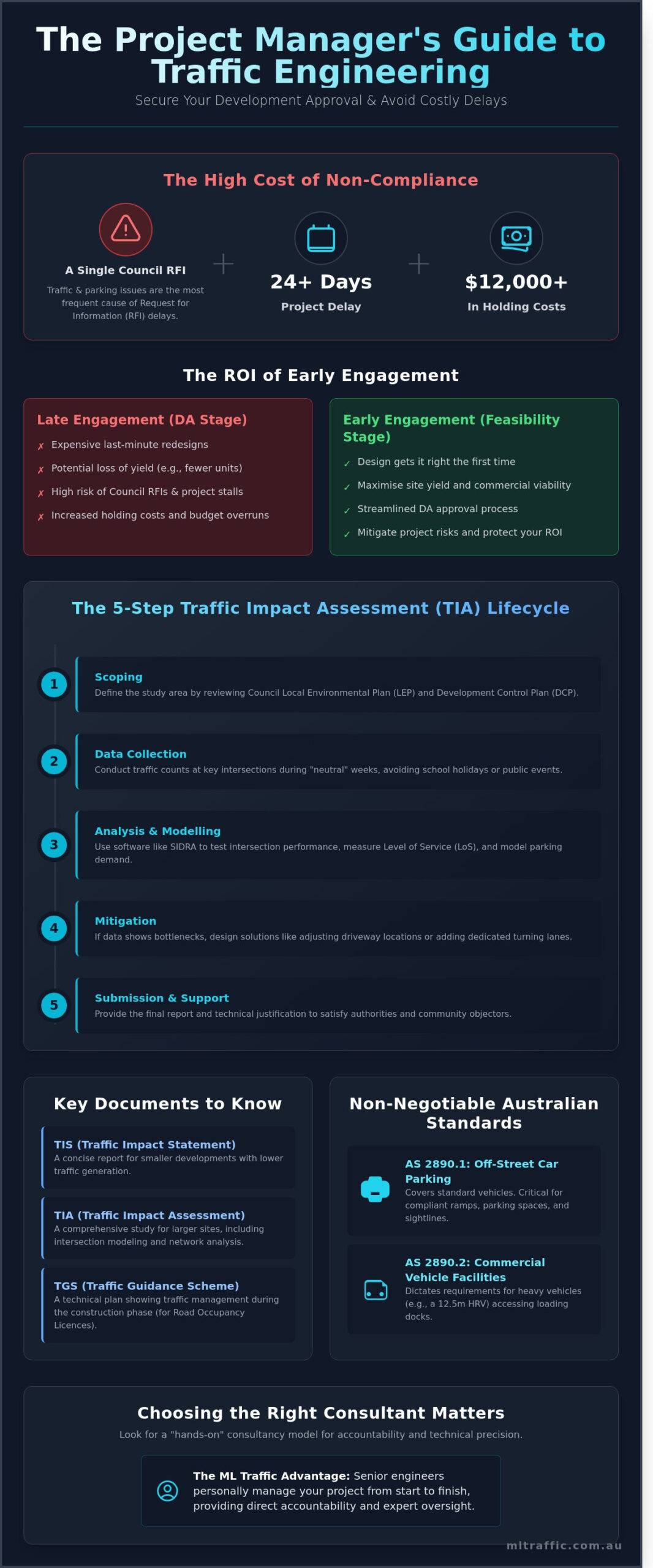
Mastering a few industry terms helps you navigate meetings with Council engineers more effectively. You should understand the difference between these three documents:
-
TIS (Traffic Impact Statement): A concise report for smaller developments with lower traffic generation.
-
TIA (Traffic Impact Assessment): A comprehensive study for larger sites that includes intersection modeling and network analysis.
-
TGS (Traffic Guidance Scheme): A technical plan showing how traffic will be managed during the construction phase.
You must also monitor compliance with specific Australian Standards. AS 2890.1 covers off-street car parking for standard vehicles, while AS 2890.2 dictates the requirements for heavy vehicle access. These standards are non-negotiable during the DA process. Integrating traffic engineering into the broader project lifecycle ensures that your design is both functional and ready for approval without expensive last-minute revisions.
Navigating the TIA Report Process for Project Approvals
Getting a Development Application (DA) through Council requires more than just a basic site plan. It demands a technical narrative that proves your project won’t paralyze local roads. Mastering traffic engineering for project managers starts with understanding the five-step Traffic Impact Assessment (TIA) lifecycle. This process ensures your development is safe, compliant, and functional from day one.
-
Step 1: Scoping. We define the study area by reviewing the Council Local Environmental Plan (LEP) and Development Control Plan (DCP). This ensures the report addresses the specific land-use requirements for your site.
-
Step 2: Data collection. We conduct traffic counts at key intersections. Timing is vital. Counts must happen during "neutral" weeks; we avoid school holidays or public events that skew data.
-
Step 3: Analysis and modelling. Using software like SIDRA, we test intersection performance and parking demand. We measure the Level of Service (LoS) to see how the project impacts delays.
-
Step 4: Mitigation. If the data shows a bottleneck, we design solutions. This might include adjusting driveway locations or adding dedicated turning lanes to manage flow.
-
Step 5: Submission and support. After lodging, we provide post-lodgement support to answer Council’s technical queries directly, ensuring no momentum is lost.
What Makes a "Council-Ready" Traffic Impact Assessment?
A generic report is a fast track to a Request for Further Information (RFI). A professional traffic impact assessment must be site-specific. It needs to address the 2024 existing traffic volumes while projecting growth over a 10-year horizon. Council engineers expect clear compliance with AS 2890.1 for parking and proof that the development won’t degrade road safety. We focus on hard data to ensure the report stands up to rigorous scrutiny.
Managing the TIA Timeline and Budget
Timing often dictates your project’s success. The biggest bottleneck is usually the traffic count window. If you miss a school term, you might wait 21 days for the next valid data window. You can accelerate the process by providing high-resolution CAD files and final site plans to your consultant early. A thorough report prevents months of expensive back-and-forth negotiations with Council later. If you want to avoid these delays, you can view our full range of traffic engineering services to see how we streamline the approval process.
Ensuring Compliance with Australian Standards and AS 2890
Navigating the technical requirements of AS 2890.1 is a core responsibility in traffic engineering for project managers. This standard dictates every millimeter of an off-street car park, from bay widths to ramp gradients. Failing to meet these specs early in the design phase often leads to expensive redesigns after a Council Request for Information (RFI). A solid PM checklist includes verifying that User Class 1A bays are 2.4 meters wide and ensuring two-way aisles provide at least 5.8 meters of clearance. It’s a binary environment; your site is either compliant or it isn’t. AS 2890.1 compliance is non-negotiable for modern Australian developments if you want to secure a timely approval.
The Critical Role of Swept Path Analysis
Think of swept path analysis as your project’s insurance policy. We use AutoTURN software to simulate how a design vehicle moves through your site. This process validates that a B85 or B99 car won’t clip a structural column or get stuck on a tight basement turn. You can find more technical details in our swept path analysis guide. Common failures we identify include 1:4 ramp transitions that are too steep for low-clearance vehicles and narrow loading docks that prevent waste trucks from exiting in a forward direction. Identifying these bottlenecks on paper saves thousands in post-construction rectifications.
Parking Demand vs. Council Requirements
Project managers often face pressure to maximize floor space, which creates a conflict with high parking requirements. If the local DCP demands 50 spaces but your site only fits 40, you don’t have to sacrifice your yield immediately. We can often argue for a reduction by submitting a formal Car Parking Demand Assessment. This report uses empirical data from similar sites to prove that the actual demand is lower than the Council’s generic rates.
While pushing for yield, you must still integrate AS 2890.6 requirements for accessible parking. These spaces require specific shared zones and vertical clearances of 2.5 meters. Safety is the final hurdle; ignoring sight distance requirements under AS 2890.1 Clause 3.2.4 is a fast track to a DA refusal. Drivers must have a clear line of sight to pedestrians before crossing the property boundary. Balancing these technical mandates is the essence of effective traffic engineering for project managers.
Traffic Management for Construction Projects: Minimising Site Delays
Construction delays cost money. In major hubs like Sydney or Melbourne, a single blocked lane without the correct permit can result in fines exceeding $2,000 per hour. Project managers must distinguish between a traffic management plan (TMP) and a Traffic Guidance Scheme (TGS). The TMP is your high-level strategy. It details how vehicles enter and exit the site over the project life. The TGS is the tactical map showing the placement of bollards, signs, and controllers. Since 2021, the term TGS has replaced the old "Traffic Control Plan" (TCP) in most Australian jurisdictions to align with AS 1742.3 standards.
Planning for Site Access and Logistics
A well-designed strategy prevents truck bottlenecks that paralyse local streets. If your site has 40 heavy vehicle movements a day, you can’t afford a queue. You need to secure a Road Occupancy Licence (ROL) from Transport for NSW or your state equivalent well in advance. This process often takes 10 to 14 business days. Coordinating with local councils for work zone permits is equally vital. Safety isn’t just a moral duty; it’s a legal shield. If a pedestrian is injured because your interface with a bus stop wasn’t managed, the liability falls on the PM. Professional traffic engineering for project managers ensures these interfaces are mapped before the first shovel hits the dirt.
TGS Compliance and Traffic Control
Compliance requires technical precision. In Queensland, for instance, certain schemes require RPEQ certification to be valid. You should ensure the consultant providing your quote is the one actually performing the design. This eliminates the "pass-the-parcel" accountability often seen in larger, bureaucratic firms. At ML Traffic Engineers, we’ve handled over 10,000 sites with a hands-on approach where the expert who quotes the job does the work. The PM’s role is to verify that what’s on the paper is what’s on the road. Don’t let a sub-standard TGS shut your site down.
-
Verify that all traffic controllers hold current state-issued qualifications.
-
Ensure the TGS is site-specific and not a generic template.
-
Check that pedestrian detours maintain a minimum width of 1.2 metres for accessibility.
Managing these moving parts requires a partner who understands the bureaucratic requirements of traffic engineering for project managers. We provide direct access to senior principals to ensure your site stays compliant and moving.
Get a compliant Traffic Guidance Scheme for your next project.
Choosing the Right Traffic Consultant for Your Project
Selecting a consultant isn’t just about finding the lowest quote. It’s about securing a partner who understands the specific friction points of traffic engineering for project managers. You need an expert who can defend a Traffic Impact Statement (TIS) during a Council meeting, not a junior staffer who lacks the experience to handle aggressive questioning. The success of your Development Application (DA) often hinges on the credibility of the person standing behind the technical data.
Many large firms send a senior director to the initial pitch but delegate the actual technical work to graduates. This creates a dangerous disconnect. When a Council officer issues a Request for Information (RFI) regarding a driveway ramp grade or a complex vehicle swept path assessment, you need the person who performed the calculations to answer the phone. A consultant who "does the work" ensures that technical nuances aren’t lost in translation between internal departments. This direct accountability reduces the risk of errors that can lead to costly redesigns or project delays.
Reliability depends on a proven track record across diverse land-use categories. Whether your project involves a 50-unit apartment complex, a childcare center, a local bar, or a sprawling warehouse, the consultant must demonstrate specific experience with Australian Standards like AS 2890.1. Integrating these experts into your workflow is straightforward. Modern firms provide high-resolution CAD files and PDFs that sync directly into project management platforms like Procore or Monday.com. This ensures your site compliance data is always accessible to the wider construction and design team, keeping everyone on the same page from lodgement to construction.
Questions to Ask Your Traffic Engineering Partner
-
Does the senior engineer who quoted the project actually write the report? Ensure you aren’t paying for senior expertise only to receive junior-level output.
-
What is your success rate with Council approvals for my specific project type? Look for a consultant who has handled similar land uses, such as medical centers, temples, or industrial sites.
-
How do you handle RFI responses and post-lodgement negotiations? You need a partner who remains active and accessible until the final approval is granted.
The ML Traffic Engineering Difference
ML Traffic Engineers brings over 15 years of industry experience and a portfolio of more than 10,000 successful sites across Australia. We operate with a strict "no gatekeepers" approach. This means you get direct mobile access to our principals, Michael Lee and Benny Chen, who have between 30 and 40 years of experience each. We don’t pass your project down the line; the consultant who provides your quote is the one who performs the work. This level of accountability is why project managers trust us to deliver results without the bureaucratic overhead found in larger firms. Contact our senior engineers today to discuss your project requirements and secure your DA approval.
Streamline Your Next Development Approval
Effective traffic engineering for project managers isn’t just a regulatory hurdle; it’s a strategic tool to ensure site compliance and prevent costly construction delays. By mastering the TIA report process and strictly adhering to AS 2890 standards, you protect your project from unnecessary revisions and council pushback. Every decision you make during the design phase impacts your bottom line. Getting the technical details right from day one is essential for a smooth path to approval.
ML Traffic Engineers brings a wealth of practical knowledge to your development team. We’ve assessed over 10,000 sites across Australia, giving us the specific insight needed to navigate complex DA approvals for private developers. You’ll get direct access to principals who have 30+ years of experience in the field. The senior consultant who quotes your job is the same expert who completes the work. We don’t believe in gatekeepers. We focus on delivering results that keep your project moving forward.
Ready to secure your approval? Get a Quote from a Senior Traffic Engineer today. Your project deserves the certainty that comes from decades of proven expertise.
Frequently Asked Questions
What is the TIA report process for a standard development application?
The TIA process follows 4 distinct stages: site inspection, data collection via 24-hour traffic counts, SIDRA intersection modeling, and the final impact report. Our engineers analyze how your development affects local road capacity and safety. We ensure every report aligns with Council requirements and Australian Standards to minimize RFI delays during the assessment period.
How long does it typically take to complete a traffic impact assessment?
You should expect a standard traffic impact assessment to take between 7 and 14 business days from the initial site visit to the final draft. This timeline includes 48 hours for traffic data collection and 3 days for technical modeling. Larger commercial projects with complex intersection analysis might require 21 days to ensure full compliance with state transport authority guidelines.
Can a project manager perform a swept path analysis using basic software?
Project managers can’t accurately perform a swept path analysis with basic office software because it requires specialized CAD tools like AutoTURN or VehiclePath. These tools simulate the 12.5-meter radius of a heavy rigid vehicle or the 5.4-meter turn of a B85 car. Professional traffic engineering for project managers ensures these simulations meet the strict AS 2890.1 design templates required for Council approval.
What happens if my project does not meet the minimum AS 2890.1 parking requirements?
If your project falls 15% or 20% short of parking requirements, we must provide a formal merit-based justification or a Performance Solution report. This involves analyzing 5 separate factors including local public transport accessibility and peak demand surveys. Our senior engineers have successfully negotiated approvals for over 500 sites with parking shortfalls by proving the actual demand is lower than the statutory rate.
Do I need a separate traffic management plan for the construction phase?
Yes, you’ll need a Construction Traffic Management Plan (CTMP) as a secondary requirement after your DA is approved but before works begin. This document outlines how 20-ton excavators or concrete pumps will safely enter the site without blocking public thoroughfares. It’s a mandatory safety requirement for 100% of medium-to-large scale developments to protect pedestrians and maintain road network flow.
How much does a professional traffic engineering report cost for a DA?
Professional fees for a standard residential or commercial DA traffic report typically range from $2,800 to $5,500 plus GST. A more complex assessment involving 3 or more intersections might exceed $8,000 due to the extensive data modeling required. We provide fixed-fee quotes so you don’t face unexpected costs during the 6-month DA assessment period.
Is a traffic report required for small-scale residential developments?
Traffic reports are usually mandatory for residential developments with 3 or more dwellings or those located on a classified road. Even a small 4-unit townhouse project requires a Traffic Impact Statement to confirm the 5.8-meter driveway width is sufficient for emergency vehicles. Local councils use these reports to verify that your site won’t create a safety hazard for the existing 50km/h residential street.
What is the difference between a Traffic Guidance Scheme and a Traffic Management Plan?
A Traffic Guidance Scheme (TGS) is a technical diagram showing the exact placement of 20 traffic cones and 2 "Roadwork Ahead" signs for a specific work site. In contrast, a Traffic Management Plan is a high-level 30-page strategy that details overall project safety, risk assessments, and stakeholder communication. While the TGS tells workers where to stand, the TMP explains the 5 logic steps used to manage the entire road network safely.
Which areas do we service?
We prepare Traffic Guidance Schemes or Traffic Control Plans in every suburb of Sydney such as Abbotsbury, Abbotsford, Acacia Gardens, Agnes Banks, Airds, Alexandria, Alfords Point, Allambie Heights, Allawah, Ambarvale, Angus, Annandale, Annangrove, Arcadia, Arncliffe, Arndell Park, Artarmon, Ashbury, Ashcroft, Ashfield, Asquith, Auburn, Austral, Avalon Beach, Badgerys Creek, Balgowlah, Balgowlah Heights, Balmain, Balmain East, Bangor, Banksia, Banksmeadow, Bankstown, Bankstown Aerodrome, Barangaroo, Barden Ridge, Bardia, Bardwell Park, Bardwell Valley, Bass Hill, Baulkham Hills, Bayview, Beacon Hill, Beaconsfield, Beaumont Hills, Beecroft, Belfield, Bella Vista, Bellevue Hill, Belmore, Belrose, Berala, Berkshire Park, Berowra, Berowra Heights, Berowra Waters, Berrilee, Beverley Park, Beverly Hills, Bexley, Bexley North, Bidwill, Bilgola Beach, Bilgola Plateau, Birchgrove, Birrong, Blackett, Blacktown, Blair Athol, Blairmount, Blakehurst, Bligh Park, Bondi, Bondi Beach, Bondi Junction, Bonnet Bay, Bonnyrigg, Bonnyrigg Heights, Bossley Park, Botany, Bow Bowing, Box Hill, Bradbury, Bradfield, Breakfast Point, Brighton-Le-Sands, Bringelly, Bronte, Brooklyn, Brookvale, Bundeena, Bungarribee, Burraneer, Burwood, Burwood Heights, Busby, Cabarita, Cabramatta, Cabramatta West, Caddens, Cambridge Gardens, Cambridge Park, Camellia, Cammeray, Campbelltown, Camperdown, Campsie, Canada Bay, Canley Heights, Canley Vale, Canoelands, Canterbury, Caringbah, Caringbah South, Carlingford, Carlton, Carnes Hill, Carramar, Carss Park, Cartwright, Castle Cove, Castle Hill, Castlecrag, Castlereagh, Casula, Catherine Field, Cattai, Cecil Hills, Cecil Park, Centennial Park, Chatswood, Chatswood West, Cheltenham, Cherrybrook, Chester Hill, Chifley, Chippendale, Chipping Norton, Chiswick, Chullora, Church Point, Claremont Meadows, Clarendon, Clareville, Claymore, Clemton Park, Clontarf, Clovelly, Clyde, Coasters Retreat, Cobbitty, Colebee, Collaroy, Collaroy Plateau, Colyton, Como, Concord, Concord West, Condell Park, Connells Point, Constitution Hill, Coogee, Cottage Point, Cowan, Cranebrook, Cremorne, Cremorne Point, Cromer, Cronulla, Crows Nest, Croydon, Croydon Park, Curl Curl, Currans Hill, Currawong Beach, Daceyville, Dangar Island, Darling Point, Darlinghurst, Darlington, Davidson, Dawes Point, Dean Park, Dee Why, Denham Court, Denistone, Denistone East, Denistone West, Dharruk, Dolans Bay, Dolls Point, Doonside, Double Bay, Dover Heights, Drummoyne, Duffys Forest, Dulwich Hill, Dundas, Dundas Valley, Dural, Eagle Vale, Earlwood, East Hills, East Killara, East Lindfield, East Ryde, Eastern Creek, Eastgardens, Eastlakes, Eastwood, Edensor Park, Edgecliff, Edmondson Park, Elanora Heights, Elderslie, Elizabeth Bay, Elizabeth Hills, Elvina Bay, Emerton, Enfield, Engadine, Englorie Park, Enmore, Epping, Ermington, Erskine Park, Erskineville, Eschol Park, Eveleigh, Fairfield, Fairfield East, Fairfield Heights, Fairfield West, Fairlight, Fiddletown, Five Dock, Forest Glen, Forest Lodge, Forestville, Frenchs Forest, Freshwater, Gables, Galston, Georges Hall, Gilead, Girraween, Gladesville, Glebe, Gledswood Hills, Glen Alpine, Glendenning, Glenfield, Glenhaven, Glenmore Park, Glenorie, Glenwood, Gordon, Grantham Farm, Granville, Grays Point, Great Mackerel Beach, Green Valley, Greenacre, Greendale, Greenfield Park, Greenhills Beach, Greenwich, Gregory Hills, Greystanes, Guildford, Guildford West, Gymea, Gymea Bay, Haberfield, Hammondville, Harrington Park, Harris Park, Hassall Grove, Haymarket, Heathcote, Hebersham, Heckenberg, Henley, Hillsdale, Hinchinbrook, Hobartville, Holroyd, Holsworthy, Homebush, Homebush West, Horningsea Park, Hornsby, Hornsby Heights, Horsley Park, Hoxton Park, Hunters Hill, Huntingwood, Huntleys Cove, Huntleys Point, Hurlstone Park, Hurstville, Hurstville Grove, Illawong, Ingleburn, Ingleside, Jamisontown, Jannali, Jordan Springs, Kangaroo Point, Kareela, Kearns, Kellyville, Kellyville Ridge, Kemps Creek, Kensington, Kenthurst, Kentlyn, Killara, Killarney Heights, Kings Langley, Kings Park, Kingsford, Kingsgrove, Kingswood, Kirkham, Kirrawee, Kirribilli, Kogarah, Kogarah Bay, Ku-ring-gai Chase, Kurnell, Kurraba Point, Kyeemagh, Kyle Bay, La Perouse, Lakemba, Lalor Park, Lane Cove, Lane Cove North, Lane Cove West, Lansdowne, Lansvale, Laughtondale, Lavender Bay, Leets Vale, Leichhardt, Len Waters Estate, Leppington, Lethbridge Park, Leumeah, Lewisham, Liberty Grove, Lidcombe, Lilli Pilli, Lilyfield, Lindfield, Linley Point, Little Bay, Liverpool, Llandilo, Loftus, Londonderry, Long Point, Longueville, Lovett Bay, Lower Portland, Lucas Heights, Luddenham, Lugarno, Lurnea, Macquarie Fields, Macquarie Links, Macquarie Park, Maianbar, Malabar, Manly, Manly Vale, Maraylya, Marayong, Maroota, Maroubra, Marrickville, Marsden Park, Marsfield, Mascot, Matraville, Mays Hill, McCarrs Creek, McGraths Hill, McMahons Point, Meadowbank, Melonba, Melrose Park, Menai, Menangle Park, Merrylands, Merrylands West, Middle Cove, Middle Dural, Middleton Grange, Miller, Millers Point, Milperra, Milsons Passage, Milsons Point, Minchinbury, Minto, Minto Heights, Miranda, Mona Vale, Monterey, Moore Park, Moorebank, Morning Bay, Mortdale, Mortlake, Mosman, Mount Annan, Mount Colah, Mount Druitt, Mount Kuring-Gai, Mount Lewis, Mount Pritchard, Mount Vernon, Mulgoa, Mulgrave, Narellan, Narellan Vale, Naremburn, Narrabeen, Narraweena, Narwee, Nelson, Neutral Bay, Newington, Newport, Newtown, Nirimba Fields, Normanhurst, North Balgowlah, North Bondi, North Curl Curl, North Epping, North Kellyville, North Manly, North Narrabeen, North Parramatta, North Rocks, North Ryde, North St Marys, North Strathfield, North Sydney, North Turramurra, North Wahroonga, North Willoughby, Northbridge, Northmead, Northwood, Norwest, Oakhurst, Oakville, Oatlands, Oatley, Old Guildford, Old Toongabbie, Oran Park, Orchard Hills, Oxford Falls, Oxley Park, Oyster Bay, Paddington, Padstow, Padstow Heights, Pagewood, Palm Beach, Panania, Parklea, Parramatta, Peakhurst, Peakhurst Heights, Pemulwuy, Pendle Hill, Pennant Hills, Penrith, Penshurst, Petersham, Phillip Bay, Picnic Point, Pitt Town, Pleasure Point, Plumpton, Point Piper, Port Botany, Port Hacking, Potts Hill, Potts Point, Prairiewood, Prestons, Prospect, Punchbowl, Putney, Pymble, Pyrmont, Quakers Hill, Queens Park, Queenscliff, Raby, Ramsgate, Ramsgate Beach, Randwick, Redfern, Regents Park, Regentville, Revesby, Revesby Heights, Rhodes, Richards, Richmond, Riverstone, Riverview, Riverwood, Rockdale, Rodd Point, Rookwood, Rooty Hill, Ropes Crossing, Rose Bay, Rosebery, Rosehill, Roselands, Rosemeadow, Roseville, Roseville Chase, Rossmore, Rouse Hill, Rozelle, Ruse, Rushcutters Bay, Russell Lea, Rydalmere, Ryde, Sackville North, Sadleir, Sandringham, Sandy Point, Sans Souci, Schofields, Scotland Island, Seaforth, Sefton, Seven Hills, Shalvey, Shanes Park, Silverwater, Singletons Mill, Smeaton Grange, Smithfield, South Coogee, South Granville, South Hurstville, South Maroota, South Penrith, South Turramurra, South Wentworthville, South Windsor, Spring Farm, St Andrews, St Clair, St Helens Park, St Ives, St Ives Chase, St Johns Park, St Leonards, St Marys, St Peters, Stanhope Gardens, Stanmore, Strathfield, Strathfield South, Summer Hill, Surry Hills, Sutherland, Sydenham, Sydney, Sydney Olympic Park, Sylvania, Sylvania Waters, Tallawong, Tamarama, Taren Point, Telopea, Tempe, Tennyson Point, Terrey Hills, The Ponds, The Rocks, Thornleigh, Toongabbie, Tregear, Turramurra, Turrella, Ultimo, Varroville, Vaucluse, Villawood, Vineyard, Voyager Point, Wahroonga, Waitara, Wakeley, Wareemba, Warrawee, Warriewood, Warwick Farm, Waterfall, Waterloo, Watsons Bay, Wattle Grove, Waverley, Waverton, Wedderburn, Wentworth Point, Wentworthville, Werrington, Werrington County, Werrington Downs, West Hoxton, West Pennant Hills, West Pymble, West Ryde, Westleigh, Westmead, Wetherill Park, Whalan, Whale Beach, Wheeler Heights, Wiley Park, Willmot, Willoughby, Willoughby East, Windsor, Windsor Downs, Winston Hills, Wisemans Ferry, Wolli Creek, Wollstonecraft, Woodbine, Woodcroft, Woodpark, Woollahra, Woolloomooloo, Woolooware, Woolwich, Woronora, Woronora Heights, Yagoona, Yarrawarrah, Yennora, Yowie Bay, Zetland.

Disclaimer
The content on www.mltraffic.com.au, including all technical articles, guides, and resources, is provided for general informational and educational purposes only. It is not intended to constitute professional advice in traffic engineering, transportation planning, development approvals, or any other technical or legal field.
While ML Traffic Engineers makes every reasonable effort to ensure the accuracy, completeness, and timeliness of the information published, we do not provide any warranties or representations (express or implied) regarding its reliability, suitability, or availability for any particular purpose. Any reliance you place on the content is strictly at your own risk.
In no event shall ML Traffic Engineers, its directors, employees, authors, or affiliates be liable for any direct, indirect, incidental, special, consequential, or punitive damages (including, without limitation, loss of profits, data, or business opportunities) arising out of or in connection with the use of, or inability to use, any information provided on this website.
The articles and guides on this site are not a substitute for engaging a qualified, registered professional traffic engineer (such as an NPER or RPEQ engineer) to assess your specific project requirements. For tailored advice, compliance assessments, or traffic engineering services, please contact a competent professional.
This disclaimer may be updated from time to time without notice. By accessing or using this website, you agree to be bound by the most current version of this disclaimer.
