

A single non-compliant driveway ramp grade can reduce your total developable area by up to 15% before you’ve even broken ground. You likely understand that unexpected council RFIs regarding parking and access are the primary bottlenecks in the 2026 development landscape. These delays don’t just stall timelines; they erode project feasibility and investor confidence. This guide demonstrates how strategic traffic engineering for property developers secures faster DA approvals and maximises site yield by ensuring every square metre of your car park layout is functional.
Our experience across more than 10,000 sites shows that expert intervention at the design stage prevents the loss of valuable parking spaces and mitigates the risk of costly redesigns. You’ll learn the specific methodologies used to meet Australian Standards (AS 2890) while maintaining the highest possible density for your site. We’ll preview the essential assessments, including swept path analysis and sight-line reviews, required to bypass council objections and move your project directly into the construction phase.
Key Takeaways
- Identify “deal-breaker” access and parking issues during the feasibility phase to prevent costly redesigns and bureaucratic delays during the DA process.
- Understand how technical reports like TIAs and vehicle swept path analysis are used in traffic engineering for property developers to justify project traffic generation to council.
- Maximise your project’s ROI by implementing strategic car park designs that increase site yield while maintaining full compliance with Australian Standards.
- Mitigate regulatory risks and avoid the expensive “redesign loop” by ensuring all technical documentation meets specific council requirements before submission.
- Secure DA success by leveraging the “Direct Access” promise, ensuring the senior engineer who quotes your project is the one personally managing your technical assessments.
Table of Contents
- What is Traffic Engineering for Property Developers?
- The Traffic Engineering Lifecycle: From Feasibility to Approval
- Essential Reports: TIAs, Swept Paths, and Parking Assessments
- How Traffic Engineering Maximises Your Project ROI
- Securing Your DA Success with ML Traffic Engineers
What is Traffic Engineering for Property Developers?
Traffic engineering for property developers is the technical discipline of managing the interface between a private development and the public road network. It isn’t merely about designating parking spots. It involves the rigorous application of mathematical modeling and safety standards to ensure a site functions without compromising the surrounding infrastructure. What is Traffic Engineering? at its core is the science of optimizing the movement of people and goods while maintaining safety for every road user.
The primary focus of this field is three-fold: ensuring safe vehicle access, providing compliant parking layouts, and maintaining minimal impact on local traffic flow. In the current Australian development environment, these factors determine whether a project proceeds or stalls at the council level. Professional traffic engineering for property developers bridges the gap between architectural vision and the rigid requirements of transport authorities.
To better understand this concept, watch this helpful video:
By 2026, Australian councils have significantly tightened their scrutiny of development applications. This shift follows a 12% increase in urban density targets across metropolitan regions. Councils now prioritize “active transport” and “integrated land use,” meaning developers must prove their projects won’t overwhelm existing streets. It’s also vital to distinguish between civil engineering and specialized traffic consultancy. While a civil engineer handles the physical construction and drainage of a site, a traffic consultant focuses on the dynamics of movement, vehicle swept paths, and regulatory compliance.
The Core Objectives for Your Project
- Securing Council DA Approval: We focus on meeting specific transport and parking requirements to avoid costly delays.
- Safety for All Users: This includes meticulous planning for pedestrians, cyclists, and heavy service vehicles to prevent onsite accidents.
- Regulatory Compliance: Every design must adhere to mandatory Australian Standards (AS 2890). Failure to meet these standards often results in immediate application refusal.
When is a Traffic Engineer Required?
You’ll typically need a traffic engineer at several critical stages of the development lifecycle. Specific trigger points include the design of new residential flat buildings, commercial change-of-use applications, or complex industrial subdivisions. If you’ve already submitted an application and received a Request for Further Information (RFI) regarding parking or access, a traffic report is non-negotiable.
Smart developers engage a consultant for pre-purchase due diligence. Assessing a site’s traffic constraints before you sign a contract can save millions in lost potential. We’ve seen cases where a site’s inability to provide a compliant driveway grade reduced the achievable yield by 20%. For more information on how we assist with these requirements, visit our services page. Our approach is direct: the consultant who provides your quote is the one who does the work.
The Traffic Engineering Lifecycle: From Feasibility to Approval
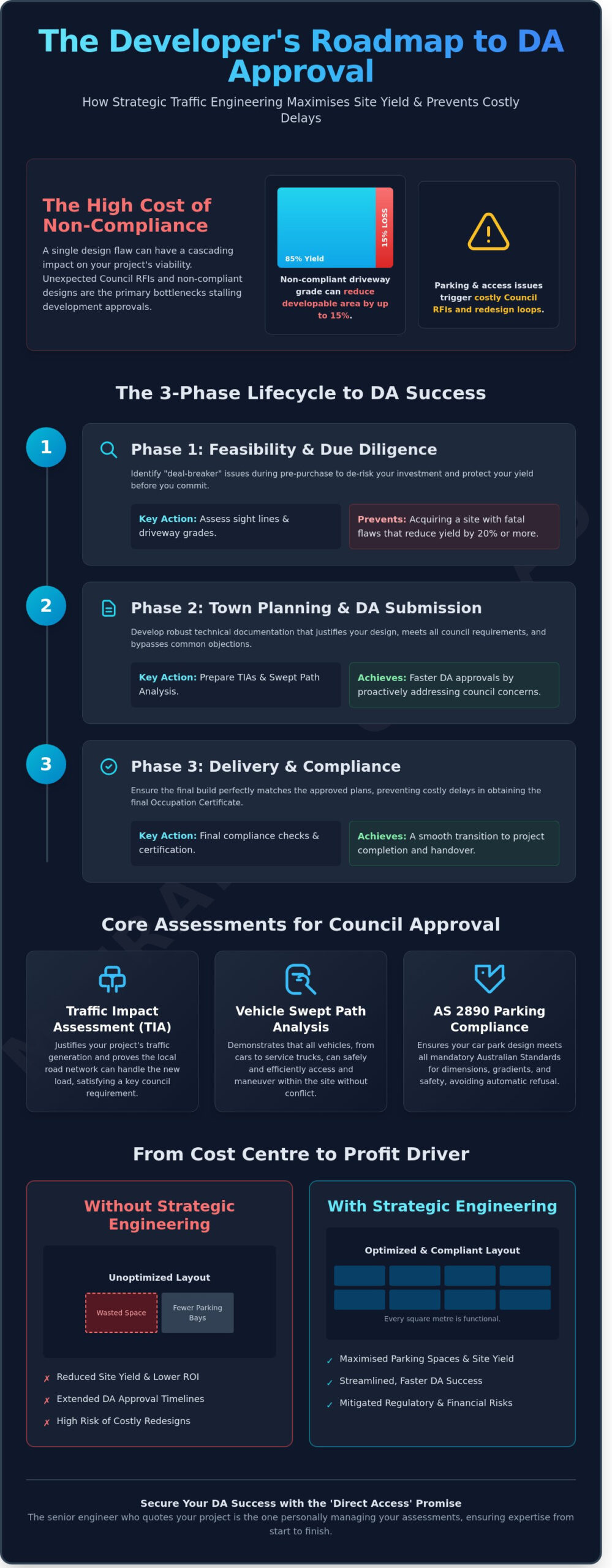
Successful projects don’t treat traffic as an afterthought. Effective traffic engineering for property developers follows a three-phase lifecycle that aligns technical requirements with commercial goals. Engaging experts early identifies constraints before they become A$100,000 redesign costs or lead to a flat refusal from Council. This lifecycle ensures that every design decision is backed by data and compliant with Australian Standards.
- Phase 1: Feasibility. We identify “deal-breaker” access issues during due diligence. This includes checking sight-line requirements and potential road widening mandates that could reduce your yield.
- Phase 2: Town Planning. This stage involves preparing the technical documentation required for DA submission. We focus on justifying parking variations and demonstrating that the local road network can absorb the new traffic.
- Phase 3: Delivery. During construction, we provide final compliance checks and certification. This ensures the physical build matches the approved plans, preventing delays in obtaining an Occupation Certificate.
Collaborating with transportation and development professionals ensures your project aligns with industry benchmarks while meeting local statutory requirements. Waiting until the design is finalised to consult an engineer is a mistake. Retrofitting a basement ramp to meet AS 2890.1 grades often results in the loss of multiple parking spaces or significant structural changes.
Feasibility and Site Access Strategy
Determining the most efficient entry and exit points is the first priority. We evaluate existing traffic volumes on adjacent roads to see if your development triggers a need for intersection upgrades, which can cost upwards of A$250,000. Our team assesses whether the site can satisfy council safety criteria without sacrificing valuable ground-floor GFA. We look at the specific constraints of the 10,000+ sites we have assessed to find the most direct path to approval.
Town Planning and DA Documentation
The core of any submission is a comprehensive Traffic Impact Assessment (TIA). This document must be robust enough to withstand scrutiny from council transport planners. We proactively liaise with authorities to resolve potential objections before they reach the formal Request for Information (RFI) stage. By integrating our findings with your Statement of Environmental Effects (SEE), we present a unified case for the development’s viability. You can review our full range of technical services to see how we support complex DA applications.
Essential Reports: TIAs, Swept Paths, and Parking Assessments
Securing a Development Application (DA) approval in 2026 hinges on the accuracy of your technical documentation. A Traffic Impact Assessment (TIA) serves as the primary justification for your project’s traffic generation. It calculates expected vehicle movements and assesses the impact on the existing road network using current RMS and Transport for NSW guidelines. For the construction phase, a Traffic Guidance Scheme (TGS) is mandatory to manage safety and site logistics. These documents aren’t mere formalities. They’re the evidence councils require to mitigate risk.
Professional traffic engineering for property developers ensures these reports align with both local council expectations and state regulations. Failure to provide granular data often results in Requests for Information (RFIs) that delay projects by months. Our engineers focus on delivering reports that are compliant, technical, and ready for immediate assessment. We’ve completed over 10,000 sites, so we know exactly what assessors look for in a submission.
The Power of Swept Path Analysis
We utilize AutoTURN software to conduct digital simulations of vehicle movements. This is essential for proving that heavy vehicles, such as 12.5-metre garbage trucks or delivery vans, can manoeuvre safely on-site. A precise swept path analysis can save significant space. By optimising driveway widths and turn radii, developers often regain 10% to 15% of floor area previously lost to inefficient traffic design. Every simulation we produce ensures strict compliance with B99 and B85 vehicle templates defined in Australian Standard AS 2890.1. Accurate simulations prevent costly mid-construction redesigns.
Justifying Parking Shortfalls
Council Development Control Plans (DCPs) often impose parking rates that don’t reflect modern car-dependency trends. A Car Parking Demand Assessment allows you to justify a reduction in required spaces. We analyse local public transport proximity and 2021 Census data to prove lower demand. In a recent Sydney-based mixed-use project, our data-driven argument supported a 25% reduction in parking spots. This saved the developer over A$480,000 in basement excavation costs. You can view our full range of assessment capabilities on our services page. Technical expertise in traffic engineering for property developers turns rigid council codes into flexible, site-specific solutions that protect your profit margins.
How Traffic Engineering Maximises Your Project ROI
Strategic traffic engineering for property developers transforms technical constraints into financial gains. It’s not just a compliance hurdle; it’s a tool to protect your margins. Every square metre in a basement costs between A$2,500 and A$4,500 to excavate and construct. Inefficient layouts waste capital. We focus on yield optimisation by refining aisle widths and pillar placements to fit more spaces into smaller footprints. This often increases parking yield by 8% to 15% on constrained sites.
Risk mitigation is the second pillar of ROI. A single redesign loop during the DA process can delay a project by 4 to 7 months. At current interest rates, these delays result in massive holding costs that eat into your profit. We provide negotiation leverage by using empirical data from over 10,000 sites to challenge unreasonable Council demands. If a Council officer requests a redundant turn-around area or excessive visitor parking, our data-backed reports provide the evidence needed to push back successfully.
Functionality also dictates long-term value. Planning for construction efficiency, waste collection, and heavy vehicle loading ensures the building works on day one. Poorly planned loading docks lead to operational bottlenecks and post-construction litigation that can devalue a commercial or mixed-use asset.
Maximising Parking Efficiency
We focus on the precision of basement layouts. Optimising pillar placement and aisle widths allows us to squeeze extra value out of every level. We design compliant ramps with grades that prevent vehicle scraping, which is a common cause of post-settlement disputes in high-end developments. Full compliance with AS 2890.1 directly ensures that every parking space is legally saleable and adds tangible value to the finished property title.
- Eliminating dead-end aisles to improve traffic flow.
- Using B85 and B99 vehicle templates to prove clearance in tight corners.
- Strategic placement of accessible bays to meet BCA requirements without wasting prime floor area.
Reducing Approval Timelines
Delays are the enemy of development. We submit “Council-ready” reports that pre-empt common RFIs and technical queries before they’re even asked. Having a senior traffic engineer with 35 years of experience handle your application means you have a consultant who understands local government bureaucracy. Professional representation at Council meetings can pivot a project toward approval by resolving technical disputes in a single session. This direct approach removes the gatekeepers and keeps your project moving toward the construction phase.
Protect your project margins by engaging experts who understand the financial stakes of traffic engineering for property developers. Contact ML Traffic Engineers for a direct quote on your next DA.
Securing Your DA Success with ML Traffic Engineers
ML Traffic Engineers has assisted private developers across Australia since 2005. Over these 19 years, we’ve completed assessments for more than 10,000 sites. Our portfolio spans every land-use type imaginable, including residential apartments, commercial offices, medical centres, child care facilities, and industrial warehouses. We understand that traffic engineering for property developers is a high-stakes component of the planning process. A single error in a swept path analysis or a parking layout can stall a project for months. We provide the technical certainty required to keep your development on track.
Our firm operates on a unique “Direct Access” promise. The senior engineer who reviews your plans and provides the initial quote is the same professional who performs the technical work and signs the final report. We’ve eliminated the layers of junior staff and administrative gatekeepers found in larger consultancies. This ensures that 30 to 40 years of senior-level experience is applied to every calculation and recommendation. It’s a hands-on approach that guarantees accountability and technical precision.
We focus on delivering practical, cost-effective solutions. We don’t believe in over-engineered reports that add unnecessary bulk to your submission or inflated costs to your construction budget. Instead, we produce concise, compliant documentation that addresses the specific requirements of local councils and state authorities. Our goal is to secure your DA approval by providing exactly what the planning authorities need to see, backed by rigorous data and professional integrity.
Why Developers Choose ML Traffic
- Senior-Level Expertise: Every project benefits from direct principal involvement. This oversight prevents the technical errors that lead to costly Requests for Further Information (RFIs) from Council.
- Rapid Turnaround: We respect your project timelines. Our streamlined internal processes allow us to meet tight DA submission deadlines without compromising on report quality.
- Regulatory Knowledge: We maintain a comprehensive understanding of national Australian Standards, such as AS 2890.1 for parking facilities. We also track local variations across different municipalities to ensure immediate compliance.
Get Started with Your Traffic Assessment
Requesting a quote for your next project is a straightforward process. To provide an accurate fee proposal, we typically need the site address and any preliminary architectural layouts or site plans. This allows us to gauge the scale of the traffic engineering for property developers required for your specific land use. We’ve worked on everything from small-scale subdivisions to massive industrial hubs, so no project is outside our scope.
During our initial consultation, we review the fundamental feasibility of your site. We look at critical factors like driveway ramp grades, vehicle swept paths, and sight-line requirements. Identifying these constraints early allows you to adjust your design before submitting to Council, saving you time and money. Our team provides the professional assurance that your project’s traffic and parking components are fully optimised for approval.
Ready to move forward? Contact ML Traffic Engineers today to secure your project’s traffic approval and benefit from nearly two decades of specialised industry experience.
Secure Your DA Approval with Technical Precision
Successful property development in 2026 requires more than basic planning; it demands rigorous technical compliance. Professional traffic engineering for property developers bridges the gap between architectural vision and Council approval. Your project’s ROI depends on accurate Traffic Impact Assessments and Vehicle Swept Path Assessments that adhere strictly to Australian Standards. Don’t let a poorly designed driveway ramp grade or inadequate parking assessment stall your project.
ML Traffic Engineers delivers 15+ years of technical experience to every site. We’ve assessed 10,000+ sites since 2005, covering everything from apartments to industrial warehouses. You’ll have direct access to senior principals throughout the lifecycle of your project. We don’t hide behind junior staff or account managers. The traffic consultant who provides your quote is the same expert who performs the assessment. This hands-on approach ensures your reports meet every regulatory requirement without unnecessary bureaucracy.
Take the next step in your development lifecycle today. Request a Quote for Your Property Development Traffic Report and secure the expertise your project deserves. We’re ready to help you navigate the complexities of your next site assessment.
Frequently Asked Questions
Why does council require a traffic report for my small development?
Council requires a traffic report to ensure that additional vehicle movements don’t compromise local road safety or neighbor access. Even a 3-unit townhouse development adds approximately 18 to 24 daily trips based on RMS guidelines. Engineers must verify that sight distances at your new driveway meet AS 2890.1 safety requirements to prevent collisions and ensure the local network can handle the increased load.
What is the difference between a Traffic Impact Statement and a TIA?
A Traffic Impact Statement (TIS) is a concise report for low-impact developments, while a Traffic Impact Assessment (TIA) is a complex study for large-scale projects. TIS reports usually cover sites with fewer than 20 parking spaces. TIA reports require detailed intersection modelling using SIDRA software to analyze delays and Level of Service changes for the surrounding road network.
How much does a typical traffic engineering report cost in 2026?
A standard report for a small to medium DA in 2026 typically costs between A$2,500 and A$5,500 plus GST. Complex TIAs for high-density residential towers or shopping centers can exceed A$15,000 depending on the number of intersections analyzed. These rates reflect the specialized RPEQ or NER certification required for professional traffic engineering for property developers in the current regulatory environment.
Can I use a general civil engineer for my traffic and parking assessment?
You shouldn’t use a general civil engineer because most councils require assessments from a qualified traffic specialist with specific transport planning experience. Traffic engineering involves specialized software and niche knowledge of AS 2890.1 for off-street car parking. A generalist often misses subtle ramp grade requirements, leading to expensive DA refusals or mandatory redesigns during the construction certificate phase.
What happens if my proposed car park doesn’t meet AS 2890 standards?
Your DA will likely be refused or hit with a Request for Further Information if your parking doesn’t comply with AS 2890. Non-compliance often results from insufficient aisle widths or blind aisles longer than 6 meters. We mitigate this by providing a merit-based justification or recommending minor structural adjustments to ensure the design meets the functional requirements of the Australian Standards.
How long does it take to prepare a Swept Path Analysis for a DA?
A standard Swept Path Analysis for a B85 or B99 vehicle usually takes 3 to 5 business days to complete. This timeline includes the time needed to model the driveway and parking bay geometry in CAD software. For heavy vehicle loading docks or complex basement ramps, the process can take 7 to 10 days to ensure every turn meets the 300mm clearance margin required.
Does a traffic engineer help with construction-stage traffic management?
Yes, we provide Construction Traffic Management Plans and Traffic Control Plans required before any work begins on site. These documents outline how 12.5-meter heavy rigid vehicles will enter and exit the site without blocking local traffic. Council usually mandates a CTMP as a condition of consent to manage the safety of pedestrians and motorists during the 12 to 24 month build period.
What is the “Z” grade in driveway design and why does council check it?
The “Z” grade is a 2-meter long transition section between a steep ramp and a level surface designed to prevent vehicle scraping. AS 2890.1 requires these transitions to be exactly half the grade of the main ramp. Council checks these calculations because a 1:4 ramp without a “Z” grade transition will cause most standard passenger cars to bottom out, creating a permanent liability.
Which areas do you cover?
We are traffic engineers servicing Melbourne, Sydney, Brisbane, Gold Coast, Hobart, Perth, Adelaide, Darwin, Canberra and surrounding areas.
Disclaimer
The content on www.mltraffic.com.au, including all technical articles, guides, and resources, is provided for general informational and educational purposes only. It is not intended to constitute professional advice in traffic engineering, transportation planning, development approvals, or any other technical or legal field.
While ML Traffic Engineers makes every reasonable effort to ensure the accuracy, completeness, and timeliness of the information published, we do not provide any warranties or representations (express or implied) regarding its reliability, suitability, or availability for any particular purpose. Any reliance you place on the content is strictly at your own risk.
In no event shall ML Traffic Engineers, its directors, employees, authors, or affiliates be liable for any direct, indirect, incidental, special, consequential, or punitive damages (including, without limitation, loss of profits, data, or business opportunities) arising out of or in connection with the use of, or inability to use, any information provided on this website.
The articles and guides on this site are not a substitute for engaging a qualified, registered professional traffic engineer (such as an NPER or RPEQ engineer) to assess your specific project requirements. For tailored advice, compliance assessments, or traffic engineering services, please contact a competent professional.
This disclaimer may be updated from time to time without notice. By accessing or using this website, you agree to be bound by the most current version of this disclaimer.
