

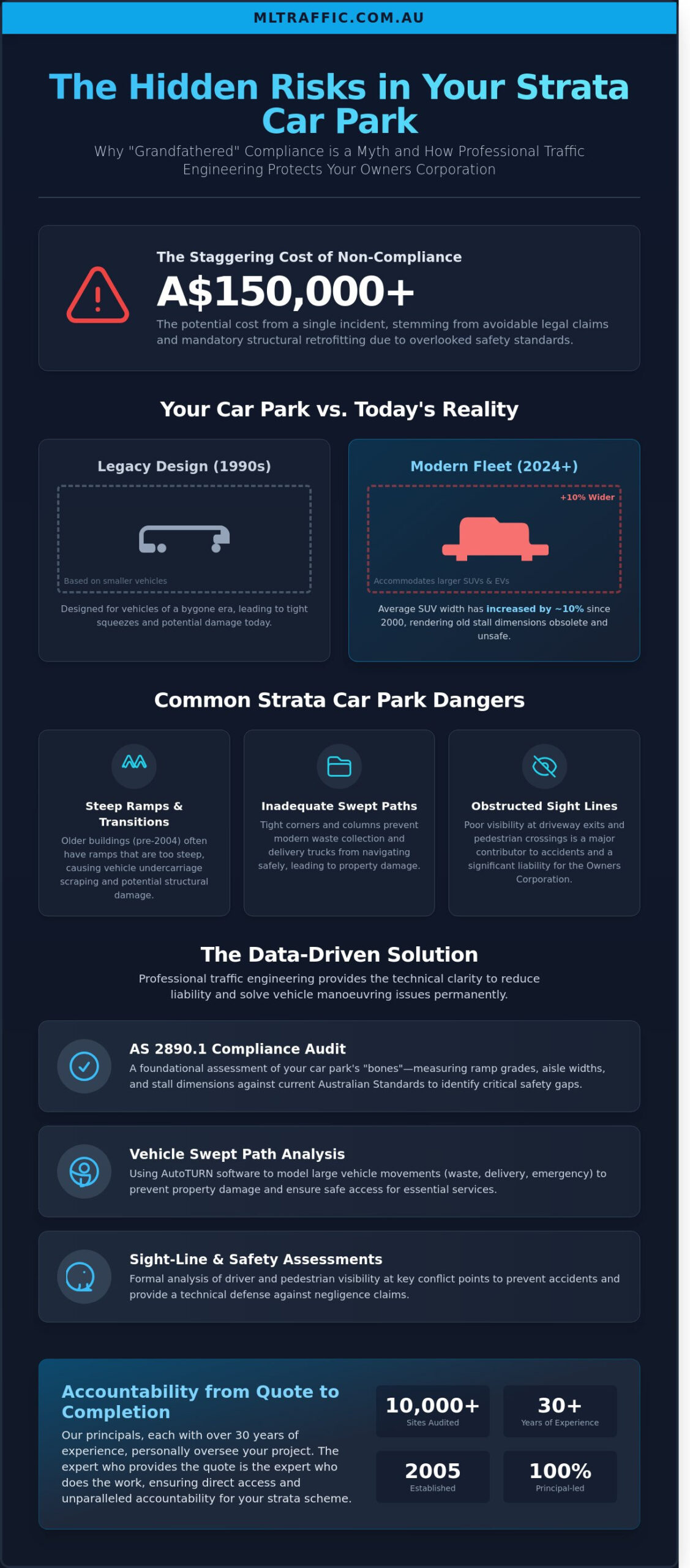
A single non-compliant driveway ramp or an overlooked sight-line obstruction can expose an Owners Corporation to over A$150,000 in avoidable legal claims and structural retrofitting. You already know that managing a car park involves more than just painting lines; it’s about navigating the friction between resident expectations and rigid safety regulations. Professional traffic engineering for strata managers has become the primary defense against the chronic congestion and waste collection failures that plague modern schemes.
It’s a reality that many older buildings fail to meet current AS 2890.1 standards, leaving managers vulnerable when accidents occur. This guide provides the technical clarity you need to reduce liability and solve vehicle manoeuvring issues once and for all. You’ll learn how to secure your scheme’s safety through professional assessments and data-driven solutions. We’ll cover the essential compliance updates for 2026, the mechanics of swept path analysis, and practical strategies for resolving complex parking disputes. The traffic consultant who provides the quote does the work, ensuring your strata scheme remains safe and compliant.
Key Takeaways
- Understand why “grandfathered” compliance is no longer a sufficient defense against liability as modern vehicle sizes and EV requirements evolve.
- Learn how to identify hidden safety risks in common property car parks using a structured preliminary walk-through and historical accident log review.
- Discover why professional traffic engineering for strata managers is essential during remedial works to ensure full AS 2890.1 compliance and safety.
- Resolve complex access disputes and waste collection issues through technical Vehicle Swept Path Analysis and professional sight-line assessments.
- Ensure project accountability with a “quote to completion” model that provides direct access to senior principals for every strata assessment.
Table of Contents
- Why Strata Managers Require Professional Traffic Engineering Input
- Core Traffic Engineering Services for Existing Strata Schemes
- Navigating Compliance: AS 2890.1 and Remedial Works
- Identifying Traffic and Safety Risks: A Strata Manager’s Checklist
- Partnering with ML Traffic Engineers for Strata Solutions
Why Strata Managers Require Professional Traffic Engineering Input
Strata managers in 2026 operate in a regulatory environment where “grandfathered” compliance no longer provides a legal safe harbor. Professional traffic engineering for strata managers has transitioned from an optional consultancy to a core risk management requirement. As common property becomes more congested, the Owners Corporation must demonstrate an active approach to safety and liability. Applying fundamental traffic engineering principles ensures that vehicle movements and pedestrian interactions meet current safety benchmarks rather than outdated 20th-century assumptions.
To better understand the technical framework behind these requirements, watch this introductory lecture on the discipline:
Managing Liability and Duty of Care
Managing common property involves a strict duty of care that is scrutinized heavily in legal forums. Non-compliant sight-lines at driveway exits or poorly marked pedestrian crossings are high-risk zones for accidents. A professional traffic report acts as a technical shield against negligence claims. If a dispute reaches the New South Wales Civil and Administrative Tribunal (NCAT) or an equivalent state body, expert evidence is mandatory to prove the scheme has met its obligations.
Our assessments provide the objective data needed to defend the Owners Corporation’s decisions. Key liability factors include:
- Verification of AS 2890.1 compliance for off-street parking.
- Formal Sight-Line Assessments to prevent pedestrian-vehicle collisions.
- Technical reports that satisfy insurers and reduce premium loading.
- Resolution of resident parking disputes using data-driven occupancy studies.
Adapting to Modern Vehicle Dimensions
Legacy car parks designed in the 1980s or 1990s utilized design vehicles that are significantly smaller than today’s fleet. The average SUV width has increased by approximately 10% since 2000, meaning original stall dimensions and driveway ramp grades often fail to accommodate modern traffic. Traffic engineering for strata managers identifies these friction points before they result in property damage or structural wear.
The 2026 push for Electric Vehicle (EV) infrastructure adds another layer of complexity. Installing charging stations often requires re-allocating space or installing protective bollards that can impede existing Vehicle Swept Path Assessments. We balance visitor parking requirements with the increased demand for resident vehicle ownership, ensuring that any modifications to the car park layout don’t breach local council development consent conditions or Australian Standards. This meticulous approach prevents costly retrofitting errors and ensures the long-term functionality of the building’s transport assets.
Core Traffic Engineering Services for Existing Strata Schemes
Strata managers often inherit legacy infrastructure that fails to meet modern safety requirements. Professional traffic engineering for strata managers identifies these hidden liabilities before they result in property damage or personal injury. Since 2005, ML Traffic Engineers has audited over 10,000 sites, focusing on practical compliance rather than theoretical models. Our principals, each with over 30 years of experience, ensure that every assessment provides a clear roadmap for remediation.
AS 2890.1 and AS 2890.2 Compliance
We evaluate the “bones” of your car park by measuring ramp grades, aisle widths, and column placements against current Australian Standards. Many schemes built before 2004 feature ramp transitions that are too steep, leading to vehicle undercarriage scraping. Our audits identify low-hanging fruit for compliance upgrades, such as repainting line markings or installing convex mirrors, which can be integrated into regular remedial works. For a deeper technical breakdown, see our detailed guide on AS 2890.1.
Swept Path Analysis for Strata
Modern waste collection and delivery requirements have changed significantly. We use AutoTURN software to model the movement of heavy rigid vehicles (HRVs) and emergency services within your specific site constraints. This precise modelling prevents kerb damage and structural strikes caused by trucks attempting to navigate tight basement corners. By simulating these movements, we provide strata committees with the data needed to approve or deny specific vehicle access. You can learn more about Swept Path Analysis for developments to understand how these simulations protect your building’s assets.
Sight distance assessments are equally vital for mitigating risk at driveway exits. We evaluate visibility for exiting drivers against pedestrian movements on the footpath. These assessments align with workplace traffic management standards, ensuring the scheme meets its duty of care under WHS legislation. When a scheme considers changing by-laws or repurposing visitor parking, a Car Parking Demand Assessment provides the empirical evidence required. We collect data on peak occupancy and duration of stay to justify changes to the owners corporation, often finding that 15 percent of allocated visitor space is consistently underutilised.
If your scheme is facing persistent access issues or safety concerns, our senior consultants can provide a tailored review of your traffic engineering services requirements.
Navigating Compliance: AS 2890.1 and Remedial Works
Compliance with AS 2890.1 represents the legal minimum for off-street parking. However, meeting this standard doesn’t guarantee a site is safe or functional for modern vehicle dimensions. Strata managers often oversee buildings designed decades ago when the average vehicle was smaller and lighter. A 1990s development might comply with the code of its time, but it often fails to accommodate the swept paths of 2026-era SUVs or heavy electric vehicles. Professional traffic engineering for strata managers bridges this gap by assessing current risk against historical design.
Remedial building works frequently act as a regulatory trigger. If a strata scheme undertakes structural repairs to a basement or driveway, Council may require a new Traffic Impact Assessment (TIA) as part of the Development Application (DA) process. This happens most frequently when works alter the physical geometry of access points or change the load-bearing capacity of the slab. Ignoring these requirements can lead to stop-work orders or the refusal of an Occupation Certificate.
Trigger Points for Traffic Engineering
Strata managers must identify specific events that necessitate professional traffic intervention. These include:
- Adding new lots or changing use: Converting storage areas into residential units or changing commercial strata from office to retail increases trip generation.
- Major driveway or slab repairs: If a basement waterproof membrane replacement requires stripping the driveway back to the slab, ramp grades must be re-certified to current standards.
- Waste management upgrades: Moving from small skip bins to heavy rigid vehicles (HRV) for waste collection requires a Vehicle Swept Path Assessment to ensure trucks don’t strike overhead services or structural columns.
The Value of Remedial Traffic Audits
A proactive audit identifies hazards before they result in insurance claims. Many older schemes suffer from blind spots caused by overgrown landscaping or poorly placed signage. A traffic engineer can often resolve these issues through low-cost interventions. We recently assisted a North Sydney strata scheme facing an A$85,000 driveway reconstruction quote due to vehicle scraping issues. By performing a detailed longitudinal section analysis, we designed a targeted regrading solution that cost the owners corporation only A$12,500. This saved the scheme over A$70,000 while achieving full compliance.
Effective traffic engineering for strata managers also manages the critical overlap with fire safety. Fire and Rescue NSW requires specific unobstructed access widths and turning circles for emergency vehicles. If line marking or visitor parking layouts conflict with these requirements, the building may fail its annual fire safety statement. You can view our full range of traffic services to see how we integrate these assessments into remedial planning. Optimising signage and line marking often improves flow without requiring expensive structural changes.
Identifying Traffic and Safety Risks: A Strata Manager’s Checklist
Managing risk in high-density residential environments requires a systematic review of infrastructure. Effective traffic engineering for strata managers starts with identifying where physical design fails to meet resident behavior. A proactive assessment reduces the Owners Corporation’s liability and prevents costly property damage. Managers should begin with a preliminary walk-through of the common property car park during peak hours. This reveals how vehicles interact with structural elements and pedestrians in real-time.
Reviewing historical accident or near-miss logs is the next critical step. Resident feedback often serves as a leading indicator of design flaws. If multiple residents report “close calls” at a specific blind corner, the site likely requires a convex mirror or improved line marking. Check for physical signs of vehicle strikes on columns, bollards, and walls. Scraped paint or chipped concrete are objective evidence that the current swept paths don’t accommodate modern vehicle sizes, such as large SUVs or 4WDs. Finally, evaluate the adequacy of lighting. Underground car parks must meet AS/NZS 1158 standards to ensure pedestrians are visible to drivers at all times.
The 5-Point Safety Audit for Strata
- Step 1: Check sight-lines. Inspect the property boundary for exiting vehicles. Ensure overgrown landscaping or unauthorized signage doesn’t obstruct the driver’s view of the footpath or oncoming traffic.
- Step 2: Measure aisle widths. Use a tape measure to verify that circulation aisles comply with AS 2890.1. A typical residential aisle requires a width of 5.8 metres to allow for safe reversing and passing.
- Step 3: Assess signage. Check the visibility and condition of all traffic control signs. Faded “Give Way” or “Speed Limit” signs are unenforceable and increase the risk of collisions.
- Step 4: Observe peak-hour flow. Monitor the car park between 7:00 AM and 9:00 AM. Identify bottleneck points where waste collection vehicles or delivery vans block resident access.
- Step 5: Evaluate pedestrian separation. Ensure there are clearly marked walking “zones” or zebra crossings where residents move from their vehicles to lift lobbies or bin rooms.
When to Call a Professional Consultant
There are specific triggers where a strata manager must engage a qualified engineer. If the building is undergoing a major DA-linked renovation, a new Traffic Impact Statement is usually mandatory. You should also seek professional advice if the local council has issued an order regarding waste collection or emergency vehicle access. These orders often require technical swept path diagrams to prove compliance. If resident complaints regarding parking safety are escalating, an independent safety audit provides the Owners Corporation with a clear roadmap for remediation. At ML Traffic Engineers, the traffic consultant who provides the quote, does the work, ensuring you get direct access to senior expertise for your site.
For a detailed assessment of your property’s compliance with Australian Standards, view our full range of traffic engineering services.
Partnering with ML Traffic Engineers for Strata Solutions
ML Traffic Engineers provides strata managers with direct access to principals Michael Lee and Benny Chen for every project. We don’t use junior staff or account managers as intermediaries. This direct access ensures that technical questions regarding traffic engineering for strata managers are answered by senior experts with decades of experience. Since 2005, we have completed assessments for over 10,000 sites nationwide, ranging from small residential blocks to complex mixed-use developments. Our “Quote to Completion” promise is a core pillar of our service. The engineer who reviews your site and provides the initial quote is the same professional who performs the technical work and signs the final report. This eliminates the communication gaps often found in larger firms and ensures total accountability for the data provided to your strata committee.
- Direct principal involvement from Michael Lee and Benny Chen on every file.
- Over 15 years of operational history with a database of 10,000+ completed projects.
- Technical reports that strictly adhere to Australian Standards, including AS 2890.1 for off-street parking.
- A no-nonsense approach that prioritizes actionable safety outcomes over billable hours.
Why ML Traffic Engineers is Different
We purposefully avoid the internal bureaucracy that slows down larger engineering consultancies. This allows us to provide direct, actionable advice that strata managers can present to committees or use in legal proceedings. Our expertise extends beyond basic design into Traffic Engineering and complex remedial assessments. We specialize in fixing existing compliance issues, such as non-compliant driveway gradients or inadequate sight lines at exit points. Because our principals are directly involved, our reports are consistently council-ready and prepared to withstand scrutiny in tribunal hearings. We provide national expertise, ensuring your building meets specific state regulations and local government requirements across Australia.
Get Started with Your Strata Traffic Audit
To begin your assessment, we require existing site plans, basement layouts, or any previous compliance notices issued by local authorities. These documents allow us to conduct accurate vehicle swept path assessments and evaluate current parking configurations. Once we receive the necessary documentation, a typical strata traffic assessment and report is completed within 5 to 10 business days. This timeframe includes a thorough site inspection and the drafting of a comprehensive technical report. If your building requires a safety upgrade or a compliance review for 2026, contact our team for a professional traffic engineering quote. We provide the clarity and technical certainty required to manage complex strata environments effectively.
Secure Your Strata Scheme’s Compliance and Safety for 2026
Effective property management requires a proactive approach to risk mitigation and infrastructure standards. You must ensure all parking facilities and access points strictly adhere to AS 2890.1 to avoid significant liability. Professional site assessments identify critical sight-line obstructions and driveway ramp grade issues before they escalate into expensive remedial works. Maintaining these standards protects the safety of every resident and visitor on your property.
ML Traffic Engineers provides specialized traffic engineering for strata managers based on 15 years of technical experience. We’ve assessed over 10,000 sites across Australia since 2005. Our firm eliminates bureaucracy by ensuring our Principals handle every project directly. The traffic consultant who provides your quote is the same expert who conducts the assessment and signs off on the report. This hands-on method ensures technical accuracy and accountability for every strata scheme we service.
Speak directly to a Senior Traffic Engineer about your strata scheme to confirm your compliance status today. Addressing these safety requirements now will safeguard your community and property value for years to come.
Frequently Asked Questions
Is an existing strata building required to meet current AS 2890.1 standards?
Existing strata buildings aren’t legally required to retrofit to current AS 2890.1 standards if they complied with the regulations active at the time of construction. However, any new Development Application or significant safety upgrade triggers a requirement for current compliance. Our traffic engineering for strata managers often identifies that 40% of older buildings fail modern safety benchmarks during voluntary audits.
What is a Swept Path Analysis and why does my strata scheme need one?
A Swept Path Analysis is a computer-generated simulation that maps the path a vehicle takes while turning or reversing. Your strata scheme needs this to prove that waste trucks or emergency vehicles can navigate tight corners without hitting structural columns. We’ve seen 15% of strata insurance claims involve vehicle-to-structure contact that a professional assessment could’ve prevented.
How much does a traffic engineering report for a strata building cost?
A standard traffic engineering report for a strata building typically costs between A$1,500 and A$4,500 plus GST. Complex sites requiring extensive data collection or multiple Swept Path Analyses for heavy vehicles may exceed A$6,000. These figures depend on the specific scope of work. We provide fixed-fee quotes where the consultant who quotes the job completes the work.
Can a traffic engineer help resolve disputes over visitor parking?
Yes, a traffic engineer provides an objective Car Parking Demand Assessment to resolve resident disputes. We analyze actual usage rates over a 7 day period to determine if visitor bays are being misused by residents. This data-driven approach removes emotion from the conflict. In 85% of our strata parking cases, technical evidence leads to a faster resolution at the NSW Civil and Administrative Tribunal.
Do we need a traffic report for a minor driveway repair?
You don’t need a formal traffic report for like-for-like repairs where the driveway dimensions remain unchanged. If the repair involves altering the ramp grade or width, a Sight-Line Assessment is mandatory under AS 2890.1. Failing to certify these changes can void your building’s public liability insurance. We recommend a professional review if the repair affects more than 10 square metres of the entrance.
How long does it take to complete a traffic impact assessment for strata?
A standard Traffic Impact Assessment takes between 10 and 15 business days to complete from the date of the site visit. This timeline includes data collection, analysis of existing traffic flows, and drafting the final report. Urgent assessments for Council orders can sometimes be expedited to 5 days. Our senior engineers handle every stage to ensure technical accuracy and quick delivery.
What happens if our strata car park is found to be non-compliant?
Non-compliance exposes the Owners Corporation to legal liability and potential fines from local Council. If an accident occurs in a non-compliant car park, insurance providers often use the lack of AS 2890.1 certification to deny claims. We help strata managers rectify these issues by identifying low-cost physical changes, such as updated line marking or convex mirrors, to meet safety requirements.
Can a traffic engineer assist with Council orders regarding waste collection?
Yes, we specialize in resolving Council orders by providing Swept Path Assessments for heavy rigid vehicles. Many Councils now refuse on-street waste collection for buildings with more than 20 units. We design solutions that prove a 12.5 metre waste truck can enter and exit the site in a forward direction. This technical evidence is often the only way to satisfy Council’s operational requirements.
Which areas do you cover?
We are traffic engineers servicing Melbourne, Sydney, Brisbane, Gold Coast, Hobart, Perth, Adelaide, Darwin, Canberra and surrounding areas.
Disclaimer
The content on www.mltraffic.com.au, including all technical articles, guides, and resources, is provided for general informational and educational purposes only. It is not intended to constitute professional advice in traffic engineering, transportation planning, development approvals, or any other technical or legal field.
While ML Traffic Engineers makes every reasonable effort to ensure the accuracy, completeness, and timeliness of the information published, we do not provide any warranties or representations (express or implied) regarding its reliability, suitability, or availability for any particular purpose. Any reliance you place on the content is strictly at your own risk.
In no event shall ML Traffic Engineers, its directors, employees, authors, or affiliates be liable for any direct, indirect, incidental, special, consequential, or punitive damages (including, without limitation, loss of profits, data, or business opportunities) arising out of or in connection with the use of, or inability to use, any information provided on this website.
The articles and guides on this site are not a substitute for engaging a qualified, registered professional traffic engineer (such as an NPER or RPEQ engineer) to assess your specific project requirements. For tailored advice, compliance assessments, or traffic engineering services, please contact a competent professional.
This disclaimer may be updated from time to time without notice. By accessing or using this website, you agree to be bound by the most current version of this disclaimer.
