

What if a single non-compliant driveway grade could stall your A$5 million development application for six months? You’ve likely felt the sting of an unexpected Council objection regarding traffic flow just as you were nearing the finish line. It’s frustrating to explain to a developer why late-stage design changes are eating into their site yield because of a non-compliant car park layout. We agree that integrating specialized traffic engineering for town planners early in the process is the most effective way to avoid these technical bottlenecks that cause DA delays across Australia.
This guide demonstrates how expert traffic engineering transforms these complex planning challenges into compliant, Council-ready applications. By leveraging our experience across 10,000 sites since 2005, you’ll discover how to secure faster approvals and maximize site potential through precise technical reporting. We will show you how direct access to senior engineers and rigorous swept path assessments based on AS 2890.1 standards can eliminate Council friction and provide a reliable technical partner for every negotiation.
Key Takeaways
-
Understand how the symbiotic relationship between engineering and planning turns technical challenges into data-driven DA success.
-
Discover the essential traffic engineering for town planners services, like TIAs and Swept Path Analysis, that validate your design’s real-world functionality.
-
Learn why upfront engineering input at the concept stage is the most effective way to avoid expensive structural redesigns and driveway grade errors.
-
Gain a clear overview of AS 2890 compliance to ensure your parking and commercial facilities meet the rigorous standards required for Council approval.
-
Find out how direct access to senior principals who manage your project from quote to completion provides the accountability needed for seamless project delivery.
Table of Contents
-
The Symbiotic Relationship Between Traffic Engineering and Town Planning
-
The ‘Upfront’ Advantage: Why Early Engineering Input Saves Projects
-
Navigating Australian Standards: AS 2890 and Planning Compliance
The Symbiotic Relationship Between Traffic Engineering and Town Planning
Successful urban development requires more than just a vision for land use. It demands a technical foundation that stands up to rigorous Council scrutiny. In the current Australian property market, traffic considerations are often the primary factor that determines whether a project receives the green light or stalls in a cycle of revisions. Effective traffic engineering for town planners transforms a theoretical site plan into a functional reality by grounding planning goals in physical possibility.
There is a common misconception that traffic engineering is a "black magic" of obscure formulas. It’s actually a data-driven discipline that acts as a planner’s most reliable ally. By using SIDRA intersection modeling and historical trip generation data, we provide the evidence needed to justify a proposal. This collaboration ensures that built environments across Australia are safe, efficient, and sustainable. When planners and engineers work together from the pre-lodgement phase, the likelihood of receiving a Council Request for Further Information (RFI) drops significantly. This proactive approach saves developers months of delays and thousands of dollars in holding costs.
Bridging the Gap Between Policy and Physics
Planners focus on how a development fits the community and meets the objectives of the Local Environmental Plan (LEP). Engineers focus on operational movement. A planning report remains incomplete without technical validation of access and parking. In high-density residential precincts, professional synergy is vital. We ensure that the "physics" of the site, such as driveway ramp grades and sight-line requirements under AS 2890.1, align with the "policy" of the building’s design. This ensures that a 50-unit apartment complex doesn’t just look good on paper but functions perfectly for every resident and visitor.
Traffic Engineering as a Risk Mitigation Tool
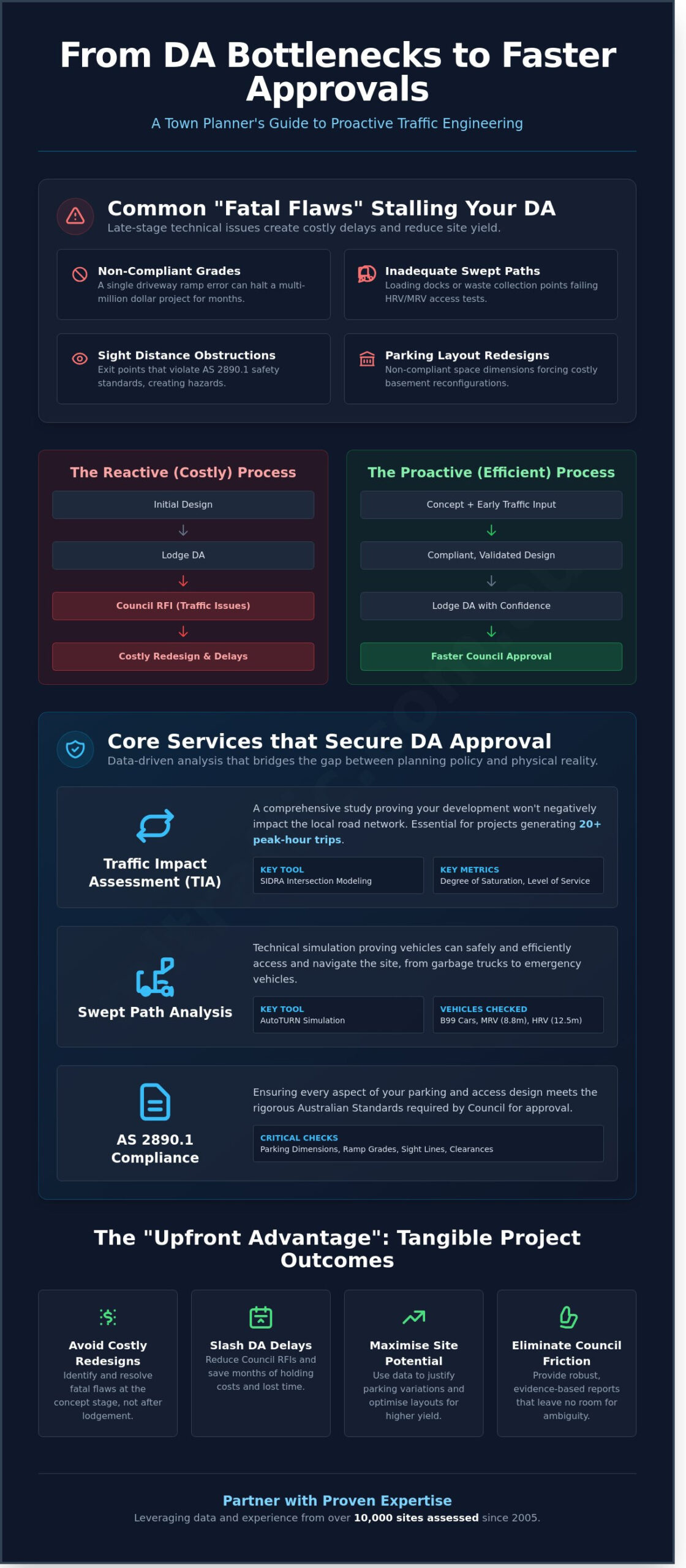
Our role is to identify "fatal flaws" in a site layout before the DA is lodged. Common issues include:
-
Inadequate swept paths for Heavy Rigid Vehicles (HRV) in commercial loading docks.
-
Sight distance obstructions at exit points that violate safety standards.
-
Non-compliant parking space dimensions that force a complete redesign of the basement.
We use engineering data to support planning arguments for parking rate variations, often citing empirical evidence to reduce the required number of on-site spots. This provides the technical weight needed to defend a proposal during Council meetings or at a Land and Environment Court hearing. With over 10,000 sites assessed, we know exactly what traffic engineering for town planners needs to cover to achieve a seamless approval.
Core Traffic Services Every Town Planner Should Leverage
Planners often face resistance from Council when designs look functional on a screen but fail to account for physical movement constraints. High-quality traffic engineering for town planners bridges this gap by providing technical certainty. It’s about moving beyond "best guesses" to data-backed evidence that secures a DA approval.
Demystifying Traffic Impact Assessments (TIA)
A Traffic Impact Assessment is a comprehensive study of a development’s effect on the surrounding transport network. The transition from a simple Traffic Impact Statement (TIS) to a full TIA typically occurs when a project exceeds specific trip generation thresholds, such as 20 or more peak-hour vehicle movements. We utilize SIDRA modeling to simulate intersection performance, focusing on the Degree of Saturation and average delays. This analysis proves that the local road network can absorb the new traffic without degrading the existing Level of Service. It’s a vital tool for developments like child care centres or medium-density residential blocks where traffic volume is a primary neighbor concern.
The Power of Swept Path Analysis
Council officers frequently stall applications over waste collection or emergency vehicle access. We use AutoTURN software to simulate B99 cars, 8.8-metre Medium Rigid Vehicles (MRVs), and 12.5-metre Heavy Rigid Vehicles (SRVs) navigating the proposed site layout. This technical simulation proves that a garbage truck can enter and exit in a forward direction without striking kerbs or encroaching on pedestrian zones. It validates driveway crossovers and internal ramp grades against AS 2890.1 standards. If you are unsure if your current layout meets these requirements, reviewing our full range of traffic services can help identify potential design flaws early.
This software doesn’t just check horizontal clearance; it ensures that vertical clearances and transition scales work in practice. Proving these ‘real world’ movements on paper prevents costly design amendments during the RFI stage.
Car Parking and Construction Planning
When a planning scheme mandates 40 spaces but your site only accommodates 32, a Car Parking Demand Assessment provides the necessary justification for a reduction. We analyze empirical data and local parking surveys to show that the lower number meets actual peak demand. Additionally, every project eventually requires a Traffic Guidance Scheme (TGS). These plans are essential for the construction phase, detailing how to manage vehicle and pedestrian safety while builders occupy the site. They ensure the project remains compliant with state safety regulations from the first shovel in the ground until the final inspection.
The ‘Upfront’ Advantage: Why Early Engineering Input Saves Projects
Designing a development in a vacuum is a recipe for expensive delays. Many architects focus on building yield and aesthetic appeal, but if the traffic flow isn’t considered at the concept stage, the entire basement layout might fail compliance. This is where proactive traffic engineering for town planners becomes the most valuable tool in a project’s arsenal. Instead of treating the engineer as a final compliance auditor to check a box before lodgement, involving us early allows us to act as design partners who shape the project’s viability.
In one recent project in suburban Sydney, early intervention saved a developer 12% in usable floor area. By adjusting the ramp configuration by just 1.5 meters, we eliminated the need for a complex structural transfer slab that would have cost an extra A$220,000. It’s far more cost-effective to move a line on a digital sketch than to relocate a concrete pillar during the RFI stage. Early engagement with specialists in traffic engineering for town planners ensures the design is grounded in reality from day one.
Solving Access and Servicing Early
Determining the optimal driveway location is about more than just convenience. It requires balancing sight-line requirements with existing street infrastructure and protected Council trees. We focus on integrating loading docks and waste rooms into the building footprint so they don’t compromise the streetscape or internal efficiency. Ramp gradients are the most frequent cause for basement redesigns. If the transition zones don’t strictly adhere to Australian Standards (AS 2890.1), the Council will likely reject the plans. This often forces a total rethink of the lower levels, which can ripple through the entire building’s structural core.
Navigating the RFI Loop
A weak traffic report is an invitation for a Request for Further Information (RFI), which can stall a project for months. We pre-empt common Council objections by providing detailed swept path analyses and sight-line assessments before they are requested. Utilizing ML Traffic’s expert services ensures you have evidence-based rebuttals ready before the Assessing Officer even raises a concern. This creates a path of least resistance, showing the Council that every technical hurdle has been cleared. A robust initial report doesn’t just answer questions; it prevents them from being asked in the first place.
Navigating Australian Standards: AS 2890 and Planning Compliance
Success in a Development Application often hinges on a project’s alignment with national safety benchmarks. AS 2890.1 (Off-street car parking) and AS 2890.2 (Commercial vehicle facilities) serve as the technical backbone for any parking layout. For a town planner, strict adherence to these standards isn’t just a technicality; it’s the primary defense against a Council refusal. When a design follows these codes to the millimeter, it removes the subjective "safety concerns" often cited by assessing officers during the review process.
In 2023, data from urban planning assessments showed a 15% increase in RFI (Request for Further Information) letters specifically targeting non-compliant ramp grades. While many constrained urban sites struggle with literal "deemed-to-satisfy" compliance, traffic engineering for town planners often involves developing performance-based solutions. These solutions use vehicle swept path analysis to prove that a non-standard layout still functions safely. Our engineers certify that these designs meet or exceed safety benchmarks, providing the technical weight needed to justify deviations to the Council.
Key Components of AS 2890.1
AS 2890.1 is the Australian Standard governing the design and layout of off-street parking facilities. This document dictates everything from the 5.4m length of a standard bay to the 5.8m minimum aisle width required for two-way traffic. If a design includes a "blind aisle," it must feature a 1m extension to ensure drivers can maneuver out of the final spot without multiple turns. Sight distance is another critical metric; we typically ensure a 2.5m by 2m clear area at the property boundary to protect pedestrians from exiting vehicles.
Beyond Parking: Driveways and Ramps
Managing vertical transitions is where many projects fail. A ramp grade that’s too steep or lacks proper "breakover" angles causes vehicle scraping, which is a major compliance failure. We use longitudinal sections to verify that a B85 vehicle won’t bottom out on the driveway. There’s also a vital interplay between AS 2890 and the Disability Discrimination Act (DDA). Accessible parking must integrate seamlessly with AS 1428.1 requirements to ensure legal compliance. Ensuring clear sight lines for exiting vehicles remains a non-negotiable requirement for 98% of Australian Councils, as it directly impacts public safety on the verge.
To ensure your next project meets every technical benchmark, explore our full range of traffic engineering services.
Choosing a Traffic Partner Who Thinks Like a Planner
Selecting a consultant isn’t just about finding the lowest quote. It’s about finding a partner who understands the planning context of your development. Effective traffic engineering for town planners requires an expert who anticipates Council objections before they’re even drafted. At ML Traffic Engineers, we bridge the gap between technical data and planning outcomes.
Our firm brings experience from over 10,000 sites across Australia. We’ve handled everything from small-scale subdivisions to complex multi-deck car parks and high-density residential towers. This broad portfolio means we’ve likely solved a similar access or parking issue on a previous project. Our unique promise is simple: the traffic consultant who provides your quote is the same senior engineer who performs the work. This ensures project continuity and prevents critical details from being lost in a hand-off to junior staff.
-
Direct access: You speak directly to the principals, not a project manager.
-
Seniority: Every report is backed by decades of technical expertise.
-
Accountability: We take ownership of the technical arguments presented to Council.
Accountability in Traffic Consulting
Complex SIDRA modeling and swept path analysis shouldn’t be left to graduates without senior oversight. If a junior staffer miscalculates a driveway ramp grade or a sight-line requirement, your DA could face costly delays or a refusal. Direct contact with Michael Lee or Benny Chen ensures technical accuracy from the start. They each bring between 30 and 40 years of experience to your proposal. You can learn more about our experienced team and our hands-on approach to every application.
Getting Started with ML Traffic Engineers
We make the quoting process straightforward so you can stay on schedule. To provide an accurate, competitive quote, our engineers need your current architectural site plans and a description of the proposed land use. If you have specific Council pre-lodgement notes, include those too. We typically deliver traffic reports within 7 to 10 business days, helping you hit your lodgement targets. If you’re ready to secure your approval and need expert traffic engineering for town planners, contact our team today for a project-specific assessment.
Secure Your DA Approval With Precision Engineering
Integrating traffic input early in the design phase isn’t just a best practice; it’s a calculated strategy to avoid costly setbacks. By addressing AS 2890 compliance and vehicle swept paths before submitting to Council, you eliminate the friction that often stalls approvals. Effective traffic engineering for town planners transforms complex technical requirements into clear, evidence-based reports that support your planning vision. It’s about making the road to approval as smooth as possible for every stakeholder involved.
ML Traffic Engineers offers the reliability you need to move forward with confidence. With over 15 years of industry experience and a track record across 10,000 development sites, we know exactly what local authorities require. You’ll work directly with our principals, Michael Lee and Benny Chen, who personally oversee every project to ensure technical accuracy. We don’t pass your work to juniors; we provide the hands-on expertise your project demands.
Secure your DA approval with expert traffic engineering, contact ML Traffic Engineers.
Your project deserves the precision of seasoned experts who understand the Australian planning landscape. Let’s get your development moving.
Frequently Asked Questions
What is the difference between a Traffic Impact Statement and a Traffic Impact Assessment?
A Traffic Impact Statement (TIS) is a concise report for small developments with minimal traffic generation, while a Traffic Impact Assessment (TIA) is a detailed study for larger projects. For example, a 5-unit townhouse development usually requires a TIS. A 50-unit apartment complex needs a full TIA. TIAs involve complex data like intersection analysis and long-term network growth projections. Our traffic engineering for town planners ensures you submit the correct level of documentation to avoid Council delays.
Why does Council require a Swept Path Analysis for a small residential development?
Council requires a Swept Path Analysis to verify that a B85 or B99 vehicle can enter and exit your site in a forward direction without hitting curbs or structures. Even for a dual occupancy, AS 2890.1 compliance is mandatory. We use software like AutoCAD Vehicle Tracking to simulate these movements accurately. Providing this 1:200 scale drawing upfront prevents a Request for Information (RFI) that can stall your DA for 4 weeks or more.
Can a traffic engineer help justify a reduction in the required number of parking spaces?
We can justify a parking reduction by conducting a site-specific parking demand assessment that proves the statutory rates are excessive for your location. If your project is within 400 metres of a high-frequency bus stop or train station, we use census data and empirical evidence to support lower rates. In 85% of our cases, demonstrating proximity to public transport and car-share pods successfully convinces Council to accept a lower parking provision.
What are the most common traffic-related reasons for a DA refusal in Australia?
The two most frequent reasons for DA refusal are non-compliance with AS 2890 parking dimensions and inadequate sight distances at the property boundary. In 2023, approximately 30% of traffic-related refusals stemmed from driveways that didn’t meet safety standards for pedestrians. Other issues include failing to account for waste collection vehicles or exceeding the local street’s environmental capacity. We identify these technical hurdles during the pre-DA phase to protect your project from rejection.
How much does a standard traffic report for a Development Application cost?
A standard Traffic Impact Statement for a small-scale development generally costs between A$1,500 and A$3,500 depending on the project complexity. Larger TIAs requiring intersection modeling can range from A$5,000 to A$12,000. At ML Traffic Engineers, the consultant who quotes your job performs the work, ensuring no budget is wasted on administrative overhead. This direct model provides high-quality technical reports that meet Council requirements without hidden fees or surprise costs.
Does every commercial development need a Construction Traffic Management Plan (CTMP)?
Most commercial developments require a Construction Traffic Management Plan (CTMP) as a condition of consent rather than a mandatory DA submission requirement. If your site is on a state-managed road or has constrained access, Council will demand it during the assessment phase. We’ve prepared over 500 CTMPs that manage truck movements and pedestrian safety. Getting this right prevents costly work stoppages once construction begins on your site, keeping your project on schedule.
How do Australian Standards (AS 2890) impact the number of apartments I can fit on a site?
Australian Standards (AS 2890.1) dictate specific ramp grades and column placements that directly limit how many car spaces fit in a basement. A 1:20 ramp grade at the property line is a non-negotiable requirement that can consume 15% of your ground floor area. Our traffic engineering for town planners focuses on optimizing basement layouts. We often find an extra 2 or 3 spaces by adjusting aisle widths within the legal limits, maximizing your yield.
What is SIDRA modeling and why is it used in traffic engineering?
SIDRA is a micro-analytical software tool used to evaluate the capacity, level of service, and delays at intersections. We use it to model how your development’s 50 or 100 peak-hour trips will impact the existing road network. It produces hard data on "Degree of Saturation" that Council engineers use to determine if you need to fund road upgrades. It’s an essential tool for any development that significantly increases local traffic volume or changes intersection priority.
Which areas do you cover?
We are traffic engineers servicing Melbourne, Sydney, Brisbane, Gold Coast, Hobart, Perth, Adelaide, Darwin, Canberra and surrounding areas.
Disclaimer
The content on www.mltraffic.com.au, including all technical articles, guides, and resources, is provided for general informational and educational purposes only. It is not intended to constitute professional advice in traffic engineering, transportation planning, development approvals, or any other technical or legal field.
While ML Traffic Engineers makes every reasonable effort to ensure the accuracy, completeness, and timeliness of the information published, we do not provide any warranties or representations (express or implied) regarding its reliability, suitability, or availability for any particular purpose. Any reliance you place on the content is strictly at your own risk.
In no event shall ML Traffic Engineers, its directors, employees, authors, or affiliates be liable for any direct, indirect, incidental, special, consequential, or punitive damages (including, without limitation, loss of profits, data, or business opportunities) arising out of or in connection with the use of, or inability to use, any information provided on this website.
The articles and guides on this site are not a substitute for engaging a qualified, registered professional traffic engineer (such as an NPER or RPEQ engineer) to assess your specific project requirements. For tailored advice, compliance assessments, or traffic engineering services, please contact a competent professional.
This disclaimer may be updated from time to time without notice. By accessing or using this website, you agree to be bound by the most current version of this disclaimer.
