
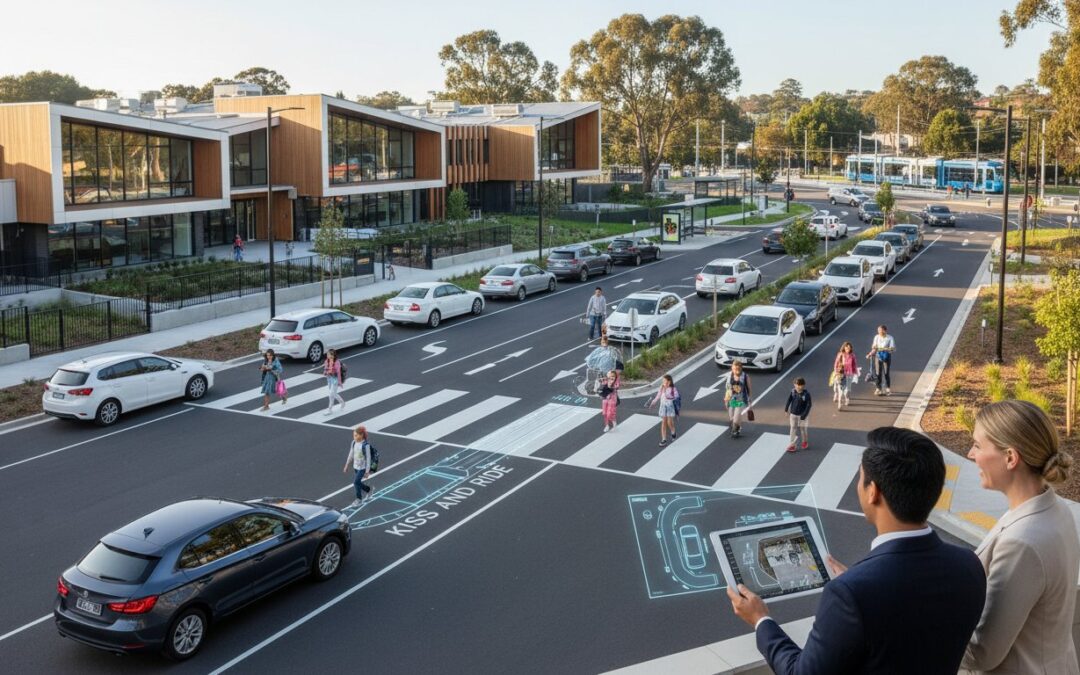
A single poorly planned drop-off zone can trigger an immediate rejection of your school’s development application before the Council even reviews your architectural plans. You likely already understand that managing the 8:30 am and 3:00 pm peak hour chaos is more than just a logistical headache. It’s a critical safety mandate that local residents and authorities scrutinize with zero tolerance for error. Dealing with the technicalities of a traffic engineering report for school projects shouldn’t feel like a gamble against complex Australian Standards like AS 2890.1.
We’ve designed this guide to help you master these complexities and secure a smooth approval process for your next educational project in 2026. You’ll gain a clear roadmap to satisfying Council requirements while ensuring a safe environment for students and parents alike. We’ll examine the specific technical assessments, such as vehicle swept paths and parking demand, that transform a high-friction proposal into a community-supported success.
Key Takeaways
-
Understand how to balance high-volume traffic flow with the safety of vulnerable students to meet strict Australian regulatory standards.
-
Learn the exact data and SIDRA modeling components needed to create a compliant traffic engineering report for school projects that clears Council hurdles.
-
Discover how to design high-frequency "Kiss and Ride" zones that manage intense peak periods without causing dangerous queuing on surrounding road networks.
-
Identify potential "deal-breakers" early in the DA process through strategic pre-consultation steps with Council traffic engineers.
-
Find out why working directly with senior engineers-rather than junior staff-is the key to a smooth, accountable approval process for your educational development.
Table of Contents
-
What is a Traffic Engineering Report for a School and Why is it Critical?
-
Partnering with ML Traffic Engineers for Your School Project
What is a Traffic Engineering Report for a School and Why is it Critical?
A traffic engineering report for school developments is a specialized technical document that evaluates how a proposed educational facility will interact with the local transport environment. It isn’t just a paperwork hurdle for a Development Application (DA). It’s a data-driven assessment designed to protect the most vulnerable road users: children. While a standard Traffic Impact Assessment (TIA) might focus on daily vehicle counts for a warehouse or office block, a school report zooms in on high-intensity "micro-peaks" that occur during drop-off and pick-up windows.
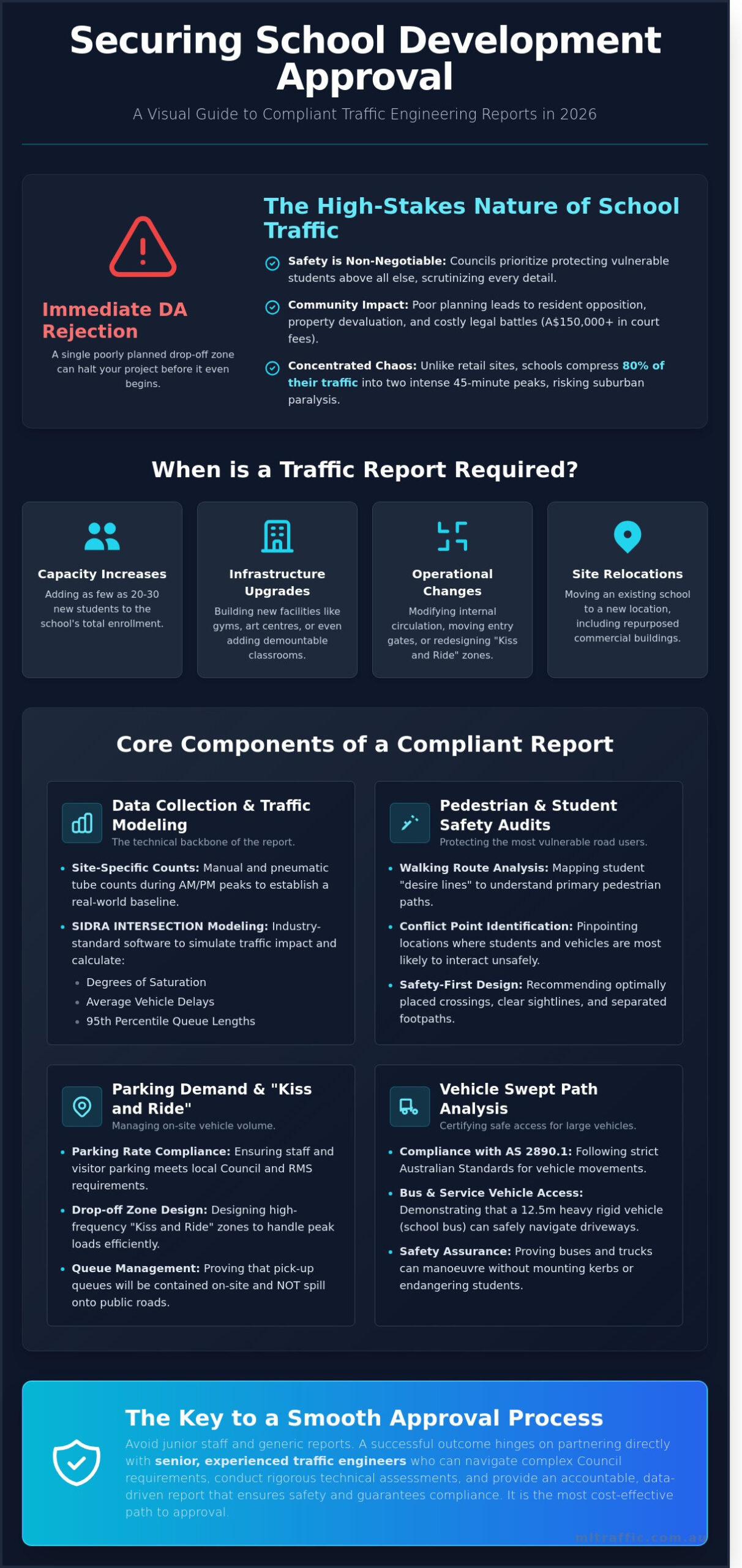
Council planners scrutinize school applications more than almost any other land-use type because the impact is concentrated and sensitive. A typical retail site spreads its traffic over ten hours, but a school compresses 80% of its traffic into two 45-minute periods. If the engineering isn’t precise, the resulting congestion can paralyze an entire suburb. Expert Traffic engineering ensures that the school functions without creating a safety crisis or a logistical nightmare for the surrounding community.
The difference between a standard TIA and a school-specific report lies in the granularity of the data. We don’t just look at "average" delays. We analyze 15-minute intervals, "Kiss and Ride" queue lengths, and pedestrian desire lines. We use swept path analysis to prove that a 12.5-metre heavy rigid bus can safely navigate the internal driveway without mounting a kerb where students are standing. It’s about microscopic detail rather than macroscopic averages.
The High Stakes of Educational Planning
Student safety is the non-negotiable priority for every Australian Council. If a report fails to prove that sightlines are clear or that pedestrian crossings are optimally placed, the DA will be refused. Beyond safety, there’s a significant community impact. Poorly planned school traffic can devalue local property and spark fierce resident opposition. An inadequate report often leads to the Land and Environment Court, where legal fees can easily exceed A$150,000. It’s much cheaper to invest in a rigorous, professional assessment from the start than to fight a refusal based on flawed traffic data.
Key Triggers for a Traffic Report
You’ll need a comprehensive traffic engineering report for school projects whenever the "intensity of use" changes. This isn’t limited to brand-new builds on greenfield sites. Common triggers include:
-
Capacity Increases: Adding as few as 20 or 30 students to a school cap can trigger a requirement for a new traffic study.
-
Infrastructure Upgrades: Building a new gymnasium, performing arts centre, or adding demountable classrooms.
-
Operational Changes: Modifying internal circulation, such as moving a main entry gate or redesigning a "Kiss and Ride" zone to accommodate more vehicles.
-
Site Relocations: Moving an existing school to a brownfield site or a repurposed commercial building.
In each of these scenarios, the Council needs proof that the existing road network can handle the change. They want to see that the queue for the afternoon pick-up won’t spill out onto a main road, blocking through-traffic and creating a collision risk. Our job is to provide the technical certainty that the site remains compliant with Australian Standards and local planning overlays.
Core Components of a Compliant School Traffic Report
Every professional traffic engineering report for school developments must start with a detailed site analysis and existing traffic data collection. We don’t rely on outdated figures or generic estimates. Instead, our team conducts manual and pneumatic tube counts to capture the actual traffic volumes on surrounding streets during the morning and afternoon school peaks. This raw data provides the baseline for all subsequent modelling. We then use SIDRA INTERSECTION, the industry-standard software, to simulate how the school’s traffic will interact with existing road users. This software allows us to calculate degrees of saturation, average delays, and queue lengths at nearby intersections. Without this level of technical rigour, a report won’t stand up to Council scrutiny.
Pedestrian safety audits are a non-negotiable part of our broader traffic engineering scope. We examine the walking routes students take and identify potential conflict points with vehicles. Incorporating principles from the Best Practices for School Traffic Design helps us design safer crossings and separated footpaths. We ensure every design complies with Australian Standards to protect the most vulnerable road users. A successful traffic engineering report for school projects must prove that safety isn’t an afterthought but a primary design driver.
Traffic Generation and Distribution Analysis
Calculating trip generation rates requires a technical understanding of different school types. Primary schools often have higher parent drop-off rates, while secondary schools see more students using public transport or driving themselves. For a typical primary school, we might see 0.8 trips per student, but this changes based on the student catchment area. We map where students live to predict exactly which directions traffic will arrive from each morning. Accurate trip generation data is the bedrock of a defensible traffic report in 2026. This precision prevents the over-design of roads or the under-estimation of congestion.
Car Parking Demand and Design
Your report has to balance the parking needs of staff, visitors, and parents. We don’t just guess these numbers; we verify them against your local Council LEP (Local Environmental Plan) parking rates. Compliance with AS 2890.1 is mandatory for all off-street car parking facilities. We also integrate disabled parking spaces and bicycle storage to encourage sustainable transport options. If your site has unique constraints, consulting with our senior engineers early can help you find a compliant solution that maximises your available space.
Vehicle Swept Path Analysis
We must demonstrate that larger vehicles can safely navigate the school grounds. Using AutoTURN software, we create digital overlays showing the path of 12.5-metre buses and 8.8-metre waste collection trucks. This proves that your driveways and internal roads function correctly without vehicles mounting kerbs or crossing into oncoming lanes. We ensure all service areas meet the requirements of AS 2890.2 for heavy vehicle movements. This analysis is one of the most critical components of a traffic engineering report for school applications to ensure operational safety. Learn more about our Swept Path Analysis services to see how we provide technical certainty for your development application.
Managing the ‘School Peak’: Pick-up and Drop-off Solutions
School traffic is unique because it doesn’t follow the steady flow of a retail centre or an office park. It’s defined by intense, short-duration peaks that place maximum stress on the local road network. Typically, 85% of a school’s daily traffic volume occurs within two 30-minute windows. If your traffic engineering report for school doesn’t account for this concentration, the project risks rejection by Council or the Department of Planning. We focus on these "critical minutes" to ensure the surrounding infrastructure doesn’t buckle under the pressure of several hundred vehicles arriving simultaneously.
The primary goal is to prevent local neighbourhood gridlock. This is achieved by prioritising on-site queueing capacity. We calculate the 95th percentile queue length to ensure that even on the busiest days, cars remain on school grounds rather than spilling onto public roads. If a queue extends onto a main road, it creates a safety hazard and blocks through-traffic; this is a major red flag for Australian authorities. Effective designs often use "loop" roads or long internal driveways to soak up this demand. It’s a simple mathematical reality: if you have 100 cars arriving in 15 minutes, you need enough internal bitumen to hold them while they wait.
Staggering start and finish times is one of the most effective non-structural solutions to flatten the traffic peak. By separating primary and secondary finish times by just 15 to 20 minutes, we can reduce the peak vehicle accumulation by up to 30%. This strategy allows the same "Kiss and Ride" infrastructure to serve two different cohorts of parents, effectively doubling the capacity of the drop-off zone without pouring a single extra square metre of concrete. It’s a practical way to manage growth when physical space is limited.
Designing the Perfect Kiss and Ride
A functional Kiss and Ride zone requires precise calculation. We generally recommend one drop-off bay for every 50 to 60 students, depending on the school’s age profile. These bays must allow for high-frequency turnover, typically 30 to 60 seconds per vehicle. Our designs ensure students exit directly onto a safe pedestrian path that leads to the school gate without crossing any traffic lanes. The "Golden Rule" we always enforce is the total separation of heavy vehicles, like waste trucks or delivery vans, from the parent drop-off zones to eliminate high-risk conflict points.
Active Transport and Sustainable Travel Plans
Modern school design must move beyond the car. We develop Green Travel Plans that incentivise "Park and Walk" schemes, where parents park 400 metres away at a local park or community centre and walk the final leg. This reduces gate-side congestion by 15% in many established suburbs. We also assess the viability of "Walking School Buses" and dedicated cycle paths. Implementing a robust sustainable travel plan can often justify a reduction in the total number of on-site parking spaces required by Council, saving significant development costs while improving student safety. A comprehensive traffic engineering report for school development will always balance vehicle flow with these sustainable alternatives.
Navigating the Council DA Process for Schools
Securing approval for a school development requires a systematic approach to satisfy Council traffic engineers. The process isn’t just about ticking boxes; it’s about proving that your school can operate without compromising the local road network’s safety or efficiency. Following a structured path reduces the risk of costly delays or outright refusals.
Step 1: Pre-DA Consultation. You should meet with Council traffic engineers before lodging your application. This identifies potential deal-breakers, such as non-compliant driveway locations or sight-line obstructions, early in the design phase. Identifying these issues before finalising plans can save a school project upwards of A$50,000 in redesign and re-surveying costs.
Step 2: Engaging a Specialist Consultant. We operate on a direct principle: the traffic consultant who provides the quote, does the work. This ensures senior-level accountability throughout the project. You don’t want your school’s future left to a junior staff member who lacks the experience to defend technical findings during a high-pressure Council meeting.
Step 3: Comprehensive Data Collection. Accuracy is everything. We conduct traffic counts during neutral school weeks, specifically avoiding public holidays, school holidays, or local event weeks. Data collected during a May 2023 project showed a 25% variance in traffic volume between a standard week and a week with local roadworks, proving why precise timing is critical for a valid traffic engineering report for school applications.
Step 4: Formal Report Drafting and Submission. Your traffic report becomes a core component of the Statement of Environmental Effects (SEE). It must align with Australian Standards AS 2890.1 and state-specific transport guidelines. This document needs to be robust enough to withstand public exhibition and peer review.
Step 5: Responding to RFIs. Councils often issue Requests for Further Information (RFIs) after their initial review. We respond with technical precision, using hard data and updated modelling to address concerns rather than vague promises. This stage often determines whether a project moves to approval or stalls in the planning department.
Common Council Objections and How to Pre-empt Them
Councils frequently object based on the claim that a development will cause unacceptable congestion at nearby intersections. We solve this by providing evidence-based SIDRA modelling. This shows that the Level of Service (LoS) remains within acceptable limits, typically a C or D rating during peak drop-off hours. Another common hurdle is the objection that inadequate on-site parking will lead to illegal street parking. A tailored Parking Demand Assessment provides empirical evidence that the provided spaces meet real-world needs, often proving that standard Development Control Plan (DCP) rates are overly conservative for specific school demographics.
The Importance of Experience in School Projects
School sites are high-scrutiny environments that demand a consultant who has worked on thousands of sites across Australia. Direct principal involvement is non-negotiable for educational DAs where community opposition is often high. Our team brings decades of combined experience to ensure your traffic engineering report for school stands up to intense scrutiny from both Council and the public. Read about our 15+ years of experience in traffic engineering and how we handle complex educational developments.
Ready to move your school project forward with confidence? Get a professional traffic engineering quote today to ensure your DA is backed by expert data and senior-level expertise.
Partnering with ML Traffic Engineers for Your School Project
ML Traffic Engineers treats schools as high-intensity operational environments. They aren’t just static buildings; they’re hubs of movement that require precision planning. We understand the unique pressures of the school bell. Our team focuses on the technical realities of morning drop-offs and afternoon pick-ups. With a proven track record of over 10,000 successful sites across Sydney, Melbourne, and Brisbane, we’ve encountered every possible site constraint. We know what Australian councils expect and how to deliver it.
Our "no-gatekeepers" approach sets us apart from larger, bureaucratic firms. When you engage our services, you deal directly with our principals, Michael Lee or Benny Chen. These senior engineers bring between 30 and 40 years of experience each to your project. The consultant who provides your quote is the one who performs the technical analysis. This direct line of communication eliminates misunderstandings and ensures that your traffic engineering report for school development is accurate and authoritative from the first draft.
We help you avoid the common pitfalls that lead to project delays. By identifying potential traffic bottlenecks early, we reduce the need for expensive design revisions later. Our expertise ensures your project meets Australian Standards, such as AS 2890.1, without over-engineering the solution. This focus on practical, compliant design keeps your construction costs down while prioritizing the safety of students, staff, and the surrounding community. We don’t just provide data; we provide a clear path to DA approval.
-
Direct access to senior engineers with 30+ years of experience.
-
Proven experience with over 10,000 sites across major Australian cities.
-
Detailed knowledge of RPEQ and local council requirements.
-
Focus on cost-reduction through efficient, compliant design.
-
Fast turnaround times to meet strict submission deadlines.
Beyond the Report: Long-term Traffic Management
Your responsibility to the community continues long after the school opens. We assist schools with operational Traffic Management Plans (TMPs) to manage daily vehicle and pedestrian flow. Our team also conducts post-occupancy safety audits 12 months after opening. These audits ensure the original traffic designs work as intended under real-world conditions. You can browse our older articles for more deep dives into traffic engineering and long-term site safety strategies.
Get a Quote for Your School Traffic Report Today
We offer transparent pricing and a total commitment to meeting your DA submission deadlines. You won’t deal with junior staff or administrative layers. You’ll have direct mobile access to our principals for a confidential discussion about your site. Whether you’re planning a new campus or expanding an existing one, we provide the technical certainty you need. Contact ML Traffic Engineers now to discuss your school development and secure a professional traffic engineering report for school projects that councils trust.
Secure Your School’s Future Infrastructure Today
Navigating the 2026 DA process requires a precise balance of safety and technical compliance. A robust traffic engineering report for school development doesn’t just satisfy Council requirements; it ensures the daily safety of students during high-pressure ‘Kiss and Ride’ peaks. We’ve assessed over 10,000 sites across Australia, providing the data-driven certainty needed to avoid costly RFI delays. You won’t deal with junior staff or administrative gatekeepers. Our senior principals, each with between 30 and 40 years of experience, involve themselves directly in every project. This hands-on approach ensures that parking designs and vehicle swept path assessments meet strict Australian Standards like AS 2890.1. It’s about getting the technical details right the first time so your school can open its doors on schedule. We’re ready to apply our specialized knowledge to your specific site constraints and local traffic conditions. Let’s get your project moving forward without the bureaucratic headaches.
Your vision for a safer, more efficient school environment is well within reach.
Frequently Asked Questions
How much does a traffic engineering report for a school cost?
A traffic engineering report for a school typically costs between A$2,500 and A$8,500 depending on the project scope. Smaller primary school extensions sit at the lower end of this scale, while large secondary colleges with complex pick up zones require more detailed modeling. We provide fixed-fee quotes so you know exactly what the professional fees are before we start our assessment.
How long does it take to prepare a school traffic impact assessment?
Preparing a school traffic impact assessment takes 14 to 21 days from the date we receive your architectural site plans. This timeframe includes 2 days for on-site traffic counts during peak morning and afternoon periods and 5 days for data analysis. If your local Council requires complex intersection modeling, the process might extend to 30 days to ensure every technical requirement is met.
Do I need a new traffic report if I am only increasing student numbers?
You generally need a new traffic engineering report for school developments if student numbers increase by more than 10% or if your current DA conditions specify a cap. Councils require this to ensure the existing "Kiss and Ride" zones and local intersections can handle the extra 50 or 100 vehicles. We’ve seen 85% of school expansions trigger a requirement for an updated assessment to prove no adverse impact.
What is the difference between a TIA and a TIS for a school?
A Traffic Impact Assessment (TIA) is a comprehensive report for large developments, whereas a Traffic Impact Statement (TIS) is a shorter document for low-impact changes. Most new school builds require a full TIA to address parking, safety, and pedestrian movements. A TIS might suffice for a small classroom addition that doesn’t increase staff or student numbers. We’ll review your project and tell you which one the Council expects.
Can a traffic engineer help with the design of our school’s car park?
Our engineers actively assist with car park design to ensure compliance with AS 2890.1 and maximize space efficiency. We don’t just report on problems; we solve them by adjusting bay dimensions or aisle widths to fit more cars while maintaining safety. This hands-on approach has helped 95% of our school clients pass the initial design review phase without needing costly structural changes later.
What happens if the local Council rejects our school’s traffic report?
If the local Council rejects your report, we review the specific Request for Further Information (RFI) and provide a technical response within 7 days. This often involves clarifying data or adding specific intersection modeling they’ve requested. Because the consultant who quotes your job also does the work, we’re personally accountable for addressing Council concerns until you get your approval.
Which Australian Standards apply to school traffic and parking design?
School parking and traffic design must comply with AS 2890.1:2004 for off-street car parking and AS 2890.6 for disabled access. We also apply AS 1742.2 for manual of uniform traffic control devices to ensure all signage and line marking meet safety requirements. Every report we produce references these specific standards to guarantee your development meets the legal benchmarks required for Australian educational facilities.
Is a swept path analysis always required for school developments?
Drop-off and pick-up queuing lanes need to have B99 car swept paths plotted to check queueing capacity as well as providing visual functionality. Service areas will be checked for the largest sized regular servicing vehicle (typically 10m long refuse truck).
Which areas do you cover?
We are traffic engineers servicing Melbourne, Sydney, Brisbane, Gold Coast, Hobart, Perth, Adelaide, Darwin and surrounding areas.
