

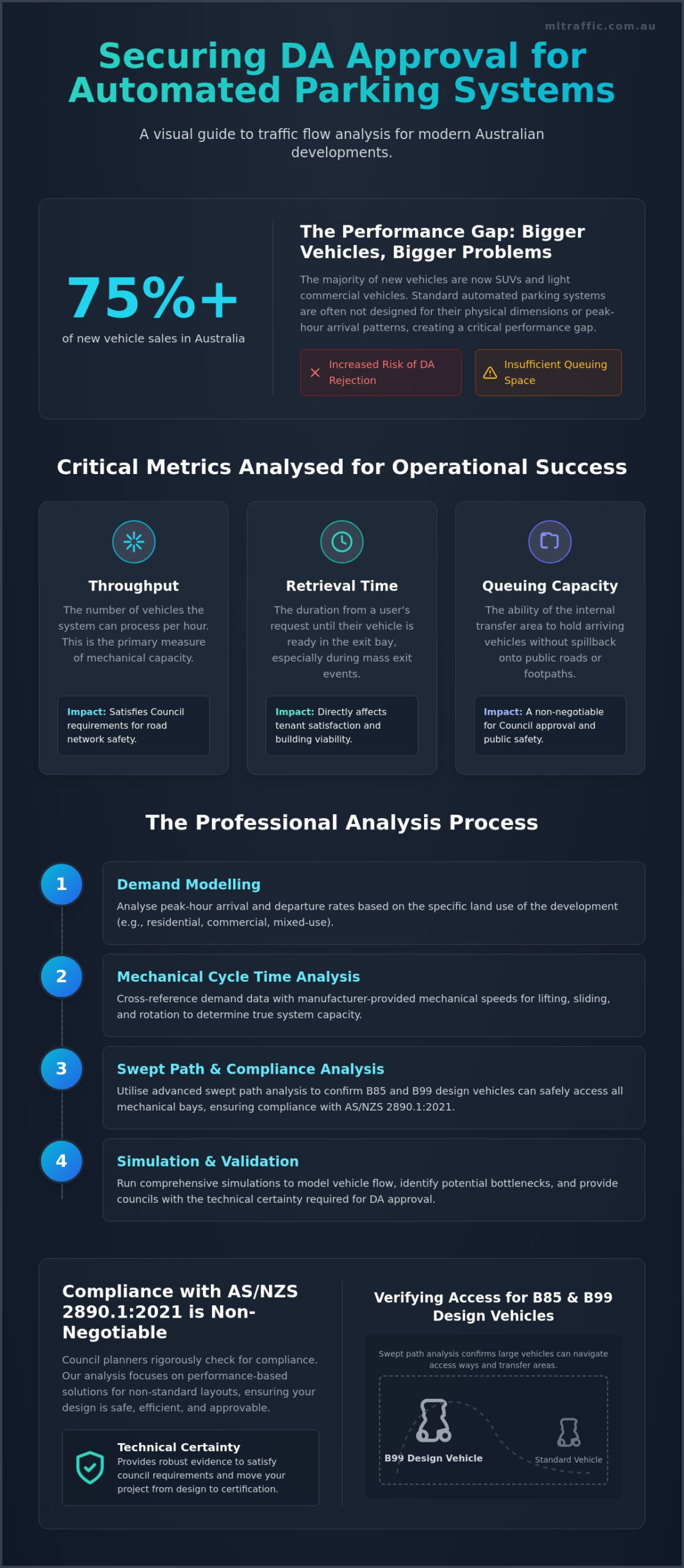
With over 75% of new vehicle sales in Australia now consisting of SUVs and light commercial vehicles, your automated parking system is likely facing a performance gap before the first car even enters the lift. A sophisticated mechanical system is worthless if it cannot handle the physical dimensions and arrival patterns of modern Australian traffic. Developers frequently face DA rejections because their plans lack sufficient queuing space or fail to account for peak-hour throughput. This is where professional traffic flow analysis for automated parking systems becomes the decisive factor in securing planning approval.
We understand that the primary challenge is not the machinery, but the interface with the public road network. A compliant car park design must align with the rigorous requirements of AS/NZS 2890.1:2021 to ensure safety and efficiency. This guide details how to use technical assessments, including swept path analysis and vehicle demand modelling, to satisfy Council requirements. You will learn how to maximise floor space while maintaining the retrieval speeds necessary for tenant satisfaction and operational reliability. Our focus remains on providing the technical certainty required to move your project from the design phase to certification.
Key Takeaways
- Master the transition from driver-centric modelling to mechanical cycle time calculations to ensure your facility handles peak-hour demand without queuing on public roads.
- Learn how professional traffic flow analysis for automated parking systems validates throughput and retrieval metrics to secure Council DA approval.
- Identify the specific requirements of AS 2890.1:2021 that apply to mechanical systems and how to navigate performance-based compliance for non-standard layouts.
- Utilise advanced swept path analysis to confirm that B85 and B99 design vehicles can safely access mechanical bays, protecting your investment from costly redesigns.
- Understand the value of direct senior principal involvement in your Traffic Impact Assessment to ensure technical accuracy and project continuity from design to certification.
What is Traffic Flow Analysis for Automated Parking Systems?
Traffic flow analysis for automated parking systems is a rigorous engineering process that uses mathematical modelling to evaluate vehicle movement within and around a facility. In a standard car park, the speed of movement depends on driver confidence and searching behaviour. However, Automated parking systems operate on predefined mechanical sequences. The technical assessment provided by ML Traffic Engineers Australia focuses on how these mechanical cycle times interact with real-world arrival patterns to prevent congestion.
The “transfer area” is the most critical component of this study. This zone is where the driver leaves the car and the mechanical system begins its task. If the time taken for a driver to exit and the system to clear the bay is longer than the arrival interval of the next vehicle, a queue forms. Without a professional Traffic Impact Assessment, these queues can extend onto public footpaths or roads, leading to immediate Council rejection of a Development Application.
To better understand the integration of technology in modern parking management, watch this helpful video:
The Core Components of APS Flow Analysis
When performing traffic flow analysis for automated parking systems, we evaluate several technical variables. We determine arrival rates by modelling peak-hour demand based on the specific land use of the development. This data is then cross-referenced with mechanical cycle times, which include lifting, sliding, and rotation speeds provided by the system manufacturer. Retrieval sequencing is also examined to predict user waiting times during the afternoon peak. A system might store 100 cars, but if the retrieval time exceeds five minutes during a mass exit event, the development’s viability is compromised.
Why Developers Must Prioritise Flow Early
Failure to address flow dynamics during the initial design phase often leads to expensive retrofits or forced reductions in yield. Council planners are increasingly aware of the queuing risks associated with mechanical parking. They will look for evidence that the system capacity aligns with a formal Car Parking Demand Assessment. By validating the feasibility of high-density residential or commercial DAs through simulation, developers can avoid the risk of being ordered to redesign the entire basement after the planning process has already commenced. Early intervention ensures that the chosen technology actually fits the site’s operational requirements.
Critical Metrics: Throughput, Retrieval, and Queuing
The operational success of an Automated Parking System (APS) depends on three interconnected metrics: throughput, retrieval time, and queuing capacity. In a traditional car park, drivers manage their own speed. In an automated environment, the machinery dictates the pace. If these technical parameters are not aligned with the building’s specific demand profile, the result is often operational failure and the rejection of planning permits. Professional traffic flow analysis for automated parking systems identifies these bottlenecks before construction begins.
Throughput is the primary measure of system capacity. It defines the number of vehicles the mechanical components can process within a sixty-minute window. Retrieval time, conversely, measures the duration from a user’s request until the vehicle is available in the exit bay. While throughput satisfies Council requirements for road safety, retrieval time directly impacts tenant satisfaction. A system that takes four minutes to retrieve a vehicle may be acceptable for a low-turnover residential building but would be entirely inadequate for a high-volume commercial centre.
Australian Councils focus heavily on the “95th percentile queue length” at the site entry. This metric represents the maximum queue length that will not be exceeded during 95% of the peak hour. If the analysis shows that vehicles will spill onto the public road or block pedestrian footpaths, the Development Application will likely fail. To mitigate this risk, we often recommend multi-bay configurations or dedicated internal buffer zones to keep waiting vehicles off the street. If you are concerned about your current layout’s capacity, our team can perform a Car Park Design review to validate your reservoir space.
Calculating Peak Demand for Australian Sites
Peak demand patterns vary significantly across different land uses. Residential developments typically experience a sharp morning peak as residents depart for work, followed by a sustained arrival period in the evening. Commercial developments face the opposite, with intense afternoon peaks as workers leave simultaneously. We use historical trip generation data and site-specific modelling to predict these arrival patterns. Throughput is the mathematical product of the number of entry cabins and the time required for the mechanical system to clear a vehicle from the transfer area.
Mitigating the Risk of Street Queuing
Compliance with Australian Standards (AS 2890)
Securing Council approval for a mechanical parking facility requires more than a manufacturer’s brochure. While the internal robotics are often proprietary, the interface between the public road and the system must strictly comply with AS 2890.1. This standard governs everything from driveway widths to ramp grades. Because automated systems do not follow the prescriptive layout of a traditional car park, we adopt a performance-based approach. This involves using traffic flow analysis for automated parking systems to demonstrate that the proposed design meets the safety and efficiency objectives of the Australian Standards.
A frequent point of failure in Development Applications is the transfer cabin’s physical dimensions. Modern Australian vehicle fleets are dominated by SUVs and light commercial vehicles. This shift makes it essential for the cabin to accommodate the B85 or B99 design vehicle specified in the 2021 update of the standard. If the cabin is too narrow or the approach angle is too steep, the system will fail to process a significant percentage of the vehicles it was designed to house. Our engineers certify these dimensions during the design phase to prevent costly modifications after the machinery has been ordered.
AS 2890.1 and the Transfer Cabin Interface
The transition from the street to the parking bay is where most regulatory conflicts occur. Driveway ramp grades must be meticulously calculated to ensure vehicles don’t bottom out while entering the transfer cabin. We also evaluate sight distance requirements at the property boundary to protect pedestrians. Safety in the transfer zone is paramount; the design must provide clear separation between users walking to the exit and vehicles waiting to enter the system. These factors are critical for achieving a compliant Car Park Design that satisfies both state and local planning policies.
The TIA Report: Proving APS Viability to Council
The Traffic Impact Assessment (TIA) report is the primary document used to prove APS viability to Council. We document the specific mechanical cycle times and retrieval sequences within this formal report to address concerns regarding queuing. Planners often focus on “worst-case scenario” delays, such as a system failure or a sudden surge in arrivals. By providing expert data and technical clarification during the DA assessment phase, we provide the accountability needed to secure approval. The same senior principal who performs your analysis will be the one defending the report if Council requests further information.
Technical Tools: Swept Path Analysis and Simulation
The transition from public road networks to the internal mechanical interface is where most operational risks reside. Traffic flow analysis for automated parking systems uses advanced simulation to bridge the gap between human driving and robotic precision. We focus heavily on the “transition zone”, ensuring that vehicles can move from the property boundary to the entry cabin without multiple-point turns or obstructing the public thoroughfare. This technical validation is the only way to prove to Council that your development won’t cause local gridlock.
Using Swept Path Analysis is mandatory for validating that the site layout accommodates the modern Australian fleet. Since over 75% of new vehicle sales in Australia are now SUVs and light commercial vehicles, designs must be tested against B85 and B99 design vehicles as specified in AS 2890.1:2021. We identify potential conflict points where entering traffic might intersect with vehicles exiting the system. This prevents a “lock-up” scenario where the internal reservoir becomes too congested for the machinery to function.
AutoTURN Modelling for APS Entry Bays
We use AutoTURN to model the exact path a vehicle takes when entering a mechanical cabin. This ensures there is adequate clearance for vehicle mirrors and doors when the driver exits the car in the transfer area. Validating these turning circles is essential for a seamless “drive-in” experience that doesn’t frustrate users or cause delays. Accurate swept path analysis prevents structural damage to the mechanical lift components by ensuring vehicles are perfectly aligned before the system initiates its cycle.
Dynamic Simulation for High-Volume Sites
Static analysis is often insufficient for high-density residential or commercial developments. Dynamic flow simulation allows us to visualise how the car park performs over a sustained peak period rather than a single moment in time. This includes modelling pedestrian movements around the parking lobby and optimising “Drop-off and Go” zones to ensure they don’t overlap with vehicle paths. For complex layouts, we provide professional Vehicle Swept Path Analysis to ensure every mechanical bay remains accessible under all operational conditions.
Why Professional Traffic Engineering is Essential for APS
The technical complexity of mechanical parking requires a level of precision that exceeds standard car park design. Traffic flow analysis for automated parking systems is not a clerical task; it’s a specialised engineering discipline that acts as the bridge between technology and planning law. A generalist approach often fails to account for the specific cycle times of mechanical lifts or the unique queuing patterns they create. We provide the technical certainty required to satisfy Council planners and ensure the facility operates as intended from day one.
Our consultancy model is built on direct access to senior leadership. We don’t use junior staff to perform critical calculations. This ensures that every report is backed by over 15 years of experience in Australian traffic engineering. We’ve established a proven track record with local Councils across the country, providing the accountability needed to defend technical findings during the DA assessment phase. Our comprehensive service offering covers every stage of the project, from initial swept path analysis to the final certification provided by ML Traffic Engineers Australia.
Avoiding the “No-Gatekeepers” Delay
Working directly with a principal traffic engineer significantly speeds up the DA process. Large firms often delegate technical work to inexperienced personnel, leading to errors that Council will inevitably identify. By removing these gatekeepers, we ensure that the engineer who starts your project is the one performing the analysis. This continuity is vital when dealing with specific mechanical brands, as each system has different operational requirements. We specialise in aligning these proprietary technologies with the rigid requirements of Australian Standards and local planning policies.
Securing Your Project’s Future
Rigorous flow analysis protects the long-term value of your development. A system that causes constant street queuing or excessive retrieval delays will quickly become a liability for the Owners Corporation. Our simulations identify these operational risks early, allowing for design adjustments that maximise floor space without compromising system performance. This proactive approach reduces potential liability and ensures the building remains functional as vehicle sizes and user expectations evolve. To discuss your site’s specific requirements, contact ML Traffic Engineers Australia for a project-specific consultation.
Securing Council Approval for Your Automated Parking System
Integrating advanced mechanical precision with site-specific demand is the final step in moving your development from concept to construction. A rigorous traffic flow analysis for automated parking systems provides the technical verification Council requires to ensure your project doesn’t adversely affect the local road network. By proactively validating reservoir capacity and mechanical throughput, you secure the long-term viability of the asset and prevent operational bottlenecks that frustrate future tenants.
ML Traffic Engineers Australia offers the specialised expertise needed to bridge the gap between proprietary technology and Australian regulatory standards. With over 15 years of experience in traffic and transport planning, we provide the expert certification and parking demand assessments required for complex urban sites. Our senior principals take full accountability for every assessment, ensuring your Car Park Design meets the performance-based criteria expected by planning authorities. Discuss your automated parking project with a senior principal at ML Traffic Engineers Australia. We provide the technical certainty required to navigate the DA process with confidence.
Frequently Asked Questions
How does an automated parking system affect a Traffic Impact Assessment (TIA)?
An automated parking system shifts the focus of a TIA from driver behaviour to mechanical throughput and cycle times. We must provide technical evidence that the system can process vehicles at a rate that matches peak arrival patterns. This requires detailed modelling of the machinery’s speed to ensure the development does not negatively impact the performance of the surrounding road network.
Will Council approve an automated parking system if it lacks queuing space?
Council will generally reject a Development Application if the 95th percentile queue length extends beyond the property boundary onto public land. Internal reservoir space is a mandatory requirement to prevent vehicles from obstructing footpaths or traffic lanes. Professional traffic flow analysis for automated parking systems is used to calculate the exact number of car lengths required to keep waiting vehicles off the street.
What is the maximum retrieval time Council will usually accept?
There is no fixed statutory limit for retrieval, but times exceeding three to five minutes often trigger concerns regarding operational efficiency. While Council focuses on road safety, excessive retrieval times can lead to secondary queuing if users arrive to collect vehicles faster than the system can deliver them. We model these sequences to ensure the system meets both regulatory expectations and practical tenant needs.
Does AS 2890.1 cover mechanical car parks?
AS 2890.1:2021 governs the non-automated components of the facility, such as the driveway grades, ramp widths, and sight distances at the property boundary. The mechanical components themselves are usually handled via a performance-based approach. A traffic engineer must certify that the interface between the human-driven areas and the automated system complies with the safety objectives of the Australian Standards.
How do you perform a swept path analysis for a mechanical parking bay?
We use AutoTURN software to simulate the specific movements of B85 and B99 design vehicles as they enter and exit the transfer cabin. This analysis confirms that larger SUVs and 4WDs have sufficient clearance for mirrors and doors. It also validates that the turning circles required to reach the cabin are achievable without multiple-point turns or risk of structural damage to the machinery.
Can an automated parking system handle peak-hour flow in a large apartment building?
Automated systems can handle high-volume flows provided the design includes multiple entry cabins and high-speed mechanical lifts. We use traffic flow analysis for automated parking systems to determine the necessary number of cabins based on the building’s specific trip generation rates. This ensures the system can process the concentrated arrival and departure surges typical of large residential developments.
What happens to traffic flow if the automated system breaks down?
A system failure can lead to immediate vehicle queuing on the public road network if not managed correctly. We typically recommend redundant mechanical components, such as dual lifts or shuttle systems, to maintain partial operation during repairs. A formal management plan should also be in place to outline how traffic will be diverted or managed during a total system outage.
Is a separate pedestrian safety audit required for APS transfer zones?
Pedestrian safety must be addressed within the Traffic Impact Assessment or the Car Park Design certification rather than as a standalone audit. The design must demonstrate clear physical separation between users walking to the parking lobby and vehicles waiting to enter the mechanical cabins. This is essential for protecting pedestrians from conflict points in the high-activity transfer area.

Disclaimer
The content on www.mltraffic.com.au, including all technical articles, guides, and resources, is provided for general informational and educational purposes only. It is not intended to constitute professional advice in traffic engineering, transport planning, development approvals, or any other technical or legal field. While ML Traffic Engineers makes every reasonable effort to ensure the accuracy, completeness, and timeliness of the information published, we do not provide any warranties or representations (express or implied) regarding its reliability, suitability, or availability for any particular purpose. Any reliance you place on the content is strictly at your own risk. In no event shall ML Traffic Engineers, its directors, employees, authors, or affiliates be liable for any direct, indirect, incidental, special, consequential, or punitive damages (including, without limitation, loss of profits, data, or business opportunities) arising out of or in connection with the use of, or inability to use, any information provided on this website. The articles and guides on this site are not a substitute for engaging a qualified, registered professional traffic engineer (such as an NPER or RPEQ engineer) to assess your specific project requirements. For tailored advice, compliance assessments, or traffic engineering services, please contact a competent professional. This disclaimer may be updated from time to time without notice. By accessing or using this website, you agree to be bound by the most current version of this disclaimer.
