

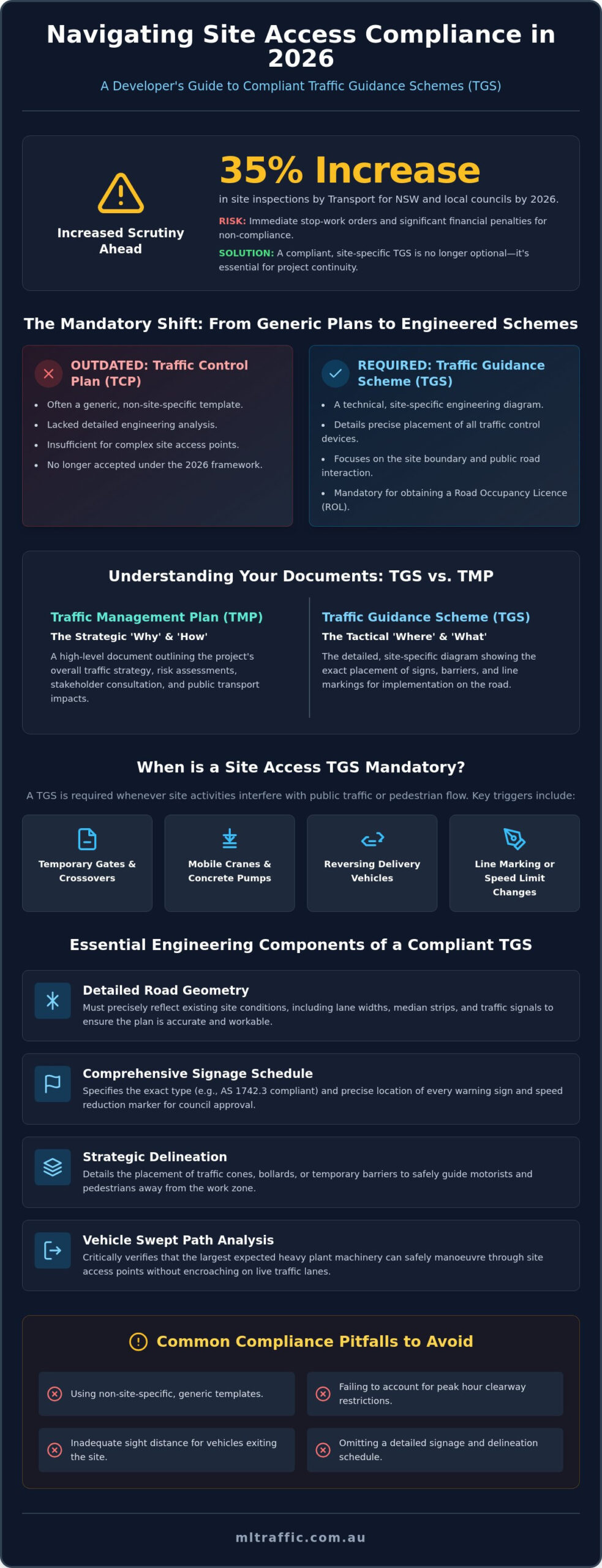
With Transport for NSW and local councils increasing site inspections by 35 per cent in 2026, a generic traffic plan is no longer a viable option for Australian developers. If your traffic guidance scheme for site access fails to account for the 7th Edition of the TCAWS Technical Manual or the latest national standards, your project faces immediate stop-work orders and significant financial penalties. We recognise that securing road occupancy and managing heavy plant deliveries shouldn’t be the bureaucratic bottleneck that stalls your construction schedule. You need a technical document that addresses complex council regulations and mitigates safety risks near the site boundary without compromising project timelines.
This guide provides the professional engineering clarity required to secure council approval on your first attempt while maintaining the highest safety standards for pedestrians and motorists. We will detail the essential components of a compliant TGS, including the integration of vehicle swept path analysis and sight distance assessments. Our focus remains on ensuring efficient movements for all deliveries and heavy plant machinery while minimising disruption to local traffic flow. By following these 2026 regulatory requirements, you can avoid costly project delays and ensure your site access remains compliant from day one.
Key Takeaways
- Understand the mandatory transition from legacy Traffic Control Plans to the modern Traffic Guidance Scheme (TGS) required under 2026 Australian standards.
- Ensure your traffic guidance scheme for site access incorporates precise road geometry and signage schedules to avoid immediate council rejection.
- Integrate vehicle swept path analysis to verify that the largest expected heavy plant can safely manoeuvre through site access points.
- Identify and mitigate common compliance pitfalls, including the use of non-site-specific templates and failure to account for peak hour clearway restrictions.
- Leverage direct access to senior traffic engineers to ensure technical accountability and personnel continuity from design to approval.
What is a Traffic Guidance Scheme (TGS) for Site Access?
A traffic guidance scheme for site access is a technical engineering diagram that illustrates the precise arrangement of temporary traffic control devices required to manage vehicle and pedestrian movements around a development’s entry and exit points. Under the current 2026 regulatory framework, this document has officially replaced the legacy term Traffic Control Plan (TCP) across most Australian jurisdictions. It functions as a tactical blueprint for site safety. Unlike a general roadwork plan, a TGS for site access focuses specifically on the interaction between the construction site boundary and the public road reserve.
The primary objective of a professionally designed TGS is to mitigate the inherent risks associated with heavy plant movements and material deliveries. This requires a deep understanding of traffic engineering principles to ensure that every sign, bollard, and lane taper complies with national safety standards. Without a compliant TGS, developers cannot obtain a Road Occupancy Licence (ROL) or the necessary council permits to commence works. It provides the technical assurance that motorists and pedestrians can navigate the area safely while construction vehicles maintain efficient access to the site.
To better understand this concept, watch this helpful video:
The Difference Between a TGS and a TMP
Developers often confuse the Traffic Management Plan (TMP) with the Traffic Guidance Scheme. A TMP is a high-level strategic document that outlines the broader project risks, public transport impacts, and stakeholder consultation strategies. In contrast, the TGS is the tactical, site-specific diagram that shows the exact placement of signage and physical barriers. Most local councils and state authorities require both documents for a single development application. The TMP provides the “why” and the “how,” while the TGS provides the literal map for implementation on the road.
When is a Site Access TGS Required?
A TGS is mandatory whenever site-related activities interfere with the normal flow of traffic or pedestrian movement. This includes several specific trigger points:
- Installation of temporary construction gates or heavy vehicle crossovers.
- Deployment of mobile cranes or concrete pumps that occupy the road or nature strip.
- Situations where delivery vehicles must reverse into the site from a public street.
- Modifications to existing line marking or speed limits near the site entrance.
All schemes must strictly adhere to Australian Standard AS 1742.3 and relevant state manuals, such as the 7th Edition of the TCAWS Technical Manual in NSW. Failure to provide a site-specific traffic guidance scheme for site access often results in immediate permit rejection and costly project delays. You can view our full range of technical assessment services at our services page to ensure your project remains compliant.
Essential Engineering Components of a Compliant TGS
A compliant traffic guidance scheme for site access must be a precise technical reflection of the physical site conditions. It is not a generic template. Each scheme must detail the existing road geometry, including lane widths, median strips, and existing traffic signals. We ensure that every proposed access point is positioned to maximise visibility and safety. A professionally engineered TGS includes a comprehensive signage schedule that specifies the exact type and location of every warning sign and speed reduction marker. This level of detail is required to satisfy 2026 council standards and avoid immediate rejection of your application.
Delineation is equally critical for maintaining order near the site boundary. This involves the strategic placement of traffic cones, bollards, or temporary water-filled barriers to guide motorists away from work zones. The Austroads Guide to Temporary Traffic Management dictates strict requirements for taper lengths and lateral buffers. These dimensions are calculated based on the prevailing road speed limits to ensure motorists have sufficient space to merge or stop safely. If you require technical assistance with these calculations, you can contact our senior engineers for a site-specific assessment.
Signage and Delineation Standards
Signage selection depends heavily on the road environment. Urban streets require different sign sizes and mounting heights compared to high-speed rural corridors. We apply standardised symbols and colours as mandated by Australian Standard AS 1742.3 to ensure instant recognition by drivers. Proper placement is vital. We calculate longitudinal distances to provide motorists with adequate reaction time before they reach the site access point. This meticulous approach prevents erratic braking and reduces the risk of rear-end collisions near the development entrance.
Managing Vulnerable Road Users
Site access planning must prioritise the safety of pedestrians, cyclists, and individuals with limited mobility. When a development interferes with a public footpath, the traffic guidance scheme for site access must include detailed diversion plans. This ensures that pram and wheelchair access is maintained through compliant ramps and clear path widths. Bicycle lane management is another critical factor. We design schemes that protect cyclists during heavy vehicle ingress and egress. This often involves specific signage or temporary lane reconfigurations to prevent conflict. Maintaining safe passage around the site boundary is a non-negotiable requirement for council approval in 2026.
Integrating Swept Path Analysis with Site Access Schemes
A traffic guidance scheme for site access is fundamentally flawed if it doesn’t account for the physical dimensions of the vehicles using the entry point. We use swept path analysis to ensure the design is physically possible before it reaches council for review. This engineering process maps the path of a vehicle’s body and tyres during a turn to prevent trucks from striking power poles, parked cars, or existing street furniture. Without this technical validation, a TGS is merely a theoretical layout that risks immediate rejection or on-site accidents.
Our engineers utilise AutoTURN software to simulate vehicle movements against the proposed site access geometry. This is critical on narrow Australian suburban roads where the “swing out” of a heavy vehicle can occupy multiple lanes. We verify that the tail swing of an articulated truck won’t encroach on pedestrian areas or oncoming traffic lanes. This data-driven approach ensures that the traffic guidance scheme for site access provides a safe environment for both the driver and the public. It eliminates the guesswork that leads to costly project delays and safety breaches.
Heavy Vehicle Considerations
We design for the specific fleet expected on your site. There is a significant technical difference between a 12.5m heavy rigid vehicle and a 19m articulated truck. We ensure the TGS entrance widths match these requirements exactly to avoid vehicles mounting kerbs or damaging infrastructure. If site constraints necessitate multi-point turns or reversing from the street, the scheme must include dedicated traffic controllers to manage the manoeuvre. This prevents traffic congestion and maintains the safety standards required by local authorities.
Sight Distance and Safety
Sight distance is a non-negotiable safety metric in any professional access design. We calculate the Safe Intersection Sight Distance (SISD) to ensure drivers exiting the site can see oncoming traffic clearly. We carefully position all temporary signage to avoid obstructing these critical sightlines. Additionally, our designs account for blind spots created by temporary site hoarding or security fencing. We ensure that the TGS provides adequate visibility for all road users at every stage of the project, regardless of the site’s physical complexity.
Common Compliance Pitfalls in Site Access Planning
Rejection by local councils often stems from fundamental design errors rather than minor clerical mistakes. The most frequent failure is the use of generic, non-site-specific templates. A traffic guidance scheme for site access must reflect the actual road geometry and current traffic conditions of the specific street. Councils don’t accept “copy-paste” plans that ignore local hazards or existing infrastructure. This leads to avoidable delays that can stall a project for weeks and inflate your preliminary costs.
Another critical oversight involves ignoring peak hour traffic restrictions and clearway times. If your site access requires vehicle movements during restricted periods, the TGS must explicitly address how these will be managed. Failure to account for these constraints leads to on-the-spot fines and potential prohibition notices from state authorities. Similarly, inadequate taper lengths remain a common technical error. These lengths must be calculated based on the posted speed limit as per the latest standards. Short tapers create high-risk merge points that compromise the safety of motorists and site workers alike.
Construction projects move through distinct phases. A TGS that was compliant during the excavation phase may become obsolete during the structural build. It’s essential to update your traffic guidance scheme for site access to reflect changing vehicle types and entry requirements as the project matures. To ensure your next submission passes council review without costly revisions, you can contact our technical team for a compliant, engineered solution.
The Council Review Process
Councils frequently request additional detail on pedestrian safety and vulnerable road user management. Typical feedback loops often involve queries regarding how heavy plant will exit the site without crossing into oncoming traffic lanes. Councils want to see that you’ve considered the human element, including school zones or high-pedestrian activity areas near the site boundary. A professionally stamped TGS by a qualified traffic engineer significantly accelerates the approval timeline. This document must align perfectly with the broader Traffic Impact Assessment submitted during the DA stage. Alignment across all planning documents demonstrates a cohesive approach to traffic management and builds confidence with assessing officers.
Regulatory Standards and Updates
Staying current with the Austroads Guide to Traffic Management (AGTM) is essential for any developer. While the national framework provides a baseline, state-specific variations in NSW, QLD, and Victoria require specialised local knowledge. Using outdated signage or obsolete traffic control methods is a guaranteed path to compliance failure. We maintain rigorous standards to ensure all plans meet the 2026 regulatory requirements for Australian developments. This meticulous attention to detail prevents the safety risks and legal liabilities associated with non-compliant site access plans.
Why Professional Traffic Engineering is Vital for Site Access
Engineering-led design provides a level of technical rigour that basic traffic control certifications cannot match. While many providers hold the mandatory accreditation to draw plans, a degree-qualified traffic engineer understands the civil complexities of road geometry and vehicle dynamics. A professionally engineered traffic guidance scheme for site access ensures that every aspect of the plan is backed by empirical data and sound civil principles. This meticulous approach is essential for complex projects where site constraints are tight and council scrutiny is high. It moves beyond simple sign placement to provide a functional, safe, and efficient access solution.
Utilising an engineering firm significantly reduces legal liability for developers and site owners. A robust TGS serves as a primary safety document in the event of an on-site incident or a WorkSafe inspection. It demonstrates that the developer has taken all reasonable steps to manage traffic risks through professional consultation and technical validation. We focus on delivering results-oriented documentation that stands up to both regulatory review and legal examination. This technical assurance is a critical component of risk management for any modern Australian development project. It ensures your site remains operational and compliant throughout the construction lifecycle.
Accountability and Senior Oversight
We operate with a “no-gatekeepers” philosophy that distinguishes our consultancy from larger, more impersonal firms. You work directly with senior traffic engineers who possess decades of industry experience. This ensures that every traffic guidance scheme for site access receives principal-level review before it is submitted to council or state authorities. We promise personnel continuity; the expert who initiates your project is the same professional performing the technical work. This direct access to leadership allows for rapid modifications if site conditions change or if a council officer requests urgent technical revisions. There is no loss of information between a sales team and a design department.
Comprehensive Site Solutions
A compliant TGS does not exist in isolation from other project requirements. It must integrate seamlessly with technical assessments such as car park design and driveway ramp grade assessments. We provide an exhaustive range of assessments to support your DA, ensuring all traffic-related components are cohesive and technically sound. This includes managing the swept path analysis alongside the access design to prevent physical clashes with existing infrastructure. For a compliant, professionally engineered scheme that passes council review the first time, contact the experts at ML Traffic Engineers Australia to discuss your specific project requirements.
Streamline Your Site Access Approval Process
Securing a compliant traffic guidance scheme for site access is a critical step in maintaining your construction schedule and meeting 2026 regulatory standards. By integrating site-specific engineering components and validated swept path analysis, you eliminate the common pitfalls that lead to council rejection. Professional oversight ensures that your documentation is meticulous and results-oriented, protecting both your project timelines and your legal liability.
ML Traffic Engineers Australia provides over 15 years of traffic engineering experience and direct access to degree-qualified senior principals. We specialise in delivering council-compliant assessments tailored to the unique civil constraints of your development. Our personnel continuity promise ensures that the same expert who initiates your project performs the technical work. Get a compliant Traffic Guidance Scheme for your site access to ensure your project commences without delay. We look forward to helping you achieve a safe and efficient site entry solution.
Frequently Asked Questions
What is the difference between a TGS and a Traffic Control Plan?
A Traffic Guidance Scheme (TGS) is the current official term for what was formerly known as a Traffic Control Plan (TCP). Under 2026 Australian standards, the TGS provides the specific technical diagram of signs and devices used to manage traffic flow. While the term TCP is still used colloquially, it is considered legacy terminology in most professional and regulatory contexts across Australia.
Do I need a new TGS for every stage of my construction project?
You must update your traffic guidance scheme for site access whenever the physical layout or vehicle requirements of the project change. The access needs during the excavation phase differ significantly from those required during structural building or final fit-out. Councils require stage-specific plans to ensure that traffic management remains appropriate for the current risks and vehicle types present on-site.
Who is legally allowed to design a Traffic Guidance Scheme in Australia?
In Australia, individuals must hold specific state-based accreditation to design these schemes, such as the Prepare a Work Zone Traffic Management Plan (PWZTMP) certification in New South Wales. For complex development site access, local councils frequently mandate that plans be certified by degree-qualified traffic engineers. This ensures technical accuracy in critical calculations such as vehicle swept paths and intersection sight distances.
How long does it typically take to get a TGS approved by a local council?
Standard approval times for a traffic guidance scheme for site access typically range from 10 to 20 business days for local council roads. If the site access affects a state-managed road, the approval process through authorities like Transport for NSW can take up to 6 weeks. Developers should factor these specific lead times into their construction schedules to avoid costly commencement delays.
Does a site access TGS need to include pedestrian management?
Yes, every site access TGS must explicitly address the safety and movement of pedestrians and other vulnerable road users. This includes detailing footpath diversions, maintaining pram and wheelchair access, and ensuring bicycle lanes remain safe during heavy vehicle movements. Councils prioritise pedestrian safety and will reject any scheme that fails to provide clear, safe passage around the site boundary.
What happens if a site vehicle cannot fit within the swept paths shown on the TGS?
If a vehicle cannot fit within the engineered swept paths, the scheme is non-compliant and poses a significant safety risk. You must either redesign the site access point to accommodate the vehicle’s turning circle or use a smaller vehicle fleet. Failure to align physical vehicle movements with the TGS diagram often leads to infrastructure damage and immediate stop-work orders from inspectors.
Can I use a generic TGS for my development application?
You cannot use generic templates for a development application. Councils require site-specific plans that reflect the actual road geometry, existing signage, and current traffic conditions of the specific street. A generic plan fails to account for unique site hazards and is the most common reason for the immediate rejection of a traffic permit application in 2026.
Is a Traffic Guidance Scheme the same as a Traffic Management Plan?
A Traffic Guidance Scheme is not the same as a Traffic Management Plan (TMP). The TMP is a high-level strategic document that outlines the overall traffic impact, public transport disruptions, and broad risk assessments for a project. The TGS is the tactical, technical diagram that shows the exact placement of signs, tapers, and barriers at a specific location, such as a site access gate.

Disclaimer
The content on www.mltraffic.com.au, including all technical articles, guides, and resources, is provided for general informational and educational purposes only. It is not intended to constitute professional advice in traffic engineering, transportation planning, development approvals, or any other technical or legal field.While ML Traffic Engineers makes every reasonable effort to ensure the accuracy, completeness, and timeliness of the information published, we do not provide any warranties or representations (express or implied) regarding its reliability, suitability, or availability for any particular purpose. Any reliance you place on the content is strictly at your own risk.In no event shall ML Traffic Engineers, its directors, employees, authors, or affiliates be liable for any direct, indirect, incidental, special, consequential, or punitive damages (including, without limitation, loss of profits, data, or business opportunities) arising out of or in connection with the use of, or inability to use, any information provided on this website.The articles and guides on this site are not a substitute for engaging a qualified, registered professional traffic engineer (such as an NPER or RPEQ engineer) to assess your specific project requirements. For tailored advice, compliance assessments, or traffic engineering services, please contact a competent professional.This disclaimer may be updated from time to time without notice. By accessing or using this website, you agree to be bound by the most current version of this disclaimer.
