

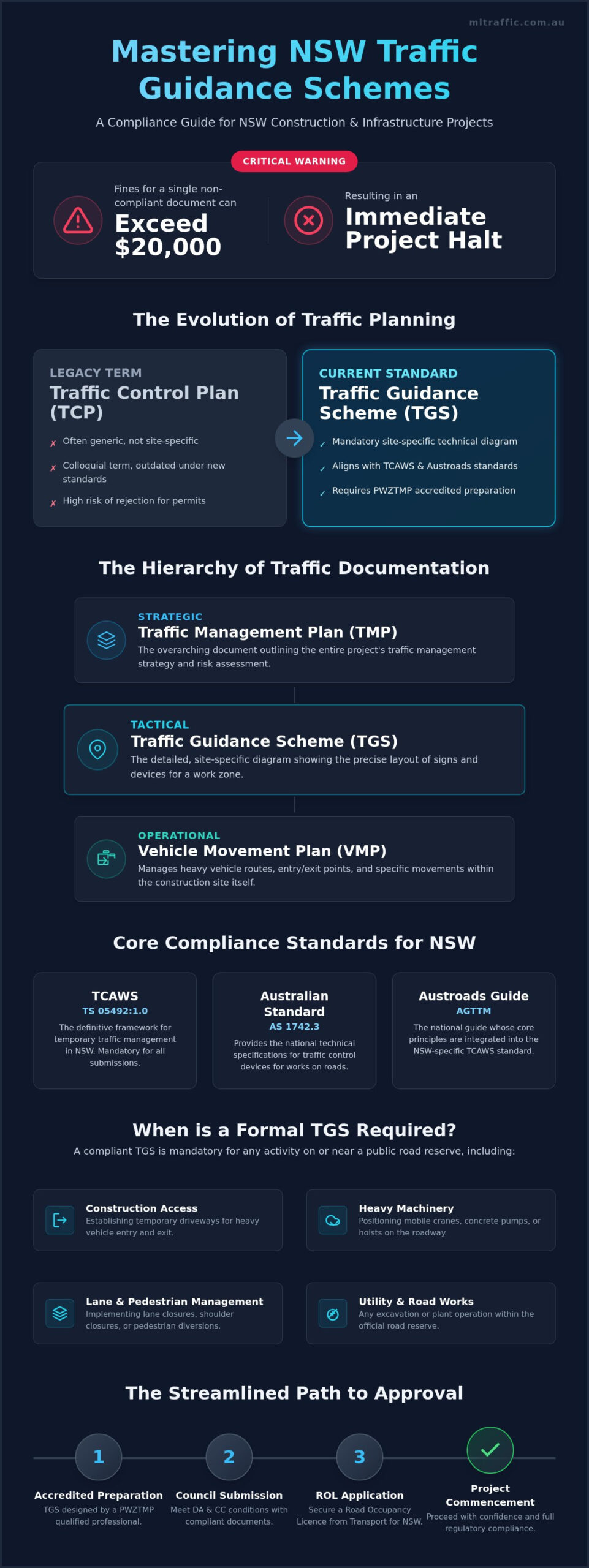
A single non-compliant document can result in fines exceeding $20,000 and an immediate halt to your construction project. Transitioning from the legacy Traffic Control Plan (TCP) to the current traffic guidance scheme nsw requirements remains a point of significant confusion for many project managers. You are likely frustrated by the complexities of the latest Technical Standard TS 05492:1.0 and the pressure of meeting strict council deadlines while ensuring site safety.
This guide provides the technical clarity required to master NSW traffic guidance schemes and secure necessary approvals without the risk of costly administrative delays. We examine the critical hierarchy of Traffic Management Plans (TMP), Vehicle Movement Plans (VMP), and site-specific TGS documentation to ensure your project remains compliant. You will learn the exact requirements for scheme preparation under the latest TCAWS standards, the role of PWZTMP accredited professionals, and the streamlined path to obtaining a Road Occupancy Licence that passes regulatory scrutiny while minimising disruption to traffic and pedestrians.
Key Takeaways
- Understand the transition from legacy Traffic Control Plans (TCP) to the mandatory site-specific traffic guidance scheme nsw required under current TCAWS standards.
- Identify the critical differences between strategic Traffic Management Plans (TMP), tactical Traffic Guidance Schemes (TGS), and Vehicle Movement Plans (VMP) to ensure document compliance.
- Learn how to align your project documentation with Technical Standard TS 05492:1.0 and AS 1742.3 to avoid rejected applications and site shutdowns.
- Navigate the streamlined process for securing Road Occupancy Licences (ROL) and local council permits through accredited traffic engineering preparation.
- Discover the benefits of direct senior leadership involvement in your traffic planning to maintain technical continuity and regulatory accountability.
What is a Traffic Guidance Scheme (TGS) in NSW?
A traffic guidance scheme nsw is a technical, site-specific diagram that dictates the precise arrangement of temporary traffic control devices. It serves as the primary operational document for managing the movement of vehicles, cyclists, and pedestrians around a work zone. This document is a core component of broader maintenance of traffic (MOT) strategies across the state. Unlike generic plans, a TGS must account for specific site geometry, local speed limits, and existing infrastructure to ensure the safety of both road users and construction personnel.
To better understand the current standards governing these schemes, watch this technical overview:
From TCP to TGS: Understanding the Terminology Shift
The NSW industry has transitioned from the term ‘Traffic Control Plan’ (TCP) to align with the Austroads Guide to Temporary Traffic Management and the latest state standards. While the acronym TCP is still used colloquially, a TGS represents a more rigorous, site-specific approach to risk management. Preparation of these schemes is restricted to individuals holding the ‘Prepare Work Zone Traffic Management Plan’ (PWZTMP) qualification. This accreditation ensures the designer understands the legislative requirements of the TCAWS standard. A professional traffic guidance scheme nsw avoids the pitfalls of generic diagrams, which often fail to address unique site constraints and lead to rejected permits.
When Your Project Requires a Formal TGS
Regulatory compliance is mandatory for any activity occurring on or near a public road reserve. A formal TGS is required for several critical project milestones, including:
- Establishing construction access points or temporary driveways for heavy vehicle entry.
- Positioning mobile cranes, concrete pumps, or hoists on the roadway.
- Implementing lane closures, shoulder closures, or pedestrian diversions.
- Utility works involving excavation or plant operation within the road reserve.
Local councils and Transport for NSW require these schemes as part of Development Application (DA) conditions and Construction Certificate (CC) approvals. Without a site-specific TGS, obtaining a Road Occupancy Licence (ROL) is impossible. Failing to provide compliant documentation doesn’t just delay the project; it exposes the principal contractor to significant legal liability. In NSW, fines for non-compliance can exceed $20,000, and the resulting project delays often cost far more in lost productivity and site standing time.
NSW Standards: Compliance with TS 05492:1.0 and AS 1742.3
Technical Standard TS 05492:1.0, commonly known as the Traffic Control at Work Sites (TCAWS) standard, is the definitive framework for temporary traffic management in NSW. As of 2026, this standard serves as the primary reference for all project managers and engineers. It integrates the core principles of the Austroads Guide to Temporary Traffic Management (AGTTM) while maintaining specific NSW regulatory requirements. Adhering to this standard isn’t optional; it’s a mandatory requirement for any traffic guidance scheme nsw submitted for approval. Failure to align your documentation with these technical benchmarks will result in immediate rejection by Transport for NSW or local government authorities.
Key Requirements of the TCAWS Standard
The TCAWS standard establishes the minimum technical requirements for managing traffic on public roads. It mandates a hierarchy of control that prioritises the safety of vulnerable road users, including cyclists and pedestrians. Modern schemes must provide clear, unobstructed paths for these groups, often requiring specific lateral buffers and safety barriers. The standard also distinguishes between short-term and long-term work sites. Short-term setups focus on rapid deployment and high visibility for mobile works. Long-term sites require more robust infrastructure, such as semi-permanent signage and physical separation devices, to manage sustained traffic flow over weeks or months.
The Role of Australian Standard AS 1742.3
While TCAWS provides the NSW framework, AS 1742.3:2019 governs the technical specifications of the devices used on site. This standard ensures that every sign, bollard, and pavement marking meets rigorous quality and visibility criteria. Using non-compliant hardware is a common cause for site shutdowns. Authorities frequently conduct spot checks to ensure that signage dimensions, retroreflectivity, and placement intervals match the approved scheme exactly. AS 1742.3 ensures national consistency in traffic safety by providing a uniform language of signs and devices that road users recognise regardless of their location. Engaging a professional to develop your traffic guidance scheme nsw ensures these complex technical benchmarks are met before submission to authorities.
Every effective guidance scheme begins with a site-specific risk assessment. This process identifies unique hazards such as limited sight distances, high-speed approach zones, or heavy vehicle turning paths. A TGS is not a static drawing; it’s a tactical response to these identified risks. By documenting how each hazard is mitigated through specific device placement, you demonstrate to council assessors that your project prioritises public safety and regulatory compliance. Meticulous documentation at this stage prevents the administrative bottlenecks that often delay construction commencement.
TGS vs TMP vs VMP: Which Documentation Do You Need?
Understanding the distinction between strategic planning and tactical implementation is essential for project success. While the terms are often used interchangeably, a Traffic Management Plan (TMP) and a traffic guidance scheme nsw serve vastly different purposes in the regulatory landscape. A failure to provide the correct combination of these documents often leads to protracted delays in Development Application (DA) or Construction Certificate (CC) approvals. Most high impact projects require a suite of documentation that addresses both the overarching strategy and the minute details of site execution.
The Hierarchy of Traffic Documentation
The hierarchy begins with a Traffic Management Strategy (TMS), which is typically a high level document used during the initial planning or tender phase. A Traffic Management Plan (TMP) is more comprehensive. It outlines the strategic approach to managing traffic impacts, including stakeholder consultation, public transport considerations, and broad risk mitigation strategies. The traffic guidance scheme nsw functions as a supporting document within this broader TMP. It is the tactical diagram used by traffic controllers on the ground to set out signs and devices. While a simple TGS might suffice for low impact works on local roads, any project involving state roads or significant traffic diversions will mandate a full TMP to satisfy Transport for NSW requirements.
Vehicle Movement Plans (VMP) for Heavy Vehicles
A Vehicle Movement Plan (VMP) is the third pillar of site documentation. It focuses specifically on the internal site logistics and the routes taken by construction vehicles. Managing truck arrivals and departures is critical to ensure that heavy vehicles don’t queue on public thoroughfares or block residential access. A VMP must detail the specific travel paths, arrival times, and marshalling procedures for all site related traffic. It also ensures that heavy vehicle routes comply with local council weight limits and avoid sensitive areas like school zones during peak hours.
Integrating a Swept Path Analysis into your VMP provides visual proof that the largest anticipated vehicles can navigate the proposed routes safely. This analysis is particularly important for tight urban sites where the geometry of the road may not easily accommodate 19 metre semi trailers or heavy plant equipment. By combining a site specific TGS with a robust VMP, you provide council assessors with a complete picture of your traffic safety measures. This comprehensive approach demonstrates a commitment to minimising community disruption and maintaining site safety standards.
Securing Approvals: Road Occupancy Licences (ROL) and Permits
Securing site access in NSW requires a structured approach to regulatory approvals. The process is divided between state managed roads, overseen by Transport for NSW (TfNSW), and local roads managed by municipal councils. A high quality traffic guidance scheme nsw is the prerequisite for both pathways. Without a compliant, site specific diagram, your application will fail the initial screening phase. Following a logical sequence of approvals ensures your project remains on schedule and avoids the risk of regulatory fines.
- Engage an accredited traffic engineer to prepare the TGS and TMP.
- Submit the TGS as part of your Road Occupancy Licence (ROL) application via the OPLINC portal.
- Coordinate with the Transport Management Centre (TMC) for state managed roads.
- Obtain local council road occupancy permits for regional or local roads.
- Implement the approved scheme using qualified traffic controllers on site.
Navigating the Road Occupancy Licence (ROL) Process
An ROL is mandatory whenever your work impacts the traffic flow or occupies road space on state managed roads. These applications are processed through the online OPLINC system. You must allow a standard lead time of 10 business days for TfNSW to review a routine application. Common rejections occur when the proposed work hours conflict with peak traffic periods or when the traffic guidance scheme nsw doesn’t meet the TCAWS standards discussed in previous sections. Having an approved TGS is a technical requirement for the OPLINC submission; it isn’t something that can be added later in the process.
Local Council Permits and DA Conditions
For works on local or regional roads, you must deal directly with the relevant council’s engineering department. These permits often have varying lead times, typically ranging from 7 to 15 business days depending on the complexity of the road environment. Your Development Application (DA) approval will likely contain specific traffic conditions that must be addressed within your TGS. Council engineers focus heavily on community safety, noise mitigation, and maintaining pedestrian access to local businesses. If you’re in the early stages of project planning, see our Traffic Impact Assessment guide to ensure your initial strategy aligns with long term permit requirements.
Meticulous preparation is the only way to avoid project standing time and the financial penalties associated with non-compliance. If you require a compliant scheme that passes council and TfNSW scrutiny, contact our senior traffic engineers to discuss your site specific requirements and secure your approvals without delay.
Professional Traffic Guidance Schemes by ML Traffic Engineers Australia
ML Traffic Engineers Australia provides authoritative traffic engineering and transport planning services across New South Wales. Our firm leverages over 15 years of industry experience to deliver technical documentation that withstands the most rigorous regulatory scrutiny. Unlike larger, impersonal firms, we offer direct access to senior principals who perform the technical work themselves. This ensures that every traffic guidance scheme nsw we produce is grounded in practical expertise and meticulous attention to detail. We specialise in managing complex developments, including high density residential towers, commercial shopping centres, medical facilities, and industrial precincts where traffic volumes are high and site constraints are significant. Our team maintains a deep understanding of the current Traffic Management Plans required for diverse land-use categories.
Why Site-Specific Schemes Outperform Generic Plans
A site-specific traffic guidance scheme nsw is a critical safety and compliance document. Generic, “off-the-shelf” plans rarely account for the unique geometry of a specific work zone. Using non-specific documentation significantly increases the risk of site shutdowns and substantial fines from SafeWork NSW. ML Traffic Engineers Australia focuses on optimising the work zone to reduce project costs. A well-designed TGS doesn’t just manage safety; it minimises community complaints and prevents site shutdowns. Our personnel continuity promise means the expert who initiates your project is the same professional performing the analysis and signing off on the final scheme. This accountability distinguishes our approach from larger consultancies that often delegate technical work to junior staff, leading to errors and rejected permits.
Comprehensive Traffic Engineering Services
Our capabilities extend beyond the preparation of diagrams. We provide a full suite of specialised services to ensure your project moves through the approval phases without administrative friction. ML Traffic Engineers Australia integrates various technical assessments to support your TGS, including:
- Traffic Impact Assessments for early stage planning and DA submissions.
- Vehicle Swept Path Analysis to confirm heavy vehicle access and turning circles for construction plant.
- Car Parking Demand Assessments to justify parking provision for complex developments.
- Driveway Ramp Grade Assessments to ensure compliance with AS 2890.1 and AS 2890.2.
- Intersection Analysis and Sight Distance Assessments for high-risk work zones.
- Expert witness services and direct council liaison for difficult approvals.
Our team understands the bureaucratic requirements of local councils and Transport for NSW inside and out. We provide a no-nonsense assessment of your site, identifying potential bottlenecks before they become costly delays. You won’t deal with gatekeepers; you’ll have a direct line to the experts performing the work. Contact our principals directly to discuss your project requirements and secure a compliant scheme that passes regulatory scrutiny on the first attempt.
Secure Your Site Access and Regulatory Compliance
Successfully implementing a traffic guidance scheme nsw requires a meticulous approach to current TCAWS standards and local council expectations. You now understand the critical hierarchy between strategic TMPs and tactical TGS diagrams, alongside the necessity of aligning with TS 05492:1.0 to avoid rejected ROL applications. Ensuring your documentation is site-specific is the only reliable way to prevent project delays and avoid the risk of significant regulatory fines. It’s essential that these documents are prepared by accredited professionals to maintain the safety of both workers and the public.
ML Traffic Engineers Australia provides the technical certainty needed for complex urban developments. With over 15 years of NSW traffic engineering expertise, we deliver direct, principal-led technical assessments that guarantee full compliance with TS 05492:1.0 and AS 1742.3. Contact our Senior Principals for a compliant TGS today to ensure your project moves forward without administrative friction. We look forward to securing your site approvals and maintaining the highest safety standards for your next development.
Frequently Asked Questions
What is the difference between a TGS and a TCP in NSW?
A Traffic Guidance Scheme (TGS) is the current terminology that replaced the legacy Traffic Control Plan (TCP) in New South Wales. While a TCP was often a generic arrangement, a modern TGS must be a site-specific diagram detailing the precise placement of signs and devices. This shift ensures alignment with national Austroads standards and improves safety outcomes for road workers and the public.
Who is authorised to prepare a Traffic Guidance Scheme in NSW?
Only individuals holding a “Prepare Work Zone Traffic Management Plan” (PWZTMP) qualification are authorised to design a TGS. This accreditation is issued by SafeWork NSW approved training providers. Engaging an unaccredited person to prepare your traffic guidance scheme nsw will lead to the immediate rejection of your Road Occupancy Licence application and potential legal liability.
How long does it take to get a Road Occupancy Licence (ROL) approved?
A standard Road Occupancy Licence (ROL) application submitted through the OPLINC portal typically takes 10 business days to process. For works on local roads, council road occupancy permits generally require between 7 and 15 business days. You must factor these lead times into your project schedule to avoid site standing time and associated costs.
Does every construction site in NSW need a Traffic Management Plan?
A full Traffic Management Plan (TMP) is mandatory for projects with significant traffic impacts, such as major diversions or long-term lane closures. Smaller projects or activities with minimal impact may only require a site-specific TGS. Local councils and Transport for NSW determine the specific documentation level required based on the risk profile and location of your work site.
What is the new Technical Standard TS 05492:1.0 TCAWS?
Technical Standard TS 05492:1.0 is the current and active standard for Traffic Control at Work Sites (TCAWS) in New South Wales. It provides the mandatory technical requirements for temporary traffic management and replaces previous versions of the TCAWS manual. All schemes must align with this standard to pass regulatory scrutiny and ensure site safety compliance.
Can a TGS be used for multiple sites or is it project-specific?
A traffic guidance scheme nsw must be project-specific and account for the unique geometry and traffic conditions of the work site. Generic or “cookie-cutter” plans are frequently rejected by authorities because they fail to address site-specific hazards like limited sight distances or heavy vehicle turning paths. Using a non-compliant, generic plan exposes the principal contractor to significant safety risks.
How much does a professional Traffic Guidance Scheme cost?
The cost of a professional Traffic Guidance Scheme varies based on the complexity of the site and the level of risk involved. Factors such as the number of stages required, the need for intersection analysis, and the inclusion of pedestrian management all influence the final technical fee. Professional preparation is a necessary investment to avoid the much higher costs of project delays and regulatory fines.
What happens if I operate without an approved TGS in NSW?
Operating without an approved TGS can result in immediate site shutdowns and fines exceeding $20,000 for non-compliance. Beyond financial penalties, failing to implement a compliant scheme voids your insurance coverage and leaves the principal contractor personally liable for any incidents. Authorities like SafeWork NSW and local council rangers conduct frequent spot checks to ensure all documentation is current and implemented correctly.

Disclaimer
The content on www.mltraffic.com.au, including all technical articles, guides, and resources, is provided for general informational and educational purposes only. It is not intended to constitute professional advice in traffic engineering, transportation planning, development approvals, or any other technical or legal field. While ML Traffic Engineers makes every reasonable effort to ensure the accuracy, completeness, and timeliness of the information published, we do not provide any warranties or representations (express or implied) regarding its reliability, suitability, or availability for any particular purpose. Any reliance you place on the content is strictly at your own risk. In no event shall ML Traffic Engineers, its directors, employees, authors, or affiliates be liable for any direct, indirect, incidental, special, consequential, or punitive damages (including, without limitation, loss of profits, data, or business opportunities) arising out of or in connection with the use of, or inability to use, any information provided on this website. The articles and guides on this site are not a substitute for engaging a qualified, registered professional traffic engineer (such as an NPER or RPEQ engineer) to assess your specific project requirements. For tailored advice, compliance assessments, or traffic engineering services, please contact a competent professional. This disclaimer may be updated from time to time without notice. By accessing or using this website, you agree to be bound by the most current version of this disclaimer.
