

A Traffic Impact Assessment is not a bureaucratic hurdle; it’s the single most critical risk-mitigation tool in your development pipeline. Many projects stall indefinitely because a non-compliant report fails to address the specific rigour required by South Australian authorities. Obtaining a professional traffic impact assessment Adelaide councils can approve requires more than just ticking boxes; it demands a technical understanding of the Department for Infrastructure and Transport (DIT) requirements and local planning codes.
You likely understand that unforeseen traffic mitigation costs or driveway ramp grade issues can compromise a project’s feasibility. This guide provides a professional framework for navigating these complex regulatory standards, including AS 2890.1 for parking facilities. We will outline the essential components of a compliant TIA, from vehicle swept path analysis to intersection performance, ensuring your site access design is both efficient and safe. This approach streamlines the approval process and minimizes your long-term project risks.
Key Takeaways
- Understand the technical role of TIAs in the Australian planning framework and how they function as strategic risk-mitigation tools.
- Learn the core components of a compliant traffic impact assessment adelaide, including traffic generation modelling and surveying existing road conditions.
- Identify the specific project triggers that necessitate a full assessment rather than a simplified Traffic Impact Statement.
- Follow the structured process from initial scoping and data collection to final council submission for streamlined approvals.
- Gain insights into why direct consultation with senior traffic engineering principals ensures technical accountability and project continuity.
What is a Traffic Impact Assessment and Why is it Critical?
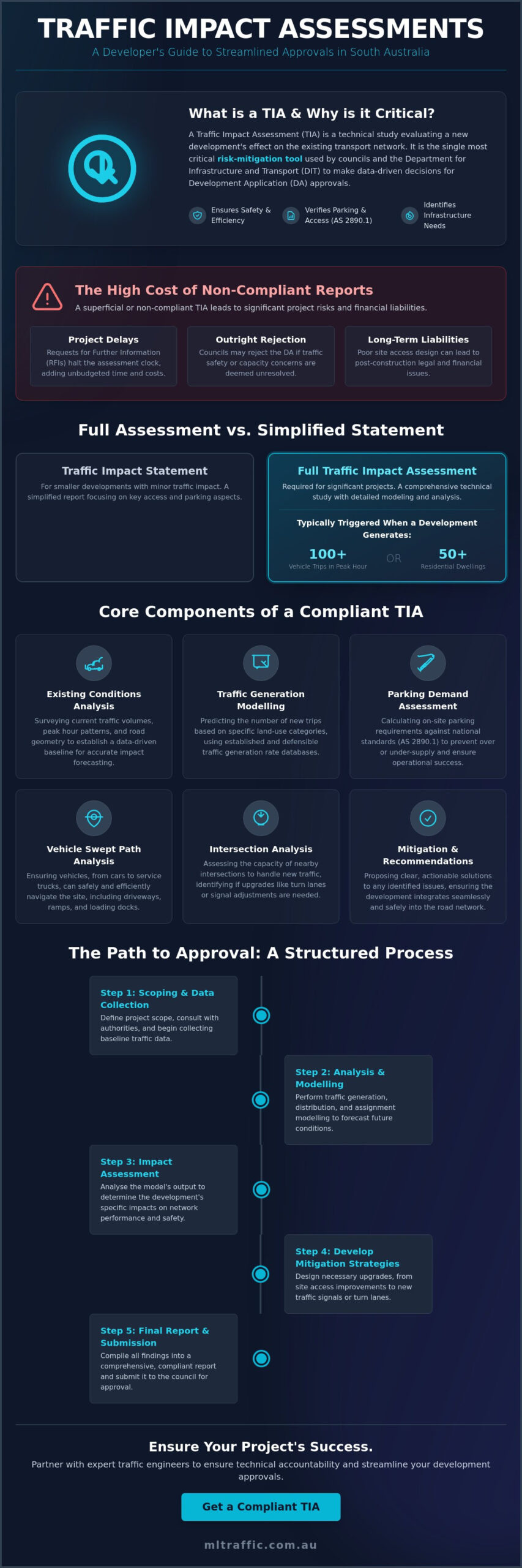
A Traffic Impact Assessment (TIA) is a formal technical study that evaluates how a proposed development influences the existing transportation network. It’s rooted in the principles of traffic engineering, focusing on safety, capacity, and infrastructure longevity. For any significant project, a traffic impact assessment adelaide developers commission is the primary document used by authorities to determine if the local road system can accommodate the projected increase in vehicle movements. Councils and the Department for Infrastructure and Transport (DIT) rely on these reports to make data-driven decisions. High-quality documentation directly correlates with faster Development Application (DA) approvals. Conversely, a superficial report often leads to administrative bottlenecks.
To better understand this concept, watch this helpful video:
In the Australian planning framework, the TIA serves as a bridge between private development and public infrastructure. Whether the site is residential, commercial, or industrial, the goal is to prevent the degradation of public road performance. Research indicates that TIAs are generally triggered for developments expected to generate 100 or more vehicle trips during peak hours, or for residential projects with 50 or more dwellings. By addressing these impacts early, developers can avoid the unforeseen costs of retrofitting site access or mitigating traffic flow issues after construction has commenced. You can view our full range of technical assessment services to see how these reports integrate into the design process.
Key Objectives of a Professional Traffic Report
- Safety and Efficiency: We assess the surrounding road network to ensure that new traffic doesn’t create hazardous conditions or excessive congestion.
- Parking and Access: We evaluate the adequacy of proposed on-site parking and internal access layouts to ensure they meet AS 2890.1 standards.
- Infrastructure Upgrades: A professional report identifies specific upgrades, such as turn lanes or signal adjustments, required to mitigate the development’s impact.
The Consequences of Non-Compliant Traffic Documentation
The most immediate risk of a poor report is the issuance of a Request for Further Information (RFI). This halts the assessment clock and adds unbudgeted consultancy costs. In some cases, a project might face outright rejection if the council deems the traffic safety concerns unresolved. Beyond the approval phase, poor site access design carries long-term legal and financial liabilities. Ensuring compliance from the start is the only way to safeguard a project’s commercial viability and maintain a professional reputation with local planning authorities.
Core Components of a Compliant Traffic Impact Assessment Adelaide
A compliant traffic impact assessment adelaide relies on a foundation of empirical data. We begin with a detailed existing conditions analysis. This process includes surveying current traffic volumes, identifying peak hour patterns, and mapping existing road geometry. This baseline allows for accurate impact forecasting. Without a precise understanding of the current network, any proposed mitigation measures lack technical merit and are unlikely to pass council scrutiny.
Traffic generation modelling follows this baseline study. We predict the number of trips based on specific land-use categories, using established databases to ensure these figures are defensible during review. Alongside this, a car parking demand assessment calculates requirements against national standards. This prevents the over-supply or under-supply of parking spaces, both of which can lead to project delays or operational failure. If you need technical verification for your project, you can review our traffic engineering services to ensure your layout meets all regulatory benchmarks.
Intersection analysis evaluates how the development affects the surrounding network’s performance. We measure the Level of Service (LoS) and the degree of saturation. Using technical tools like SIDRA Intersection, we provide clear metrics on delay and queue lengths. If an intersection’s performance drops below acceptable thresholds, we identify necessary infrastructure upgrades. These data-driven insights ensure that the development does not compromise the safety or efficiency of the public road system.
Integrating AS 2890.1 and AS 2890.2 Standards
National geometric requirements are strict and non-negotiable. We ensure all off-street parking designs comply with AS 2890.1 for residential and commercial sites. Adherence to AS 2890.1 is critical for ensuring site safety and functional vehicle movement. We also apply AS 2890.2 standards for service vehicle areas and loading docks. This ensures heavy vehicles can operate without obstructing public thoroughfares or creating safety hazards for pedestrians.
Vehicle Swept Path and Access Assessments
Safe site access is demonstrated through vehicle swept path analysis. We use specialized AutoTURN software to simulate the movements of the largest anticipated vehicles. This confirms that trucks or emergency vehicles can navigate the site without hitting infrastructure or crossing into opposing lanes. Detailed access assessments prevent costly redesigns during the construction phase. For a deeper look at this process, read our guide on Swept Path Analysis: A Developer’s Guide to Council Approval.
Traffic Impact Statement vs. Full Assessment: Choosing the Right Path
Determining whether your project requires a full technical study or a simplified report is a critical first step in the development process. This decision is primarily driven by the scale of the proposal and its anticipated effect on the surrounding road network. A full traffic impact assessment adelaide councils demand is a deep dive into network capacity, while a Traffic Impact Statement (TIS) is a more focused review of site-specific safety. Making the wrong choice early can result in a Request for Further Information (RFI), which stalls the approval process and increases costs. We recommend consulting with a senior traffic engineer before finalizing your application to ensure the report scope matches the council’s expectations.
Development scale is the most common trigger for a full assessment. For example, residential projects with 50 or more dwellings or commercial sites with a significant Gross Floor Area (GFA) almost always require a TIA. The threshold is often set at 100 or more vehicle trips during peak periods. If your development falls below these metrics, a TIS might be acceptable. However, even small projects on high-volume arterial roads may be elevated to a full TIA if the council identifies potential safety risks at the access point. Early engagement with specialists ensures you provide exactly what the authorities need to see, no more and no less.
Small-Scale Developments and Traffic Statements
A Traffic Impact Statement is suitable for projects where the traffic increase is marginal. Typical scenarios include minor subdivisions, small retail fit-outs, or medical consulting rooms with limited staff. The core data requirements for a TIS are less intensive than a full assessment. We focus on ensuring the proposed parking meets AS 2890.1 standards and that the driveway design allows for safe entry and exit. Because a TIS doesn’t involve complex corridor modelling, it’s a more cost-effective and faster path for developers working on low-impact sites. It provides the necessary assurance to the council that the site functions safely without requiring an analysis of the broader city network.
Major Projects and Comprehensive TIA Reports
Comprehensive reports are non-negotiable for high-impact developments like shopping centres, industrial hubs, and large residential estates. These projects necessitate a full traffic impact assessment adelaide authorities use to manage regional congestion. A key component of these reports is SIDRA intersection modelling. This software allows us to evaluate the Level of Service (LoS) at nearby junctions and predict how your project will affect queue lengths and delays. We also analyze cumulative impacts, which account for the traffic generated by other nearby developments currently in the planning pipeline. This holistic view is essential for major projects to secure approval and maintain the efficiency of the South Australian transport network.
The TIA Process: From Scoping to Council Submission
The execution of a professional traffic impact assessment adelaide follows a rigorous, multi-stage methodology. It starts with initial project scoping. During this phase, senior traffic engineers consult with the developer to define the study area and the specific requirements of the local planning authority. This early alignment prevents technical oversights that often lead to project delays. We then move into detailed data collection, which forms the empirical backbone of the entire report.
Technical analysis follows the data gathering phase. A detailed traffic impact assessment adelaide requires sophisticated modelling to predict how a new development will alter local trip generation. We model traffic distribution patterns and calculate parking demand based on the specific land-use category of the development. Every report undergoes internal quality assurance checks to verify that all calculations and design recommendations meet national standards. This meticulous approach ensures that the final document submitted to the council is defensible and technically sound. Our involvement doesn’t end at submission; we provide ongoing support to address technical queries raised during the official review period.
Data Collection and Site Surveys
Accurate peak-hour traffic data is the most critical element of a reliable study. Obtaining the data required for a traffic impact assessment adelaide involves more than just counting cars. We conduct site visits to observe real-world conditions that digital maps might miss. This includes identifying existing sight distance constraints and potential road hazards that could impact safe site access. We also conduct an exhaustive review of local council Development Control Plans (DCPs). This ensures that the proposed traffic and parking solutions align with specific local government requirements and regional transport strategies.
Liaising with Planning Authorities
Securing approval often requires direct communication with council traffic departments and state road authorities. We address technical feedback and clarify complex engineering solutions to ensure the project moves forward. Professional representation in planning meetings is invaluable for resolving disputes or clarifying technical nuances. If your project requires expert advocacy, you can access ML Traffic Engineers Australia for professional representation throughout the application process. This no-gatekeepers approach ensures you have a direct line to the senior principals performing the technical work.
Why Expert Traffic Engineering is Non-Negotiable for Development Success
Expert traffic engineering ensures your project isn’t just compliant but commercially optimized. With over 15 years of specialized experience, ML Traffic Engineers Australia provides technical depth that generalist firms cannot replicate. A professional traffic impact assessment adelaide developers rely on requires a precise balance between regulatory mandates and site functionality. We don’t just identify constraints; we engineer solutions that maximize site yield while satisfying the safety requirements of local authorities. Optimizing site functionality involves more than just meeting minimum standards. It requires a strategic understanding of how vehicle movements interact with complex site geometry. We verify that every driveway ramp grade and parking stall meets geometric requirements without wasting valuable land.
Our “No-Gatekeepers” approach is a fundamental pillar of our professional identity. Clients gain direct access to senior principals who possess deep technical expertise. You won’t be passed off to junior staff once the engagement begins. This ensures technical accountability and provides a direct line to the experts performing the analysis. Our personnel continuity promise means the same expert who initiates your project will be the one finalizing the technical work. This consistency reduces communication errors and ensures the nuances of your site are understood throughout the entire assessment process. This results-oriented philosophy distinguishes our firm from larger, more impersonal organizations where project knowledge is often diluted during internal handovers.
National Expertise with Local Planning Insight
Navigating complex planning codes requires a thorough understanding of both local and national jurisdictions. We ensure every report meets the specific standards of South Australian councils and the Department for Infrastructure and Transport. Senior leadership involvement in every project guarantees that all recommendations are backed by professional accountability and rigorous engineering standards. This high-level oversight is essential for managing the bureaucratic requirements of major developments across diverse project environments. We maintain a clear focus on adherence to national regulatory standards to ensure your project stands up to the most rigorous technical scrutiny.
Securing Your Approval with ML Traffic Engineers Australia
We are committed to providing meticulous, results-oriented traffic consultancy. Our specialized services, including professional car park design and vehicle swept path analysis, are designed to minimize project risks before they reach the council review phase. By identifying potential access issues or parking shortfalls early, we prevent the need for expensive redesigns. A compliant traffic impact assessment adelaide is a strategic asset that facilitates smoother approvals and ensures your development functions as intended. Our dependability is built on a foundation of multi-decade professional longevity and a hands-on approach to every technical challenge. Contact ML Traffic Engineers Australia for a compliant TIA report to secure the technical expertise your project demands.
Securing Project Approval through Technical Excellence
Navigating the complexities of council approvals requires more than basic data collection. Successful developments rely on reports that demonstrate strict adherence to AS 2890.1 and AS 2890.2 standards. By correctly identifying whether your project triggers a full traffic impact assessment adelaide or a simplified statement, you can avoid unnecessary delays and unbudgeted mitigation costs. It’s the technical accuracy in vehicle swept path analysis and intersection modelling that ensures your site access design is both safe and defensible.
ML Traffic Engineers Australia provides over 15 years of specialized traffic engineering experience to every project. Our “no-gatekeepers” approach ensures you have direct access to senior principals who remain accountable from scoping to final submission. This personnel continuity ensures that the technical integrity of your report is maintained throughout the planning process. We focus on achieving full compliance while optimizing your site’s functionality. Get a Quote for Your Traffic Impact Assessment and move your project toward a successful council review with confidence.
Frequently Asked Questions
How much does a traffic impact assessment cost in Australia?
The cost of a report depends on the scale of the development and the complexity of the required technical analysis. Minor projects requiring a simple Traffic Impact Statement are less resource-intensive than major commercial hubs needing extensive intersection modelling. Developers should request a project-specific fee proposal to ensure the scope of work aligns with the specific requirements of the local planning authority.
When is a traffic report mandatory for a development application?
A traffic report is mandatory when a proposed development meets specific trip generation thresholds or impacts road safety. In South Australia, this typically applies to projects expected to generate 100 or more vehicle trips during peak hours. It’s also required for residential developments with 50 or more dwellings or sites with complex access points onto arterial roads.
What is the difference between a TIA and a TIS?
A TIA is a comprehensive technical study of the broader road network, while a TIS is a focused statement on site-specific issues. A traffic impact assessment adelaide councils demand for major projects includes SIDRA modelling and cumulative impact analysis. A Traffic Impact Statement is usually sufficient for low-impact developments like minor subdivisions or small retail fit-outs where network performance isn’t compromised.
How long does it take to prepare a compliant traffic impact assessment?
Preparation typically takes between two and four weeks, depending on the availability of traffic count data and the complexity of the modelling. Assessments requiring specialized surveys or extensive consultation with state road authorities may require additional time. We prioritize early data collection and site visits to ensure the final report meets your council submission deadlines without sacrificing technical rigour.
Do I need a traffic engineer for a small residential subdivision?
Yes, councils often require a qualified traffic engineer to certify that a subdivision layout meets safety and parking standards. We verify that the proposed driveways provide adequate sight distances and that internal access ways accommodate emergency vehicles. Professional engineering input ensures the development complies with local planning codes and reduces the risk of a project being rejected on safety grounds.
What standards must my car park design follow for council approval?
Car park designs must strictly adhere to Australian Standards AS 2890.1 for off-street parking and AS 2890.2 for commercial vehicle facilities. These standards define the geometric requirements for parking bay dimensions, aisle widths, and driveway ramp grades. Compliance with these national standards is non-negotiable for securing council approval and ensuring the long-term functionality of the site.
Can a traffic impact assessment help if council has already issued an RFI?
A professional traffic impact assessment adelaide can resolve technical objections raised in a Request for Further Information (RFI). We provide the empirical evidence and engineering analysis necessary to address council concerns regarding traffic flow or parking shortfalls. This technical advocacy is essential for clearing administrative hurdles and moving a stalled development application toward a successful decision.
What software is used for swept path analysis and intersection modelling?
We use industry-standard software such as AutoTURN for vehicle swept path analysis and SIDRA Intersection for modelling intersection performance. These tools allow us to simulate vehicle movements and predict delays or queue lengths with high precision. Using recognized software ensures that our technical findings are defensible and meet the evidentiary requirements of state and local transport authorities.

Disclaimer
The content on www.mltraffic.com.au, including all technical articles, guides, and resources, is provided for general informational and educational purposes only. It is not intended to constitute professional advice in traffic engineering, transportation planning, development approvals, or any other technical or legal field.
While ML Traffic Engineers makes every reasonable effort to ensure the accuracy, completeness, and timeliness of the information published, we do not provide any warranties or representations (express or implied) regarding its reliability, suitability, or availability for any particular purpose. Any reliance you place on the content is strictly at your own risk.
In no event shall ML Traffic Engineers, its directors, employees, authors, or affiliates be liable for any direct, indirect, incidental, special, consequential, or punitive damages (including, without limitation, loss of profits, data, or business opportunities) arising out of or in connection with the use of, or inability to use, any information provided on this website.
The articles and guides on this site are not a substitute for engaging a qualified, registered professional traffic engineer (such as an NPER or RPEQ engineer) to assess your specific project requirements. For tailored advice, compliance assessments, or traffic engineering services, please contact a competent professional.
This disclaimer may be updated from time to time without notice. By accessing or using this website, you agree to be bound by the most current version of this disclaimer.
