

How much of your project’s profit margin is currently being swallowed by “unforeseen” council infrastructure levies? It’s a recurring frustration for developers when a local authority demands significant road widening or intersection works that weren’t accounted for in the initial feasibility study. A professional traffic impact assessment for council infrastructure upgrades acts as your primary defensive tool during these high-stakes negotiations. By providing rigorous technical evidence of your development’s actual impact, you ensure that infrastructure contributions remain fair, proportional, and grounded in engineering reality rather than bureaucratic guesswork.
We recognise that navigating the shifting landscape of Australian planning regulations, including the NSW Housing and Productivity Contribution and Victoria’s 2027 standardised frameworks, is becoming increasingly complex. This guide explains how a TIA report aligns your site with local infrastructure plans while protecting you from excessive developer costs. You’ll learn the essential technical requirements for successful DA approval, how we utilise AutoTURN for access compliance, and the strategic steps required to minimise your contribution liabilities. We’ll also examine the latest 2026 Austroads updates to ensure your project meets the most current national standards, providing you with a clear roadmap for site access and regulatory compliance.
Key Takeaways
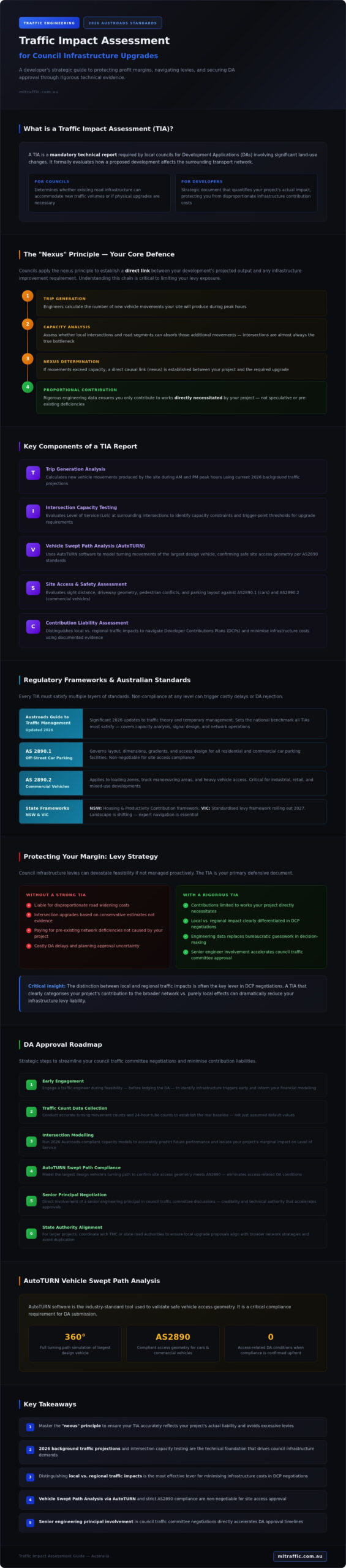
- Master the “nexus” principle to ensure a traffic impact assessment for council infrastructure upgrades accurately reflects your project’s liability and avoids excessive levies.
- Understand how current 2026 background traffic projections and intersection capacity testing influence council infrastructure demands for new developments.
- Learn to distinguish between local and regional traffic impacts to effectively navigate Developer Contributions Plans (DCPs) and minimise infrastructure costs.
- Ensure site access compliance by incorporating rigorous Vehicle Swept Path Analysis and adhering to the latest Austroads and AS2890 standards.
- Discover how direct involvement from senior engineering principals can streamline negotiations with council traffic committees and expedite your DA approval.
Understanding the Role of Traffic Impact Assessments in Infrastructure Planning
A Traffic Impact Assessment (TIA) is a mandatory technical report required by local councils for most Development Applications (DAs) involving significant land-use changes. It serves as a formal evaluation of how a proposed development will affect the surrounding transport network. For developers, a traffic impact assessment for council infrastructure upgrades is not merely a box-ticking exercise. It is a strategic document that quantifies the additional demand placed on public assets. By identifying potential safety risks and capacity constraints early, the TIA provides a clear roadmap for site access and regulatory compliance.
Councils rely on these assessments to determine whether existing road infrastructure can accommodate new traffic volumes or if physical upgrades are necessary. Without a robust, evidence-based report, developers risk being held liable for disproportionate infrastructure costs. A well-prepared TIA ensures that any required road widening, intersection treatments, or signalling changes are justified by technical data rather than conservative estimates. To better understand the fundamental concepts of this analysis, watch this helpful video:
The Nexus Between Private Development and Public Infrastructure
Councils apply the “nexus” principle to establish a direct link between a development’s projected output and the requirement for infrastructure improvements. This process begins with trip generation, where engineers calculate the number of new vehicle movements the site will produce. If these movements exceed the capacity of local intersections or road segments, it triggers a requirement for upgrades. Professional engineering data is vital here to ensure the scale of the required improvements is fair. Our team provides the technical precision needed to negotiate these requirements, ensuring you only contribute to works directly necessitated by your project. You can view our detailed traffic engineering services to see how we support this process.
Regulatory Frameworks and Australian Standards
Compliance is non-negotiable in infrastructure planning. Every TIA must adhere to the Austroads Guide to Traffic Management, which saw significant updates in early 2026 regarding traffic theory and temporary management. Site designs must also meet the rigorous requirements of AS2890.1 for off-street car parking and AS2890.2 for commercial vehicle facilities. For larger projects with regional implications, the Transport Management Centre (TMC) or state road authorities often join the review process. Their involvement ensures that local upgrades align with broader network strategies. Adhering to these national standards provides the reliability councils demand, reducing the likelihood of costly delays during the planning approval phase.
Evaluating the Impact of New Developments on Council Road Networks
Assessing how a new project fits into the existing urban fabric requires a granular look at the local road network. A traffic impact assessment for council infrastructure upgrades must quantify exactly how much capacity remains in the system to accommodate your project. While mid-block capacity refers to the straight sections of road, the true bottlenecks are almost always intersections. While specific requirements vary by local government area, the underlying logic remains consistent with international standards, such as the Anchorage Traffic Impact Analysis Policy, which emphasises that developers must mitigate the traffic impacts they generate to maintain public safety.
We utilise SIDRA modelling to simulate current and future traffic conditions. This software provides data on average delay, queue lengths, and the Level of Service (LoS). LoS is a qualitative measure ranging from A (free flow) to F (gridlock). For 2026 and beyond, we calculate background traffic growth by applying annual growth rates derived from historical data and strategic transport models. This ensures the TIA accounts for general population growth rather than unfairly attributing existing network failures to your development. If you require a precise intersection analysis to support your DA, our senior principals provide the technical oversight needed for council approval.
Intersection Analysis and Capacity Testing
Intersection performance is the primary driver of infrastructure requirements. Peak hour variables, such as school zones or afternoon commutes, are critical during this testing phase. SIDRA software allows us to present a defensible case to council traffic committees by showing that a development might only contribute a marginal increase in delay. We isolate your project’s specific impact by comparing “With Development” and “Without Development” scenarios. This technical distinction is vital; it prevents councils from requesting upgrades that don’t meet the nexus of your site’s actual traffic contribution.
Trip Generation and Distribution Modelling
Trip generation is the calculation of vehicle movements entering and exiting a site. We rely on the Transport for NSW Guide to Traffic Generating Developments to determine these rates. The RTA Guide defines trip generation as the total number of trips produced by a specific land-use category during peak operational hours. Directional distribution is equally important. It isn’t enough to know how many cars leave the site; we must know where they go. If 80% of your traffic turns left toward a major highway, that specific intersection approach may require a dedicated turn lane. This precision ensures you don’t pay for upgrades on roads your tenants’ vehicles won’t use.
Navigating Developer Contributions Plans and Infrastructure Funding
A traffic impact assessment for council infrastructure upgrades is often the only barrier between a profitable project and one crippled by excessive levies. Councils operate under Developer Contributions Plans (DCPs), which are formal frameworks used to fund local roads, parks, and community facilities. In 2026, these costs are rising sharply. For instance, contribution estimates from various Australian councils can reach A$56,000 per new lot. When fees exceed state-mandated caps, a TIA becomes your primary tool for challenging these valuations. It allows you to differentiate between local impacts caused by your site and regional traffic growth that should be funded by state agencies or broader community levies.
Your TIA protects your bottom line by ensuring you don’t pay to fix pre-existing road deficiencies. If a nearby intersection is already failing, the law dictates that you are only responsible for the additional delay your project creates. By providing technical evidence of existing network performance, we prevent councils from “gold-plating” their infrastructure at your expense. These requirements are often triggered by specific development thresholds, much like those outlined in many Australian council planning policies, which clarify when a formal study is necessary to mitigate public infrastructure strain.
Developer Contributions vs. Direct Infrastructure Delivery
Developers generally face two pathways: paying a flat cash levy or constructing the required road upgrades themselves. The new NSW Housing and Productivity Contribution (HPC) system, for example, sets residential rates between A$6,000 and A$12,000 per dwelling. However, a TIA may reveal that constructing a specific turn lane or traffic signal is more cost-effective than paying the full levy. We use the principle of “apportionment” to negotiate these costs. This ensures you only pay for the exact percentage of the infrastructure upgrade that your development traffic actually uses, rather than the total cost of the project.
The Role of the TIA in Works-in-Kind (WIK) Agreements
A Works-in-Kind (WIK) agreement occurs when a developer builds infrastructure instead of paying a cash contribution. This is a common strategy for larger sites where immediate road improvements are necessary for site access. To secure a WIK agreement, you need a traffic engineer to certify the value and necessity of the works. Our traffic engineering services include the detailed intersection analysis and design required to satisfy council engineers that your proposed works meet the standards set out in the DCP. This approach gives you greater control over construction timelines and can significantly improve your project’s overall cash flow.
Key Components of a TIA for Council Infrastructure Projects
A robust traffic impact assessment for council infrastructure upgrades must translate complex traffic flow data into actionable engineering requirements. It is not a generic document. It consists of several critical technical modules, including trip generation analysis, intersection modelling, and safety evaluations. These components ensure that every proposed entry point and internal road layout meets the rigorous safety standards set by local authorities and national bodies. By providing this level of detail, you demonstrate that your project aligns with broader network objectives.
Vehicle Swept Path and Access Assessment
Proving that a site can accommodate the intended vehicle types is a prerequisite for DA approval. We use AutoTURN software to perform Vehicle Swept Path Analysis, simulating the movement of heavy vehicles, waste collection trucks, and emergency services. This analysis ensures that the proposed geometry of driveways and internal circulation areas complies with AS2890.2 for commercial and industrial developments. Failing to provide this technical proof often leads to council requests for total site redesigns. For a deeper look at these requirements, see our Swept Path Analysis Guide.
Car Parking Design and Demand Assessment
Static council parking rates often don’t reflect the actual needs of modern mixed-use or high-density developments. A Car Parking Demand Assessment allows us to justify a reduction in mandatory parking spaces by providing data-driven evidence of peak occupancy. This is often coupled with a review of driveway ramp grades to ensure they meet the strict vertical alignment criteria of AS2890.1. Correct ramp design prevents vehicle scraping and ensures pedestrian safety at the property boundary. You can read more in our guide on AS2890.1 explained.
Sight distance assessments are the final pillar of a compliant report. We evaluate the visibility at new entry points to ensure drivers can safely enter and exit the site without obstructing the existing traffic flow. This includes assessing both Safe Intersection Sight Distance and Entering Sight Distance as defined in the Austroads guidelines. If your project requires a high-level traffic impact assessment for council infrastructure upgrades to clear these hurdles, you can contact our senior engineering team for a consultation.
Why Professional Traffic Engineering is Vital for DA Approval
Council traffic committees operate on a foundation of technical trust. When they review a traffic impact assessment for council infrastructure upgrades, they look for reports that demonstrate a deep understanding of both the Austroads standards and local planning instruments. A report from ML Traffic Engineers Australia carries significant weight because it is backed by professional indemnity and a history of successful project delivery. This professional standing is crucial for minimising the risk of a project being deferred or rejected due to insufficient technical evidence or non-compliance with Australian Standards like AS2890.
Direct Access to Senior Principal Expertise
Many large-scale consultancies utilise a junior-led model where senior staff manage client relationships while graduates perform the actual technical modelling. We operate differently. Our “Personnel Continuity Promise” ensures the senior principal who initiates your project is the same expert who performs the intersection analysis and site assessment. This hands-on approach significantly reduces the volume of Requests for Information (RFIs) from council, as the technical nuances of the site are addressed correctly the first time. You can learn more about our leadership team and our 15-year history at ML Traffic Engineers Australia.
Navigating the bureaucratic requirements of various councils requires more than just technical skill; it requires experience with the specific expectations of local traffic committees. Over more than 15 years of consultancy, we’ve developed an intimate knowledge of how different local government areas interpret infrastructure contribution plans. If a Development Application is challenged or proceeds to a tribunal, our senior engineers act as expert witnesses, providing defensible testimony grounded in rigorous data. This level of accountability is a primary marker of reliability that distinguishes seasoned experts from impersonal, high-volume firms.
Achieving Defensible Results for Complex Infrastructure
A professional TIA functions as a vital risk management tool for developers. By accurately predicting traffic demand and intersection performance, we provide a clear roadmap for site access that resists council pushback. Meticulous traffic engineering is the foundation of successful DA outcomes. It ensures that your infrastructure liabilities are quantified accurately and defended vigorously throughout the entire planning process, protecting your project’s commercial viability. To secure your project’s approval and manage your infrastructure costs, contact ML Traffic Engineers Australia for a project-specific TIA quote.
Secure Your Development Approval with Technical Precision
A high-quality traffic impact assessment for council infrastructure upgrades is the most effective way to protect your project’s commercial viability. By applying the nexus principle and conducting rigorous intersection analysis, you ensure that infrastructure contributions remain fair and proportional to your project’s actual impact. Technical compliance with the latest 2026 Austroads updates and AS2890 standards is essential to avoid costly redesigns and planning delays. Relying on verified SIDRA modelling and precise vehicle swept path analysis provides the defensible data needed to satisfy council traffic committees and expedite your DA approval.
With over 15 years of Australian traffic engineering experience, the team at ML Traffic Engineers Australia provides direct principal-level accountability on every report produced. We don’t delegate your critical technical work to junior staff; the expert who starts your project is the one who completes it. This hands-on approach ensures your site access plans are robust, compliant, and ready for scrutiny. Get an Expert Traffic Impact Assessment for Your Project from ML Traffic Engineers Australia today to ensure your development aligns with council infrastructure plans while managing your contribution costs. We look forward to helping you achieve a successful and cost-effective planning outcome.
Frequently Asked Questions
Is a Traffic Impact Assessment required for all council infrastructure upgrades?
A traffic impact assessment for council infrastructure upgrades is mandatory for any development that significantly alters traffic patterns or trip generation. Councils set specific thresholds based on the scale of the land-use change and its proximity to sensitive intersections. While minor residential additions might be exempt, commercial, industrial, or multi-unit residential developments almost always require this formal report to ensure the local road network remains safe and functional.
How much does a Traffic Impact Assessment cost for a standard development?
The cost of a Traffic Impact Assessment depends entirely on the project’s complexity and the level of modelling required. Small-scale developments with minimal network impact involve lower technical overhead than major subdivisions or shopping centres. Factors such as the need for SIDRA intersection modelling, onsite parking demand surveys, and extensive vehicle swept path analysis will influence the final fee. We provide project-specific quotes to ensure technical requirements are met without unnecessary expenditure.
Can a TIA report help reduce my developer contribution fees?
Yes, a TIA is a primary tool for negotiating fair developer contributions by establishing a clear technical nexus. It ensures you only pay for infrastructure upgrades directly necessitated by your project’s traffic. By isolating your site’s impact from general background traffic growth, the report prevents you from funding pre-existing network deficiencies. This distinction is vital for ensuring that your contribution to local infrastructure remains proportional and commercially viable.
What is the difference between a Traffic Impact Assessment and a Traffic Management Plan?
A TIA is a strategic planning document used to secure DA approval by assessing long-term network impacts. In contrast, a Traffic Management Plan (TMP) or Traffic Guidance Scheme (TGS) focuses on the physical control of traffic during construction or specific events. While the TIA models future intersection capacity and road geometry, the TGS provides the site-specific signage and barricade layouts required to maintain safety for workers and the public during works.
How long does it take to prepare a TIA for a council submission?
Preparing a comprehensive TIA typically takes between two and four weeks, depending on the availability of current traffic data. More complex projects requiring extensive intersection analysis or multi-day parking surveys may take longer to complete. Early engagement is essential to ensure the report is ready for your DA lodgement. This timeframe includes the necessary quality assurance checks by senior principals to ensure compliance with the latest 2026 Austroads guidelines.
What happens if council disagrees with the findings of my traffic engineer?
If a council traffic committee challenges the report’s findings, our senior engineers provide additional technical evidence to justify the original assessment. This process often involves refining SIDRA models or providing further site-specific data. Because our reports are prepared by senior principals with over 15 years of experience, they are technically robust. If a dispute proceeds to a tribunal, we provide expert witness services to defend the engineering data in a legal setting.
Does a TIA cover pedestrian and cyclist safety around infrastructure upgrades?
Yes, modern TIAs must address the safety and accessibility requirements for all road users, including pedestrians and cyclists. This is a core component of the Austroads Guide to Traffic Management. The assessment evaluates sight distances at crossing points, the adequacy of footpath widths, and the integration of cycling lanes into new infrastructure. Ensuring multimodal safety is a key requirement for achieving DA approval and meeting the safety objectives of local government authorities.
Do I need a new TIA if my development plans change slightly?
Minor modifications to a site layout may only require a brief technical addendum rather than a completely new traffic impact assessment for council infrastructure upgrades. However, significant changes to the gross floor area, the number of dwellings, or the location of access points will necessitate a revised assessment. Councils require the TIA to reflect the exact project being considered for approval to ensure the underlying trip generation and swept path data remains accurate.

Disclaimer
The content on www.mltraffic.com.au, including all technical articles, guides, and resources, is provided for general informational and educational purposes only. It is not intended to constitute professional advice in traffic engineering, transportation planning, development approvals, or any other technical or legal field.
While ML Traffic Engineers makes every reasonable effort to ensure the accuracy, completeness, and timeliness of the information published, we do not provide any warranties or representations (express or implied) regarding its reliability, suitability, or availability for any particular purpose. Any reliance you place on the content is strictly at your own risk.
In no event shall ML Traffic Engineers, its directors, employees, authors, or affiliates be liable for any direct, indirect, incidental, special, consequential, or punitive damages (including, without limitation, loss of profits, data, or business opportunities) arising out of or in connection with the use of, or inability to use, any information provided on this website.
The articles and guides on this site are not a substitute for engaging a qualified, registered professional traffic engineer (such as an NPER or RPEQ engineer) to assess your specific project requirements. For tailored advice, compliance assessments, or traffic engineering services, please contact a competent professional.
This disclaimer may be updated from time to time without notice. By accessing or using this website, you agree to be bound by the most current version of this disclaimer.
