
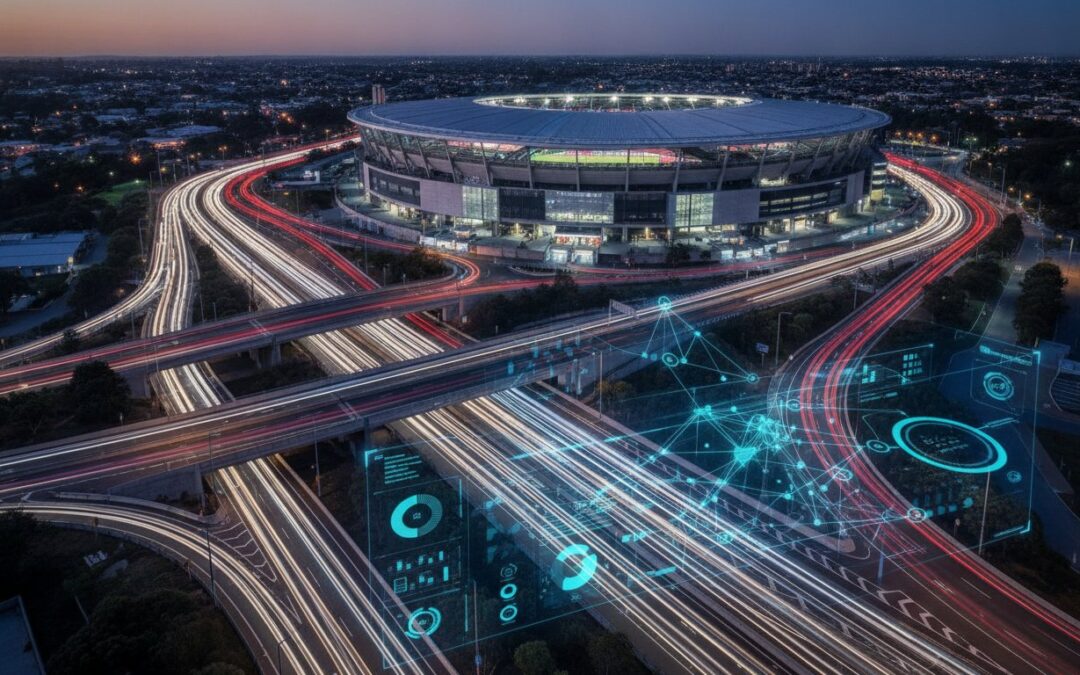
A single major event can paralyse a local road network, and Council planners are acutely aware of this risk. You’ve likely spent months on venue design, only to face the daunting prospect of a Development Application (DA) rejection due to perceived traffic congestion. Securing a traffic impact assessment for entertainment venues is not just a procedural hurdle; it’s the foundation of a defensible project. Standard daily averages don’t apply here. Success is measured by how effectively you manage peak-hour surge flow and patron dispersal.
Navigating the technicalities of AS 2890.1:2021 requires a precise approach to surge demand modelling. This guide provides the expert insight needed to secure a successful DA approval without unnecessary delays. We’ll examine how to develop a defensible TIA report, apply the latest ITE Trip Generation Manual data, and implement efficient patron dispersal strategies. By focusing on dynamic flow rather than static capacity, you can address Council concerns and ensure your venue’s infrastructure is both compliant and functional. We’ll also look at how to meet the rigorous expectations of Australian regulatory authorities through meticulous site assessments and infrastructure design.
Key Takeaways
- Understand why standard traffic models fail for high-capacity sites and how to define a realistic “Design Event” to manage surge flow effectively.
- Learn how a professional traffic impact assessment for entertainment venues uses micro-simulation to prove intersection performance and Level of Service (LoS) to Council.
- Ensure site compliance with AS 2890.1 and AS 2890.2 by accurately calculating parking demand and designing efficient commercial vehicle access.
- Discover strategies to integrate multimodal transport, including dedicated ride-share zones and public transport links, to mitigate congestion and noise concerns.
- Gain insights into structuring a defensible TIA report that addresses common Council objections to secure DA approval without unnecessary delays.
The Unique Surge Demand Profile of Large Entertainment Venues
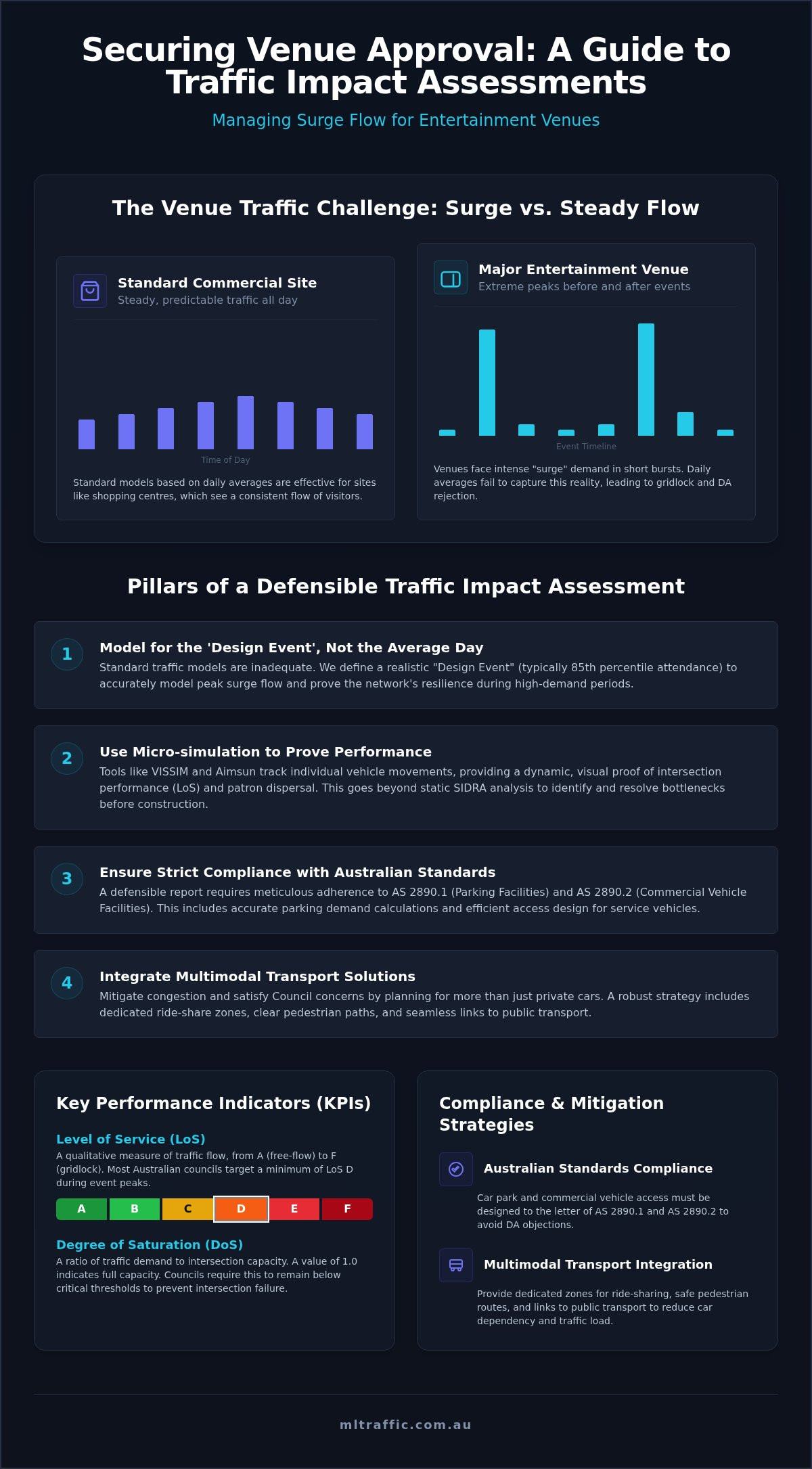
Entertainment venues do not behave like standard retail or commercial developments. They generate extreme “surge” demand that places intense pressure on the local road network in very short bursts. While a shopping centre might see steady turnover throughout the day, a stadium or concert hall experiences near-zero activity followed by a massive influx of thousands of vehicles. This is the core challenge of a traffic impact assessment for entertainment venues. Applying traffic engineering principles to these sites requires a shift from daily averages to dynamic, event-based modelling.
Why Daily Averages Fail in Venue Planning
Standard trip generation rates found in the RMS Guide to Traffic Generating Developments or Austroads publications often rely on steady-state flows. These metrics are fundamentally inadequate for high-capacity sites where patrons arrive within a 90-minute window and attempt to depart in under 60 minutes. Council reviewers are trained to identify TIAs that rely on generic data; they know these models fail to reflect the reality of gridlock during post-event dispersal. An assessment that ignores this surge nature will likely face immediate scrutiny. We prioritise the use of bespoke data collected from similar national venues to provide a defensible report. This approach ensures the modelling reflects actual patron behaviour and justifies the proposed infrastructure requirements based on empirical evidence rather than theoretical averages.
Establishing the Peak Demand Period
Identifying the critical one-hour window for patron dispersal is the most vital step in the analysis. This peak frequently overlaps with existing road network peak hours, particularly for weekday evening sporting matches or concerts. A weekend matinee presents different variables, including higher proportions of family groups and varied parking durations. We meticulously analyse arrival and departure curves to understand the intensity of the “pre-event” and “post-event” rush periods. The “Design Event” is defined as the 85th percentile attendance figure. This figure ensures the venue can handle the vast majority of events without over-engineering for a once-in-a-decade sell-out. Our specialised technical services focus on these temporal variations to ensure the road network remains functional during peak surge times, which is essential for securing DA approval.
Methodology for Traffic Flow Analysis and Intersection Modelling
Managing thousands of patrons leaving a venue simultaneously requires more than static calculations. A robust traffic impact assessment for entertainment venues must employ dynamic modelling to account for the unique arrival and departure curves discussed previously. This technical phase transforms attendance data into a functional representation of the road network’s capacity. We use these models to prove that the proposed venue can operate without causing systemic failure in the surrounding infrastructure.
Micro-simulation vs. Macro-modelling
SIDRA is the industry standard for isolated intersection analysis, providing essential data on Degree of Saturation (DoS) and Level of Service (LoS). While SIDRA is effective for static assessments, complex entertainment precincts often require micro-simulation software like VISSIM or Aimsun. These tools track individual vehicle and pedestrian movements in real-time. This level of detail allows us to identify bottlenecks, such as slow-moving car park exits or narrow pedestrian crossings, before they become construction problems. Visual simulations are particularly valuable during Council presentations, as they provide an intuitive demonstration of how the network handles surge flow. If you require technical clarity on your site’s capacity, our specialised intersection analysis provides the data needed for a defensible application.
Key Performance Indicators for Venue Traffic
We assess intersection performance using specific metrics to ensure the development meets Australian regulatory expectations. These KPIs are the primary focus of Council engineers during the review process.
- Level of Service (LoS): This qualitative measure ranges from A (free flow) to F (forced flow). Most Australian jurisdictions target a minimum LoS D during event peaks.
- Degree of Saturation (DoS): This ratio measures demand against intersection capacity. For signalised intersections, a DoS exceeding 0.90 typically triggers a requirement for mitigation.
- Queue Lengths: We model the 95th percentile queue length at site entry and exit points. It’s vital to ensure that vehicles don’t spill back into major arterial roads, which creates safety hazards and community complaints.
- Pedestrian Interaction: High-volume venues create significant vehicle-pedestrian conflict. Our analysis integrates these movements to ensure safe dispersal without compromising the efficiency of vehicle flow.
Accurate modelling prevents costly retrofits and ensures the safety of all road users. By identifying potential failure points early, we can design effective traffic management strategies that satisfy both regulatory requirements and patron expectations.
Parking Demand and Car Park Design Compliance (AS 2890)
Parking provision for entertainment venues requires a delicate balance between peak attendance demand and commercial viability. Unlike residential developments, where parking is typically occupied overnight, event-based sites must facilitate rapid turnover. A traffic impact assessment for entertainment venues must justify the proposed parking rates by comparing local Council requirements with actual demand data from similar facilities. If the provision is too low, the resulting overflow into surrounding residential streets often leads to community opposition and potential DA rejection.
Vehicle Swept Path and Access Assessments
Operational logistics for large venues extend beyond private vehicles. We use AutoTURN software to perform rigorous vehicle swept path analysis, ensuring that coaches, emergency vehicles, and heavy rigid vehicles (HRVs) can navigate the site safely. This is critical for loading docks and dedicated coach bays where clearance is often tight. Ensuring compliance with AS 2890.2 for commercial vehicles prevents operational failures that could lead to on-street congestion. For more detailed technical requirements, refer to our Swept Path Analysis Guide.
Car Park Design and Efficiency
Internal car park geometry must prioritise speed and safety to manage surge flow. High-turnover event parking necessitates wider aisles and optimised ramp grades to prevent internal bottlenecks that spill back onto the public road network. We ensure every design adheres to the latest Australian Standards, including AS/NZS 2890.1:2021. You can find a breakdown of these requirements in our AS 2890.1 Explained article.
Modern planning often involves balancing physical parking spots with “Green Travel Plan” concessions. By demonstrating robust public transport integration or ride-share provisions, developers can sometimes justify a reduction in the total number of required on-site spaces. This approach reduces construction costs while still meeting regulatory expectations. We provide the technical evidence needed to support these concessions, ensuring the final TIA report is both defensible and cost-effective. Meticulous design at the DA stage avoids the need for expensive modifications once the venue is operational.
Multimodal Transport Strategies and Traffic Mitigation
Modern entertainment developments cannot rely solely on private vehicle access. Reducing reliance on cars is a fundamental component of a traffic impact assessment for entertainment venues. We develop multimodal strategies that prioritise public transport integration and active transport links. This reduces the total number of vehicle trips and minimises the impact on the surrounding road network. Councils increasingly demand these strategies to ensure sustainability and community safety. A robust strategy often allows for concessions in physical parking requirements, provided the alternative transport options are viable and well-documented.
Ride-Share and Coach Management
Patron pick-up and drop-off zones require specific kerbside demand calculations. During the post-event rush, the volume of Uber, Ola, and taxi movements can exceed the capacity of standard street frontage. We design dedicated zones that separate these vehicles from general traffic flow to prevent queuing on arterial roads. This involves calculating the expected number of ride-share requests based on venue capacity and transit accessibility. Charter coaches also require specialised planning. We ensure sufficient parking to accommodate heavy rigid vehicle (HRV) dimensions and design prioritised exit routes to facilitate rapid patron dispersal. Separating these high-occupancy vehicles from private traffic is essential for maintaining intersection performance and Level of Service (LoS).
Event Traffic Management Plans (ETMP)
An ETMP is frequently a mandatory condition of DA approval for large-scale venues. It functions as an operational blueprint, outlining how the site will operate during specific event categories, from small matinees to full-capacity concerts. While traffic is a priority, organisers should also explore Project-based Event Production Fees to ensure the venue’s technical infrastructure is adequately planned. A successful ETMP requires collaboration with local authorities to manage road closures or signal timing adjustments. This ensures the road network can handle the temporary surge without compromising safety. Key components of our ETMPs include:
- Pedestrian link safety and crowd control measures to manage high-volume foot traffic.
- Cycle parking provision and active transport connectivity to encourage non-vehicular arrivals.
- Staffing schedules for traffic guidance and parking marshals to ensure orderly movement.
- Contingency plans for emergency vehicle access during peak dispersal flows.
For a comprehensive look at the regulatory requirements for these documents, see our Traffic Management Plan Guide. A defensible ETMP ensures that event-day operations don’t compromise local road safety or lead to gridlock. If you need a compliant strategy that satisfies Council requirements, contact our senior principals to discuss your project directly. We provide the technical expertise needed to manage complex dispersal scenarios effectively and secure your development application.
Securing Council Approval with a Defensible TIA Report
A successful traffic impact assessment for entertainment venues must be structured to withstand intense regulatory scrutiny. Council engineers often focus on high-risk areas like congestion, community safety, and local amenity. We address these concerns by providing a clear, evidence-based narrative that justifies every design decision. A defensible TIA report doesn’t just present data; it anticipates objections and provides pre-emptive engineering solutions. This structured approach builds confidence with planning authorities and reduces the likelihood of project delays.
Navigating the DA Review Process
The review process often involves Requests for Further Information (RFI) from Council planners or state transport authorities. We handle these responses personally to ensure technical accuracy and consistency throughout the application. Presenting complex data to non-technical planning committees requires a specific communication style that balances engineering precision with clarity. Understanding the role of a traffic engineer during these negotiations is vital for maintaining project momentum. We act as your technical advocate, ensuring the merits of the development are clearly understood by all stakeholders.
Why Technical Expertise is Non-Negotiable
High-impact developments carry significant risk if handled by non-specialist consultants. Inadequate modelling or non-compliant car park designs lead to costly delays and potential DA rejection. We offer a personnel continuity promise: the senior principal who initiates your project will be the one performing the technical work. This “no-gatekeepers” approach ensures deep-seated expertise is applied to every calculation and report section. For projects requiring this level of accountability and results-oriented consultancy, you can directly contact our senior principals for specialised consultancy services.
A DA-ready traffic assessment must include a comprehensive set of technical deliverables. Use this final checklist to ensure your report is defensible and compliant with Australian Standards:
- Accurate trip generation data based on the 85th percentile “Design Event” attendance figure.
- Detailed intersection modelling showing acceptable Level of Service (LoS) and Degree of Saturation (DoS).
- Full compliance with AS 2890.1 and AS 2890.2, including verified vehicle swept path analysis for heavy rigid vehicles.
- A robust multimodal transport strategy that incorporates ride-share zones and public transport integration.
- A draft Event Traffic Management Plan (ETMP) outlining operational dispersal and pedestrian safety strategies.
This rigorous methodology ensures that noise, safety, and congestion concerns are addressed through technical evidence rather than vague operational promises. By involving senior leadership from the outset, you build a relationship of trust with regulatory authorities. This is the most effective way to secure a successful development application for any high-capacity entertainment venue.
Securing Your Venue’s Operational Success
Managing the extreme surge demand of a high-capacity site requires more than generic traffic modelling. A robust traffic impact assessment for entertainment venues must address specific arrival and departure curves while ensuring full compliance with AS 2890 and Austroads guidelines. By prioritising dynamic intersection analysis and multimodal dispersal strategies, you can mitigate Council concerns regarding congestion and safety. This technical foundation is essential for securing a successful development application without the frustration of repeated requests for further information.
ML Traffic Engineers Australia provides over 15 years of specialised Australian consultancy experience to ensure your project meets every regulatory standard. You receive direct access to senior principals who perform the technical work personally, maintaining accountability from the initial site assessment to final approval. Contact ML Traffic Engineers Australia for a defensible Traffic Impact Assessment to ensure your venue is both compliant and operationally efficient. We look forward to helping you deliver a successful event space that serves the community safely and effectively.
Frequently Asked Questions
What is the difference between a standard TIA and one for an entertainment venue?
A standard TIA typically assesses daily traffic generation for residential or commercial uses, whereas a traffic impact assessment for entertainment venues focuses on extreme surge demand. Venues experience massive arrival and departure peaks within very short timeframes. We model these specific windows rather than relying on daily averages. This requires bespoke data from similar sites to justify the infrastructure’s ability to handle high-volume patron dispersal effectively.
How much parking is actually required for a 5,000-seat venue in Australia?
There is no single statutory parking rate for a 5,000-seat venue in Australia as requirements vary by local planning schemes and site accessibility. A Car Parking Demand Assessment is necessary to determine the appropriate provision. We calculate this based on expected mode share, vehicle occupancy rates, and the availability of nearby public transport. This data-driven approach often justifies a lower parking provision than generic council codes might initially suggest.
Will my project need a full Traffic Management Plan for the DA?
A full Event Traffic Management Plan (ETMP) is frequently required as a condition of consent for high-capacity venues. While the initial DA submission focuses on the traffic impact assessment for entertainment venues, the ETMP provides the operational detail for event days. This includes specific strategies for road closures, signal adjustments, and pedestrian management. We prepare these documents to ensure that the site can operate safely without causing systemic network failure.
What is Swept Path Analysis and why is it mandatory for event sites?
Vehicle Swept Path Analysis is a computer-aided simulation used to verify that specific vehicles can safely navigate a site’s layout. We use AutoTURN software to model the movements of coaches, emergency vehicles, and heavy rigid vehicles (HRVs). This is mandatory for entertainment sites to ensure loading docks and bus bays are functional. It prevents operational issues where large vehicles might otherwise mount kerbs or block internal circulation roads.
Can a Green Travel Plan reduce the number of required parking spots?
A Green Travel Plan can justify significant concessions in mandatory parking provisions. By demonstrating robust public transport integration, dedicated ride-share zones, and high-quality active transport links, developers can reduce the total number of on-site spaces required. This approach aligns with multimodal planning trends and can lower construction costs. We provide the technical evidence and demand modelling needed to support these reductions during the DA review process.
How does the Council evaluate the impact of event traffic on local residents?
Council planners evaluate event impacts by reviewing potential noise, safety hazards, and traffic congestion in local streets. They specifically look for “overflow” parking where patrons might use residential verges instead of designated venue parking. Our reports address these concerns by modelling dispersal routes and implementing traffic mitigation strategies. This ensures that the venue’s operation does not compromise the amenity of the surrounding community or lead to safety risks.
What software is used for traffic flow analysis for large event venues?
We utilise several industry-standard software packages for high-capacity venue analysis. SIDRA Intersection is used for assessing the capacity and delay of individual intersections. For complex precincts, micro-simulation tools like VISSIM or Aimsun model individual vehicle and pedestrian movements in real-time. Additionally, AutoTURN is employed for vehicle swept path analysis to ensure all commercial and emergency vehicles can access the site according to AS 2890.2 requirements.
What happens if my traffic report shows a “Level of Service F” for an intersection?
A “Level of Service F” indicates an intersection has failed and cannot handle the projected traffic volume. If this occurs during event peaks, Council will likely reject the application unless mitigation is provided. We identify physical upgrades, such as lane widening or signal phasing adjustments, to improve the intersection performance. Our role is to find defensible engineering solutions that bring the Level of Service back to an acceptable threshold, typically LoS D.

Disclaimer
The content on www.mltraffic.com.au, including all technical articles, guides, and resources, is provided for general informational and educational purposes only. It is not intended to constitute professional advice in traffic engineering, transportation planning, development approvals, or any other technical or legal field.
While ML Traffic Engineers makes every reasonable effort to ensure the accuracy, completeness, and timeliness of the information published, we do not provide any warranties or representations (express or implied) regarding its reliability, suitability, or availability for any particular purpose. Any reliance you place on the content is strictly at your own risk.
In no event shall ML Traffic Engineers, its directors, employees, authors, or affiliates be liable for any direct, indirect, incidental, special, consequential, or punitive damages (including, without limitation, loss of profits, data, or business opportunities) arising out of or in connection with the use of, or inability to use, any information provided on this website.
The articles and guides on this site are not a substitute for engaging a qualified, registered professional traffic engineer (such as an NPER or RPEQ engineer) to assess your specific project requirements. For tailored advice, compliance assessments, or traffic engineering services, please contact a competent professional.
This disclaimer may be updated from time to time without notice. By accessing or using this website, you agree to be bound by the most current version of this disclaimer.
