
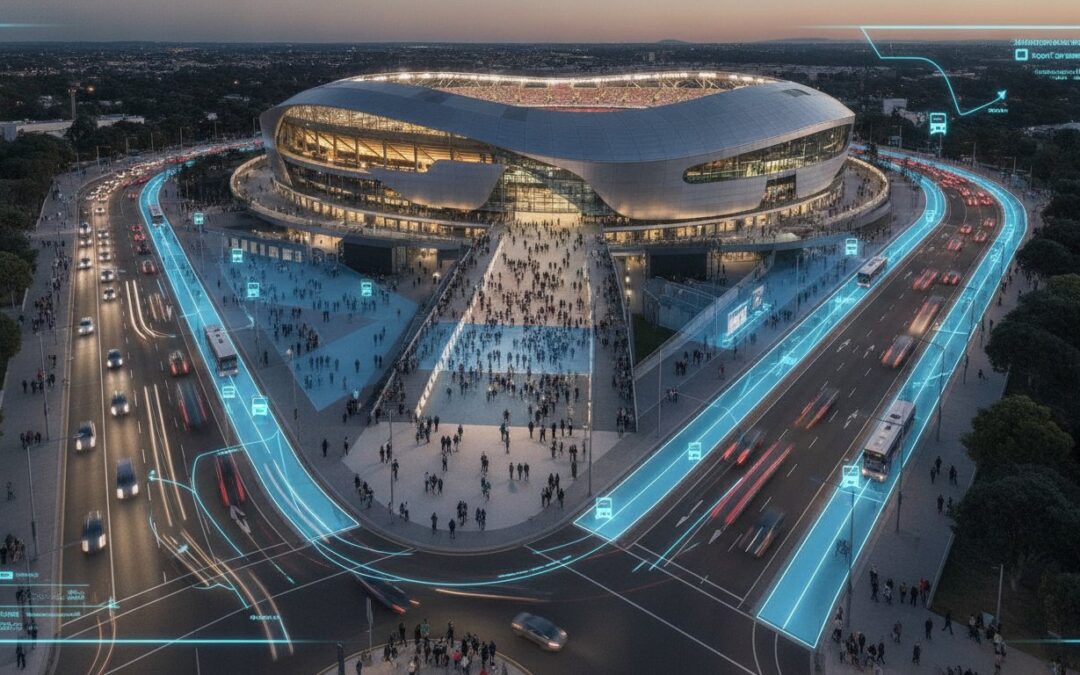
A standard traffic report focusing on daily averages will almost certainly lead to a rejected development application for a high-capacity site. When you’re planning a stadium, theatre, or major event space, the local council isn’t interested in your Tuesday morning off-peak flow; they require a robust traffic impact assessment for entertainment venues that specifically addresses extreme surge demand. The fear of a DA rejection due to gridlock concerns is valid, especially as Australian standards for parking and access become increasingly stringent to accommodate larger modern vehicles.
We understand the complexity of balancing thousands of patron arrivals with strict pedestrian-vehicle safety requirements. This article provides the technical clarity you need to move from uncertainty to a defensible TIA report that meets AS 2890.1:2021 and AS 2890.2 requirements. You’ll learn how to calculate surge demand accurately, integrate multimodal transport solutions, and ensure your project complies with updated state guidelines, such as the 2024 NSW Guide to Transport Impact Assessment. We’ll break down the essential components of site access, intersection analysis, and car parking demand to secure your approval without unnecessary bureaucratic delays.
Key Takeaways
- Understand why standard traffic generation models fail for sports and entertainment sites and how to model event-based surge demand effectively.
- Identify the specific components required for a traffic impact assessment for entertainment venues to ensure compliance with local council DCP requirements and Austroads guidelines.
- Learn to analyse worst-case scenarios, such as sell-out events during peak periods, to maintain patron safety and efficient vehicle flows.
- Master the relationship between car parking demand assessments and public transport accessibility to optimise your site design and infrastructure layout.
- Discover how senior principal involvement and technical expertise in civil engineering standards can streamline your development application and secure council approval.
Why Entertainment Venues Require Specialist Traffic Impact Assessments
A traffic impact assessment for entertainment venues is a specialised technical study designed to evaluate how a proposed stadium, theatre, or sports complex interacts with the surrounding transport network. Unlike standard assessments for retail or residential developments, which focus on consistent daily flows, entertainment TIAs must account for extreme peaks. These reports provide the empirical evidence required to prove a venue can function without causing systemic failure at local intersections. Councils scrutinise these applications heavily because the event-day impact often exceeds the capacity of existing infrastructure.
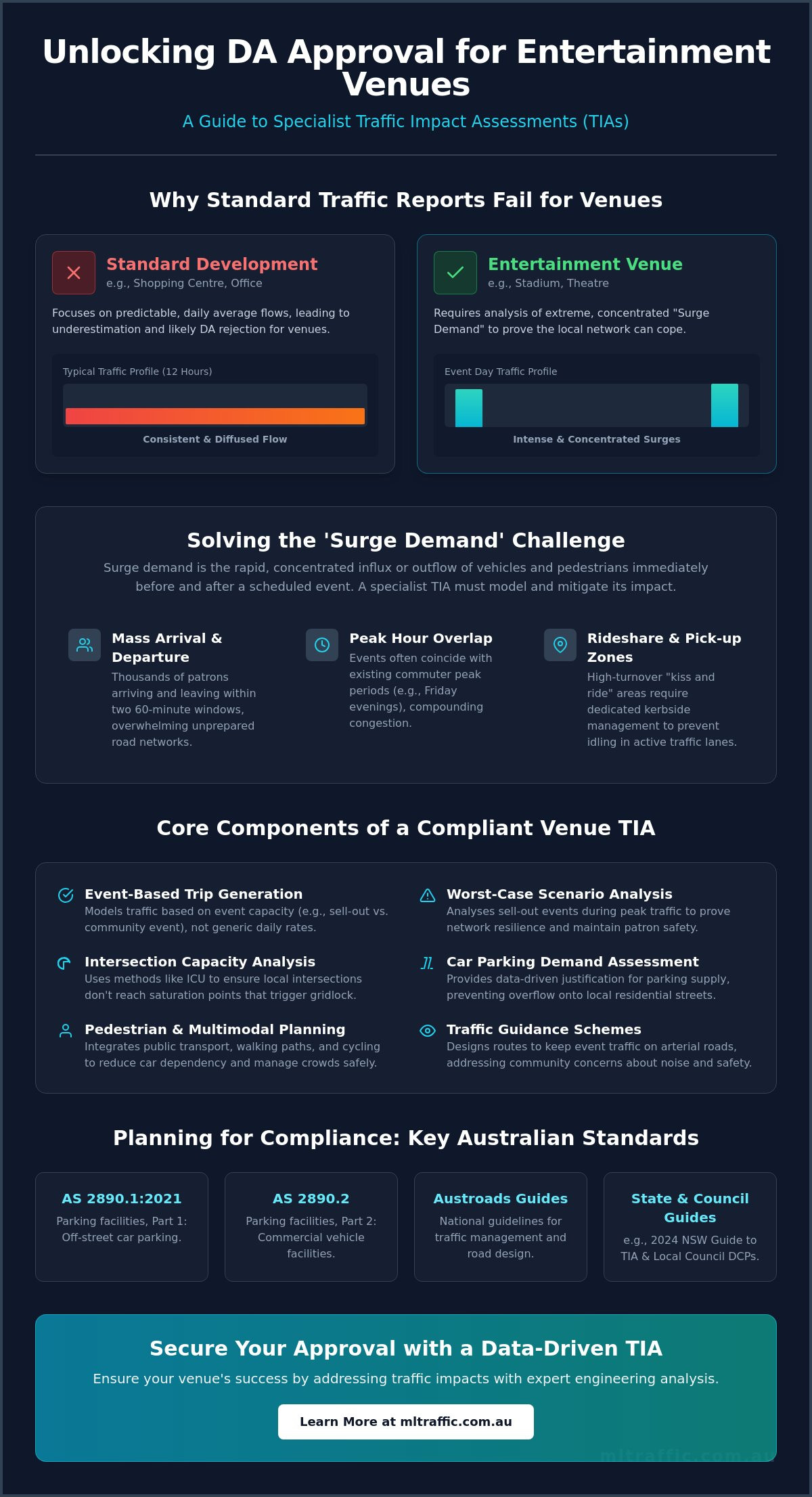
The primary difference lies in the predictability and intensity of vehicle movements. A shopping centre generates steady traffic over twelve hours; an entertainment venue generates the majority of its daily volume within two sixty-minute windows. This concentration of demand forces engineers to use the Intersection Capacity Utilization method to ensure the local network does not reach a saturation point that triggers gridlock. This distinction is critical for securing approval, as generic traffic models fail to capture the reality of venue operations.
To better understand the technical requirements of these studies, watch this helpful video:
The Unique Traffic Profile of Large-Scale Venues
Large-scale venues operate on a distinct temporal scale. Analysts must model pre-event and post-event peak hour volumes, which rarely align with traditional morning or afternoon commuter peaks. For example, a stadium may experience its highest ingress during a Friday evening, overlapping with the standard PM peak, while a theatre might see staggered arrivals over ninety minutes. Modern TIAs must also account for the rise of rideshare services and “kiss and ride” zones. These high-turnover areas require dedicated kerbside space to prevent vehicles from idling in active traffic lanes and reducing road capacity.
Balancing Patron Experience with Road Network Capacity
Successful venue planning requires managing the mass egress challenge. When five thousand patrons depart a theatre simultaneously, the pressure on the car park exits and nearby traffic signals is immense. Effective engineering solutions often involve intersection analysis to optimise signal timings specifically for event windows. Surge demand in venue planning is defined as the rapid, concentrated influx or outflow of vehicles and pedestrians that occurs immediately before or after a scheduled event. Proper mitigation through our professional traffic services ensures that this surge does not lead to community opposition or noise complaints from idling traffic.
Councils and state authorities apply rigorous standards to entertainment DAs to protect public safety and amenity. Community opposition often centres on the fear of local streets being used as overflow parking or the noise associated with thousands of vehicles leaving a site late at night. A comprehensive TIA addresses these concerns by providing data-driven parking demand assessments and traffic guidance schemes that keep patrons on arterial roads rather than residential side streets. This technical rigour acts as a critical tool for developers to demonstrate that they have addressed safety and congestion before the first brick is laid.
Core Components of a TIA for Sports and Entertainment Sites
A robust traffic impact assessment for entertainment venues involves more than simple car counts. It requires sophisticated trip generation and distribution modelling for various event scales. We analyse sell-out scenarios alongside smaller community events to provide a complete picture of network performance. This modelling identifies specific pressure points in the local infrastructure before they become operational failures. Integration with existing public transport and active transport links is also vital. By providing clear pathways for pedestrians and cyclists, we can reduce the overall car parking demand and improve the site’s sustainability profile.
Safety at all site access points is a non-negotiable requirement for council approval. We perform rigorous sight distance assessments to ensure visibility meets national standards. If your project involves complex entry or exit points, our technical traffic assessments can identify and mitigate safety risks early in the design phase. Every report we produce is designed to stand up to council scrutiny and provide a clear path toward development approval.
Parking Demand and Car Park Design Compliance
Venues with high-turnover parking must comply with AS 2890.1. This standard governs everything from bay dimensions to aisle widths. We calculate the precise number of accessible and VIP parking spaces required to meet both statutory obligations and patron expectations. Our engineers also conduct driveway ramp grade assessments. This ensures that both low-clearance vehicles and heavy buses can navigate the site without risk of damage or obstruction. We focus on practical design that avoids bottlenecking during peak arrival periods.
Pedestrian Safety and Crowd Flow Analysis
Pedestrian-vehicle conflict points are a major concern for local councils and are often overlooked in standard reports. We evaluate footpath widths and crossing capacities to manage peak egress safely. When thousands of people leave a venue at once, the surrounding infrastructure must support that flow without forcing patrons onto the road. We also design safe queueing areas for security and ticketing. This prevents crowd build-up from interfering with vehicle movements or blocking emergency access routes. Our approach ensures that patron safety and vehicle efficiency are managed as a single, integrated system.
Solving the Surge Demand Challenge: Event vs. Non-Event Days
Standard traffic reports for retail or office developments rely on average daily traffic figures. This metric is fundamentally insufficient for a traffic impact assessment for entertainment venues. A venue might sit idle for 300 days a year, but its impact during a sell-out event can paralyse a suburb. We focus our analysis on the worst-case scenario. This usually involves modelling a full-capacity event coinciding with the Friday afternoon commuter peak. Councils require this level of stress-testing to ensure the network can handle the most extreme pressure without failing.
Surge demand is not just a volume issue; it’s a timing issue. We utilise SIDRA modelling to test intersection performance under these specific, high-pressure conditions. This software allows us to simulate queue lengths and delays with high precision. If the modelling shows that an intersection will fail during a major event, we propose proportional mitigation measures. These solutions are tailored to the frequency of the events. It’s often unnecessary to build permanent six-lane roads for a venue that only reaches capacity once a month. We specialise in finding smarter engineering solutions that satisfy council without requiring excessive infrastructure spend.
Developing an Event Traffic Management Plan
A static TIA is often just the first step for high-capacity sites. For high-impact venues, councils frequently require a dynamic Event Traffic Management Plan (ETMP) as a condition of consent. This document outlines how the venue will coordinate with local authorities for temporary road closures or diversions. We provide detailed Traffic Guidance Schemes (TGS) to manage these disruptions. A TGS ensures that temporary traffic control measures are compliant with state regulations and maintain safe patron flow while minimising the impact on non-event traffic.
Mitigation Strategies for High-Impact Projects
Council requirements for intersection upgrades depend on the degree of impact. If a development pushes a local intersection beyond its capacity, physical upgrades like additional turn lanes or signalisation may be mandatory. However, we also explore ways to reduce private vehicle trips. Incentivising public transport through integrated ticketing or shuttle services can significantly lower the traffic load. Variable Message Signs (VMS) also play a critical role. These signs provide real-time information to drivers, directing them to available parking or alternative routes and preventing bottlenecks before they form. Our goal is to balance the venue’s operational needs with the existing capacity of the road network.
Planning for Compliance: Australian Standards and Council Expectations
Compliance for entertainment venues is governed by a strict hierarchy of regulations. At the national level, Austroads guidelines dictate road design and traffic management principles. Locally, each council’s Development Control Plan (DCP) sets specific triggers for parking rates and access requirements. Professional traffic engineering ensures these diverse requirements are integrated into a single, cohesive design. A traffic impact assessment for entertainment venues must demonstrate absolute adherence to these standards to withstand technical challenges during the DA process.
Touring productions introduce unique logistical challenges that standard retail TIAs never encounter. Major concerts or theatrical tours often require multiple 19-metre semi-trailers arriving and departing within tight windows. These vehicles have large turning circles and require significant vertical clearance. If the site design fails to accommodate these heavy vehicles, the venue’s operational viability is compromised. We focus on ensuring that loading dock access does not conflict with patron arrival routes, maintaining safety for all site users.
Swept Path Analysis for Loading and Logistics
We utilise AutoTURN software to perform detailed vehicle swept path analysis for every project. This allows us to simulate the exact movements of semi-trailers and buses as they navigate the site. Designing loading docks that operate independently of patron car parks is essential for preventing bottlenecks. We also verify emergency vehicle access for fire and ambulance services. This is a critical safety requirement that councils prioritise. If a fire truck cannot reach every part of the building, the DA will be refused. Our technical assessments ensure your site layout is both functional and compliant.
Navigating the Council DA Review Process
Traffic-related concerns are among the most common reasons for DA deferral or refusal. Councils often issue a “Request for Information” (RFI) if the initial TIA lacks detail on surge demand or pedestrian safety. Responding to these requests requires precise technical data rather than general promises. Early consultation with transport authorities is the most effective way to avoid these delays. By identifying potential issues before the formal submission, we can adjust the design to meet council expectations. If you are facing a complex RFI or preparing a new application, you can contact our senior principals directly to discuss your requirements.
Securing DA Approval with ML Traffic Engineers Australia
ML Traffic Engineers Australia provides a direct line to technical expertise for complex sports and entertainment developments. We bring over 15 years of specialist experience in producing traffic impact assessment reports that meet the specific requirements of Australian local councils and state road authorities. Our firm operates with a “no-gatekeepers” approach, ensuring clients have direct contact with senior principals who possess deep knowledge of civil engineering and urban planning regulations. We do not delegate projects to junior staff; the expert who initiates the relationship performs the technical work.
This level of accountability is vital for entertainment venues where the margin for error in surge demand modelling is minimal. A traffic impact assessment for entertainment venues must be technically robust to withstand the scrutiny of both council engineers and community stakeholders. ML Traffic Engineers Australia has a proven track record with high-capacity projects across diverse project environments, providing the meticulous documentation needed to secure approval. Our reports are defensible and data-driven, ensuring that concerns regarding pedestrian-vehicle safety and network capacity are addressed with empirical evidence.
Our Hands-On Technical Approach
Our technical methodology focuses on meticulous data collection and advanced modelling to provide accurate surge demand forecasts. By using industry-standard software to test every variable, including intersection capacity and pedestrian flow rates, we identify the most efficient design path. This technical rigour allows ML Traffic Engineers Australia to propose cost-effective solutions that satisfy council without recommending over-engineered infrastructure. Personnel continuity is a core promise; the senior engineer assigned to your project remains your primary point of contact from the initial site assessment through to final report submission.
Ready to Progress Your Development Application?
Securing a traffic impact assessment for entertainment venues requires a consultant who understands the intersection of patron experience and road network capacity. We provide tailored fee proposals based on the specific scale and complexity of your project. Our comprehensive site assessment process involves a thorough review of existing conditions, trip generation modelling, and compliance checks against AS 2890.1 and AS 2890.2. Contact our senior team today to discuss your traffic solutions for entertainment and sports venues. ML Traffic Engineers Australia ensures your development application is supported by expert technical analysis and professional accountability.
Streamline Your Development Approval with Proven Technical Expertise
Securing council approval for high-capacity sites requires more than a generic traffic report. It demands a sophisticated traffic impact assessment for entertainment venues that prioritises surge demand modelling and pedestrian-vehicle safety. By addressing the complexities of mass egress and ensuring strict compliance with AS 2890 standards, you mitigate the risk of costly DA deferrals or refusals. Our firm brings over 15 years of specialist consultancy experience to every project, providing the technical rigour needed for complex sports and theatre developments.
We provide direct access to senior principals who manage your assessment from the initial site visit through to final council submission. This hands-on approach ensures your venue’s transport infrastructure is both functional and defensible under rigorous authority scrutiny. We understand the bureaucratic requirements of local government and the importance of personnel continuity in delivering results. We are ready to help you navigate the technical requirements of your next major development. Speak directly with a Senior Traffic Engineer about your venue project to obtain a tailored fee proposal and expert guidance. We look forward to securing a successful outcome for your development.
Frequently Asked Questions
What is a traffic impact assessment for a new entertainment venue?
A traffic impact assessment for entertainment venues is a comprehensive technical study that evaluates how a proposed development will interact with the local transport network. It focuses on the specific trip generation patterns of patrons, staff, and logistics vehicles. Unlike standard reports, it prioritises surge demand modelling to ensure that the influx of visitors during events does not lead to intersection failure or safety hazards on surrounding roads.
When is a TIA required for a sports or entertainment development?
A TIA is mandatory when a development application (DA) involves a land use that significantly alters traffic patterns or exceeds specific size thresholds. For sports and entertainment sites, triggers often include seating capacity, floor area, or proximity to major arterial roads. Councils require these reports to confirm that the existing infrastructure can support the peak loads associated with major events without compromising public safety.
How does event-based traffic differ from standard daily traffic reports?
Event-based traffic is characterised by extreme surge demand where the majority of vehicle movements occur within narrow sixty-minute windows. Standard traffic reports typically average volumes over a twelve-hour period, which fails to capture the intensity of a venue’s impact. Our assessments model the worst-case scenario, such as a sell-out event coinciding with a Friday evening peak, to ensure the network remains functional under maximum pressure.
Do stadiums need a specific parking demand assessment for DA approval?
Stadiums require a detailed car parking demand assessment to justify parking provision that may differ from statutory council rates. This study considers venue capacity, expected car occupancy rates, and the availability of public transport. By providing evidence-based modelling of how patrons will actually travel to the site, we can demonstrate that the proposed parking layout is sufficient to prevent overflow into residential side streets.
What Australian Standards apply to venue car park and access design?
Compliance with AS 2890.1:2021 is required for off-street car parking design, specifically for bay dimensions and aisle widths. Large venues must also adhere to AS 2890.2 for commercial vehicle facilities to accommodate touring production trucks and buses. Additionally, AS 2890.6 governs the specific requirements for accessible parking spaces. These standards ensure the site is safe for all vehicle types and meets national regulatory benchmarks.
How long does it take to prepare a TIA for an entertainment project?
The preparation of a comprehensive TIA typically takes between four and eight weeks. This timeframe allows for meticulous data collection, SIDRA modelling, and the analysis of various event scenarios. Complex projects involving major intersection upgrades or coordination with state transport authorities may require additional time for consultation. Engaging a senior engineer early in the design phase is the most effective way to prevent delays in the DA process.
Can a TIA help reduce the number of required parking spaces?
A traffic impact assessment for entertainment venues can often support a reduction in the number of required parking spaces by demonstrating high public transport accessibility. If a venue is located near major rail or bus hubs, we can model a lower reliance on private vehicles. This data-driven approach allows developers to avoid the excessive costs of building unnecessary parking while still satisfying council concerns regarding local street congestion.
What happens if the council disagrees with the traffic report findings?
If a council engineer disagrees with the report, they will typically issue a formal Request for Information (RFI) seeking further technical clarification. Our senior principals handle these responses directly, providing additional modelling or design refinements to address specific concerns. We focus on technical accountability and direct negotiation with authorities to resolve disputes and keep the development application moving toward a successful determination.

Disclaimer
The content on www.mltraffic.com.au, including all technical articles, guides, and resources, is provided for general informational and educational purposes only. It is not intended to constitute professional advice in traffic engineering, transportation planning, development approvals, or any other technical or legal field. While ML Traffic Engineers makes every reasonable effort to ensure the accuracy, completeness, and timeliness of the information published, we do not provide any warranties or representations (express or implied) regarding its reliability, suitability, or availability for any particular purpose. Any reliance you place on the content is strictly at your own risk. In no event shall ML Traffic Engineers, its directors, employees, authors, or affiliates be liable for any direct, indirect, incidental, special, consequential, or punitive damages (including, without limitation, loss of profits, data, or business opportunities) arising out of or in connection with the use of, or inability to use, any information provided on this website. The articles and guides on this site are not a substitute for engaging a qualified, registered professional traffic engineer (such as an NPER or RPEQ engineer) to assess your specific project requirements. For tailored advice, compliance assessments, or traffic engineering services, please contact a competent professional. This disclaimer may be updated from time to time without notice. By accessing or using this website, you agree to be bound by the most current version of this disclaimer.
