
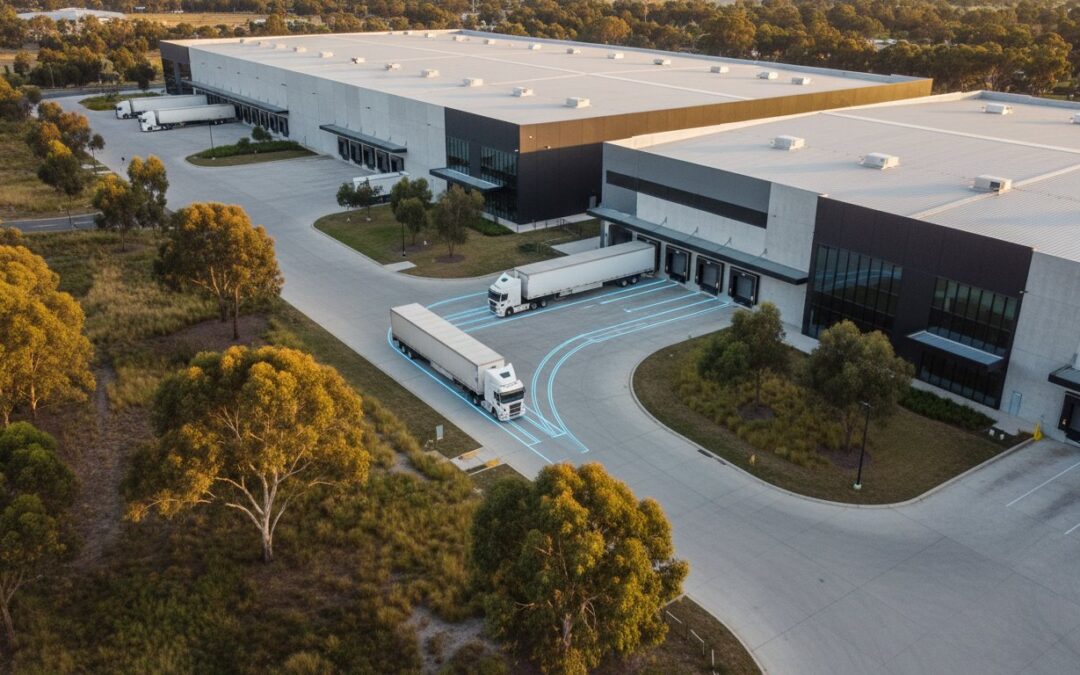
A single non-compliant swept path analysis can stall a multi-million dollar logistics project for months or lead to a definitive DA rejection. For developers, the stakes are high as big-box leasing increased by 80.7% year-over-year in early 2026, yet council scrutiny regarding heavy vehicle movements remains at an all-time high. Securing a comprehensive traffic impact assessment for warehouse and logistics developments is no longer just a bureaucratic hurdle; it’s a critical requirement for both regulatory approval and long-term site viability.
You likely understand that uncertainty regarding council requirements for heavy vehicle hubs often results in costly delays and operational bottlenecks. We’ll show you how to navigate these technical complexities to ensure your project meets strict AS 2890.2 compliance while maintaining maximum loading dock efficiency. This guide details the essential traffic engineering reports, from vehicle swept path analysis to car parking demand assessments, required to move your development from the planning stage to successful operation.
Key Takeaways
- Understand how a professional traffic impact assessment for warehouse and logistics developments quantifies a project’s impact on the local road network to facilitate DA approval.
- Discover how AutoTURN simulations and swept path analysis prevent operational bottlenecks by verifying heavy vehicle manoeuvrability within constrained industrial sites.
- Learn technical strategies for segregating heavy vehicle movements from staff parking and pedestrian zones to enhance site safety and loading dock efficiency.
- Identify the specific compliance requirements under Australian Standards, such as AS 2890.2, to mitigate the risk of rejection during the planning phase.
- Explore the importance of direct senior principal involvement in technical assessments to ensure accountability and professional certification.
The Critical Role of Traffic Solutions for Warehouse and Logistics Developments
Modern logistics hubs operate with a distinct traffic profile characterized by high heavy-vehicle turnover and constant loading dock activity. Unlike standard commercial or residential developments, warehouse sites must accommodate B-doubles, semi-trailers, and smaller delivery vans simultaneously. A comprehensive traffic impact assessment for warehouse and logistics developments is essential to quantify these movements and ensure the surrounding infrastructure can handle the load without failing.
To better understand how these assessments function within the planning process, watch this technical overview:
Standard traffic management often lacks the technical depth required for high-intensity industrial land uses. Challenges such as heavy vehicle queuing, internal circulation conflicts, and site access constraints require specialized solutions. Professional traffic engineering provides the necessary framework to address these challenges before they become operational liabilities or grounds for DA rejection. Applying established Traffic Engineering Principles ensures that site viability is assessed against real-world operational needs and regulatory constraints.
The Rise of Micro-Fulfilment and Urban Distribution Centres
E-commerce growth has fundamentally changed urban logistics. The shift toward micro-fulfilment centres means high-frequency delivery hubs are now situated closer to residential zones. This proximity increases the pressure on local road networks and intersection capacity. Developers must use a traffic impact assessment for warehouse and logistics developments to prove that these smaller hubs won’t degrade the level of service for existing road users. Council scrutiny is particularly high for sites where heavy vehicle movements intersect with sensitive urban receptors.
Why Traffic Engineering is the Foundation of Logistics Success
Traffic engineering serves as the foundation for any successful logistics project. Poor site layout leads to operational bottlenecks and increased safety risks, especially where heavy vehicles interact with staff or pedestrians. Engaging a consultant early in the site selection phase allows for the application of technical standards to identify potential deal-breakers. This proactive approach helps in mitigating community and council objections, ensuring a smoother pathway through the DA process. A robust traffic management plan (TMP) and detailed swept path analysis are critical tools that demonstrate a site’s ability to operate safely and efficiently under peak load conditions.
Navigating Planning Approvals with Traffic Impact Assessments (TIA)
A traffic impact assessment for logistics developments is a specialised technical report designed to model high-volume heavy vehicle movements. Unlike standard commercial studies, this assessment focuses on the unique trip generation rates of freight hubs and last-mile delivery centres. It quantifies exactly how many additional heavy vehicle movements your project will introduce to the local road network. Councils use this data to determine if existing intersections can maintain an acceptable level of service or if developer-funded upgrades are necessary. A robust traffic impact assessment for warehouse and logistics developments is the primary tool for securing a Development Application (DA) approval.
A compliant report for council submission must include detailed trip distribution models and rigorous intersection analysis. It addresses the specific concerns of local authorities, such as noise from night-time operations, potential congestion at site ingress points, and overall road safety. By providing empirical data on sight distances and vehicle queuing, the report mitigates the risk of council refusal based on perceived traffic impacts. If you are preparing a submission, it’s advisable to consult with a senior traffic engineer during the initial design phase to identify potential site constraints.
Compliance with AS 2890.2: Off-Street Commercial Vehicle Facilities
Adherence to AS 2890.2 is non-negotiable for logistics developments. This Australian Standard dictates the specific dimensions, height clearances, and driveway gradients required for commercial vehicles. Our traffic engineers ensure that your site layout accommodates everything from Small Rigid Vehicles (SRVs) to B-doubles. We meticulously check that loading bays and manoeuvring areas meet these strict width and gradient standards. Non-compliance often leads to costly site re-designs or total DA rejection because councils won’t approve a layout that forces heavy vehicles to reverse onto public roads or clip kerbs during entry.
Calculating Parking Demand and Loading Dock Requirements
Logistics hubs require a different methodology for calculating parking than traditional industrial sites. We use car parking demand assessments to justify the number of loading docks and staff parking spaces provided. The “peak hour” for a warehouse often occurs in the early morning or late evening, which differs significantly from the standard commuter peak. By accurately modelling these high-frequency courier movements and staff shift changes, we optimise the site footprint. This ensures you have enough loading capacity to prevent operational bottlenecks without wasting valuable land on excess asphalt.
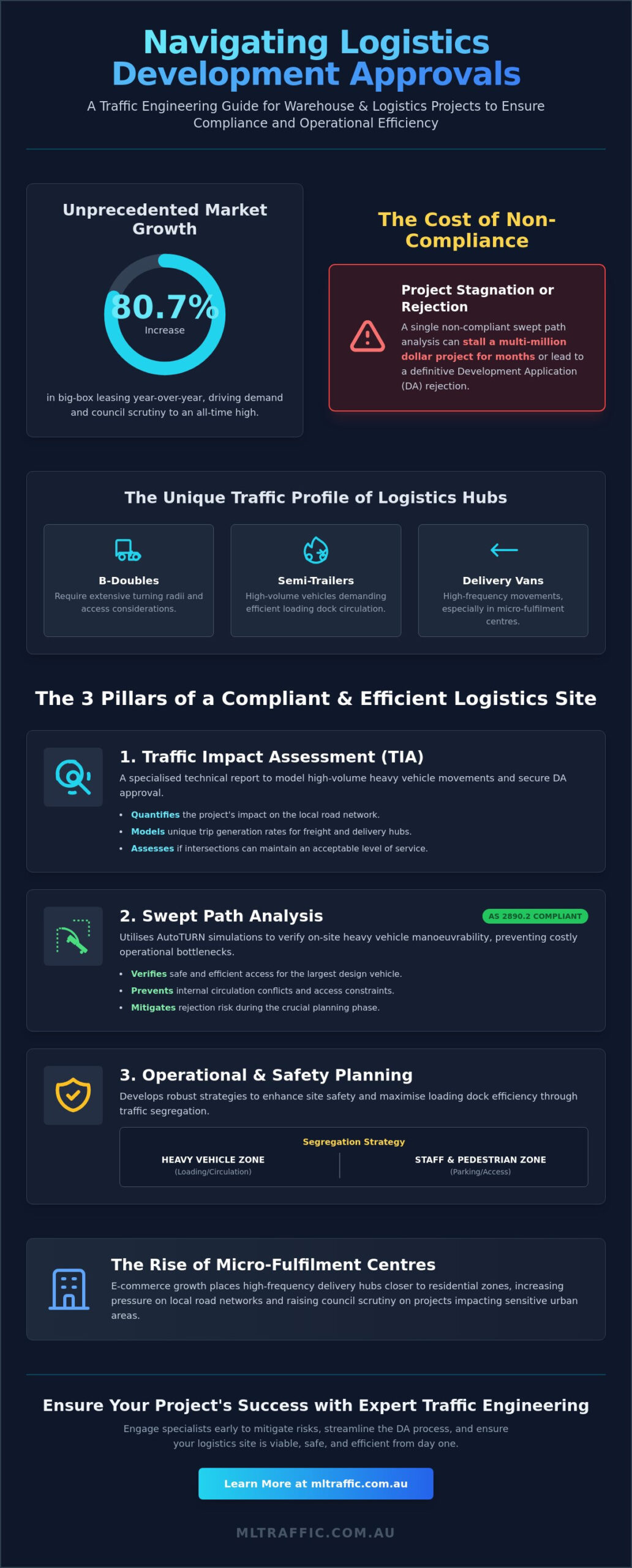
Swept Path Analysis: Optimising Heavy Vehicle Access
Swept path analysis is the technical process of simulating the horizontal distance required by a vehicle to complete a turning manoeuvre. In the context of a traffic impact assessment for warehouse and logistics developments, this analysis is a mandatory requirement for heavy vehicle access certification. We use industry-standard AutoTURN software to overlay vehicle movements onto site plans. This ensures that a specific design can accommodate the largest anticipated vehicles without impacting kerbs, structural columns, or parked cars.
The primary challenge for developers is balancing the need for maximum Gross Floor Area (GFA) with the spatial requirements of heavy vehicle paths. Council planners will not accept manual estimations; they require digital proof that vehicles can enter and exit the site in a forward direction. By integrating swept path simulations early in the design phase, we identify where site layouts need adjustment to prevent operational bottlenecks. This technical validation protects the project from the risk of expensive post-construction modifications.
Designing for MRVs, HRVs, and Articulated Vehicles
Australian logistics hubs typically accommodate a range of vehicle classes, including Medium Rigid Vehicles (MRV), Heavy Rigid Vehicles (HRV), and Articulated Vehicles (AV). Each class has distinct turning circles and clearance requirements. A 19-metre semi-trailer requires significantly more manoeuvring space than a standard delivery van. We apply “worst-case scenario” planning by designing for the largest vehicle expected to service the facility, such as a 26-metre B-double. This approach ensures that all smaller vehicles can navigate the site with ease, maintaining a high level of operational safety and efficiency.
Entry and Exit Safety: Sight Distance Assessments
A sight distance assessment is critical for evaluating the interface between a private logistics hub and the public road network. Our engineers measure the visibility available to truck drivers at site ingress and egress points to ensure they can see oncoming traffic and pedestrians. We account for potential obstructions such as urban furniture, boundary fencing, and site signage. Proper sightline evaluation is a key component of a traffic impact assessment for warehouse and logistics developments because it directly impacts road safety. Ensuring that heavy vehicles can exit safely without obstructing traffic flow is a primary concern for both council and state transport authorities.
Operational Traffic Management and Safety Solutions
Operational success requires more than just planning approval. A traffic management plan (TMP) provides the technical framework for daily site activity. It ensures that the high-intensity movements identified in the traffic impact assessment for warehouse and logistics developments are managed safely and predictably. The TMP outlines specific rules for vehicle speeds, right-of-way, and loading protocols within the facility boundaries to maintain order during peak operational periods.
Effective site design prioritises the total segregation of heavy vehicles from staff parking and pedestrian zones. We implement dedicated access points for passenger vehicles to eliminate conflict points with heavy freight. Internal traffic flow must be designed to prevent queuing on public roads. If a B-double is forced to wait on a council road due to internal site congestion, the developer risks significant regulatory penalties and non-compliance with DA conditions. During the construction phase, we develop a Traffic Guidance Scheme (TGS) to manage plant equipment and delivery movements safely without disrupting the local road network.
Loading Dock Design and Management
Loading dock configuration directly impacts operational throughput and site safety. “Drive-through” designs offer the highest efficiency for high-turnover sites, while “reverse-in” configurations are often necessary for space-constrained urban hubs. We ensure all docks feature clear signage and high-visibility pavement markings to guide drivers accurately. Traffic engineers also plan for peak delivery windows. By modelling these arrival patterns, we prevent site gridlock and ensure that the loading capacity matches the demand calculated in the earlier planning stages. This precision keeps the facility running at maximum capacity without compromising safety.
Pedestrian Safety in High-Activity Freight Zones
Mixing foot traffic with heavy delivery vehicles creates significant liability and safety risks. We mitigate these risks through physical barriers, including heavy-duty bollards and dedicated raised walkways. High-intensity LED lighting is essential for 24-hour operations to maintain visibility in loading areas and around blind corners. For existing facilities, our team performs safety audits to identify latent risks in current layouts, such as inadequate signage or poor sightlines. If you need to upgrade your site safety protocols, contact our senior principals for a technical review of your current traffic management plan.
Engaging Expert Traffic Engineers for Your Logistics Project
Partnering with a consultancy that provides direct access to senior principals is a strategic advantage for developers. Technical decisions in a traffic impact assessment for warehouse and logistics developments require the oversight of experienced professionals who understand the nuances of council expectations. Working directly with senior leadership ensures that the expert who initiates the client relationship is the same person performing the technical work. This personnel continuity promise is vital for complex, multi-year developments where information loss between junior staff can lead to design inconsistencies and regulatory delays.
Professional certification acts as a guarantee of compliance with Australian Standards and local planning instruments. ML Traffic Engineers Australia applies meticulous attention to detail to ensure every facet of the site layout, from driveway ramp grades to car park design, meets the required benchmarks. This authoritative approach streamlines the DA process by presenting councils with a technically sound, results-oriented submission. By integrating expert traffic engineering early, you reduce project risk and avoid the high costs associated with post-submission design modifications.
Mitigating Council Objections Through Evidence-Based Reports
Councils frequently raise concerns regarding the impact of heavy vehicle hubs on local road safety and noise levels. We address these objections using data-driven traffic modelling and intersection analysis. Our reports provide a defensible case for your development by proving that the proposed traffic volumes won’t compromise the existing network’s level of service. If a project faces significant opposition, our senior principals possess the qualifications to serve as expert witnesses in legal proceedings. This high level of accountability ensures that your technical documentation stands up to the most rigorous scrutiny from planning authorities and community stakeholders.
Next Steps: From Site Assessment to DA Approval
The timeline for preparing a traffic impact assessment for warehouse and logistics developments typically depends on the scale of the hub and the complexity of the surrounding road network. We encourage developers to conduct a feasibility study before committing to a site purchase. This preliminary review identifies potential access constraints or parking demand issues that could impact the project’s bottom line. Once the site is secured, we move through the detailed assessment phase, including vehicle swept path analysis and sight distance evaluations. For expert consultation and a technical review of your logistics project, contact ML Traffic Engineers Australia to speak directly with our senior leadership team.
Securing Your Logistics Hub’s Operational Future
Logistics developments face increasing regulatory pressure and technical complexity. A professional traffic impact assessment for warehouse and logistics developments ensures that your site layout accommodates heavy vehicle movements while maintaining strict AS 2890.2 compliance. By addressing council concerns regarding noise and congestion through data-driven modelling, you mitigate the risk of project delays and costly site re-designs. Early engineering intervention is the most effective way to balance maximum floor area with functional vehicle access and pedestrian safety.
ML Traffic Engineers Australia brings over 15 years of Australian traffic engineering experience to your project. We maintain a proven track record with local councils and successful DA approvals across diverse industrial and micro-fulfilment land uses. Every technical report involves direct Senior Principal oversight to ensure total accountability and precision. This hands-on approach guarantees that the technical work is performed by the same expert who initiates the project. Speak directly with a Senior Principal at ML Traffic Engineers Australia for your logistics assessment to streamline your planning submission and secure your site’s operational future. We look forward to assisting with your development goals.
Frequently Asked Questions
What is a traffic impact assessment for warehouse and logistics developments?
A traffic impact assessment for warehouse and logistics developments is a technical report that evaluates how a proposed freight hub will affect the surrounding road network. It quantifies trip generation for specific vehicle classes, assesses intersection performance, and verifies internal site circulation. The report provides the empirical evidence necessary for councils to determine if the local infrastructure can support the projected heavy vehicle volumes.
Why does my delivery hub need a TIA for council approval?
Councils require a TIA to ensure that high-intensity logistics operations don’t compromise road safety or cause excessive congestion. The assessment proves that your development meets regulatory standards and won’t force heavy vehicle queuing onto public roads. Without this professional documentation, planning authorities lack the technical assurance needed to grant a Development Application (DA) for high-impact industrial land uses.
What is the difference between a TMP and a TGS for a logistics site?
A Traffic Management Plan (TMP) is a strategic document outlining the long-term operational rules for a site, such as speed limits and right-of-way protocols. Conversely, a Traffic Guidance Scheme (TGS) is a technical diagram showing the specific placement of signs and barriers for temporary traffic control. Developers typically use a TGS during the construction phase to manage plant equipment and delivery movements safely.
How does AS 2890.2 impact the design of my loading dock?
AS 2890.2 provides the mandatory Australian Standards for off-street commercial vehicle facilities, including minimum bay dimensions and height clearances. It dictates the maximum allowable gradients for driveway ramps to prevent heavy vehicles from bottoming out. Our engineers use these standards to ensure that loading docks are accessible for the largest anticipated vehicle class, such as a 19-metre semi-trailer or a B-double.
Can Swept Path Analysis help me fit more delivery bays on my site?
Yes, swept path analysis allows engineers to optimize site layouts by simulating exact vehicle turning radii using AutoTURN software. By moving away from generic estimations, we can identify the minimum spatial requirements for safe manoeuvring. This technical precision often reveals opportunities to increase the number of delivery bays or maximize Gross Floor Area (GFA) while maintaining full compliance with council safety requirements.
What are the most common traffic-related reasons for a warehouse DA being rejected?
DA rejections often occur due to non-compliant swept paths that show vehicles clipping kerbs or structural columns. Other frequent issues include insufficient on-site queuing space, which leads to trucks idling on public roads, and inadequate sight distances at entry points. Councils also reject applications that fail to demonstrate total segregation between heavy vehicles and pedestrian zones, citing unacceptable safety risks to staff and the public.
Do I need a traffic engineer for a small micro-fulfilment centre?
Professional traffic engineering is essential for micro-fulfilment centres because they often operate in constrained urban environments near residential receptors. High-frequency courier movements can quickly overwhelm local intersections if not managed correctly. An engineer ensures that the site handles rapid turnover without disrupting traffic flow, which is a primary concern for councils during the approval process for last-mile delivery hubs.
How do I manage pedestrian safety in a busy freight environment?
Pedestrian safety is managed through the implementation of physical mitigation strategies identified during a traffic impact assessment for warehouse and logistics developments. This includes installing heavy-duty bollards, raised walkways, and high-intensity LED lighting for night operations. We focus on eliminating conflict points by designing separate access routes for staff vehicles and delivery trucks, ensuring that foot traffic never intersects with heavy vehicle manoeuvring areas.

Disclaimer
The content on www.mltraffic.com.au, including all technical articles, guides, and resources, is provided for general informational and educational purposes only. It is not intended to constitute professional advice in traffic engineering, transportation planning, development approvals, or any other technical or legal field.
While ML Traffic Engineers makes every reasonable effort to ensure the accuracy, completeness, and timeliness of the information published, we do not provide any warranties or representations (express or implied) regarding its reliability, suitability, or availability for any particular purpose. Any reliance you place on the content is strictly at your own risk.
In no event shall ML Traffic Engineers, its directors, employees, authors, or affiliates be liable for any direct, indirect, incidental, special, consequential, or punitive damages (including, without limitation, loss of profits, data, or business opportunities) arising out of or in connection with the use of, or inability to use, any information provided on this website.
The articles and guides on this site are not a substitute for engaging a qualified, registered professional traffic engineer (such as an NPER or RPEQ engineer) to assess your specific project requirements. For tailored advice, compliance assessments, or traffic engineering services, please contact a competent professional.
This disclaimer may be updated from time to time without notice. By accessing or using this website, you agree to be bound by the most current version of this disclaimer.
