

A single Request for Information (RFI) from the City of Gold Coast can stall your development for months, eroding your margins before the first sod is turned. Navigating the intersection of the Gold Coast City Plan Version 10 and the Queensland Guide to Traffic Impact Assessment (GTIA) is the most technical hurdle in the DA process. You likely already know that even a minor 5% increase in traffic volume on any movement triggers the requirement for a professional traffic impact assessment gold coast. It is a high-stakes balancing act where failing to account for the latest onsite servicing standards or the “no net worsening” principle can result in lost saleable area or rejected applications.
This guide provides the technical roadmap to mastering your traffic report requirements to secure Council approval and protect your project’s yield. You will learn how to align your car park design with AS 2890.1 and AS 2890.2 while meeting specific local mandates for Heavy Rigid Vehicles (HRV) on sites under 1,000 square metres. We provide a clear breakdown of the 10-year design horizon, background growth rates, and the critical data needed to ensure your engineer delivers a compliant, RFI-proof submission.
Key Takeaways
- Identify the specific traffic generation thresholds and land-use changes that necessitate a formal traffic impact assessment gold coast to prevent early-stage Council delays.
- Ensure your development complies with AS 2890.1 and AS 2890.2 by utilising AutoTURN for precise Swept Path Analysis and car park design.
- Understand the July 2024 GTIA updates to determine if your project requires a Department of Transport and Main Roads (TMR) referral for state-controlled road impacts.
- Eliminate common RFI triggers by integrating a Waste Management Plan and verifying driveway ramp grades and sight distances before your DA submission.
- Protect your project’s saleable yield by working directly with senior principals who ensure technical reports are defensible and accurate.
Understanding Traffic Impact Assessment Requirements for Gold Coast Developments
A Traffic Impact Assessment (TIA) is a technical report required by the City of Gold Coast to evaluate how a proposed development influences the surrounding transport infrastructure. It is a critical component of the broader transportation planning process; ensuring that new projects do not compromise the safety or efficiency of the existing road network. For developers, a traffic impact assessment gold coast serves as a defensible document that justifies access arrangements, parking provisions, and onsite servicing layouts.
Council planners use these reports to determine if the local road network can accommodate the additional vehicle trips generated by a site. While a full TIA is standard for larger projects, a simpler Traffic Impact Statement (TIS) may suffice for lower-impact developments that do not significantly alter traffic patterns. Engaging a traffic engineer during the initial site planning phase is vital to identify “fatal flaws” in access or layout before they are embedded in the architectural plans.
To better understand the technical workflow of a traffic study, watch this guide on assessment tools:
When is a Traffic Report Mandatory?
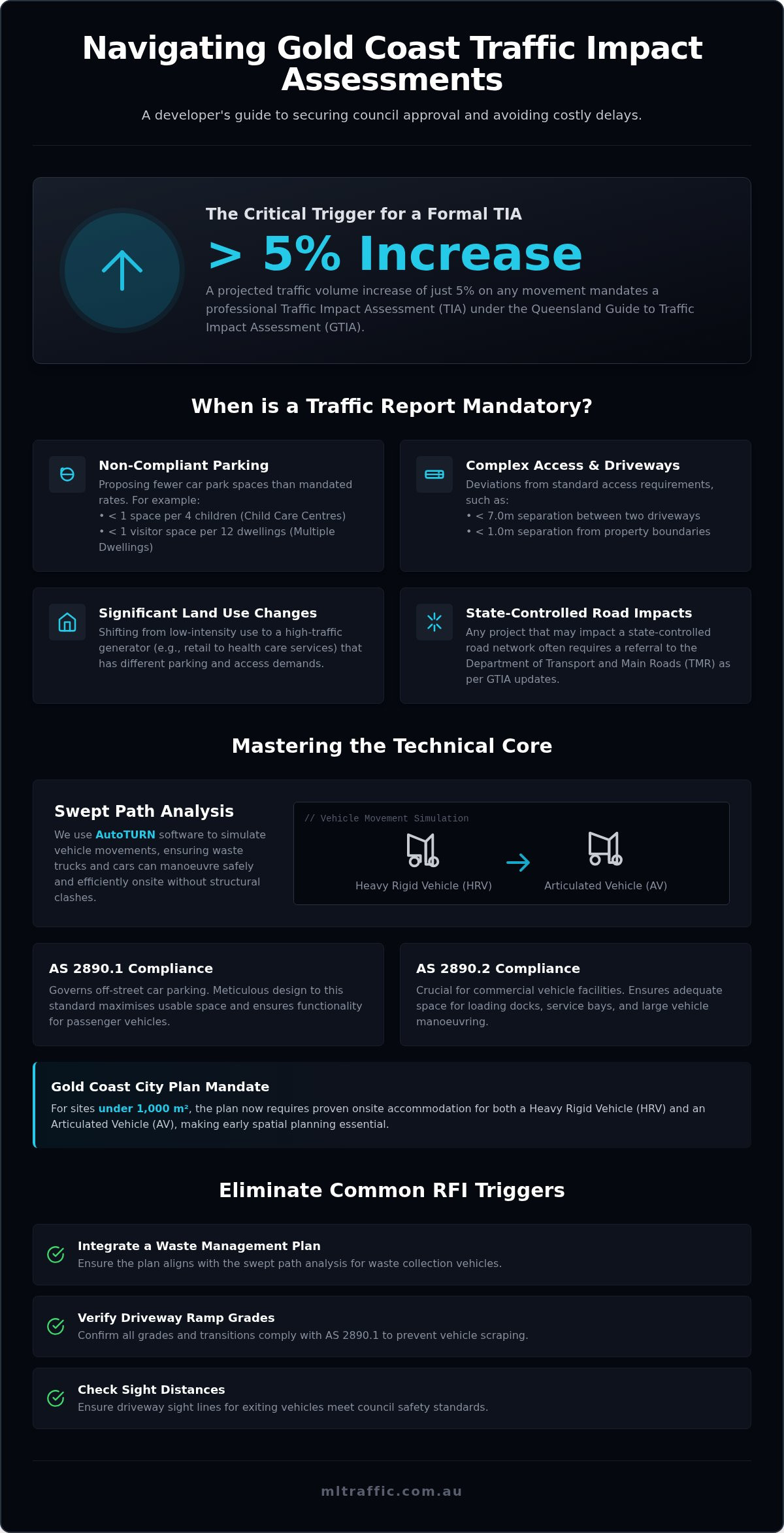
A formal report is typically triggered when a development is projected to add more than 5% to the existing traffic volume on any movement. This threshold is established under the Queensland Guide to Traffic Impact Assessment (GTIA). Under the Gold Coast City Plan Version 10, several specific triggers necessitate engineering input:
- Non-compliant parking: Proposing fewer spaces than the mandated rates, such as 1 space per 4 children for child care centres or 1 visitor space per 12 dwellings for multiple dwellings.
- Complex access: Residential developments requiring two driveways must maintain a 7.0m separation. Any deviation from this or the 1.0m boundary separation requires technical justification.
- Land use changes: Shifting from a low-intensity use to high-traffic generators like health care services, which require specific consulting room parking ratios.
The Benefits of Early Traffic Engineering Input
Securing input from a specialist engineer during the early DA phase prevents the “locking in” of inefficient basement or driveway designs. Once a building footprint is set, correcting a non-compliant driveway grade or an inadequate swept path for a Heavy Rigid Vehicle (HRV) becomes exponentially more expensive. The Gold Coast City Plan now requires sites less than 1,000 square metres to accommodate both an HRV and an Articulated Vehicle (AV) onsite, making early spatial planning non-negotiable.
Early consultancy ensures that site access is safe and functional from day one. This proactive approach reduces the risk of Council RFIs or outright refusal. Developers can access these early-stage insights through ML Traffic Services to ensure their car park design and access strategies are compliant with AS 2890 standards before formal lodgement.
Technical Core: Swept Path Analysis and Car Park Design
Precision in engineering is the difference between a project that stalls and one that succeeds. A traffic impact assessment gold coast relies on technical simulations to prove a site’s functionality. We use AutoTURN software to conduct Vehicle Swept Path Analysis, simulating real-world movements for waste trucks and passenger cars. This process ensures every turn and reverse manoeuvre is physically possible within the proposed footprint, preventing costly onsite congestion or structural clashes.
Ensuring compliance with AS 2890.1 for off-street car parking and AS 2890.2 for commercial vehicle facilities is a non-negotiable requirement for Council approval. Meticulous car park design does more than tick a regulatory box; it recovers lost spaces and increases the commercial value of a site. By refining column placements and aisle widths, we can often protect or even increase the saleable site yield that would otherwise be lost to inefficient layouts.
Vehicle Swept Path Analysis for Council Approval
Council requires specific diagrams for loading docks and basement turn-arounds to verify safety and accessibility. These simulations utilise the B85 and B99 design vehicles as defined by Australian Standards to represent the 85th and 99th percentile of vehicles on the road. Swept Path Analysis is the geometric verification of vehicle manoeuvrability. Without these diagrams, your DA will likely face an immediate RFI regarding service vehicle access or parking safety, particularly for sites requiring Heavy Rigid Vehicle (HRV) access.
Optimising Car Park Demand and Layout
Balancing Council parking rates with actual empirical demand is a strategic way to justify parking reductions. This process is governed by the Queensland Guide to Traffic Impact Assessment (GTIA), which provides the framework for technical justifications when a project cannot meet the standard City Plan rates. We conduct compliance checks for disabled parking under AS 2890.6 and ensure visitor bicycle parking meets the latest visitor rates for multiple dwelling uses.
A common failure point in basement design is the relationship between ramp grades and vehicle clearance. Incorrect transitions lead to vehicles “bottoming out,” a defect that Council will not overlook during the assessment phase. Our AS 2890.1 Explained guide details how to navigate these technicalities. If you need a Vehicle Swept Path Analysis to verify your basement layout, our senior engineers provide the technical defensibility required to secure your approval.
Navigating the Queensland Guide to Traffic Impact Assessment (GTIA)
The Queensland Guide to Traffic Impact Assessment (GTIA) provides the technical framework for all major developments in South East Queensland. While the Gold Coast City Plan dictates local parking and driveway standards, the GTIA governs impacts on the state-controlled road network. The July 2024 updates to the GTIA reinforce the “no net worsening” principle. This means developers are expected to mitigate their traffic impacts regardless of the existing capacity or congestion levels of the surrounding roads. A traffic impact assessment gold coast must address these state-level mandates whenever a project triggers a referral to the Department of Transport and Main Roads (TMR).
Local Council vs. State TMR Requirements
Council assessments and TMR referrals have distinct focus areas that developers must manage simultaneously. Local Council prioritises onsite safety, parking variations, and driveway compliance under the City Plan. In contrast, TMR focuses on regional network capacity and intersection delays. Under the Planning Act 2016, a referral is mandatory if a development is located near a state-controlled road or exceeds specific trip generation thresholds. Managing this dual-approval process requires a report that satisfies both jurisdictions to avoid conflicting conditions of approval that can stall a project’s timeline.
Key Components of a GTIA-Compliant Report
A GTIA-compliant report requires rigorous intersection modelling, typically utilising SIDRA software to simulate traffic flow and delay. This analysis must consider a 10-year design horizon after the development becomes fully operational. Engineers generally apply a 2.0% annual background traffic growth rate based on historical TMR data to ensure the modelling is accurate. All technical assessments must align with Austroads’ national guidelines to remain defensible during the departmental review process. Key technical requirements include:
- Network Capacity Analysis: Evaluating how additional trips affect the Degree of Saturation (DOS) at key intersections.
- Pavement Impact Assessments: Required if the project significantly increases heavy vehicle traffic, potentially accelerating road wear.
- Safety and Sight Distance: Verifying that all access points meet the geometric standards required for state-controlled environments.
Mitigation strategies often involve infrastructure charges or “fair share” contributions for necessary road upgrades. The Council of the City of Gold Coast Charges Resolution (No. 1) of 2023 currently governs these levies, though a new 2025 Charges Resolution is scheduled for July 1, 2025. Identifying these obligations early prevents unexpected costs from eroding your project’s feasibility. Working with an engineer who provides direct access to senior leadership ensures these complex state-level requirements are handled with technical precision from the outset.
How to Avoid Costly Council RFIs and Delays
A Request for Information (RFI) from the City of Gold Coast can add months to your approval timeline and thousands to your holding costs. Most traffic-related RFIs are predictable and entirely preventable. They generally target technical oversights such as non-compliant driveway grades, inadequate sight distances, or failures in simulating the “worst-case” vehicle movement. A technically robust traffic impact assessment gold coast addresses these triggers before the DA is lodged, ensuring the assessment officer has no reason to pause the clock.
The RFI Prevention Checklist for Developers
Delays often stem from small geometric errors that have large operational impacts. Use this checklist to audit your plans before formal submission:
- Check 1: Driveway Ramp Grades. Are your transitions verified by a qualified engineer? Council will flag any ramp that risks vehicle “bottoming out” or exceeds the maximum allowable gradient under AS 2890.1.
- Check 2: Swept Path Accuracy. Does your analysis account for the specific vehicles required by the City Plan? For sites under 1,000 square metres, you must prove that a Heavy Rigid Vehicle (HRV) can manoeuvre safely without striking kerbs or structures.
- Check 3: Sight Distance Compliance. Is the exit sight distance compliant with the 5-second rule? Verifying safety at the property boundary as per AS 2890.1 is a core requirement that planners check early in the process.
Integrating Waste Management and Traffic
Council frequently issues RFIs when a traffic report fails to align with the Waste Management Plan (WMP). Planners scrutinise how refuse vehicles enter and exit the site with high intensity. If your layout forces a waste truck to reverse across a footpath or onto a busy road, your application will likely be stalled. Modern Gold Coast standards now heavily favour on-site collection to satisfy traffic safety requirements, even for smaller developments.
A common mistake is treating the WMP as a secondary document. In reality, the swept path of a waste truck often dictates the entire basement or service area layout. Understanding the role of a traffic engineer in developments is essential for coordinating these technical documents from day one. A defensible report eliminates the back-and-forth that kills project momentum. If you need to clear these hurdles without delay, contact our senior principals for a compliant traffic and waste assessment.
Professional Traffic Engineering for Your Development
Technical accuracy is the foundation of every successful development application. For a traffic impact assessment gold coast to be defensible at Council, it must be prepared by experts who understand the nuances of the Gold Coast City Plan and state-level GTIA mandates. ML Traffic Engineers provides this level of technical rigour through a model of direct accountability. We eliminate the layers of junior staff common in larger consultancies; ensuring you have a direct line to the senior principal responsible for your project.
The ML Traffic Engineering Advantage
Our firm operates on a personnel continuity promise. The expert who initiates your project relationship is the same specialist who performs the technical work and signs the final report. This hands-on approach ensures that nothing is lost in translation between the concept design and the engineering simulation. With over 15 years of specialist experience, we have delivered thousands of successful assessments across diverse project environments, including:
- High-rise residential and multiple dwelling developments.
- Large-scale commercial and retail centres.
- Industrial precincts requiring complex heavy vehicle manoeuvring.
- Health care services and child care centres with specific parking demands.
We focus on a results-oriented methodology. Our goal is to provide the antidote to over-engineered infrastructure requirements that can inflate your project costs. By providing meticulous car park design and demand assessments, we protect your site’s saleable yield and ensure compliance without unnecessary expenditure.
Securing Your DA Approval
Streamlining the path to DA approval begins with a comprehensive fee proposal tailored to your specific site. To provide an accurate quote, your traffic engineer typically requires the latest architectural site plans, basement layouts, and a clear description of the proposed land use. These documents allow us to identify the specific triggers for your traffic impact assessment gold coast and determine the scope of the required Swept Path Analysis.
The timeline for a standard TIA report depends on the complexity of the intersection modelling and the depth of the car park design requirements. Engaging our team early in the design phase allows us to identify potential access flaws before they become embedded in your plans. This proactive coordination is the most effective way to prevent the RFIs that stall project momentum. To discuss your project requirements and secure a technical report that Council can approve without delay, contact ML Traffic Engineers to speak directly with a senior principal.
Securing Your Project’s Yield Through Technical Precision
Mastering the technical requirements of a Gold Coast traffic report is more than a compliance exercise; it’s a strategy to protect your site’s commercial value. By integrating precise Swept Path Analysis and adhering to AS 2890 standards early in the design phase, you eliminate the geometric flaws that trigger costly Council delays. Navigating the intersection of the Gold Coast City Plan and the latest GTIA mandates requires a level of technical rigour that only comes from deep-seated expertise.
ML Traffic Engineers provides the technical defensibility required for a seamless DA approval process. With over 15 years of national experience and a commitment to direct principal access, we ensure your traffic impact assessment gold coast is accurate, compliant, and results-oriented. Our personnel continuity promise means the engineer signing off on your project is the same expert who performed the work; removing the gatekeepers that slow down your project’s momentum.
Get a compliant Traffic Impact Assessment for your project—Contact our Senior Principals today. We look forward to helping you streamline your next development.
Frequently Asked Questions
What is the difference between a Traffic Impact Assessment and a Traffic Management Plan?
A Traffic Impact Assessment (TIA) is a technical report submitted during the development application phase to evaluate the long-term effects of a project on the road network. In contrast, a Traffic Guidance Scheme (TGS) focuses on the operational safety of traffic and pedestrians during construction. While a TIA justifies the permanent access and parking layout, a TGS provides the specific site setup and signage required for temporary road occupations and works.
How much does a traffic impact assessment gold coast typically cost for a DA?
The cost of a traffic impact assessment gold coast varies based on the scale of the development and the complexity of the required intersection modelling. Factors influencing the fee include the number of land uses and whether a referral to the Department of Transport and Main Roads (TMR) is necessary. We recommend requesting a site-specific fee proposal once your architectural plans are finalised to ensure the scope accurately reflects the local Council’s technical requirements.
When is a Swept Path Analysis required by Council?
Council requires a Swept Path Analysis whenever a development involves complex vehicle movements or restricted access points. This is mandatory for projects where waste collection vehicles or delivery trucks must manoeuvre onsite. Planners use these simulations to verify that the design vehicles, such as a Heavy Rigid Vehicle (HRV), can enter and exit the site in a forward gear without striking structural columns, kerbs, or parked cars. It is a critical component for basement certification.
Does my small residential subdivision need a professional traffic report?
Small residential subdivisions often require a professional traffic report if the project involves new road connections or potential safety issues at the property boundary. While minor projects may not reach the 5% traffic growth threshold, Council still needs to verify that driveway locations meet sight distance requirements and don’t conflict with existing infrastructure. Engaging an engineer early helps determine if a simplified statement is sufficient to satisfy the local planning scheme without the cost of a full TIA.
How long does it take for a traffic engineer to prepare a TIA for Council?
Preparation times generally range from one to three weeks depending on the availability of background traffic data and the complexity of the site layout. If your project requires intersection analysis using SIDRA software, the timeline may extend to accommodate the rigorous modelling required by authorities. Providing your engineer with finalised architectural plans and any previous Council correspondence at the outset is the most effective way to expedite the reporting process and avoid unnecessary technical revisions.
What is AS 2890 and why is it critical for my car park design?
AS 2890 refers to the Australian Standards for parking facilities, which dictate the geometric requirements for off-street car parking and commercial vehicle facilities. Compliance with AS 2890.1 for user parking and AS 2890.2 for commercial vehicles is mandatory for DA approval. These standards define the minimum aisle widths, parking bay dimensions, and ramp gradients necessary to ensure safety. Failure to adhere to these specifications usually results in an immediate Request for Information (RFI) from Council planners.
Can a traffic engineer help reduce the number of parking spaces Council requires?
A traffic engineer can justify a parking reduction by conducting a Car Parking Demand Assessment based on empirical data or similar land-use surveys. If the mandated rates are higher than the actual demand for your specific project, we can provide a technical justification for a variation. This process involves analysing the site’s proximity to public transport and the shared use of parking spaces between different land uses to protect your project’s saleable site yield.
What happens if Council issues an RFI regarding my traffic report?
If Council issues a Request for Information (RFI), your traffic engineer must provide a technical response addressing each concern. This typically involves refining the swept path diagrams or providing additional data for your traffic impact assessment gold coast. Our senior principals handle these technical responses directly to ensure the arguments are defensible and accurate. A robust initial report is the best defence; but a professional engineering response is essential for maintaining your project’s approval momentum.

Disclaimer
The content on www.mltraffic.com.au, including all technical articles, guides, and resources, is provided for general informational and educational purposes only. It is not intended to constitute professional advice in traffic engineering, transportation planning, development approvals, or any other technical or legal field.
While ML Traffic Engineers makes every reasonable effort to ensure the accuracy, completeness, and timeliness of the information published, we do not provide any warranties or representations (express or implied) regarding its reliability, suitability, or availability for any particular purpose. Any reliance you place on the content is strictly at your own risk.
In no event shall ML Traffic Engineers, its directors, employees, authors, or affiliates be liable for any direct, indirect, incidental, special, consequential, or punitive damages (including, without limitation, loss of profits, data, or business opportunities) arising out of or in connection with the use of, or inability to use, any information provided on this website.
The articles and guides on this site are not a substitute for engaging a qualified, registered professional traffic engineer (such as an NPER or RPEQ engineer) to assess your specific project requirements. For tailored advice, compliance assessments, or traffic engineering services, please contact a competent professional.
This disclaimer may be updated from time to time without notice. By accessing or using this website, you agree to be bound by the most current version of this disclaimer.
