

The difference between a seamless development approval and a costly Council Request for Information (RFI) rests on the technical precision of a single report. If you’re managing a project, you know that a poorly executed traffic impact assessment gold coast leads to over-engineered infrastructure requirements or a loss of site yield due to inefficient car park design. With the City Plan Version 10 in effect and the updated Queensland Guide to Traffic Impact Assessment released on July 9, 2024, the margin for technical error has narrowed.
We understand that navigating the intersection of AS/NZS 2890.1:2021 compliance and local regulatory expectations is a meticulous process. This article provides the technical clarity you need to master these requirements and ensure your application meets current Australian Standards. We’ll examine the critical components of a TIA, from optimizing car park layouts to ensuring your project aligns with the latest infrastructure charges and state-level guidance. By following this framework, you can secure your project’s yield and avoid the delays associated with non-compliant submissions.
Key Takeaways
- Determine when a traffic impact assessment gold coast is mandatory based on traffic generation thresholds and parking variations.
- Identify core technical components including network capacity analysis and trip generation modeling using industry-standard data.
- Navigate the dual regulatory framework by aligning with Austroads standards and Queensland-specific TMR supplements.
- Protect site yield and prevent RFI delays by conducting parking demand assessments during the concept design phase.
- Ensure technical accountability through direct access to senior engineering principals at ML Traffic Engineers Australia.
What is a Traffic Impact Assessment and Why is it Mandatory?
A Traffic Impact Assessment (TIA) is a specialized technical report designed to evaluate the operational effects of a proposed development on the surrounding transport network. It serves as a critical component of the broader Impact Assessment process, providing objective data to planning authorities. For developers, a traffic impact assessment gold coast is a regulatory necessity that ensures a project doesn’t compromise public safety or trigger unforeseen infrastructure bottlenecks. By identifying potential traffic volume increases and intersection delays before construction begins, these assessments allow for the mitigation of safety risks and the optimization of site access.
To better understand the scope and methodology of these technical studies, watch this overview:
Compliance is non-negotiable. Reports must adhere to the Gold Coast City Plan Version 10 and the Queensland Guide to Traffic Impact Assessment, which was updated on July 9, 2024. These reports also align with national Austroads guidelines to maintain consistency across the Australian road network. A comprehensive assessment prevents the loss of site yield by identifying the most efficient parking and access configurations early in the planning phase.
The Role of the Traffic Engineer in DA Approvals
Traffic engineers act as the technical bridge between a developer’s vision and the Council’s regulatory requirements. We translate complex municipal codes into actionable site designs. This role involves acting as a technical liaison during the Development Application (DA) process to address Council RFIs. In Queensland, Registered Professional Engineer of Queensland (RPEQ) certification is often required to validate the safety and integrity of proposed transport infrastructure. You can learn more about our specific technical capabilities on our services page.
Triggers for a Formal Traffic Assessment
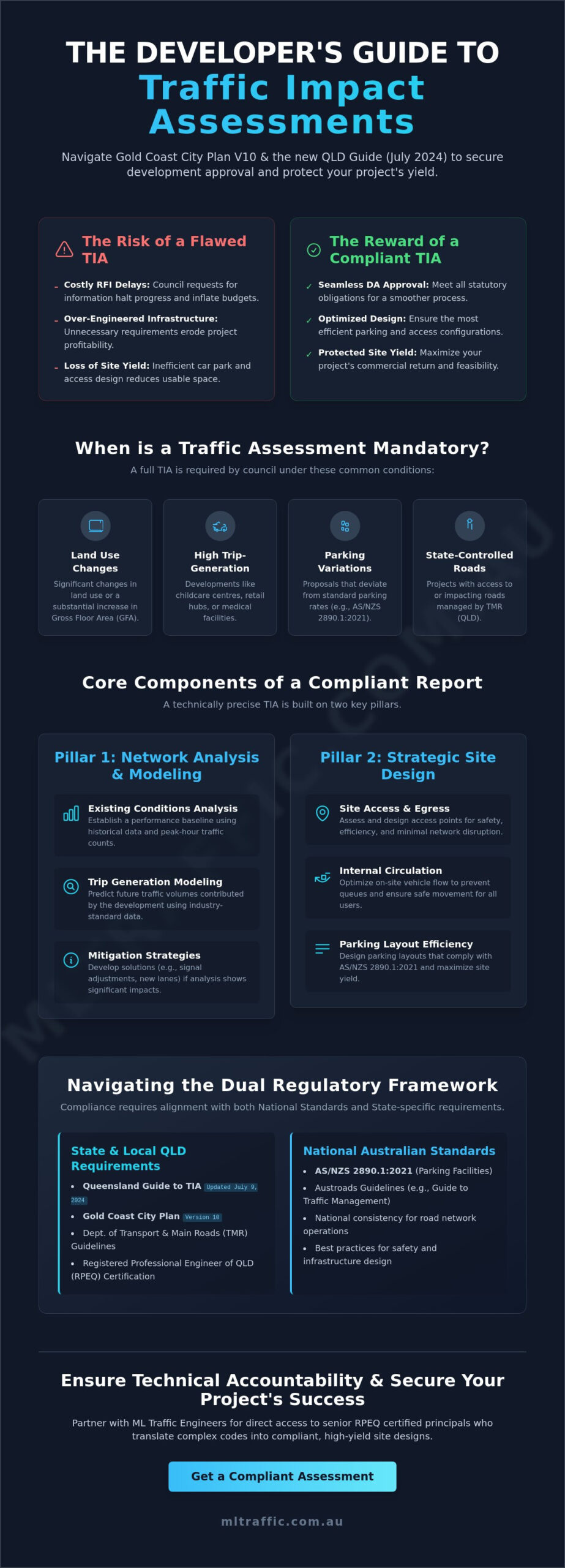
Not every project requires a full TIA, but several specific triggers make one mandatory under current regulations. Common triggers include:
- Land Use Changes: Any significant change in land use or a substantial increase in gross floor area (GFA).
- High Trip-Generation: Developments with high traffic profiles, such as childcare centers, retail hubs, or medical facilities.
- Parking Variations: Proposals involving variations to the standard parking requirements outlined in AS/NZS 2890.1:2021.
- State-Controlled Roads: Projects impacting state-controlled roads, requiring assessment under the Department of Transport and Main Roads (TMR) guidelines.
Identifying these triggers early prevents costly redesigns. A professional traffic impact assessment gold coast ensures your project meets all statutory obligations while protecting your commercial interests.
Core Components of a Compliant Traffic Report
A compliant traffic impact assessment gold coast requires a multifaceted technical approach. It begins with a meticulous analysis of existing traffic conditions and the residual capacity of the surrounding road network. We use historical data and peak-hour counts to establish a baseline of current performance. From here, trip generation and distribution modeling are performed using industry-standard datasets. This modeling predicts how much additional traffic the development will contribute to the local network. If the analysis indicates significant delays at nearby junctions, we develop specific mitigation strategies, such as signal phasing adjustments or auxiliary lane additions, to maintain acceptable levels of service.
Strategic site design is the second pillar of a compliant report. We assess site access points, internal vehicle circulation, and the efficiency of the parking layout. This is where technical precision directly impacts project feasibility. Aligning with City of Gold Coast traffic management requirements ensures that the proposed infrastructure is neither under-designed for safety nor over-engineered to the point of excessive cost. Trip generation is not a one-size-fits-all calculation. We examine specific land-use categories, such as high-density residential or bulky goods retail, to apply the correct rates. Every component is designed to satisfy the City Plan while protecting the commercial viability of your development.
Integrating Vehicle Swept Path Analysis
Ensuring that operational vehicles can navigate the site without conflict is essential for DA approval. We utilize AutoTURN software to perform vehicle swept path analysis in accordance with AS 2890.1 and AS 2890.2. This simulation confirms that waste collection trucks and delivery vehicles can enter, maneuver, and exit the site in a forward gear. For a deeper technical breakdown, refer to our Swept Path Analysis Guide. Failure to demonstrate these maneuvers often results in immediate Council RFIs. If you are concerned about heavy vehicle access, our team can provide a technical consultation to review your plans.
Parking Demand and Car Park Design
Maximizing site yield frequently requires a reduction in standard parking rates. We justify these variations through empirical data and rigorous car parking demand assessments. Our technical staff provides certification for critical design elements, including driveway ramp grades and aisle widths, to ensure full AS 2890.1 compliance. This level of detail prevents the loss of valuable floor area to inefficient parking configurations. When modeling distribution, we consider local travel patterns and public transport proximity to justify parking variations. These data-driven justifications are far more effective than general claims during the DA assessment process.
Navigating National Standards vs. State Requirements
Managing a development on the Gold Coast requires a precise understanding of overlapping regulatory jurisdictions. A defensible traffic impact assessment gold coast must align with the Austroads Guide to Traffic Management while simultaneously satisfying Queensland-specific supplements. While national standards provide a consistent framework for road design, state authorities such as the Department of Transport and Main Roads (TMR) often enforce more stringent requirements for impacts on state-controlled roads. Additionally, local planning scheme overlays within the Gold Coast City Plan Version 10 can override general national guidelines. For any report to hold legal and technical weight, it must be prepared or supervised by a Registered Professional Engineer of Queensland (RPEQ).
The complexity of these dual frameworks means that a standard “cookie-cutter” approach often fails at the assessment stage. Each project must be evaluated against the specific hierarchy of roads it impacts. Local council roads follow one set of rules, while state-controlled corridors require a different analytical methodology. Our technical approach ensures that every report satisfies both local and state assessors, reducing the likelihood of conflicting requirements that can stall a project for months.
Austroads and Australian Standards (AS 2890)
Australian Standards form the technical foundation of every report. AS 2890.1:2021 dictates the requirements for off-street parking facilities, covering bay dimensions, headroom, and aisle widths for residential and commercial sites. For industrial or retail projects, AS 2890.2 governs commercial vehicle facilities, including loading dock clearances and heavy vehicle maneuvering areas. These standards ensure that site designs are functional and safe for all users. Adhering to these national benchmarks prevents the technical challenges often raised by Council assessors during the DA process. We provide detailed certification for these elements to ensure your site layout is fully compliant before submission.
Managing State-Controlled Road Impacts
Developments located near major arterial routes often trigger a referral to TMR. Under the Guide to Traffic Impact Assessment (GTIA), which was updated on July 9, 2024, developers must quantify their impact on state-controlled infrastructure. This process often involves:
- Referral Triggers: Identifying when a project meets the traffic generation thresholds that mandate state-level review.
- Monetary Contributions: Calculating proportional infrastructure charges or contributions for external road upgrades.
- Performance-Based Solutions: Negotiating design alternatives that meet safety intent when strict compliance with standard drawings is not feasible.
We focus on delivering solutions that meet the safety intent of the regulations without imposing unnecessary financial burdens on the project. Direct involvement from our senior principals ensures these negotiations are handled with the necessary technical authority. If your project impacts a state-controlled road, you can reach us via our contact page for a preliminary review of your referral requirements.
DA Preparation Checklist for Developers
Successful development applications require the integration of traffic engineering from the earliest stages of project planning. Waiting until a design is finalized to request a traffic impact assessment gold coast often leads to costly architectural revisions and lost floor area. To maintain project timelines and optimize commercial outcomes, developers should follow a structured technical checklist before submitting their DA to the City of Gold Coast.
- Concept Phase Engagement: Involve a traffic consultant during the initial site layout to ensure access points and internal roads are feasible.
- Preliminary Parking Assessment: Conduct a demand study early to determine if a parking variation is necessary to protect site yield.
- Swept Path Verification: Use vehicle swept path diagrams to confirm that refuse and delivery vehicles can navigate the site without encroaching on structures.
- Constraint Identification: Review the Gold Coast City Plan Version 10 overlays to identify “red flag” issues such as proximity to major intersections or protected vegetation.
- Technical Finalization: Compile all data into a comprehensive TIA report that addresses both local and state-level requirements.
Avoiding Common Council RFIs
Council assessors frequently issue Requests for Information (RFIs) when technical details are omitted or vague. Ensuring that sight distance at driveways meets the minimum safety standards of AS 2890 is a primary requirement. If your proposal includes a parking shortfall, you must provide empirical justification rather than general claims of public transport proximity. Additionally, the site layout must demonstrate safe integration for pedestrians and cyclists, separating these movements from heavy vehicle loading zones to minimize conflict risks.
Optimizing Site Yield and Commercial Space
Efficient traffic engineering identifies opportunities to reduce “dead space” within car parks, directly increasing the available GFA for commercial or residential use. This often involves the strategic use of tandem parking or mechanical stacking systems where site dimensions are constrained. Understanding the role of a traffic engineer in this process allows developers to maximize their return on investment while maintaining full regulatory compliance. We specialize in identifying these design efficiencies to protect your project’s bottom line. If you need a technical review of your current site plan, contact our senior principals for a direct assessment of your project’s traffic requirements.
Why Choose ML Traffic Engineers Australia for Your Assessment?
Selecting a consultancy with deep-seated expertise is the final step in securing a reliable project outcome. ML Traffic Engineers Australia brings over 15 years of professional longevity to the field of transport planning and civil engineering. We specialize in navigating the specific technical and bureaucratic requirements of the Gold Coast planning scheme. Our capabilities extend across a comprehensive range of specialized assessments, including vehicle swept path analysis, intersection analysis, and driveway ramp grade assessments. We provide the technical rigor necessary to satisfy both local council and state-controlled road authorities.
A professional traffic impact assessment gold coast requires meticulous attention to regulatory certification. Every report we issue is performed or supervised by RPEQ certified engineers to ensure total compliance with the Professional Engineers Act 2002. This commitment to professional status protects our clients from the legal and financial risks associated with non-compliant technical submissions. We don’t delegate work to junior staff; we ensure that senior leadership is involved in every project phase to maintain the highest standards of accuracy and reliability.
A Hands-On, Accountable Approach
We operate with a strict “no-gatekeepers” philosophy. When you engage ML Traffic Engineers Australia, you have direct access to the senior principals performing the technical work. Our personnel continuity promise means the expert who initiates your project is the same one who performs the analysis and defends the findings to the Council. This direct line of communication eliminates the inefficiencies common in larger firms. We deliver tailored engineering solutions that balance commercial yield with national regulatory standards, ensuring your site design is both functional and cost-effective. Our results-oriented approach has secured thousands of successful DA approvals nationwide.
Get Your Professional Traffic Assessment Started
Meeting planning deadlines requires a partner who understands the urgency of the DA process. We offer fast turnaround times and preliminary site reviews to identify potential design constraints early. Our extensive track record includes thousands of successful projects across diverse land-use categories, from childcare and retail to high-density residential developments. Secure the technical authority your project needs by contacting our senior engineering team. Request a Traffic Impact Assessment Quote from ML Traffic Engineers Australia today to begin your preliminary assessment.
Securing Your Development Approval
Navigating the technical requirements of a traffic impact assessment gold coast is a critical step in the development process. Achieving compliance with the latest City Plan Version 10 and the updated July 2024 state guidelines requires more than just standard data entry. It demands senior-led analysis that balances engineering standards with commercial site yield. By following the preparation checklist and verifying vehicle swept paths during the concept phase, you can eliminate the common bottlenecks that lead to council RFIs.
ML Traffic Engineers provides the technical authority needed to move your project forward. Our team brings over 15 years of experience and RPEQ certification to every assessment. You’ll work directly with a senior principal who remains accountable for your project from the initial review to final approval. This hands-on approach ensures that your traffic and parking solutions are both defensible and optimized for your site’s specific needs. We’re ready to help you navigate the complexities of the planning process and secure a successful outcome for your development.
Secure Your 2026 DA Approval with ML Traffic Engineers
Frequently Asked Questions
How much does a Traffic Impact Assessment cost for a DA?
Technical fees for a report depend entirely on the project scale, the number of intersections requiring analysis, and the complexity of the modeling. A basic assessment for a minor commercial change of use involves fewer resources than a high-density residential development. Developers should provide site plans to receive a specific fee proposal that reflects the technical scope required by the City of Gold Coast.
When is a Traffic Impact Statement required instead of a full TIA?
A Traffic Impact Statement is generally sufficient for low-impact developments that generate minimal additional vehicle trips. If the proposal falls below the traffic generation thresholds defined in the Gold Coast City Plan, a simplified statement may satisfy Council. A full traffic impact assessment gold coast becomes mandatory for larger projects that significantly alter road network performance or require substantial parking variations.
Can a TIA help me reduce the number of required parking spaces?
Yes, a technical assessment can justify parking reductions by using empirical demand data. By analyzing local travel patterns, public transport proximity, and specific land-use characteristics, engineers can demonstrate that the actual demand is lower than the standard planning code. This data-driven justification allows developers to optimize site yield while maintaining full compliance with AS 2890.1 standards.
What is the typical turnaround time for a traffic engineer report?
Turnaround times typically range from two to four weeks depending on the data collection requirements and modeling complexity. Projects involving intersection analysis or extensive swept path simulations require more time for rigorous testing. Engaging a consultant during the concept design phase ensures the technical report is finalized well before your planned development application submission date.
Do I need a traffic engineer for a small residential development?
Small residential projects usually only require a traffic engineer if they involve non-standard access or variations to parking requirements. If the driveway ramp grade or sight distances don’t meet the deemed-to-comply criteria of the City Plan, a technical assessment is necessary. RPEQ certification ensures these specific safety and design elements satisfy the engineering standards required for council approval.
What happens if my development application is rejected due to traffic concerns?
If a DA is rejected, you must address the specific technical grounds for refusal through design modifications or more detailed modeling. This often involves negotiating performance-based solutions with Council assessors to resolve disputes regarding safety or network capacity. Engaging a senior principal to lead these technical negotiations is the most effective way to resolve concerns during the appeal or resubmission process.
What is the difference between a TIA and a Traffic Management Plan?
A TIA evaluates the permanent operational impact of a completed development on the road network. In contrast, a Traffic Management Plan (TMP) focuses on the temporary management of vehicle and pedestrian movements during the construction phase. While the TIA is a prerequisite for DA approval, the TMP ensures site safety and road efficiency while construction activities are actively occurring.
Is RPEQ certification required for all traffic reports in Queensland?
Yes, professional engineering services in Queensland must be performed or supervised by a Registered Professional Engineer of Queensland (RPEQ). This is a legal requirement under the Professional Engineers Act 2002 for any report involving engineering design or safety assessments. Council and state authorities will not accept a traffic impact assessment gold coast that lacks valid RPEQ certification.

Disclaimer
The content on www.mltraffic.com.au, including all technical articles, guides, and resources, is provided for general informational and educational purposes only. It is not intended to constitute professional advice in traffic engineering, transportation planning, development approvals, or any other technical or legal field.
While ML Traffic Engineers makes every reasonable effort to ensure the accuracy, completeness, and timeliness of the information published, we do not provide any warranties or representations (express or implied) regarding its reliability, suitability, or availability for any particular purpose. Any reliance you place on the content is strictly at your own risk.
In no event shall ML Traffic Engineers, its directors, employees, authors, or affiliates be liable for any direct, indirect, incidental, special, consequential, or punitive damages (including, without limitation, loss of profits, data, or business opportunities) arising out of or in connection with the use of, or inability to use, any information provided on this website.
The articles and guides on this site are not a substitute for engaging a qualified, registered professional traffic engineer (such as an NPER or RPEQ engineer) to assess your specific project requirements. For tailored advice, compliance assessments, or traffic engineering services, please contact a competent professional.
This disclaimer may be updated from time to time without notice. By accessing or using this website, you agree to be bound by the most current version of this disclaimer.
