

A single council objection regarding vehicle swept paths can stall a multi-million dollar development for six months or more, often resulting in thousands of dollars in avoidable holding costs. You know that the DA process is the most volatile stage of any project. The technical jargon and rigid requirements of Australian Standards like AS 2890.1 frequently cause confusion and lead to those dreaded Requests for Information (RFI). When you’re managing a site, whether it’s a small apartment block or a large-scale warehouse, you need a traffic impact assessment Australia that stands up to rigorous council scrutiny from the first submission.
This strategic guide helps you master the technical requirements and engineering nuances needed to secure your Australian development approval without costly setbacks. We draw on experience from over 10,000 successful sites to show you how to navigate council expectations and mitigate risk through precise, authoritative reporting. We’ll detail the essential components of a compliant assessment, from sight-line requirements to driveway ramp grades, ensuring your project remains on schedule and within budget.
Key Takeaways
- Understand the technical role of a TIA in the Australian Development Application (DA) process to ensure your project meets transport network requirements.
- Identify the specific residential and commercial development thresholds that trigger the need for a professional traffic impact assessment Australia wide.
- Learn the essential components of a compliant report, including traffic generation modeling based on industry-standard RTA/RMS databases.
- Follow a structured roadmap from site analysis and data collection to final Council submission to prevent costly delays in your approval timeline.
- Discover why direct engagement with senior traffic engineers ensures adherence to Australian Standards and higher success rates for complex developments.
Table of Contents
-
What is a Traffic Impact Assessment (TIA) in the Australian Context?
-
Choosing the Right Traffic Engineering Consultant in Australia
What is a Traffic Impact Assessment (TIA) in the Australian Context?
A Traffic Impact Assessment (TIA) is a technical analysis that evaluates how a proposed development affects the surrounding transport network. It’s a mandatory requirement within the Development Application (DA) process across Australia. These reports are foundational to transportation planning. They provide local councils and state road authorities with the data needed to approve or request modifications to a project. A TIA ensures that new land-use proposals don’t create safety hazards or cause gridlock on existing roads.
To better understand this concept, watch this helpful video:
State road authorities and local governments mandate these reports to protect public infrastructure. The assessment process involves rigorous data collection, including traffic counts and site observations. It’s a no-nonsense, fact-based requirement. Developers must prove their project won’t negatively impact the community. A professional traffic impact assessment Australia based consultant will use Australian Standards, such as AS 2890.1, to validate all design elements.
The Primary Objectives of a Traffic Report
A traffic report serves three critical functions. First, it ensures the safety of all road users. This includes vulnerable groups like pedestrians and cyclists. Second, it maintains the operational efficiency of the road network. Engineers model intersection delays to prevent excessive queuing. Third, it validates that the development provides adequate parking. This prevents "spillover" parking from congesting residential streets. Every report aims for technical compliance and functional design.
TIA vs. TIS: Determining the Level of Assessment
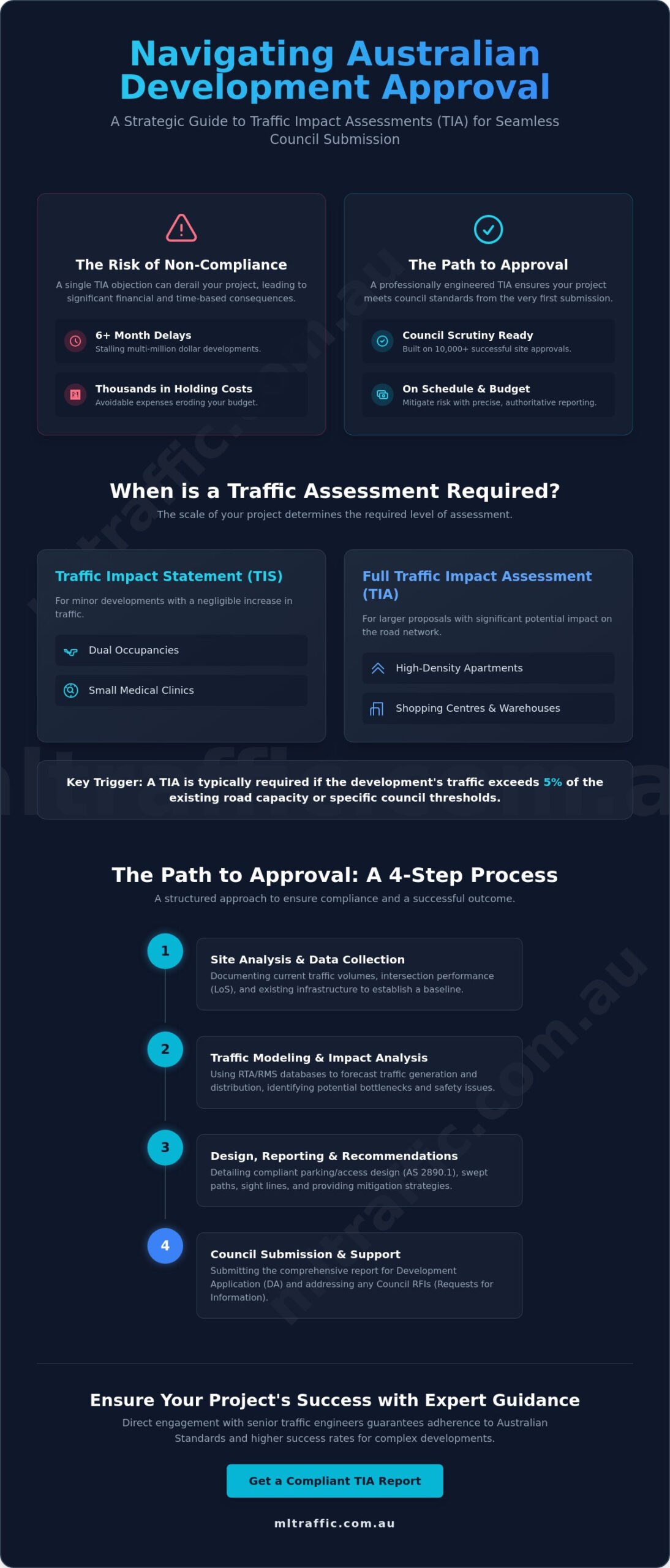
The scope of work depends on the project’s scale. A Traffic Impact Statement (TIS) is a shorter report for minor developments. These might include small medical clinics or dual occupancies with negligible traffic increases. A full traffic impact assessment Australia is necessary for larger proposals like shopping centres, schools, or high-density apartments. A professional traffic engineer determines the appropriate level of assessment based on trip generation rates and location. They look at whether the development’s traffic exceeds 5% of the existing road capacity or specific council thresholds. This ensures the assessment is proportionate to the potential impact.
Key Components of a Comprehensive Traffic Impact Assessment
A professional traffic impact assessment Australia requires a meticulous audit of existing road conditions and infrastructure. Engineers first document current traffic volumes, intersection degrees of saturation, and existing Level of Service (LoS) ratings. This baseline data ensures that any proposed development is evaluated against a realistic snapshot of the surrounding transport network. This includes assessing the capacity of nearby arterial roads and the safety of existing pedestrian crossings or cycling lanes.
Traffic Generation and Distribution Modeling
Accurate modeling begins with land-use specific data. Traffic generation is the total number of trips produced by a development site. To calculate this, engineers use industry-standard databases like the TfNSW (formerly RTA/RMS) Guide to Traffic Generating Developments or project-specific trip generation surveys. These figures determine the peak hour vehicle movements that the local network must absorb. While NSW standards are common, different jurisdictions have specific frameworks, such as the WA government’s transport impact assessment guidelines, which define how these trips influence regional planning goals.
Once volume is established, distribution modeling maps exactly where these vehicles will travel. It’s a critical step to identify potential intersection bottlenecks before they become operational failures. By assigning traffic to the most likely routes, consultants can recommend specific upgrades, such as dedicated turn lanes or signal timing adjustments, to maintain network fluidity.
Parking and Access Compliance (AS 2890)
Failure to meet Australian Standards is a primary cause for development application refusal. Every assessment must verify that parking supply meets local council requirements and adheres to AS 2890.1 (Off-street car parking) for private vehicles. For industrial or retail sites, AS 2890.2 governs commercial vehicle facilities, ensuring loading docks can accommodate the specific heavy vehicles intended for the site. Technical precision is required when calculating driveway ramp grades; for example, a 1:20 grade for the first 6 metres is a standard safety requirement to prevent scraping and ensure visibility.
Verifying vehicle maneuverability is achieved through swept path analysis. This software-based simulation proves that B99 cars or heavy rigid vehicles (HRVs) can enter and exit the site in a single forward motion without striking curbs or other structures. Safety compliance also hinges on sight distance assessments at the property boundary. Consultants must ensure that exiting drivers have a clear line of sight to pedestrians and oncoming traffic, as defined by the sight distance triangles in AS 2890.1.
If you’re preparing a development application, reviewing our traffic engineering services can help ensure your project meets these technical benchmarks.
When is a TIA Required? Common Development Triggers
Local councils and state road authorities determine the necessity of a traffic impact assessment Australia based on the scale and nature of the proposed development. Most triggers are defined by specific thresholds in local planning schemes or State Environmental Planning Policies (SEPPs). If a development is likely to generate significant vehicle movements or impact the safety and efficiency of the existing road network, a formal report is mandatory.
Residential and Mixed-Use Developments
High-density apartment buildings typically trigger a full TIA when they exceed 20 to 50 dwellings, depending on the specific local government area requirements. Medium-density townhouses often require a more concise Traffic Impact Statement (TIS). Even small-scale projects might require formal assessment if the site access is located near a busy intersection or on a classified road. Mixed-use precincts create complex peak-hour demands. We analyze these to ensure residential amenity isn’t compromised by overflow street parking or excessive noise from increased vehicle movements. Compliance with AS 2890.1 is mandatory for all parking and access designs to ensure safety.
Commercial and Industrial Site Requirements
Industrial developments focus heavily on logistics and heavy vehicle movements. A critical component for these sites is a swept path analysis. This assessment ensures that B-doubles or articulated vehicles can enter, turn, and exit the site in a forward direction without impacting curbs or structures. Retail centers and high-turnover sites, such as fast-food outlets or service stations, trigger assessments based on Gross Leasable Floor Area (GLFA) or predicted trip generation rates. These sites often cause significant delays at local intersections during Saturday peaks or evening rush hours. We assess loading dock efficiency to prevent service vehicles from queuing on public roads, which is a major safety concern for councils.
Specialized Land Uses and Changes in Use
Specific land uses have unique traffic profiles that require specialized attention. Common triggers include:
-
Childcare Centers: A 40-place childcare center generates concentrated "drop-off" peaks that can overwhelm local residential streets between 7:00 AM and 9:00 AM.
-
Medical Clinics: These are assessed based on the number of practitioners. This number dictates patient turnover and the required car parking demand.
-
Educational Facilities: Schools and colleges require detailed pick-up and drop-off management plans to prevent traffic gridlock.
-
Changes in Land Use: Repurposing a quiet warehouse into a 200-seat gym or a licensed bar significantly alters the site’s traffic profile.
If a new use generates more than 10 additional vehicle trips per hour, most Australian councils will mandate a formal review. This ensures the traffic impact assessment Australia accurately reflects the new demand on local infrastructure. Our role is to provide the technical data needed to prove the site can handle these changes without degrading the current level of service on surrounding roads.
The TIA Process: From Site Analysis to Council Approval
The process for a traffic impact assessment Australia begins with a technical consultation to define the project scope. This initial phase identifies the specific requirements of the local road authority, which prevents the collection of redundant data. A qualified traffic consultant evaluates the site’s proposed use against local planning instruments like the Sydney Development Control Plan or the Brisbane City Plan. This ensures the assessment addresses the exact parameters council engineers will scrutinize during the DA process.
Data collection follows this scoping phase. We gather empirical evidence through several methods:
-
Traffic Counts: Conducting 24-hour or peak-period counts to establish baseline volumes.
-
Site Observations: Evaluating existing road geometry, sight-line distances, and driveway ramp grades.
-
Review of Planning Instruments: Ensuring compliance with AS 2890.1 for car parking and local council transport policies.
Once data is collected, the analysis moves into technical modeling and report drafting. Every report we produce concludes with clear, actionable recommendations to ensure the development is both functional and compliant.
Technical Modeling and Intersection Analysis
Engineers use industry-standard software like SIDRA SOLUTIONS to evaluate how a development affects the surrounding road network. We model intersection performance by calculating the Level of Service (LoS), average delay in seconds, and 95th percentile queue lengths. Intersection analysis quantifies a development’s impact on local congestion levels. If the modeling indicates that an intersection will drop from a LoS B to a LoS D, the assessment must justify this change or propose specific infrastructure upgrades to maintain flow. This technical rigor provides the evidence needed to satisfy council transport planners.
Mitigation Strategies for Traffic Impacts
When an assessment identifies potential capacity or safety issues, we propose targeted mitigation strategies. These often involve physical road improvements, such as the construction of dedicated turn lanes or adjustments to site access points to improve safety. We also implement Travel Demand Management (TDM) strategies. These encourage sustainable transport through the provision of superior bicycle facilities or car-sharing schemes. Expert recommendations can turn a potential council refusal into a conditional approval by solving traffic problems before they reach the council’s desk.
The final stage involves submitting the completed report to the council. We remain active throughout the post-submission phase, responding to technical queries or "Requests for Further Information" (RFI) from council engineers. Our hands-on approach ensures that the person who wrote the report is the one defending it.
Ensure your development application meets all regulatory requirements with expert engineering support. View our full range of traffic engineering services to get started.
Choosing the Right Traffic Engineering Consultant in Australia
Selecting a consultant for your traffic impact assessment Australia requires more than a simple price comparison. You need a partner with a deep understanding of local council requirements and a proven history of successful DA approvals. In Australia, traffic regulations vary significantly between states and local government areas. A consultant with decades of experience in New South Wales might not grasp the specific nuances of a Victorian council’s car parking requirements or the necessity of RPEQ certification in Queensland. You should verify that your engineer holds senior membership in professional bodies like the Australian Institute of Traffic Planning and Management (AITPM). An effective consultant acts as your advocate during negotiations. They don’t just submit reports; they defend your project’s design against overly conservative council demands that could compromise your site yield.
-
Check for a track record across various land uses, from childcare centres to industrial warehouses.
-
Ensure the consultant understands Australian Standards (AS 2890.1) for parking and access in detail.
-
Look for direct access to senior staff who can attend council meetings and provide expert testimony.
The Advantage of Senior-Led Traffic Engineering
ML Traffic Engineers operates on a simple principle: the traffic consultant who provides the quote, does the work. It’s common for large firms to use senior staff to win a contract, only to pass the technical analysis to junior drafters. This "junior-drafter" trap often leads to technical errors that councils quickly identify during the review process. Senior-led traffic engineering ensures that 15 to 40 years of expertise is applied to every swept path and sight-line assessment. You get direct access to principals for rapid troubleshooting of design issues. This hands-on approach eliminates the bureaucracy found in larger consultancies and ensures technical accuracy from the first draft.
Securing Your Development Approval
A robust traffic impact assessment Australia is the best defense against Requests for Information (RFIs). Council RFIs can stall a project for months. These delays often cost developers thousands of dollars in holding costs and missed market opportunities. By delivering a comprehensive report that addresses driveway ramp grades and parking demand upfront, you minimize council friction. Your traffic engineer must collaborate seamlessly with architects, planners, and civil engineers to integrate technical requirements into the broader site layout. This technical synergy is vital for achieving a smooth approval path. Contact ML Traffic Engineers to discuss your specific project requirements today.
Secure Your Development Approval with Expert Traffic Engineering
Navigating the complexities of local council requirements requires a meticulous approach to site analysis and technical compliance. A successful development application hinges on a robust traffic impact assessment Australia wide, ensuring every vehicle swept path and parking demand assessment meets strict Australian Standards. Proactive planning helps you avoid costly delays and unnecessary revisions during the council approval process.
ML Traffic Engineers brings over 15 years of specialized traffic engineering experience to your project. We’ve successfully delivered results for over 10,000 sites across Australia, ranging from small residential developments to large scale industrial warehouses. We operate with a unique promise: the senior engineer who provides your quote is the same expert who completes your work. This direct accountability eliminates bureaucracy and ensures your project benefits from deep technical expertise from start to finish.
Don’t leave your development’s success to chance. Get a Professional Traffic Impact Assessment Quote today to ensure your project meets every regulatory requirement. We’re ready to help you move your development forward with confidence.
Frequently Asked Questions
What is the difference between a TIA and a TIS?
A Traffic Impact Statement (TIS) is a concise report for smaller developments with minimal traffic generation. A Traffic Impact Assessment (TIA) is a comprehensive study required for larger projects that significantly affect the road network. While a TIS focuses on site access and parking, a TIA includes complex SIDRA intersection modeling and broader network analysis to satisfy Council requirements.
How long does it take to prepare a Traffic Impact Assessment report?
A standard report typically takes 10 to 15 business days to complete from the date we receive all site plans. Complex projects requiring fresh traffic counts or extensive intersection modeling can take 20 to 30 business days. We ensure the senior consultant who provides your quote is the one who performs the work, which maintains technical accuracy and avoids delays.
Is a swept path analysis always required as part of a TIA?
Yes, a vehicle swept path assessment is mandatory for almost every development application to prove functional access. It demonstrates that the largest design vehicle, such as an 8.8m Medium Rigid Vehicle or a 12.5m Heavy Rigid Vehicle, can enter and exit the site in a forward direction. This analysis ensures your design complies with AS 2890.1 and AS 2890.2 standards.
Can I use a general civil engineer for my traffic report?
You should use a specialist traffic engineer because most Councils require certification from a Registered Professional Engineer of Queensland (RPEQ) or a qualified transport planner. General civil engineers often lack the specific SIDRA software and niche expertise required for a traffic impact assessment Australia. Our team brings between 30 and 40 years of experience to every project to ensure compliance.
What happens if the TIA shows a significant impact on local traffic?
If the assessment identifies a significant impact, you must propose mitigation measures like dedicated turn lanes or signal timing adjustments. Council might refuse the application or impose 15 to 20 specific conditions if the impact isn’t resolved. We work directly with developers to find cost-effective engineering solutions that satisfy road authorities while maintaining project viability.
How much does a Traffic Impact Assessment cost in Australia?
Fees for a basic Traffic Impact Statement for a small development typically start around A$2,000. Larger, more complex assessments that require multi-day traffic counts and detailed network modeling often exceed A$5,000. Total costs depend on the number of intersections analyzed and the specific requirements set by the local Council or state road authority.
Do I need a TIA for a change of use application if I’m not building anything new?
You often need a traffic report because a change of use can drastically alter trip generation and parking demand. For instance, converting a 500 square metre warehouse into a fitness centre significantly increases peak hour vehicle movements. Council requires professional evidence that the existing infrastructure can support the new land use without compromising local road safety or parking availability.
What Australian Standards govern car park and access design?
The primary regulations are the AS 2890 series, which dictates the design of all parking facilities. AS 2890.1:2004 covers off-street car parking, while AS 2890.6:2009 focuses on off-street parking for people with disabilities. Compliance with these standards is essential for development approval. We use these benchmarks to assess driveway grades, aisle widths, and bay dimensions for every traffic impact assessment Australia.
Which areas do you cover?
We are traffic engineers servicing Melbourne, Sydney, Brisbane, Gold Coast, Hobart, Perth, Adelaide, Darwin, Canberra and surrounding areas.

Disclaimer
The content on www.mltraffic.com.au, including all technical articles, guides, and resources, is provided for general informational and educational purposes only. It is not intended to constitute professional advice in traffic engineering, transportation planning, development approvals, or any other technical or legal field.
While ML Traffic Engineers makes every reasonable effort to ensure the accuracy, completeness, and timeliness of the information published, we do not provide any warranties or representations (express or implied) regarding its reliability, suitability, or availability for any particular purpose. Any reliance you place on the content is strictly at your own risk.
In no event shall ML Traffic Engineers, its directors, employees, authors, or affiliates be liable for any direct, indirect, incidental, special, consequential, or punitive damages (including, without limitation, loss of profits, data, or business opportunities) arising out of or in connection with the use of, or inability to use, any information provided on this website.
The articles and guides on this site are not a substitute for engaging a qualified, registered professional traffic engineer (such as an NPER or RPEQ engineer) to assess your specific project requirements. For tailored advice, compliance assessments, or traffic engineering services, please contact a competent professional.
This disclaimer may be updated from time to time without notice. By accessing or using this website, you agree to be bound by the most current version of this disclaimer.
